Section 8 Company Registration



Section 8 Company Registration

Years of Experience
What’s Included?
Company Name Approval Company PAN & TAN Company Master Data DSC with Token Post Incorporation Documents & DSC Dispatch Support Incorporation Certificate PF & ESIC Registration Section 8 License, AOA & MOA Bank Account Opening Support Dedicated Incorporation Manager
Get Expert Consultation

Section 8 Company Registration in India - Document, Process & Fees
A Section 8 Company is a non-profit organisation registered under Section 8 of the Companies Act, 2013, formed to promote charitable objectives such as education, art, science, research, sports, social welfare, religion, environmental protection, or any other object of public benefit. Unlike a private limited company, a Section 8 company cannot distribute profits to its members — all income must be reinvested to further its stated charitable purposes.
For Section 8 company registration in India, you submit your documents through the MCA portal, obtain a licence from the Central Government (via the Regional Director), and receive your Certificate of Incorporation from the Registrar of Companies. The process typically takes 20–25 working days and the cost starts at ₹7,499 (inclusive of government fees and our professional fees) for a company with authorised capital up to ₹1 lakh.
Section 8 Company Registration Process
The entire process for Section 8 Company registration is online through the MCA portal (mca.gov.in). Here are the steps and the whole process: 20-25 working days.
- STEP 1 • Obtain Digital Signature Certificate (DSC) Every director and subscriber must obtain a Class-III DSC to digitally sign all MCA forms. DSCs are issued by authorised certifying agencies (eMudhra, Sify, Capricorn). You will need a self-attested PAN, address proof, and a brief video verification. It takes 1-2 working days.
- STEP 2 • Apply for Name Approval via SPICe+ Part A File SPICe+ Part A on the MCA portal with two proposed names and the main object. The Central Registration Centre (CRC), Manesar reviews the names for uniqueness and guideline compliance. Once approved, the name is reserved for 20 days (extendable). DIN for new directors is applied at this stage. It takes 2-5 working days.
- STEP 3 • Apply for Section 8 Licence via Form INC-12 This is the step unique to Section 8 companies. File Form INC-12 with the Regional Director. Attach draft MOA (INC-13), draft AOA, declaration from a CA/CS/CMA/Advocate (INC-14), declaration from subscribers (INC-15), 3-year financial projection, and grounds on which licence is applied. Once approved, a 6-digit Section 8 licence number is issued. It takes 10-15 working days.
- STEP 4 • File SPICe+ Part B (Form INC-32) This is your incorporation form. It is a single integrated form that covers: company details, director details (DIN application if needed), registered office address proof, PAN + TAN application, EPFO + ESIC registration, profession tax (where applicable), and GSTIN (optional). It takes 3-5 working days.
- STEP 5 • File e-MOA (INC-33) and e-AOA (INC-34) The Memorandum of Association (MOA) defines the object, powers and scope of the company. The Articles of Association (AOA) set the internal governance rules.
- STEP 6 • Receive Certificate of Incorporation (COI) Once all filings are approved, CRC Manesar issues the Certificate of Incorporation with your CIN (Corporate Identification Number), PAN, and TAN. Your company is now legally born. Open the company bank account within 60 days and deposit the subscribed capital. It takes up to 3 days.

Documents Required for Section 8 Company Registration
Collect all of these before you start registering your Section 8 company. Missing documents cause the majority of rejections.
From Each Director & Subscriber
- PAN Card (Indians) / Apostilled Passport (NRIs & foreign nationals)
- Aadhaar Card
- Address proof — bank statement or utility bill (≤ 2 months old)
- Passport-size photograph
For the Registered Office
- Latest utility bill (≤ 2 months old)
- Rent agreement + NOC from owner (if rented)
- Sale deed or property tax receipt (if owned)
Section 8 Specific
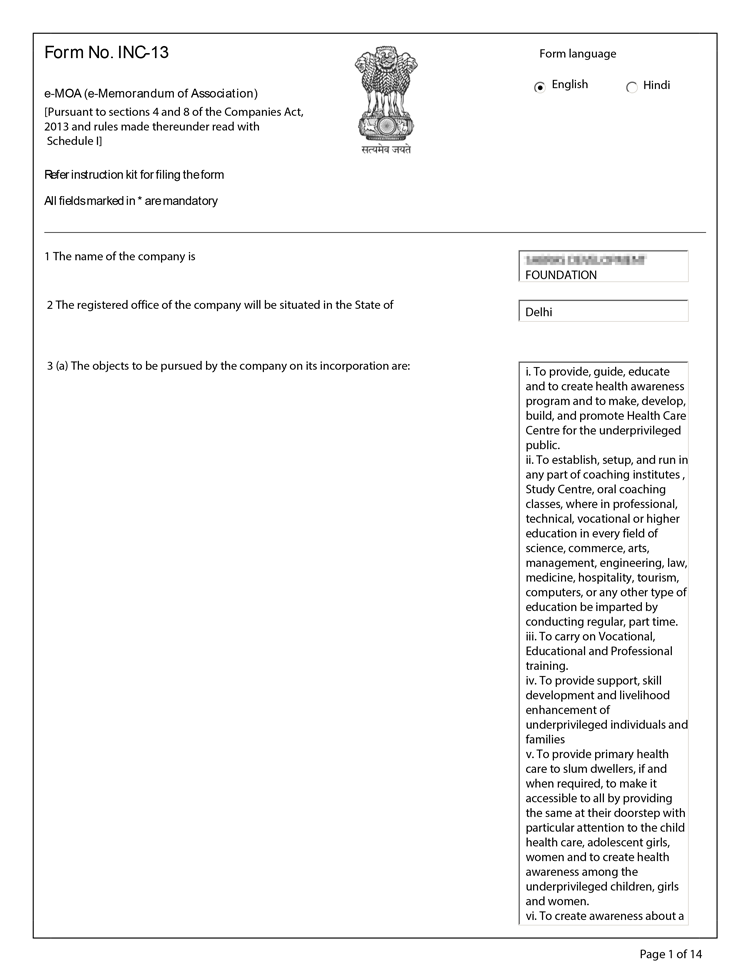
- Draft MOA (INC-13) and AOA
- 3-year financial projection (mandatory)
- INC-14 (declaration by CA/CS/CMA/Advocate)
- INC-15 (subscriber declaration)

Read More - Documents Required for Section 8 company registration

Documents You Receive After Section 8 Company Registration
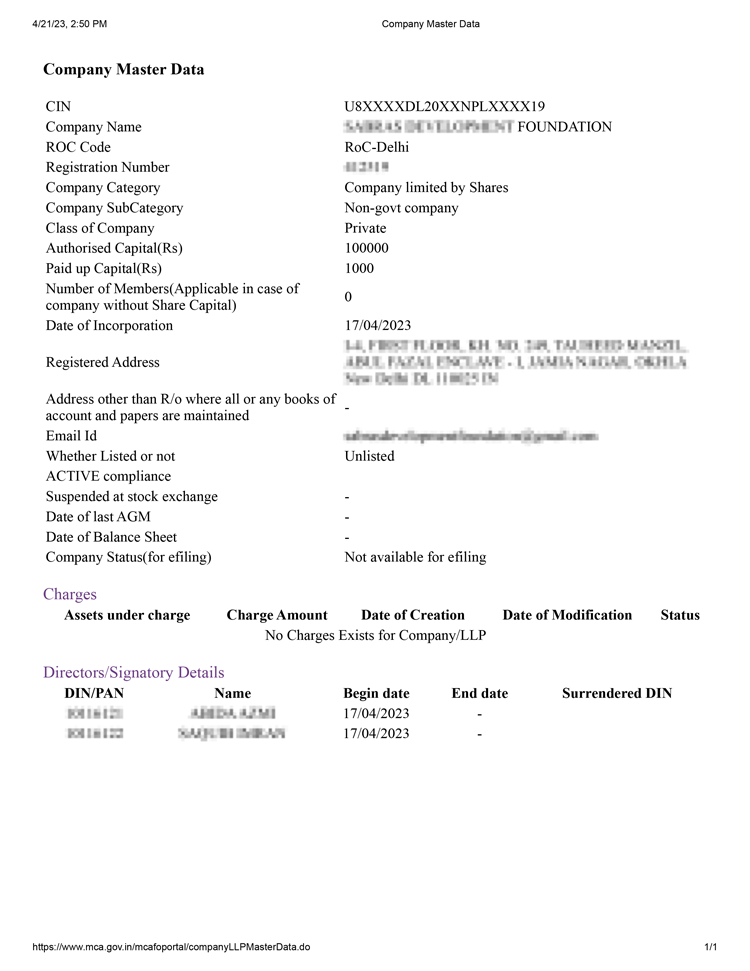
Once your Section 8 company registration is successfully, you will receive:
Registration Fees for Section 8 Company

Total Section 8 company registration cost depends on the state where you register, because stamp duty varies. The professional fee and DSC cost remain uniform across India.
| Section-8 Company Registration | Registration Fees |
|---|---|
| ✅ Digital Signature Certificate Fee | ₹1,000 |
| ✅ Government Fees(Stamp Duty) | ₹2,500 |
| ✅ Professional Fees | ₹3,999 |
| ✅ Total Cost | ₹7,499 |
Charges applicable for DSC certificate would be paid directly to certifying agencies.
Note:All fees are exclusive of 18% GST. Fees above are for a Section 8 company with 2 subscribers and authorised capital up to ₹1 lakh. Capital above ₹1 lakh attracts additional MCA fees and higher stamp duty.
What is a Section 8 Company?
A Section 8 Company is a company registered under Section 8 of the Companies Act, 2013 with the exclusive object of promoting commerce, art, science, sports, education, research, social welfare, religion, charity, protection of the environment, or any other such object of public benefit.
The key features that distinguish a Section 8 company from a regular company or NGO structure are:
- It is licensed by the Central Government (via the Regional Director) before incorporation.
- It does not use the suffix “Private Limited” or “Limited” in its name.
- It cannot distribute profits or dividends to its members — all surplus is reinvested.
- It has perpetual succession and limited liability for members.
- It enjoys higher credibility than a Trust or Society because of strict ROC scrutiny.
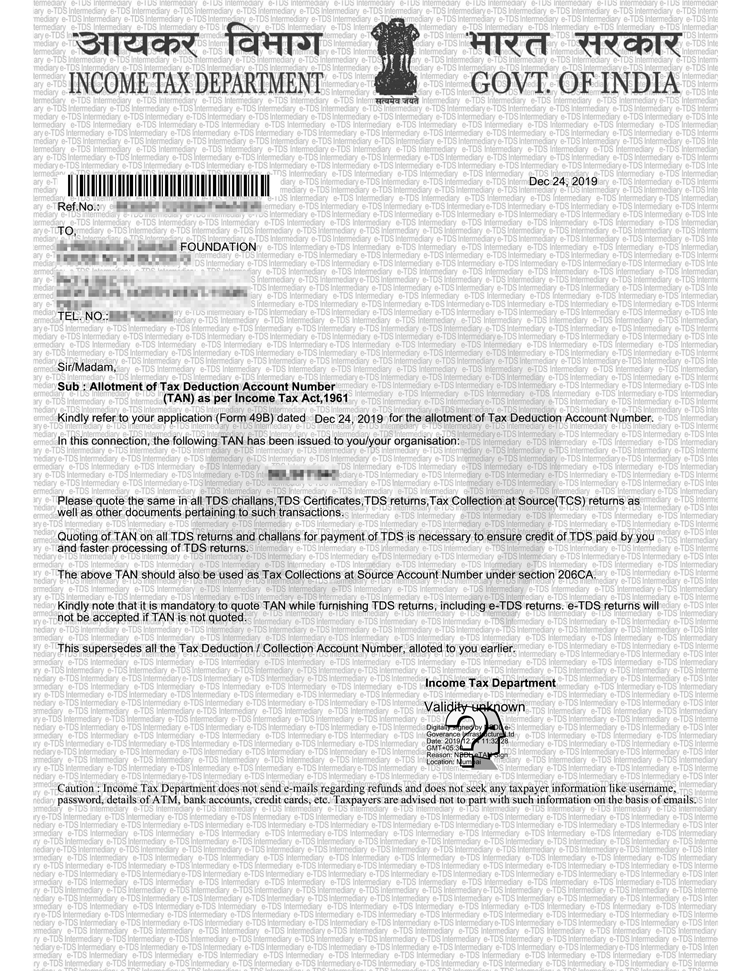
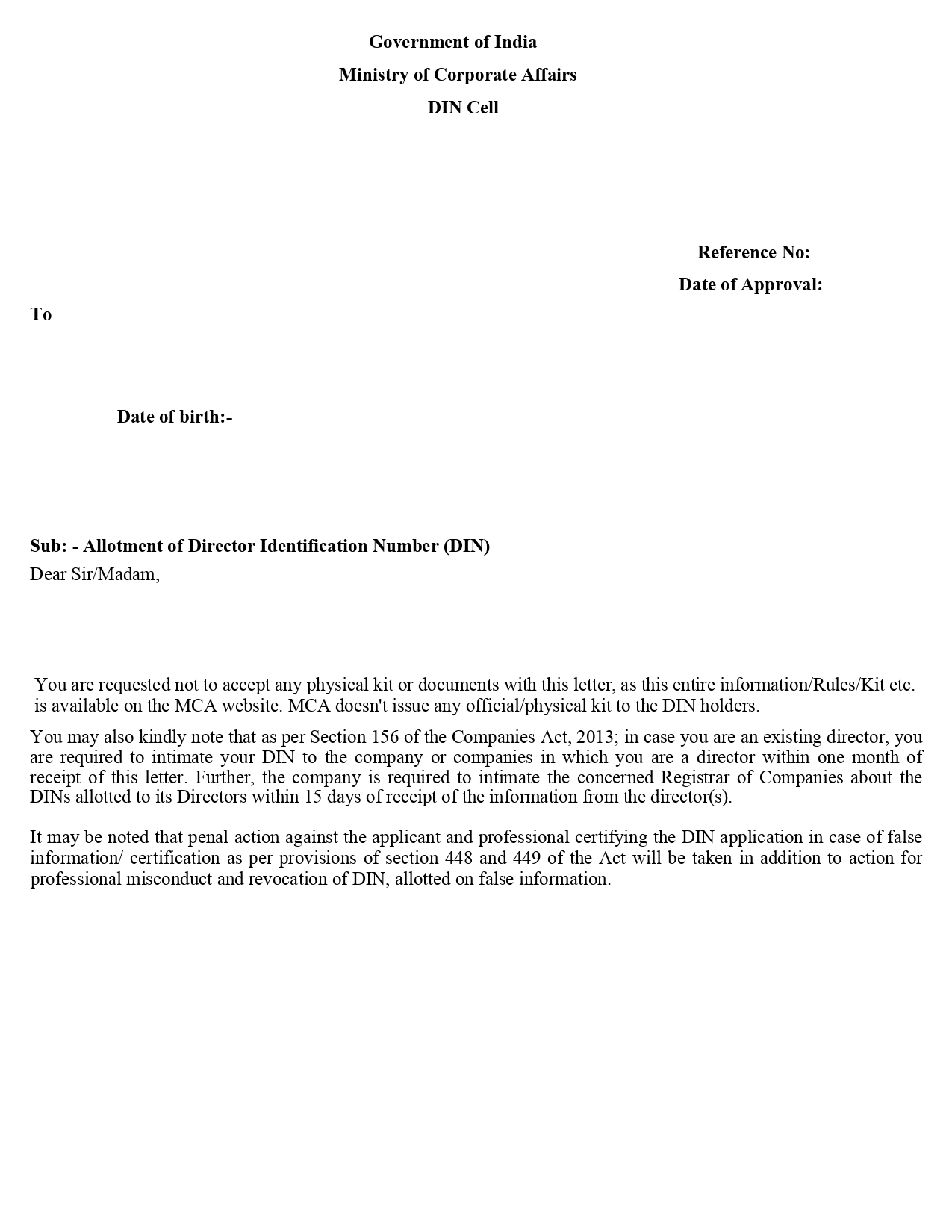
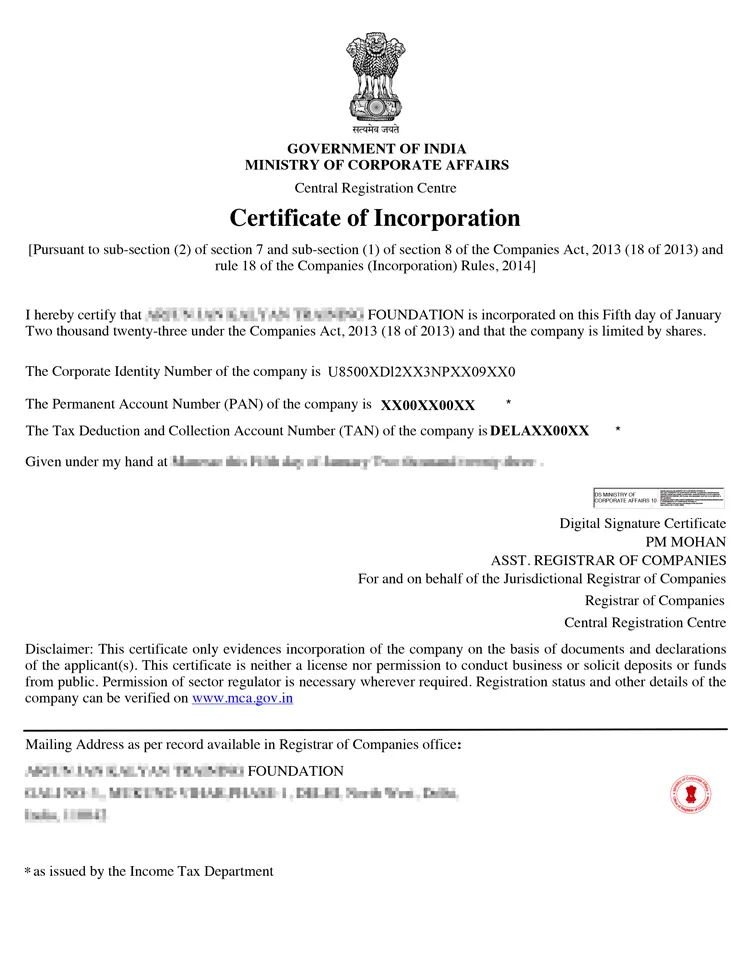
Section 8 Company Sample Documents
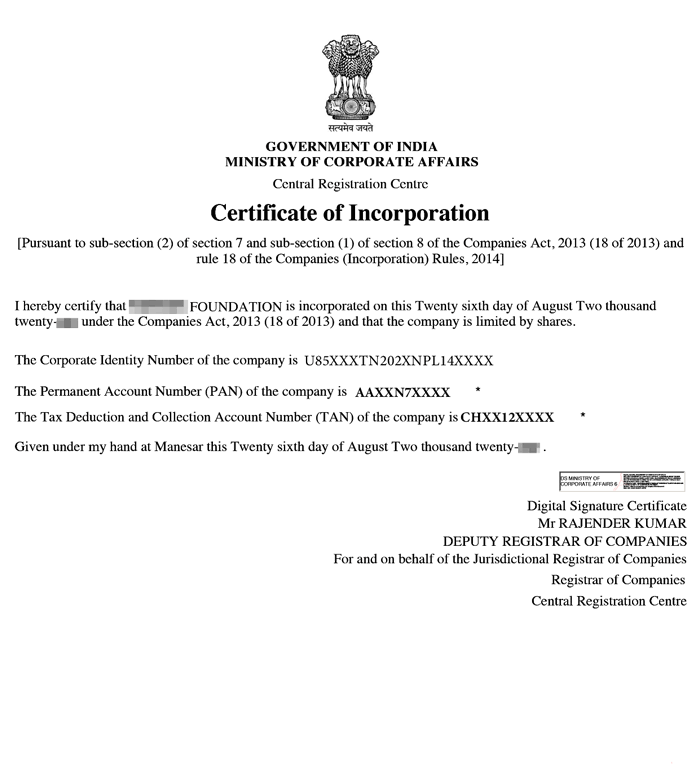
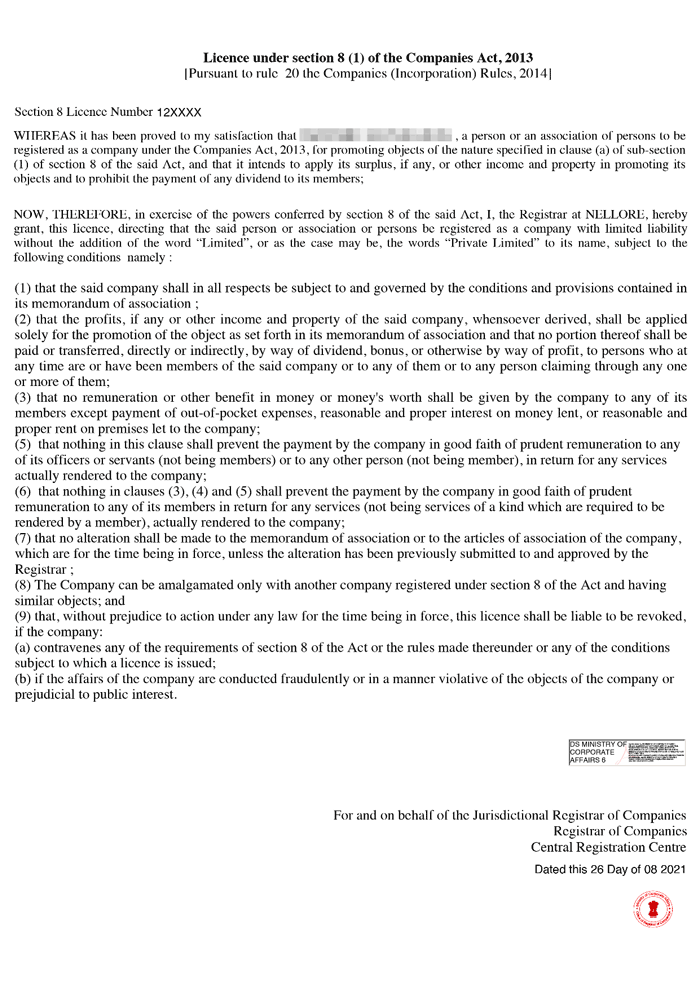
Eligibility Criteria for Section 8 Company Registration
Confirm you meet these criteria before starting registration of Section 8 company.
Directors & Members
- There should be minimum 2 directors (private) or 3 directors (public)
- At least one resident Indian director (182+ days in India in the previous year)
- All directors must be aged 18+
- Members can be: individuals, HUFs, NRIs, foreign nationals, firms, trusts, or other companies
Who Cannot Register
- A One Person Company (OPC) — explicitly prohibited
- Persons disqualified under Section 164 of the Companies Act
- Entities formed purely for profit
Object & Capital
- Object must promote charity, education, science, art, sports, social welfare, religion, or environment
- 3-year financial projection is mandatory in INC-15 (most rejections happen here)
- No minimum capital required, but subscribed capital must be deposited within 60 days of incorporation
- Profits cannot be distributed to members
Key Differences between Section 8 Company vs Trust vs Society
Before you pick Section 8, make sure it is the best fit. NGOs in India can be registered under three different legal structures, each governed by a different law. Here is how they compare:
| Parameter | Section 8 Company | Trust | Society |
|---|---|---|---|
| Governing Act | Companies Act, 2013 | Indian Trusts Act, 1882 | Societies Registration Act, 1860 |
| Registration Authority | MCA (Central Govt) | Sub-Registrar (State) | Registrar of Societies (State) |
| Minimum Members | 2 (Private) / 3 (Public) | 2 Trustees | 7 Members |
| Governing Document | MOA + AOA | Trust Deed | MOA + Rules & Regulations |
| Legal Personality | Separate legal entity | Not a separate entity | Separate legal entity |
| Credibility / Donor Trust | Highest | Moderate | Moderate |
| Foreign Funding (FCRA) | Easier to obtain | Harder | Harder |
| CSR Funding Eligibility | Yes (preferred) | Yes (with 12AB + 80G) | Yes (with 12AB + 80G) |
| Compliance Load | High (ROC + IT) | Low | Medium |
| Best For | CSR-funded NGOs, foundations, social enterprises seeking credibility & scale | Family trusts, religious endowments, small charities | Cultural, literary, scientific membership-based organisations |
What to Do After Section 8 Company Incorporation?
THere is the 7-step action list every new Section 8 company should complete in the first 90 days:
- Open a current bank account - Use your COI, PAN, MOA & AOA. Deposit the subscribed capital within 60 days of incorporation it is mandatory under the Companies Act.
- File INC-20A (Commencement of Business) - Within 180 days of incorporation, confirming capital has been deposited. Missing this costs ₹50,000 penalty.
- Apply for NGO Darpan registration - Free registration with NITI Aayog and it is mandatory for applying to any Central / State Government grant or scheme.
- Apply for 12AB Registration - Exempts the Section 8 company's income from income tax. Apply through the new Income Tax portal; valid 5 years, renewable.
- Apply for 80G Registration - Allows your donors to claim 50% deduction on their contributions. Major fundraising enabler.
- Apply for CSR-1 Registration - CSR-1 registration is necessary to receive CSR funds from Indian corporates. File on MCA portal, prerequisite: 12AB + 80G.
- Apply for FCRA Registration (if receiving foreign funds) - Required under FCRA 2010 to accept foreign contributions. Minimum 3 years of operation required for normal FCRA; prior-permission route available earlier.
Advantages of Section 8 Company Registration
A Section 8 company isn't just the most credible NGO structure in India; it's the only one that gives you limited liability, tax exemptions, CSR eligibility, and foreign funding access all under one roof.
- Highest credibility among NGO structures - Strict ROC oversight, mandatory audit, and MCA regulation make Section 8 companies the most trusted NGO structure for CSR givers, foreign donors, and government grants.
- Tax exemption under 12AB - The company's income is exempt from income tax (if used for charitable purposes). Donors claim deduction under 80G.
- No minimum capital requirement - You can start a Section 8 company with as little as ₹100 of subscribed capital.
- No stamp duty in several states - Delhi, Karnataka, and West Bengal fully exempt stamp duty on Section 8 MOA/AOA thus saving ₹2,500–₹5,000 at incorporation.
- Limited liability - Members are only liable to the extent of their share contribution and personal assets are protected.
- Perpetual succession - The company continues even if members, directors, or founders change or in case of death.
- Eligible for CSR & foreign funding -After 12AB + 80G + CSR-1 + FCRA registration a Section 8 company can receive domestic CSR, Indian donations, and foreign contributions.
- No 'Limited' / 'Pvt Ltd' suffix needed - It keeps branding clean and charity-oriented.
Limitations of Section 8 Company Registration
Section 8 companies are not the right choice for everyone. Here are the some limitations:
- Stricter compliance than Trust or Society - Mandatory annual audit, AOC-4, MGT-7, DIR-3 KYC, and ITR-7 filings. The compliance cost is ₹12,000–₹25,000 per year.
- No profit distribution to members - If your objective is to build equity value or distribute dividends, a Section 8 company is not for you thus you can consider a Private Limited Company Registration or LLP.
- Penalty up to ₹1 lakh per year for non-compliance - Plus possible licence revocation under Section 8(6) if the company acts contrary to its charitable object.
- RD approval required for any alteration of MOA - Changing the Object Clause or converting to another company type requires prior RD approval that is a 3–4 week process.
- 12AB and 80G are not automatic - These must be applied for separately on the Income Tax portal after incorporation. Without them, the tax exemption advantage does not apply.
Annual Compliance Calendar of Section 8 Company
A Section 8 company has the highest compliance load among NGO structures. Missing deadlines attracts penalties up to ₹1 lakh per year and can lead to DIN deactivation or licence revocation. Here is the annual calendar you must follow:
| Form | Purpose | Due Date | Penalty if Missed |
|---|---|---|---|
| INC-20A | Commencement of business declaration | Within 180 days of incorporation | ₹50,000 on company + ₹1,000/day on directors |
| ADT-1 | Auditor appointment filing | Within 15 days of AGM / within 30 days of incorporation (first auditor) | ₹300 per day |
| AOC-4 | Financial statements filing | Within 30 days of AGM | ₹100 per day (no cap) |
| MGT-7 | Annual return filing | Within 60 days of AGM | ₹100 per day (no cap) |
| DIR-3 KYC | Annual KYC of each director | On or before 30 September | ₹5,000 per director + DIN deactivation |
| ITR-7 | Income Tax Return for the NGO | 31 October (or as extended) | ₹5,000 – ₹10,000 + loss of exemption |
| 12AB Renewal | Renewal of tax exemption registration | Every 5 years | Loss of tax-exempt status |
| 80G Renewal | Renewal of donor-deduction certificate | Every 5 years | Donors lose deduction benefit |
| Form 10BD | Statement of donations received | 31 May each year | ₹200 per day delay |
| CSR-2 | CSR funding report (if applicable) | 31 March each year | Disqualification from CSR pool |
Registration you should get after Company Incorporation



Penalty for Non-Compliance under Section 8 Company
A Section 8 Company must comply with the Companies Act, 2013. Failure to follow the law or act within its objectives can put a Section 8 Company’s license at risk.
Non-compliance attracts financial penalties: the company may be fined ₹10 lakh to ₹1 crore, while directors or officers responsible may face ₹25,000 to ₹25 lakh, or both fines and imprisonment for up to three years.
Strict compliance not only protects the company’s license but also strengthens its credibility with donors, stakeholders, and regulatory authorities.
Therefore, maintaining full legal compliance guarantees the company’s continued goodwill, functioning stability, and long-term success.
Register your Section 8 company with Professional Utilities
Starting a Section 8 company is a great way to build a non-profit that people actually trust, but the process isn't easy. There's a lot of paperwork, the rules change slightly from state to state, and even small mistakes can cost you weeks. A poorly written 3-year projection or a small error in your object clause can delay your registration by 3–4 weeks and cost extra money on resubmissions.
That's where we come in. Professional Utilities has incorporated 1,000+ Section 8 companies across every state in India, with a dedicated team of Company Secretaries, Chartered Accountants, and legal experts handling each case end-to-end.



Step 1:
Get in touch via call or contact form
Step 2:
Provide necessary documents
Step 3:
Get your incorporation registered in 10-14 days
FAQs on Section 8 Company Registration
What is the minimum cost to register a Section 8 company in India?
The minimum cost is ₹7,499 in stamp-duty-exempt states like Delhi, Karnataka, and West Bengal. In most other states, the total cost falls between ₹7,499 and ₹9,999 (inclusive of DSC, government fee, state stamp duty, and our professional fees). All figures are exclusive of 18% GST.
How long does Section 8 company registration take in India?
The complete process takes 20–25 working days from the date all documents are received. DSC takes 1–2 days, name approval takes 2–5 days, Section 8 licence (INC-12) at the Regional Director 10–15 days, and SPICe+ incorporation 3–5 days.
What is the minimum number of directors needed for a Section 8
company?
Minimum 2 directors for a private Section 8 company and minimum 3 directors for a public Section 8 company. At least one director must be a resident of India (physically present in India for 182+ days in the previous calendar year).
Is there a minimum capital requirement for Section 8 companies?
No, Section 8 companies have no minimum paid-up capital requirement. You can start with as little as ₹100 of subscribed capital. Whatever capital you subscribe to in the MOA must be deposited into the company bank account within 60 days of incorporation.
Can a One Person Company (OPC) be registered as a Section 8 company?
No, according to rule 3 of the Companies (Incorporation) Rules, 2014, explicitly prohibits a One Person Company (OPC) from being incorporated as, or converted into, a Section 8 company. As you need a minimum of 2 subscribers.
Can NRIs or foreign nationals be directors of a Section 8 company?
Yes, NRIs and foreign nationals can be directors after obtaining a Director Identification Number (DIN). They must provide an apostilled passport as identity proof. However, at least one director on the board must be an Indian resident.
What is the role of the Regional Director (RD) in Section 8
registration?
The Regional Director grants the Section 8 Licence (Form INC-12) before the ROC can issue the Certificate of Incorporation. Without the RD licence, the Section 8 company cannot be incorporated. This is the stage that usually takes the longest (10–15 working days).
Is a partnership firm allowed to be a member of a Section 8 company?
Yes, a partnership firm (through its partners) can be a member of a Section 8 company. Trusts, co-operative societies and other registered companies are also eligible as members.
Speak Directly to our Expert Today

Reliable

Affordable

Assured
Industries Served by
Professional Utilities

Apparels

Footwear

Furniture

Gems and Jewellery

Tourism & Hospitality

Consumer Electronics

Chemicals

Telecom

Oils & Gas

Hotel

Railways

Liquor

Health & Medical

Food Processing

Dangerous/ Haz. Goods

Tea & Coffee

Capital Goods

Recycling

Rubber

NGOs

Silk

Handloom

IT & BPM

Steel

Automobile

Tobacco

Constructions


Disclaimer:The information provided on this website is intended for general information purposes only. Although all reasonable efforts are made to ensure that the information provided is correct and reliable, it is not advised to be used as a substitute for professional advice. The information herein is not to be used in place of seeking professional services, counsel, or guidance. We highly advise that you consult a professional before you make any business or legal decisions regarding the information presented on this website. This website and its contents are given "as is", and we do not take any responsibility for any action that is taken based on information given on this website.

- Written by: Archana Singh
- Fact-checked: Sahil Singh
- Updated on: April 28, 2026
Testimonials
"Explore how Professional Utilities have helped businesses reach new heights as their trusted partner."





It was a great experience working withProfessional Utilities. They have provided the smoothly. It shows the amount of confidence they are having in their field of work.

Atish Singh


It was professional and friendly experience quick response and remarkable assistance. I loved PU service for section 8 company registration for our Vidyadhare Foundation.

Ravi Kumar
I needed a material safety data sheet for my product and they got it delivered in just 3 days. I am very happy with their professional and timely service. Trust me you can count on them.

Ananya Sharma
Great & helpful support by everyone. I got response & support whenever I called to your system. Heartly thanx for Great & Super Service. Have a Great & Bright future of team & your company.

Prashant Agawekar
Thank you so much Professional Utilities team for their wonderful help. I really appreciate your efforts in getting start business. Pvt Ltd company registration was smooth yet quick.
Abhishek Kumar
I applied for Drug licence and company registration and their follow-up for work and regular updates helped me a lot. They are happily available for any kind of business consultancy.

Vidushi Saini
Great experience went to get my ITR done, process was quite convenient and fast. Had a few queries, am happy about the fact those people explained me all things I wanted to know.

Taniya Garyali
Great services provided by Professional Utilities. They are best in this industry and the best part is their prices are so affordable. Kudos to you. Now you guys are my full-time consultant.

Aftab Alam
Trusted By