Online MSDS Certificate



MSDS Delivered

Years of Experience
What’s Included?
MSDS/SDS physical & PDF file MSDS Drafting (16 sections) Global Compliance Alignment Shipping / Custom Documentation Support DG / HAZMAT Classification Support Revision support & Version control Hazard classification & Compliance check Label & Packaging guidance Information collection & Product assessment
Get Expert Consultation

MSDS Certificate Registration in India – Process, Fees & Documents
MSDS, commonly referred to as the Material Safety Data Sheet, is a technical document that provides detailed information about the chemical and physical properties of a product. Material Safety Data Sheet also known as SDS provides measures required for the safe handling, storage, transportation, and disposal of hazardous chemicals.
Countries involved in importing dangerous material and goods made of hazardous substances need an MSDS certificate. Businesses or entities involved in trade and export of hazardous chemicals or substances must provide MSDS for smooth customs clearance and regulatory compliance.
Under the Globally Harmonized System (GHS), MSDS has been officially replaced by SDS (Safety Data Sheet), which follows a standardized 16-section format. However, in India and many Asian markets, the term MSDS certificate remains widely used for import/export compliance, and many businesses still search for the MSDS full form while understanding chemical safety documentation requirements for exports and imports.
The material safety data sheet format is designed in such a way that it delivers all the required information such as chemical behavior, hazard identification and safety precautions regarding the substance used in the products that are being imported in the country.
The MSDS Sheet or Safety Data Sheet is prepared on the basis of OSHA guidelines and taking all international standards such as GHS, WHMIS (Workplace Hazardous Materials Information System), and REACH (EU) into consideration. Organizations exporting products to multiple countries must ensure that their MSDS certificate aligns with the destination country’s specific regulatory standards and format requirements. Read about Material Safety Data Sheets, what is MSDS used for, it's requirement, and how to get an MSDS certificate in India.
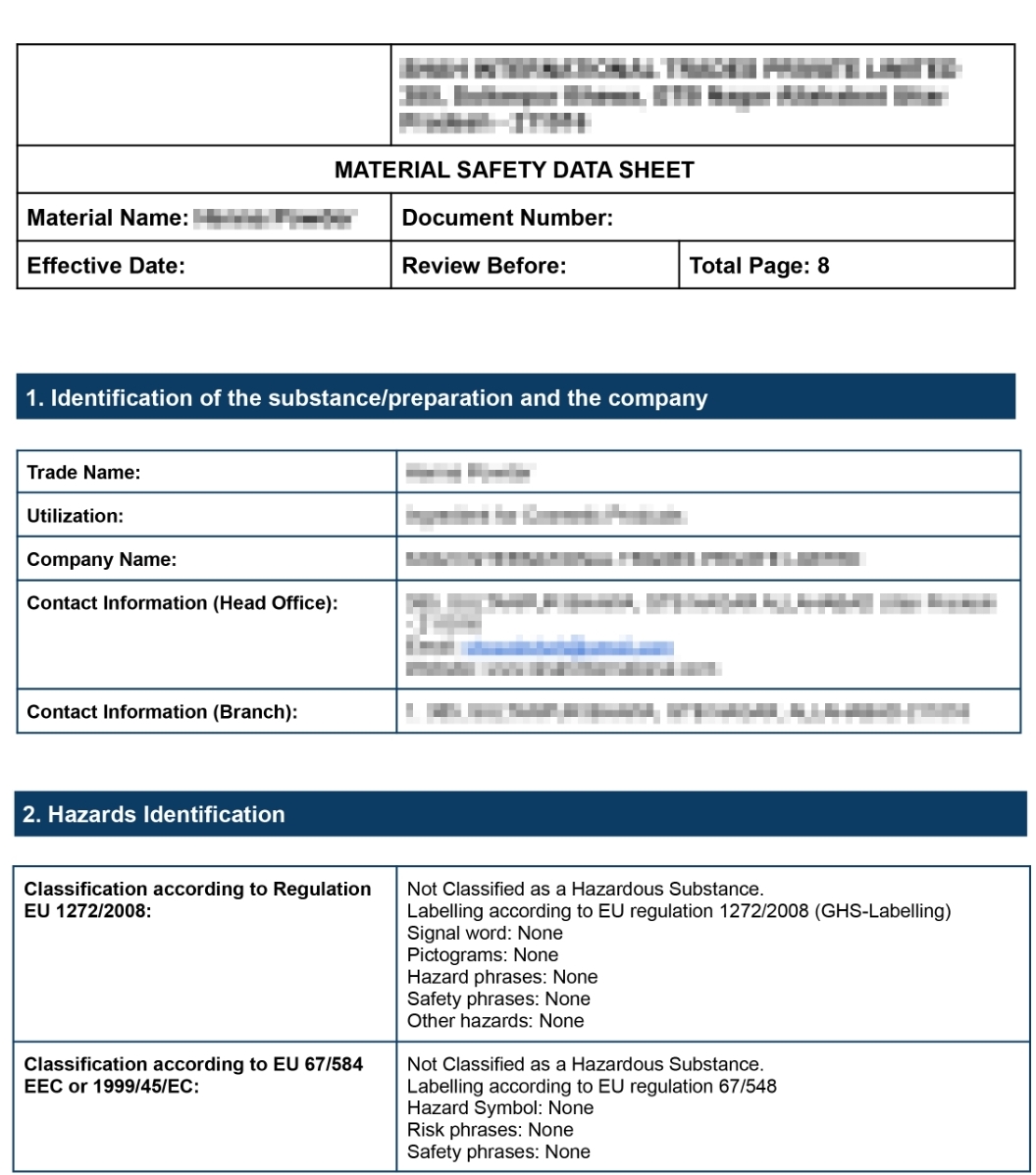
MSDS Certificate [Sample]
How to Apply for MSDS Certificate Online – Step-by-Step Process
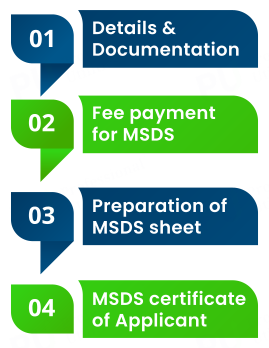
The process for obtaining an MSDS certificate for chemicals is very detailed and includes all the essential steps to ensure the proper handling, storage, and safety of chemicals in accordance with regulatory requirements. The following are the key steps that will guide you through the process.
Step 1. Documentation
All the necessary legal & product related documentation needs to be shared with the EHS (Environment, Health & Safety) firm. These documents help the author to accurately issue the MSDS Certificate.
Step 2. Test Report of the Product
Product testing ensures correct physical and chemical composition of a substance. MSDS certificate helps in precise identification of parameters such as pH, density, flash point, viscosity, & appearance.
Step 3. Author Appointment
MSDS author is responsible for collection and verification of formulation data, hazard categorization and preparation of MSDS certificate with technical precision. SDS author ensures compliance with region specific guidelines, maintain confidentiality, perform quality review & provide assistance in MSDS revision.
Step 4. Examination & Approval
All MSDS sections are carefully examined for precision, consistency, and compliance with the legal requirements. Once verified the MSDS/SDS certificate is issued to the applicant.

Documents Required for MSDS Certificate
Mandatory documents for MSDS certificate generally include:

- Product name and detailed composition
- GST Registration Certificate
- CAS number (Chemical Abstracts Service) of each ingredient
- Manufacturer or importer details (name, address, contact)
- Intended use of the product
- Physical and chemical properties of the product
- Hazard classification and labelling information
- Safety and handling instructions
- Storage and disposal guidelines
- Transport information (if applicable)
- Health hazard and exposure information (if available)
- Stability and reactivity details (if available)
- Import Export Code (IEC)
- Technical Datasheet or Product Brochure
Fees for MSDS Certificate
The MSDS Certificate fees with Professional Utilities are ₹4,499 only including GST For more than one MSDS, the charges would be lower.
| S.N. | No. of MSDS | Cost |
|---|---|---|
| 1 | 1 MSDS Certificate | ₹4,499 |
| 2 | 2 MSDS Certificate | ₹8,999 |
| 3 | For more than 2 MSDS | Contact Our Expert |
The aforementioned Fees is inclusive of GST.
What is Material Safety Data Sheet Certificate (MSDS) ?
An MSDS certificate also known as SDS certificate is a legally mandated document that contains detailed information on the chemical and physical properties of a substance. The SDS document also contains information on risks involved in using the substance, including instructions on handling and disposing of hazardous substances.
An MSDS sheet must be displayed prominently on packaging of all hazardous products along with a UN Mark IIP Certificate as required. Both MSDS certification for exporters and for importers are required to ensure safe handling, storage, and transportation of hazardous substances. A UN Mark IIP Certificate symbolizes that packaging for hazardous or dangerous goods has passed the rigorous testing process and complies with international safety standards.
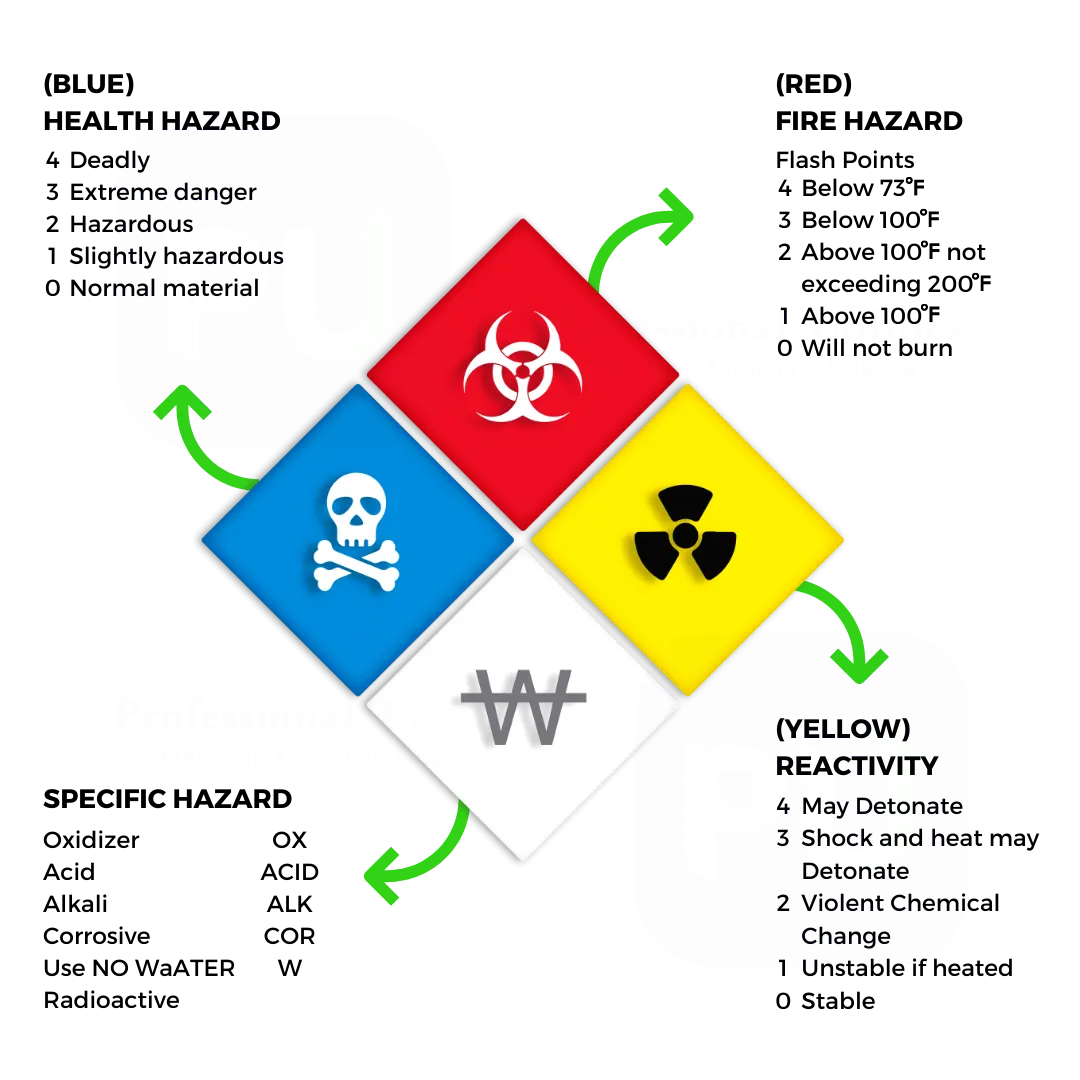
MSDS Updates Under the Latest IATA Lithium Battery Guidelines 2026
Latest MSDS updates on IATA lithium battery guidelines 2026 includes:
- Revised clear distinction and new UN numbers for lithium batteries
- Updated packaging and labeling rules for air cargo
- Mandatory declaration of State of Charge (SoC) for lithium-ion batteries
- Improved shipper obligations for IATA Dangerous Goods Regulations
- Enhanced focus on transport documentation and classification information for lithium batteries in IATA DGR
Note: For detailed technical reference, businesses may review the official IATA Lithium Battery Guidance Document (PDF) available here.
Sections in Material Safety Data Sheet
A Safety Data Sheet (SDS), earlier known as a Material Safety Data Sheet (MSDS), is divided into 16 standardized sections under the Globally Harmonized System (GHS). Each section addresses a specific aspect of chemical safety, ensuring the safe handling, storage, transportation, and disposal of hazardous chemicals.
- Identification: The first section in MSDS includes identification of product, recommended use, details of supplier, and emergency contact numbers.
- Hazard(s) Identification: Highlights the hazards the product presents, including warning labels and symbols.
- Composition/Information on Ingredients: Provides detail on hazardous physical and chemical components available in the product.
- First-Aid Measures: It involves information on the initial care given by responders at incident site an individual exposed to the chemical.
- Fire-Fighting Measures: This section provides instruction on protective actions for firefighters including extinguishing techniques and equipment and chemical hazards from fire.
- Accidental Release Measures: It includes advisory actions to clean the area in case of spills or leaks to reduce exposures to people, properties and the environment.
- Handling & Storage: Instruction on handling & storage gives information on safe handling & storage technique of the chemical.
- Exposure Controls/Personal Protection: Section on exposure control & protection provides details on control measures in case of exposure and recommended personal protective equipment (PPE).
- Physical and Chemical Properties: This section provides detailed information on the physical and chemical properties of a substance.
- Stability and Reactivity: Section 10 of Material Safety Data Sheet gives information on potential of a substance to undergo dangerous reactions.
- Toxicological Information: The section details about the side effects of exposure to the chemical, information is delivered on both immediate and long-term effects.
- Ecological Information (non-mandatory): The section gives information about effect of chemical on environment.
- Disposal Considerations (non-mandatory): Gives information on proper disposal of the chemical and its contaminated packaging.
- Transport Information (non-mandatory): Detail on classification and labelling for shipping and transporting.
- Regulatory Information (non-mandatory): List of regulations applied to the chemical.
- Other Information: Information on last revision date and other possible information that is not included in other sections of Safety Data Sheet.
Classes of Hazardous Products Covered Under MSDS Certificate
Dangerous goods are susceptible to volatility and pose destructive risks when not handled correctly. Shipping dangerous goods internationally have its own set of complications - complying with regulations and restrictions is everyone’s responsibility to uphold safe practices.
There are 9 classes of dangerous goods (DG), each consisting of unique characteristics and features.
Classes of Dangerous Category Products
Following are the nine classes of Dangerous Category products:
Explosives

Substances that explode or can trigger explosive devices. e.g., fireworks, dynamite, detonators, ammunition
Flammable Gas

Gases that may ignite or burn instantly. e.g., Aerosol, fire extinguishers, gas lighters, camping gas
Flammable Liquids
Liquids that at a temperature of 60°C emit flammable gases. e.g., Gasoline, oil-based paints, perfume, aftershave
Flammable Solids

Solids that may either combust during transportation or cause/contribute to a fire. e.g., Matches, camphor, waste rubber
Oxidising Substances

Substances that may give off oxygen and therefore cause or contribute to the combustion of another material. e.g., Oxygen generators, zinc chlorate, potassium chlorate
Toxic Substances

Substances that may cause death, injury, or harm to humans if swallowed, inhaled, or contacted by the skin. e.g., Cyanide, rat poison, herbicides, insecticide
Radioactive Material

Substances that spontaneously and continuously emit radiation that can be harmful to humans or animals' health can affect photographic film or X-ray film. e.g., X-ray machines, some fire, and smoke alarms
Corrosive Substances

Substances that may cause severe damage when in contact with living tissue (e.g., skin) and other materials, including metal. e.g., Sulfuric acid, mercury, hydrochloric acid, and various other acids
Miscellaneous

Substances that do not meet the criteria of the classes of dangerous goods yet are considered dangerous for transport. e.g., asbestos, dry ice, magnetic material, consumer goods, & self-inflating equipment.
Note: Cosmetics (Perfumes, Nail Polish) and electronic items containing lithium batteries are also considered as Dangerous Goods (DG) or Hazardous Materials by customs-even though they appear non-hazardous.
Who Needs an MSDS Certificate?
MSDS certificate is necessary for any entity or organization, including e-commerce platforms, that manufactures, imports, exports, transports, or stores chemical products. With most nations making this certificate a legal requirement, the MSDS certificate is equally essential for customs clearance.
- Chemical Manufacturers
- Pharmaceutical & API Manufacturers
- Agrochemical Companies
- Paint & Coatings Industry
- Essential Oils & Fragrances Producers
- Cosmetic Manufacturers
- Chemical Importers
- Logistics & Freight Forwarders
- Shipping agents and exporters transporting chemical goods
- Research Laboratories & Academic Institutions

Difference between MSDS vs SDS
Learn the major differences between MSDS and SDS and why SDS replaced MSDS under the Globally Harmonized System (GHS).
| Aspect | MSDS | SDS |
|---|---|---|
| Full Form | Material Safety Data Sheet | Safety Data Sheet |
| Standardization | MSDS formats are not globally standardized and may vary significantly between manufacturers and countries. | SDS follows a fixed & globally harmonized 16-section structure under GHS format. |
| Regulatory Framework | MSDS framework can vary from country to country with different presentations. | SDS is aligned with global standards i.e. GHS which promotes uniform presentation. |
| Global Acceptance | May not be accepted if not aligned with GHS format. | Globally accepted & preferred for exports. |
| Acceptance by Shipping Carriers | MSDS may be rejected by DHL/FedEx if not GHS-aligned. | SDS is universally accepted. |
Note: GHS, often referred to as the ‘Purple Book’, is a UN-established framework that standardizes how chemical hazards are classified and communicated globally.
Benefits of MSDS Certificate
Material Safety Data Sheet (MSDS) is a technical document providing information about potential hazards and product safety. Listed below are some of the common benefits of the MSDS certificate:
- Consumer Protection: Provides helpful information on the safe storage and handling of chemical products for consumers.
- Workplace Safety: Ensures workplace safety and gives specific information on safe operations with hazardous substances.
- Emergency Response: Provides technical information on emergency response in case of exposure.
- Safe Management: Safety Data Sheet (SDS) provides detailed guide on management, production, transportation, and storage of chemical and hazardous substances.
Validity & Renewal of MSDS/SDS Certificate
An MSDS/SDS certificate is generally valid for 3 years from the date of issuance, and it must be renewed in case of any changes in GHS guidelines or every 3 years, whichever is earlier. However, any changes must be updated within 90 days. An updated SDS certificate helps avoid customs delays, as authorities often consider certificates that are not older than 3–5 years.
MSDS Certificate must be updated when:
- Purity, chemical composition, or ratio of substance changes.
- New information on toxicity, carcinogenic properties, or environmental effects becomes available.
- New handling, storage, or emergency response information becomes available.
Note: If there is any change in regulations within 6 months from the date of issuance of MSDS certificate, Professional Utilities issues the updated MSDS certificate on a complimentary basis.
Purpose and Requirement of MSDS Certificate
MSDS certificate is a mandatory document for businesses or entities dealing with hazardous chemicals or substances. Refer to MSDS Certificate in Delhi for more detailed guidance on purpose and requirement of Safety Data Sheet.
1. Supporting document for Shipment of Chemical Substances : MSDS is a mandatory document required by manufacturers, suppliers, or the exporting entities of hazardous substances. SDS must contain information about the chemical substance including storage, disposal and potential hazards associated with the use of chemical.
2. Regulatory Compliance : Material Safety Data Sheet ensures adherence to global safety frameworks like OSHA (Occupational Safety and Health Administration) and GHS (Globally Harmonized System). MSDS ensures adherence to proper packaging and transport guidelines.
3. Safety Preparedness : Provides safety measures in case of spill or leakage, provides critical information to firefighters, doctors, and spill-response teams.
4. Mandatory in Europe and North America : Sellers of hazardous substances must obtain MSDS before selling their products in Europe and North America.
5. For compliance of OHSAS 18001 : Entities with OHSAS 18001 Certification must obtain an MSDS certificate to comply with occupational health and safety standards.
Related Services You Should get after MSDS



Get Expert Assistance from Professional Utilities for MSDS Certification
Material Safety Data sheet (MSDS) ensures product safety, compliance with regulations, smooth customs clearance and builds credibility of product manufacturers both domestically and internationally. With expansion of trade relations among nations across the globe it has become legally mandatory for consignees to maintain accurate and correct Safety documents to avoid delays or rejection.
Professional Utilities with over a decade of experience assist in securing a well drafted MSDS certificate. Our team of experts provide complete assistance in MSDS preparation, review and compliance with regulatory standards.
FAQ’s On Online MSDS Certificate
What is Material Safety Data Sheet?
The Material Safety Data Sheet certificate is a document that consists of detailed information about the physical and chemical substances of a specific product, particularly hazardous chemicals and how to regulate it.
What is the full form of MSDS?
The full form of MSDS is Material Safety Data Sheet. It is a document that provides detailed information about the properties, handling, storage, and safety precautions for chemicals and hazardous materials.
What documents are required for an MSDS Certificate?
There are certain documents mandatory while applying for Material Safety Data Sheet (MSDS). All those documents are stated below:
- Import Export Code
- GST Registration
- Ingredients of the product
- Details of Product (with images)
How to get MSDS certificate?
To get an MSDS certificate, one must provide the necessary information and documents, get the documents verified, pay the required fee, and then proceed with the preparation of the MSDS as per regulatory standards. The MSDS certificate is issued upon the successful completion of the process.
Who needs an MSDS certificate?
An MSDS (Material Safety Data Sheet) certificate is mandatory for manufacturers, importers, exporters, and distributors of hazardous chemical products, including cosmetics, electronics containing batteries, and industrial chemicals.
What is the cost of MSDS certificate?
The MSDS Certificate fees with Professional Utilities start at ₹4,499 only. Get in touch with our experts today for a detailed consultation and quick processing assistance.
How many years is a MSDS valid for?
The MSDS Certificate is valid for three years from the date of release by the concerned authorities. To continue to comply with all the safety and chemical handling regulations, renew your certificate before the expiry of the validity period.
What is a Material Safety Data Sheet (MSDS)
certificate for batteries and how to obtain it in India?
Material Safety Data Sheet (MSDS) Certificate for Batteries explains the purpose, requirements, and procedure for obtaining an MSDS certificate for batteries in India. It helps manufacturers and importers understand safety guidelines, regulatory compliance under hazardous substances rules, and documentation needed to ensure safe handling, storage, and transportation of batteries.
Speak Directly to our Expert Today

Reliable

Affordable

Assured
Industries Served by
Professional Utilities

Apparels

Footwear

Furniture

Gems and Jewellery

Tourism & Hospitality

Consumer Electronics

Chemicals

Telecom

Oils & Gas

Hotel

Railways

Liquor

Health & Medical

Food Processing

Dangerous/ Haz. Goods

Tea & Coffee

Capital Goods

Recycling

Rubber

NGOs

Silk

Handloom

IT & BPM

Steel

Automobile

Tobacco

Constructions


Disclaimer:The information provided on this website is intended for general information purposes only. Although all reasonable efforts are made to ensure that the information provided is correct and reliable, it is not advised to be used as a substitute for professional advice. The information herein is not to be used in place of seeking professional services, counsel, or guidance. We highly advise that you consult a professional before you make any business or legal decisions regarding the information presented on this website. This website and its contents are given "as is", and we do not take any responsibility for any action that is taken based on information given on this website.

- Written by: Anuja Sahi
- Fact-checked: Sahil Singh
- Updated on: May 27, 2026
Testimonials
"Explore how Professional Utilities have helped businesses reach new heights as their trusted partner."





It was a great experience working withProfessional Utilities. They have provided the smoothly. It shows the amount of confidence they are having in their field of work.

Atish Singh


It was professional and friendly experience quick response and remarkable assistance. I loved PU service for section 8 company registration for our Vidyadhare Foundation.

Ravi Kumar
I needed a material safety data sheet for my product and they got it delivered in just 3 days. I am very happy with their professional and timely service. Trust me you can count on them.

Ananya Sharma
Great & helpful support by everyone. I got response & support whenever I called to your system. Heartly thanx for Great & Super Service. Have a Great & Bright future of team & your company.

Prashant Agawekar
Thank you so much Professional Utilities team for their wonderful help. I really appreciate your efforts in getting start business. Pvt Ltd company registration was smooth yet quick.
Abhishek Kumar
I applied for Drug licence and company registration and their follow-up for work and regular updates helped me a lot. They are happily available for any kind of business consultancy.

Vidushi Saini
Great experience went to get my ITR done, process was quite convenient and fast. Had a few queries, am happy about the fact those people explained me all things I wanted to know.

Taniya Garyali
Great services provided by Professional Utilities. They are best in this industry and the best part is their prices are so affordable. Kudos to you. Now you guys are my full-time consultant.

Aftab Alam
Trusted By