India Australia Free Trade Agreement

IND-AUS ECTA Certificate

Years of Experience
What’s Included?
India-Australia ECTA Certificate of Origin Rules of Origin & Value Addition Verification HS Code Classification & Product Eligibility IEC & GST Verification Assistance in DGFT Coordination & Liaison Application on DGFT Trade Connect Platform Expert Filing & Follow-Up
Get Expert Consultation

India-Australia ECTA Certificate Registration – Process, Fees & Documents
The IND-AUS ECTA is a landmark agreement between India and Australia that aims to enhance economic cooperation and promote trade and investment between the two nations. By reducing tariffs on a wide range of goods and services and establishing clear rules and regulations, the agreement seeks to create a more favorable and transparent environment for commercial activity between the two countries. This will make it easier and more cost-effective for businesses in both nations to trade with each other, thereby boosting economic growth and job creation.
IND-AUS ECTA includes provisions to protect and encourage investment, such as guarantees against discriminatory treatment, the free transfer of funds, and mechanisms to resolve disputes effectively. It also aims to enhance cooperation in key sectors like education, agriculture, and technology. The agreement assists companies in both countries to invest in each other's markets and drive further economic growth and development, fostering a long-term strategic partnership between India and Australia. The ECTA between India and Australia is an interim economic arrangement and not a comprehensive Free Trade Agreement. Negotiations for a full Comprehensive Economic Cooperation Agreement (CECA) between India and Australia are ongoing. The ECTA provides immediate tariff benefits while the broader CECA is being negotiated. IND-AUS ECTA assist businesses by expanding market access, reduced trade barriers, and a more predictable regulatory environment, leading to greater opportunities for innovation and collaboration.
INDAUS Certificate [Sample]
![CEPA Certificate [Sample]](./upload/cepa.webp)
What is IND-AUS ECTA (Economic Cooperation and Trade Agreement)?
Under the provisions of the IND-AUS ECTA agreement, exporters must complete the registration process to claim preferential tariff benefits when trading with Australia. India-Australia ECTA signed on 2 April 2022 and implemented on 29 December 2022 provides reduced tariffs on eligible goods and improved market access for services. Bilateral trade between India and Australia stood at approximately USD 27.5 billion at the time of signing, with a target of reaching USD 45-50 billion within five years. To obtain a certificate of origin, exporters can apply through government authorities such as the DGFT or authorized councils like the Indian Spices Board, among other recognized agencies.
After Economic cooperation and Trade Agreement (ECTA) between Australia and India, Australia offered nil rate of customs duty on 98% of its tariff lines, with immediate effect from the date of implementation, on goods including textiles, leather, footwear, and furniture from India. Key tariff commitments under India-Australia ECTA also include elimination of duties on 40% of its tariff lines immediately by India with another 30.3% phased over 3, 5, 7, or 10 years. A staging category determines how many equal annual instalments India uses to eliminate a duty for example, a product in the 5-year category moves from its current rate to zero in five equal annual steps from the date of implementation. Sensitive agricultural products including dairy, chickpea, wheat, rice, and live animals (29.8% of tariff lines) have been excluded from India's commitments.

Process for INDIA AUSTRALIA - ECTA Registration
IND-AUS Economic Cooperation and Trade Agreement (ECTA) simplifies export procedures and provides tariff benefits for eligible goods. Exporters must complete the following steps to obtain the Certificate of Origin:
- Create an Account with Organisation-Based DSC - Create an account on the DGFT Trade Connect portal using an organisation-based Digital Signature Certificate (DSC) linked to the Importer Exporter Code (IEC).
- Apply Online for the Certificate of Origin - Log in to the portal and initiate an online Certificate of Origin application by selecting India-Australia ECTA as the applicable trade agreement.
- Complete the Application Form - Provide the required details, including HS Code, product description, FOB value, consignee details, and shipment information, along with the applicable supporting documents.
- Upload the Required Documents - Upload the prescribed documents, which may include the commercial invoice, purchase documents containing details of raw material origin, manufacturer-exporter declaration, product description, and purchase order, as applicable.
- Verification and Issuance of ECTA Certificate of Origin - The application is reviewed by the designated issuing authority. Upon successful verification and payment of the applicable fee, the India-Australia ECTA Certificate of Origin is issued electronically.
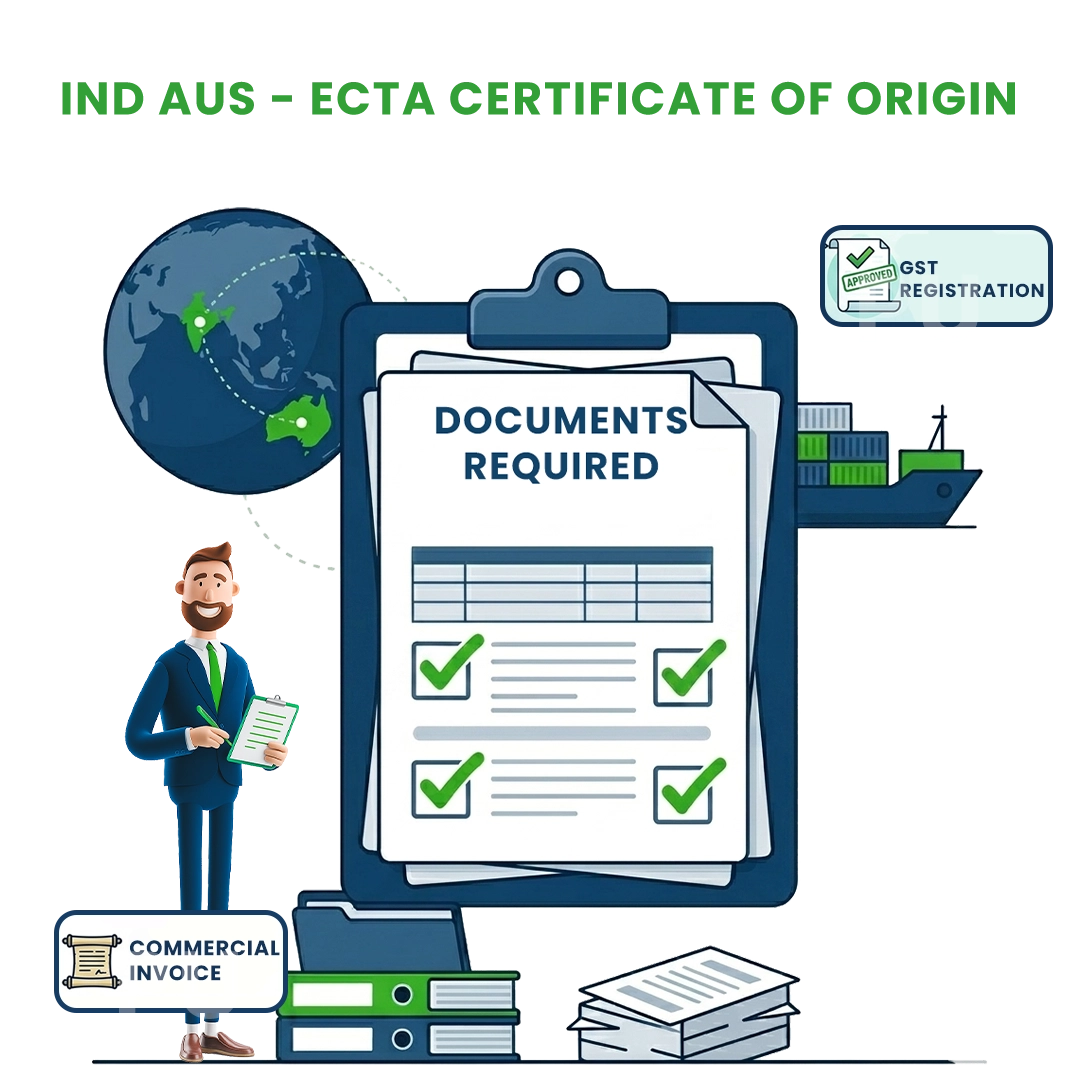
Documents Required for INDIA AUSTRALIA - ECTA Registration
Exporters applying for the IND-AUS ECTA Certificate of Origin must submit the following documents to verify eligibility and product authenticity:
- Commercial Invoice
- Product Description
- Digital Signature Certificate
- Mobile No. & Email address
- Updated Import Export Code
- Purchase order from importer company
- Organization based Digital Signature Certificate
- Manufacturer Exporter Declaration on the company’s Letterhead
- Purchase Bill that has details of quantity, origin of raw materials, consumables used in product meant for export
- Packing List
- Bill of Lading
- Shipping Bill
Fees for INDIA AUSTRALIA - ECTA Registration
The total cost of registering the IND-AUS ECTA Certificate of Origin, including professional charges, is listed below. The registration remains valid for up to 12 months from the date of issuance.
| Types of Fees | Fees |
|---|---|
| One Time Portal Registration Fee | ₹1,500/- |
| Professional Fee | ₹2,000/- |
| GST @ 18% on Professional Fees | ₹360/- |
| Total Fees | ₹3,860/- (All Inclusive) |
Sample Tariff Outcomes under India- Australia ECTA
Indicative duty rates and staging categories for key Indian export sectors are:
| HS Code | Product | Pre-ECTA Duty | ECTA Duty | Staging | Direction |
|---|---|---|---|---|---|
| 6109.10 | T-shirts, cotton knitted | 5% | 0% | Immediate | IN → AU |
| 6403.99 | Leather footwear | 5% | 0% | Immediate | IN → AU |
| 9401.61 | Wooden furniture, upholstered | 5% | 0% | Immediate | IN → AU |
| 7113.19 | Jewellery of precious metal | 5% | 0% | Immediate | IN → AU |
| 8703.23 | Passenger cars (1000–1500cc) | 5% | 0% | 5 years | AU → IN |
| 2208.30 | Whisky | 150% | 25% | 10 years | AU → IN |
| 0402.10 | Milk powder | 60% | Excluded | Sensitive list | IN → AU |
| 1001.19 | Wheat | 50% | Excluded | Sensitive list | IN → AU |
Note: Both HS Codes and duty rates are indicative.

Difference Between ECTA and CECA
The key differences between ECTA and CECA are based on their scope, coverage, and market access.
| Key Differences | ECTA | CECA |
|---|---|---|
| Definition | IND-AUS ECTA is a landmark agreement between India and Australia that aims to enhance economic cooperation and promote trade and investment between the two nations | Comprehensive Economic Cooperation Agreement (CECA) is a much broader pact that includes complex areas like digital trade, govt. Procurement and investment protection |
| Scope | Covers tariff eliminations on targeted list of products | Covers broad range of products including investment frameworks and broader market access |
| Key Areas Covered | Merchandise goods, market access for selected services | Covers topics such as digital trade, e-commerce data flows and innovation among other |
| Negotiation Approach | Simpler to negotiate because it neglects broader range of products | Complex, hard to negotiate and takes more time for negotiation than ECTA |
Rules of Origin (ROO) Under INDIA AUSTRALIA - ECTA
Rules of certificate of origin are the criteria used to determine the country of origin of a product that is being exported. They are established through agreement between the signatory parties of a trade agreement and serve as a basis for determining whether a product is eligible for preferential treatment under the agreement.
- Wholly Obtained - Agricultural products, minerals and fisheries product must be entirely grown, harvested or manufactured in India with no imported inputs.
- Value-added Criteria (Regional Value Content) - Indian processing must add a minimum of 35% of the FOB export value.
- Change in Headings (CTH) - First 4 digits of the product's HS code must change during Indian processing.
- Change in Sub-Headings (CTSH) - First 6 digits of the HS code must also change.
- Change in HS Chapter (CC) - The first 2 digits must change. Represents the highest level of transformation.
- Accurate product details - The product must be shared with authorities to comply with preferential treatment
Key Exclusions from the India-Australia ECTA
India- Australia ECTA offers numerous tariff benefits, however there are certain product categories that remain outside the scope of India’s commitments under the agreement
- Excluded Agricultural Products - India has excluded approximately 29.8% of its tariff lines from ECTA commitments. Products explicitly kept outside India's concessions include dairy products, chickpeas, wheat, rice, live animals, certain meat and poultry products, and specific fruits and vegetables.
- Services-Government Procurement - Government procurement is explicitly excluded from the services chapter of the ECTA. Australian companies do not gain preferential access to Indian government contracts under this agreement.
Note: Exporters and importers must verify whether their specific product HS Code is covered under the ECTA tariff schedule before applying for ECTA Certificate of Origin.
Product Eligibility Under INDIA AUSTRALIA - ECTA Agreement
If the Product meets the following criteria, it will be considered to have come from a contracting nation and be eligible for preferential treatment.
- Wholly Obtained & Produced Products
- Live animals
- Agri products
- Products made of animals
- Products made of Marine animals
- Products made of natural resources
- Product produced in the territory of the country exclusively
- Products have undergone sufficient working or production according to the Product Specific Rules
Note: According to the IND-AUS ECTA trade agreement, exporters are required to submit a certificate of origin for their Product in order to verify its validity.
Benefits of INDIA AUSTRALIA - ECTA Registration
The main advantage of this agreement is that it facilitates the exchange of goods and services between the two nations. This, in turn, has the potential to increase trade and economic growth
- Reducing tariffs & trade barriers in preferred countries
- Encouraging cross- border transactions between the territories of the Contracting counties.
- Promoting fair competition in the free trade states
- Ensuring equitable benefits to all Contracting countries
- Effective mechanism for joint administration & resolution of disputes
- Framework for regional cooperation and enhance mutual benefits for trade.
- The agreement facilitates work and holiday visas for Indian nationals aged 18-31
- Post-study work visas for Indian students in Australia
- Professional qualification recognition in sectors including financial services, telecommunications, and other professional services
Responsibility of Exporters under INDIA AUSTRALIA - ECTA
The responsibilities of the exporter under ECTA are as follows:
- The exporters are responsible for providing asked documents during the IND AUS - ECTA certification process.
- Exporters proving misleading information and documents are liable to be punished or penalized.
- Exporters need to keep minimum information & supporting documents of their products for 5 years from the expiry date of their IND AUS - ECTA certificate.
- The exporter shall keep appropriate accounting records of the production supply of the products.
- The exporter shall notify the issuing authority, custom authority, and the importer of any chances that could affect the accuracy or validity.
Non-compliance & Penalties
- Customs duties will be charged if the Product's certificate of origin shows that it doesn't meet the rules of origin of IND-AUS - ECTA.
- Each Party must also ensure civil and administrative laws are to be followed. When necessary, it will use criminal punishments for people who break its customs laws.
Other Free Trade Agreements
India has enhanced its market access commitments for neighbouring service providers. These commitments provide companies with an opportunity to build market expertise and grow by international expansion. Under Free or Preferential Trade Agreement there are multiple options where certificate of origin can be generated from India for import benefits to importing companies:
ICPTA - India Chile Preferential Trade Agreement
SAFTA - South Asia Free Trade Agreement
SAPTA - SAARC Preferential Trade Agreement
IKCEPA - India Korea Comprehensive Economic Partnership Agreement
IJCEPA - India Japan Comprehensive Economic Partnership Agreements
AIFTA - ASEAN India Free Trade Agreement
ISFTA - India Sri Lanka Free Trade Agreement
APTA - Asia Pacific Trade Agreement
GSP - Generalized System of Preferences
GSTP - Global System of Trade Preferences
IMCECA - India Malaysia Comprehensive Economic Cooperation Agreement
ISCECA - India Singapore Comprehensive Economic Cooperation Agreement

Secure Your IND-AUS ECTA Certificate of Origin with Expert Assistance
The IND-AUS ECTA has many advantages that enhance the grants in tariffs for companies oriented in transparent trading between India and Australia. It provides for improved market access and investment protection and a more liberalized investment environment in sectors of interest such as education, agriculture and technology. The process includes certifying the original copy from DGFT eCoO or authorized issuing agency, and the fee payable for the certification is ₹3,860. This agreement helps to enhance the framework of trade cooperation, develop investments with cross-border characteristics, and foster stability in relations with regard to creating favorable conditions for the development of new strategic relations and innovations for both countries, and businesses can also explore the India-New Zealand Free Trade Agreement (FTA) to unlock new trade opportunities in emerging international markets. Additionally, Professional Utilities provides assistance for various trade agreements, ensuring a smooth and hassle-free process for businesses expanding globally.
FAQ's on IND AUS - ECTA Registration
What is the Australia India trade agreement 2026?
Australia India Trade Agreement also known as IND-AUS ECTA is a landmark agreement between India and Australia that aims to enhance economic cooperation and promote trade and investment between the two nations.
Which products are covered under the India-Australia ECTA?
India-Australia ECTA provides preferential tariffs to a wide range of products including textiles and apparel, leather goods, gems & jewellery, engineering products, pharmaceuticals, chemicals, agricultural products, seafood and selected manufactured goods as well. Products that satisfy trade agreement Rules of Origin can avail reduced or zero customs duties under the Ind-Aus ECTA.
What are the Rules of Origin under the India-Australia ECTA?
Rules of Origin under the India-Australia ECTA are the criteria used to determine the originating country of a product being exported. These rules are established under the agreement between the signatory countries and form the basis for determining whether a product qualifies for preferential tariff treatment under the India-Australia ECTA.
How can exporters claim ECTA tariff benefits?
Exporters can claim ECTA tariff benefits by ensuring that their products comply with the Ind-Aus ECTA Rules of Origin and by securing India-Australia ECTA certificate of Origin from authorized issuing agency. To claim preferential tariff benefits certificate of origin must be submitted to customs in the importing country.
What is the Cost of Obtaining an India-Australia ECTA Certificate of
Origin?
The total cost of obtaining an India-Australia ECTA Certificate of Origin is ₹3,860, inclusive of government fees, professional fees, and GST.
Who is eligible to apply under ECTA?
Registered exporters, producers or an authorized representative based in India or Australia are eligible to apply for preferential tariff treatment under the India-Australia Economic Cooperation and Trade Agreement (ECTA).
How can I apply for the India-Australia ECTA?
To apply for India-Australia ECTA exporters must register on DGFT trade connect portal, submit the required documents & fees and apply for Ind-Aus ECTA certificate of origin. Upon approval, the certificate can be used to take advantage of preferential tariff.
Speak Directly to our Expert Today

Reliable

Affordable

Assured
Industries Served by
Professional Utilities

Apparels

Footwear

Furniture

Gems and Jewellery

Tourism & Hospitality

Consumer Electronics

Chemicals

Telecom

Oils & Gas

Hotel

Railways

Liquor

Health & Medical

Food Processing

Dangerous/ Haz. Goods

Tea & Coffee

Capital Goods

Recycling

Rubber

NGOs

Silk

Handloom

IT & BPM

Steel

Automobile

Tobacco

Constructions


Disclaimer:The information provided on this website is intended for general information purposes only. Although all reasonable efforts are made to ensure that the information provided is correct and reliable, it is not advised to be used as a substitute for professional advice. The information herein is not to be used in place of seeking professional services, counsel, or guidance. We highly advise that you consult a professional before you make any business or legal decisions regarding the information presented on this website. This website and its contents are given "as is", and we do not take any responsibility for any action that is taken based on information given on this website.

- Written by: Anuja Sahi
- Fact-checked: Sahil Singh
- Updated on: August 25, 2026
Testimonials
"Explore how Professional Utilities have helped businesses reach new heights as their trusted partner."







It was a great experience working withProfessional Utilities. They have provided the smoothly. It shows the amount of confidence they are having in their field of work.

Atish Singh


It was professional and friendly experience quick response and remarkable assistance. I loved PU service for section 8 company registration for our Vidyadhare Foundation.

Ravi Kumar
I needed a material safety data sheet for my product and they got it delivered in just 3 days. I am very happy with their professional and timely service. Trust me you can count on them.

Ananya Sharma
Great & helpful support by everyone. I got response & support whenever I called to your system. Heartly thanx for Great & Super Service. Have a Great & Bright future of team & your company.

Prashant Agawekar
Thank you so much Professional Utilities team for their wonderful help. I really appreciate your efforts in getting start business. Pvt Ltd company registration was smooth yet quick.
Abhishek Kumar
I applied for Drug licence and company registration and their follow-up for work and regular updates helped me a lot. They are happily available for any kind of business consultancy.

Vidushi Saini
Great experience went to get my ITR done, process was quite convenient and fast. Had a few queries, am happy about the fact those people explained me all things I wanted to know.

Taniya Garyali
Great services provided by Professional Utilities. They are best in this industry and the best part is their prices are so affordable. Kudos to you. Now you guys are my full-time consultant.

Aftab Alam
Trusted By