Apply Online Now for BIS Registration for Lithium-ion Battery Manufacturers

4.9


BIS CRS Registration for Lithium Ion Batteries in India - Process, Fee
Lithium-ion batteries have gained significant popularity due to their wireless convenience and exceptional audio quality. As the demand for these devices continues to rise, it is essential to ensure that they adhere to critical quality and safety standards. In India, the Bureau of Indian Standards (BIS) has implemented the Compulsory Registration Scheme (CRS) to regulate and certify products such as Lithium-ion batteries for the Indian market. The CRS is a government initiative designed to guarantee the quality and safety of products available in India. This certification process involves rigorous testing and evaluation by accredited laboratories to ensure compliance with the latest safety norms and technical specifications.
According to the CRS, all Lithium-ion batteries are required to be registered with the BIS and must comply with specific quality and safety standards. This regulation helps safeguard consumers from purchasing counterfeit or unsafe products. Additionally, the CRS fosters fair competition in the market by ensuring that every lithium-ion battery meets the same criteria. Moreover, acquiring BIS CRS certification not only enhances a brand's credibility but also provides customers with the assurance that the products conform to stringent safety regulations. With the increasing use of Lithium-ion batteries in electronics, electric vehicles, and energy storage systems, BIS CRS certification has become a vital necessity for businesses operating in India. Certification also opens up wider market opportunities and builds consumer trust in an increasingly competitive industry.
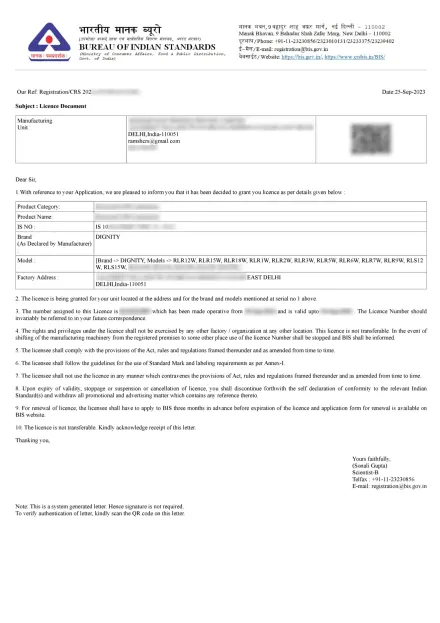
BIS CRS for Lithium-ion-batteries Sample
Process of BIS CRS Certification for Lithium-ion-batteries
The registration process can be broken down into the following steps:
- Identification of IS standard: Determining the appropriate quality standards for the product before applying for CRS registration is a crucial step in the entire registration process.
- Documentation and Filing: After the appropriate quality standard has been determined for the product, applicants must provide the relevant information and documentation, which will be attached to the BIS application. Applicants must also provide test reports for their products from BIS-accredited testing laboratories.
- Verification and inspection: Once the application, application fees, and test report have been submitted, the licensing authorities will conduct a thorough inspection and verification of the documents and premises (in some cases) before issuing a BIS certificate.
- Issuance of BIS certificate: BIS CRS registration will be issued within 20-25 days of completing all the required steps.

Documents required for BIS CRS Certification for Lithium-ion-batteries
The following are the documents that must be submitted during the CRS registration for a Lithium-ion-batteries :-
- Nomination Letter of AIR ( In case of foreign manufacturer )
- Test Report for the product
- Undertaking regarding the product
- ISO Certificate of the manufacturer
- Product manual of the applied devices
- Trademark Certificate if available or required
- Testing documents such as filled CCL and CDF
- Authorized Indian Representative and Affidavit (In case of Foreign Manufacturer)
- Trademark Authorisation Letter, in case the brand, is not owned by the manufacturer
- If the signatory person is other than the head of the manufacturing facility, then submit the Authorisation Letter

Fees for BIS CRS Certification of Lithium-ion-batteries?
The costs for BIS CRS registration for Lithium-ion Batteries are - Application Fee ₹15,340 and Professional Fee ₹14,999. The cost of Lithium-ion Batteries in India also depends on BIS compliance, making a valid BIS license mandatory.
| Particulars | Fees |
|---|---|
| ✅ Lab Test | ₹ 25,000 |
| ✅Application Fee | ₹ 15,340 |
| ✅Professional Fee | ₹ 14,999 |
| ✅Validity of CRS Registration | 2 years |
| ✅Renewal Fee | Same as application fee, additional our professional fee for renewal is ₹ 7,500. |
Note : The aforementioned Fees is exclusive of GST.
Foreign Manufacturers and Non-MSME entities are required to pay an additional fee of ₹ 10,000 for their BIS CRS application.
What is the BIS CRS Certification for Lithium-ion Batteries?

The Bureau of Indian Standards (BIS) issues the Compulsory Registration Scheme (CRS) certificate specifically for products like Lithium-ion batteries used in electronics and other applications. This certification ensures that Lithium-ion batteries comply with strict quality, safety, and performance standards set by BIS for the Indian market.
The BIS CRS certification for Lithium-ion batteries serves to safeguard consumers against unsafe or counterfeit batteries that may present risks of fire, explosion, or environmental dangers. This certification mandates that manufacturers and importers have their batteries evaluated and certified by laboratories approved by BIS, ensuring both reliability and safety.
Tests Conducted for Lithium-Ion Batteries
Testing requirements for secondary batteries and cells are outlined as per BIS requirements are stated below:
- Crushing Test
- Incorrect installation Test
- Low-pressure Test
- Forced Discharge Test
- Over-charging Test
- Charging / Discharging Test
- Continuous charging Test
- Insulation Resistance Test
- Vibration Test
- Temperature Cycling Test
As BIS registration is mandatory and testing requirements for Lithium-Ion batteries, let's move to BIS certification procedure for lithium-ion batteries.
Benefits of BIS CRS Certification
Obtaining BIS CRS registration can help you in the following ways:
- Increase brand value and customer confidence: BIS CRS registration is a mark of quality and safety. It shows that your Lithium-ion-batteries meets all the required standards and is safe to use. This can help you in increasing your brand value and gaining the confidence of your customers.
- Reduce risk of product recalls and penalties: BIS CRS registration can help you in reducing the risk of product recalls and penalties. If your Lithium-ion-batteries is not registered with BIS, it can be recalled from the market and you may be liable to pay penalties.
- Access to government tenders and contracts: BIS CRS registration is a requirement for many government tenders and contracts. If you are not registered with BIS, you may not be able to participate in these tenders and contracts.
- Improved market access: BIS CRS registration can help you in improving your market access. It shows that your Lithium-ion-batteries meets the required standards and is safe to use. This can help you in getting your Lithium-ion-batteries approved for sale in more markets.

Conclusion
Businesses that comply with Indian government standards and obtain BIS CRS registration can benefit from a number of advantages, including increased credibility and customer trust. BIS CRS registration ensures that businesses comply with safety and quality regulations, which can help to prevent legal and regulatory issues and maintain a good reputation in the market. It can also give businesses a competitive edge by demonstrating a commitment to quality and safety.
FAQ’s On BIS CRS Registration for Lithium Ion Batteries in India
What is UN 38.3 registration certificate and how to obtain it in
India?
UN 38.3 Registration Certificate explains the importance, testing requirements, and application procedure for obtaining the UN 38.3 certificate in India. It helps manufacturers and exporters of lithium batteries and related products comply with international safety standards for air transport, ensuring safe handling, shipping, and regulatory adherence.
Is it obligatory for importers to get CRS Registration for
Lithium-ion Batteries?
Yes, according to the Ministry of Electronics and Information Technology (MeitY), it is mandatory for importers of Lithium-ion Batteries to obtain BIS CRS registration. This certification ensures the batteries meet Indian safety standards and allows their legal import, sale, and distribution in the country.
What is BIS CRS registration?
BIS CRS registration stands for Compulsory Registration Scheme. It was introduced by the Ministry of Electronics and Information Technology (Meity). Under the CRS registration, all manufacturers and importers of electronic products are now required to obtain BIS CRS certification in order to start business in India.
How to do crs registration?
All applicants located in India have to submit an affidavit cum undertaking as per Format C. Fee to be deposited as per the fee structure for CRS. Fill the application form(Form VI) online. Refer the checklist of documents to be submitted along with the application form.
How long is the BIS certificate valid for?
A BIS certificate is generally valid for two years and can be renewed for one to five years if there are no changes in the product or standards. Manufacturers must submit a renewal application and fees before the certificate expires to avoid a late fee and maintain compliance with BIS standards. Periodic inspections and tests may also be required to maintain the certificate's validity.
What is the cost of BIS CRS registration?
The professional consulting fee for CRS registration is ₹ 14,999.
How to get BIS CRS registration?
Professional Utilities can help you get your BIS compulsory Scheme (CRS) certificate in just 3 easy steps.
- Provide document & details
- Filing and submission of fee
- Issuance of certificate
What is a UN 38.3 registration certificate and when is it
required?
A UN 38.3 registration certificate is required for manufacturers and shippers of lithium batteries and other dangerous goods for air, sea, or road transport. It certifies that the batteries have passed all safety tests under the UN 38.3 standard to ensure safe handling and transportation. Complete guidance for obtaining the certificate is available at UN 38.3 Registration Certificate.
Speak Directly to our Expert Today

Reliable

Affordable

Assured
Industries Served by
Professional Utilities

Apparels

Footwear

Furniture

Gems and Jewellery

Tourism & Hospitality

Consumer Electronics

Chemicals

Telecom

Oils & Gas

Hotel

Railways

Liquor

Health & Medical

Food Processing

Dangerous/ Haz. Goods

Tea & Coffee

Capital Goods

Recycling

Rubber

NGOs

Silk

Handloom

IT & BPM
Steel

Automobile

Tobacco

Constructions


BIS CRS Certification For Other category
Testimonials
"Explore how Professional Utilities have helped businesses reach new heights as their trusted partner."







It was a great experience working withProfessional Utilities. They have provided the smoothly. It shows the amount of confidence they are having in their field of work.

Atish Singh


It was professional and friendly experience quick response and remarkable assistance. I loved PU service for section 8 company registration for our Vidyadhare Foundation.

Ravi Kumar
I needed a material safety data sheet for my product and they got it delivered in just 3 days. I am very happy with their professional and timely service. Trust me you can count on them.

Ananya Sharma
Great & helpful support by everyone. I got response & support whenever I called to your system. Heartly thanx for Great & Super Service. Have a Great & Bright future of team & your company.

Prashant Agawekar
Thank you so much Professional Utilities team for their wonderful help. I really appreciate your efforts in getting start business. Pvt Ltd company registration was smooth yet quick.
Abhishek Kumar
I applied for Drug licence and company registration and their follow-up for work and regular updates helped me a lot. They are happily available for any kind of business consultancy.

Vidushi Saini
Great experience went to get my ITR done, process was quite convenient and fast. Had a few queries, am happy about the fact those people explained me all things I wanted to know.

Taniya Garyali
Great services provided by Professional Utilities. They are best in this industry and the best part is their prices are so affordable. Kudos to you. Now you guys are my full-time consultant.

Aftab Alam
Trusted By