


ZED Certification for MSMEs in India - Process, Fees & Documents
The Ministry of MSME of the Government of India introduced the ZED Certification (Zero Defect Zero Effect Certification) as a quality certification program. It is intended to promote the adoption of best practices in manufacturing and services by Micro, Small, and Medium-Sized Enterprises (MSMEs). Producing high-quality products (zero defect) with negligible environmental impact (zero effect) is the goal of the Zero Defect Zero Effect concept.
Businesses show their dedication to environmental responsibility, sustainable practices, and international quality standards by earning ZED Certification. A certified business increases its competitiveness in the global market in addition to gaining credibility in the home market.
An organization is assessed during the certification process based on factors such as environmental impact, workplace safety, waste management, energy efficiency, process efficiency, and quality management. Businesses receive Bronze, Silver, Gold, Diamond, or Platinum ratings based on their degree of compliance.
ZED Certification acts as a symbol of sustainability, quality, and trust for any MSME hoping to develop, attract customers, and go global. Additionally, it assists companies in obtaining government incentives, cutting waste, increasing productivity, and bolstering client trust.
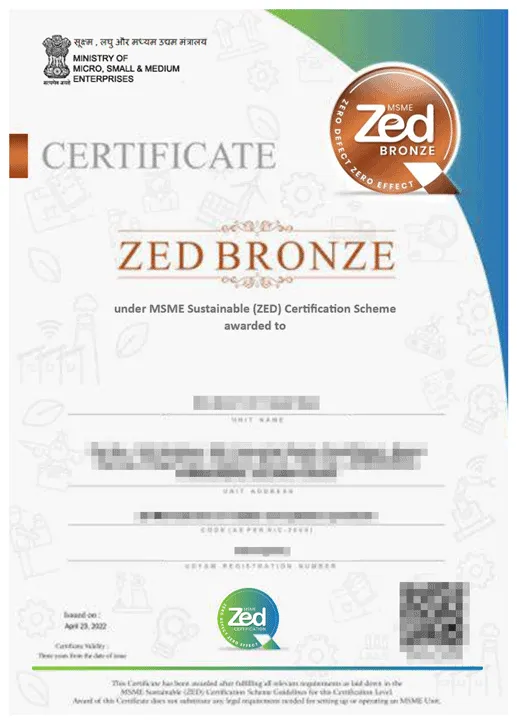
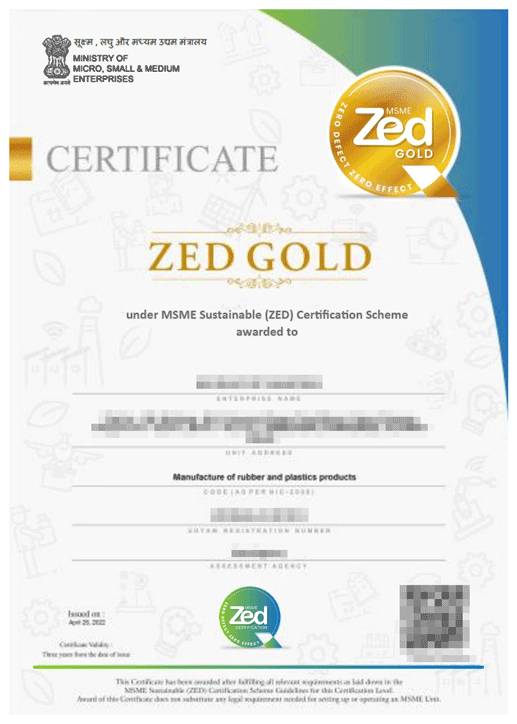
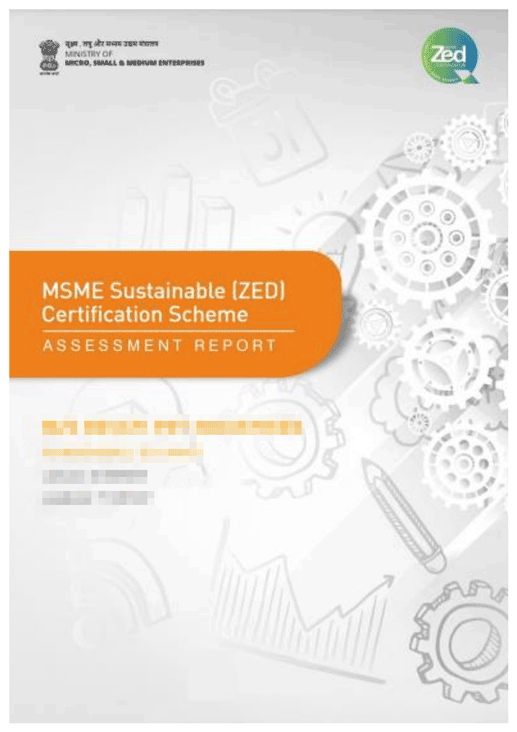
ZED Certificate Sample
- Bronze
- Silver
- Golden
- Assessment

Process of ZED Certification
The process of obtaining a ZED Certificate in India, guided by the Ministry of MSME, is simple and structured, enabling MSMEs to apply smoothly and meet compliance requirements.
- Creating an account on the ZED Portal: Use your Udyam Registration Number (URN) and basic business information to register your company on the official ZED Certification portal.
- Making a Profile: Enter information about your company, including contact details, product/service type, and business category.
- Submission of Documents: Upload all necessary paperwork, such as GST, PANs, MSME registration, and other compliance certificates.
- Self-Evaluation: Fill out the online self-assessment form, which covers topics like safety procedures, energy efficiency, quality, and the environment.
- Desktop/On-Site Evaluation: An authorized ZED assessor may visit your location for verification or perform a desktop review based on your application.
- Assessment and Points: The certification level (Bronze, Silver, Gold, Diamond, or Platinum) of your company will be determined by a score based on a number of criteria.
- Award of Certification: After approval, you will receive the ZED Certification along with access to government incentives and benefits.
- Upgrading or Renewing: The certification needs to be renewed after it expires. Businesses can also advance to a higher level by refining their procedures and reapplying.

Documents Required for ZED Certification
To apply for ZED Certification, MSMEs must submit the required documents for ZED Certification to ensure smooth processing and regulatory compliance.
- Udyam Registration Certificate ( MSME Registration )
- PAN Card of the enterprise
- Company Incorporation Certificate / Partnership Deed
- Factory License / Shop & Establishment Certificate
- Identity Proof of Authorized Signatory (Aadhaar / Voter ID / Passport)
- Address Proof of Business Premises (Utility Bill, Rent Agreement, or Property Papers)
- GST Registration Certificate
- Bank Account Details / Canceled Cheque
- Environmental Compliance Certificates (if applicable)
- Quality Management Certificates (like ISO, if available)
- Previous Year’s Financial Statements (optional but recommended)
- List of Machinery, Tools & Equipment


ZED Certification Fees in India
Here are given the ZED Certification Fees in India, which vary according to the certification level. Each level has its own cost to help industries get certified.
| Certification Level | Government Fee | Professional Fees |
|---|---|---|
| BRONZE | Rs. 10,000/- | Rs. 15,000/- |
| SILVER | Rs. 40,000/- | Rs. 25,000/- |
| GOLD | Rs. 100,000/- | Rs. 50,000/- |
Note: The aformentioned Fees is exclusive of GST.
What is ZED Certification?
ZED Certification, or Zero Defect Zero Effect Certification, is a government of India initiative run by the Ministry of MSME. Micro, Small, and Medium-Sized Enterprises (MSMEs) can use this eco-friendly and high-quality certification to enhance their production procedures, guarantee product quality, and implement sustainable practices.
The phrase "zero defect" refers to the highest quality, flawless products that satisfy both national and international standards. Making these products with as little impact on the environment as possible through responsible waste management, energy conservation, and pollution reduction is known as "zero effect."
Types of ZED Certificate in India
Here are the types of ZED Certification in India: Bronze, Silver, and Gold. Each level highlights an MSME’s dedication to quality, sustainability, and eco-friendly practices, helping businesses enhance their reputation and demonstrate continuous improvement:-
- Bronze :The ZED Bronze Certificate is awarded by the Ministry of Micro, Small and Medium Enterprises (MSME) in India. The certification is based on the ZED (Zero Defect Zero Effect) framework, which is a set of principles and practices that help MSMEs to improve their environmental performance, occupational health and safety, and overall sustainability. Hence ZED Certification aims at enhancing the competitiveness of an MSME through assessment, handholding, managerial and technological intervention etc.
- Silver : ZED Silver Certificate is the middle level of certification offered by the ZED (Zero Defect Zero Effect) It is a middle level of certification offered by the ZED Scheme, which is a government-backed initiative to help Micro, Small, and Medium Enterprises (MSMEs) improve their quality, safety, and environmental performance.
- Gold : ZED Gold Certificate is the highest level of quality certification provided under the ZED Certification Scheme for MSMEs in India. It is given to MSMEs who have excelled in every sphere of quality, safety, production, tidiness, energy, and the environment. For MSMEs, the ZED Gold Certificate is a great asset since it promotes safety, sustainability, and an environment that uses less energy.
Benefits of ZED Certification
The ZED (Zero Defect Zero Effect) Certificate offers multiple benefits to Micro, Small, and Medium Enterprises (MSMEs) by enhancing their quality standards, sustainability, and competitiveness.
- Government Incentives & Subsidies: The MSME Ministry offers access to financial assistance, rebates, and special programs.
- Increased Market Credibility: This improves brand recognition both domestically and abroad and fosters consumer trust.
- Quality Excellence Promotes: The creation of flawless goods that satisfy international standards.
- Sustainability & Eco-Friendliness: Encourages green manufacturing, waste minimization, and energy efficiency.
- Opportunities for Business Growth: Increases access to new export and domestic markets.
- Long-Term Competitiveness: This helps MSMEs thrive in a fiercely competitive business climate.
Validity of ZED Certificate in India
The Zero Defect Zero Effect (ZED) Certification Scheme grants MSMEs the ZED Bronze Certificate, which is normally valid for three years after the date of issuance. The business must apply for renewal or upgrade to a higher-level certification, such as Silver, Gold, Diamond, or Platinum, after the validity period has passed.
This validity guarantees that MSMEs will consistently uphold quality standards, implement sustainable practices, and continue to qualify for government assistance and incentives under the ZED program. Frequent renewal also encourages businesses to progressively enhance their operations and advance toward worldwide competitiveness.
Parameters for ZED Certificate
The ZED (Zero Defect Zero Effect) Certificate is awarded to MSMEs based on a set of well-defined parameters that assess their commitment to quality, sustainability, and efficient business practices.
- Quality Standards: Implementing procedures to produce reliable, superior, and flawless products.
- Sustainability Practices: Using environmentally friendly methods to cut down on pollution and carbon emissions.
- Workplace Safety: Adhering to legal requirements for employee health and safety measures.
- Resource Efficiency: The best possible use of raw materials, water, energy, and other resources.
- Process Improvement: The ongoing evaluation and enhancement of production techniques to increase their effectiveness.
- Innovation & Technology: To remain competitive, employ cutting-edge technology and creative methods.
- Customer Satisfaction: Ensuring product dependability, prompt delivery, and general client trust is what is meant by customer satisfaction.
Conclusion
The ZED Certification (Zero Defect Zero Effect Certification) is more than just a quality mark it is a step towards excellence, sustainability, and global competitiveness for MSMEs in India. By obtaining this certification, enterprises showcase their commitment to producing zero-defect products with zero effect on the environment, while also gaining customer trust, government incentives, and international recognition.
From registration and documentation to assessment and certification, the process encourages businesses to adopt best practices in quality management, safety, and eco-friendly operations.
FAQs on ZED Certificate Registration
What is ZED certification?
ZED (Zero Defect Zero Effect) is a voluntary rating and certification scheme by the Ministry of MSME. It helps manufacturing MSMEs improve quality, reduce defects, and ensure environmental sustainability through a structured maturity model assessment.
Who is eligible for ZED?
Any manufacturing MSME registered on the Udyam (formerly UAM/EM‑II) portal under the Micro, Small and Medium Enterprises Development Act, 2006, can apply. No requirement for prior ISO or similar certifications.
What is the ZED rating system?
MSMEs are evaluated on ~30+ quality and sustainability parameters, each rated across 5 maturity levels (Learner → World‑Class). Based on their score, they receive one of five distinctions: Bronze, Silver, Gold, Diamond, or Platinum
Is ZED certification mandatory for MSMEs?
No - it is entirely optional. However, it offers financial incentives and boosts competitiveness, making it a valuable enhancement for MSMEs
What is MSME zero defect zero effect scheme?
Zero defect zero effect scheme (ZED scheme) is launched by government of india to promote small and medium manufacturing industry. Aim of zed certification is to ensure the quality of products. Which means product should be defect free and should be eco friendly.
How much zed certificate cost?
The total government fee for zed certification is as follows:
| Type of Zed certification | Govt Fees for Zed Certification |
|---|---|
| Bronze certificate | INR 10,000 |
| Silver certificate | INR 40,000 |
| Gold certificateINR 90,000 | INR 90,000 |
| To promote Zed certification govt also provide subsidies to MSME's. | |
The total government fee for zed certification is as follows:
| Type of Zed certification | Govt Fees for Zed Certification |
|---|---|
| Bronze certificate | INR 10,000 |
| Silver certificate | INR 40,000 |
| Gold certificateINR 90,000 | INR 90,000 |
| To promote Zed certification govt also provide subsidies to MSME's. | |
What is the benefits of zed certificate?
- Increases credibility of the company
- Monetary award for taking Zed pledge
- Waver form banks for certification
- MSMEs registered under Udyam can also apply
Who issue zed certificate to MSMEs?
Zed certification is issued by Quality Council of India (QCI) after through evaluation the MSME.
Speak Directly to our Expert Today

Reliable

Affordable

Assured
Industries Served by
Professional Utilities

Apparels

Footwear

Furniture

Gems and Jewellery

Tourism & Hospitality

Consumer Electronics

Chemicals

Telecom

Oils & Gas

Hotel

Railways

Liquor

Health & Medical

Food Processing

Dangerous/ Haz. Goods

Tea & Coffee

Capital Goods

Recycling

Rubber

NGOs

Silk

Handloom

IT & BPM

Steel

Automobile

Tobacco

Constructions


ZED Certificate in Other States
Testimonials
"Explore how Professional Utilities have helped businesses reach new heights as their trusted partner."







It was a great experience working withProfessional Utilities. They have provided the smoothly. It shows the amount of confidence they are having in their field of work.

Atish Singh


It was professional and friendly experience quick response and remarkable assistance. I loved PU service for section 8 company registration for our Vidyadhare Foundation.

Ravi Kumar
I needed a material safety data sheet for my product and they got it delivered in just 3 days. I am very happy with their professional and timely service. Trust me you can count on them.

Ananya Sharma
Great & helpful support by everyone. I got response & support whenever I called to your system. Heartly thanx for Great & Super Service. Have a Great & Bright future of team & your company.

Prashant Agawekar
Thank you so much Professional Utilities team for their wonderful help. I really appreciate your efforts in getting start business. Pvt Ltd company registration was smooth yet quick.
Abhishek Kumar
I applied for Drug licence and company registration and their follow-up for work and regular updates helped me a lot. They are happily available for any kind of business consultancy.

Vidushi Saini
Great experience went to get my ITR done, process was quite convenient and fast. Had a few queries, am happy about the fact those people explained me all things I wanted to know.

Taniya Garyali
Great services provided by Professional Utilities. They are best in this industry and the best part is their prices are so affordable. Kudos to you. Now you guys are my full-time consultant.

Aftab Alam
Trusted By