Apply for Startup India Registration for Section 8 Company
Section 8 Company Startup India Registration Fee Starts @ ₹4,999

4.9


Startup India Registration for Section 8 Company - DPIIT Certificate
Startup India registration for a Section 8 Company is an important step for companies looking to expand and get recognition through government-sponsored initiatives. The Startup India scheme, launched by the Indian government, provides qualifying Section 8 companies with a variety of incentives, including income tax deductions, eased compliance rules, speedier processing of IPR applications, and preferential access to different government schemes.
To take advantage of these benefits, a Section 8 company must apply for DPIIT (Department for Promotion of Industry and Internal Trade) accreditation through the official Startup India portal. The application procedure entails providing critical business information, needed documentation, and a brief write-up emphasizing the company's innovation, scalability, job creation, or sectoral effect.
Once authorized, the firm receives a DPIIT Startup Recognition Certificate. This certificate provides access to important benefits such as the Startup India Seed Fund Scheme, a tax exemption under Section 80 IAC, and registration on the Government e-Marketplace (GeM) platform for public procurement.
Whether you're starting a new Section 8 company or currently run one that's less than 10 years old, acquiring Startup India designation is a critical step toward building up with government backing and legitimacy.
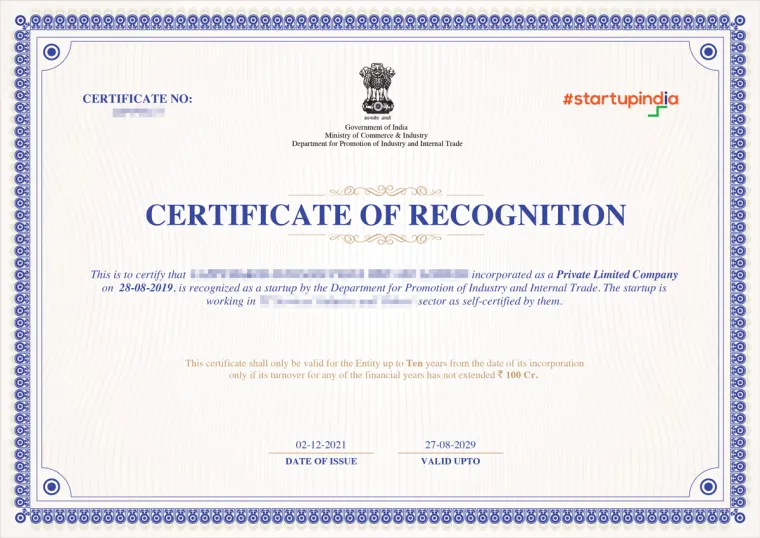
Startup India DPIIT Sample Report
Startup India Registration Process for Section 8 Company
Individuals seeking Steps for Startup India Registration for Section 8 Company can follow the steps below to complete the application process:
- Business Entity Incorporation: Private Limited Company (Companies Act, 2013)
- Create an Account on the Startup India Portal: Visit startupindia.gov.in to register and verify your email to access the dashboard.
- Prepare Required Documents: Certificate of Incorporation or Registration
- Apply for DPIIT Recognition: Entity name and type
- Respond to Non-Conformities (if any): In case any issues are being raised fom DPIIT, respond with corrections or clarifications appropriately.
- Receive Certificate of Recognition: Upon successful examination of application from department, DPIIT will issue the Startup India Recognition Certificate.

Documents Required for Startup India Registration for Section 8 Company
The following documents are needed to be submitted by the Section 8 Companys for recognition of Startup India by DPIIT.
- Certificate of Incorporation
- Companies P.A.N. Card
- Director's Aadhar & P.A.N. card
- Passport-size photograph of the directors
- Website or company's profile deck (if available)
- Photo & video of products/services
- Authorization Letter
- Brief write-up on how the business is working towards:
- Innovation in the industry
- High potential for wealth creation
- High potential for employment generation
- GST registration
- MSME registration
- Trademark registration
- Copyrights registration
Other Certificates, if available:
Startup India Registration Fees for Section 8 Company
The professional charge for getting DPIIT recognition for Section 8 Company under Startup India initiatives is Rs 4,999 only and the total time it would take in the process would be 20-25 business days. The professional fees are exclusive of GST. There is no government fee for DPIIT recognition.
| Particulars | Fees |
|---|---|
| Our Professional Charges | ₹4,999 |
| Time Taken in Process | 20–25 Days |
What is DPIIT Startup India Registration for Section 8 Company?
DPIIT Startup India Registration as a Section 8 Company is an official recognition conferred by the Department for Promotion of Industry and Internal Trade via the Startup India program. Eligible Section 8 companies can apply online by uploading the necessary documents and company information via the Startup India portal.
Once authorized, the entity obtains a Startup India Recognition Certificate, which officially identifies it as a DPIIT-recognized startup. This certificate allows the firm to take benefit of a variety of government-backed benefits, including tax breaks, financing possibilities, easier compliance processes, and eligibility for public procurement schemes and innovation-driven programs developed by the Government of India.
Benefits of Startup India Registration for Section 8 Company
Listed below are the benefits that Section 8 Companys recognized under Startup India registration get:
- Self-certification
- Easy winding up process
- Exemption from 6 labour laws
- Tax exemption under section 56
- Easier public procurement norms
- Startup patent & I.P.R. application
- Exemption from 3 environmental laws
- Tax exemption under 80 IAC (for 3 consecutive years)
- Recognized startups are given preference on GeM portal to boost startup ecosystem in India
Note: Businesses with DPIIT recognition are exempted from deposition of EMD (Earnest money deposit) in tender participation on public procurement platforms.
Eligibility for Startup India Registration for Section 8 Company
Under the Startup India Action Plan, Section 8 Companys that meet the definition prescribed under G.S.R. notification 127 (E) can apply for recognition under the program. The program aims to create a robust ecosystem and pick up new-age enterprises.
The following are the eligibility criteria for Startup India registration for Section 8 Companys set up by DPIIT.
- Company Age: The Section 8 Company should be less than 10 years old from its date of incorporation.
- Annual Turnover: Must be below ₹100 crores in any financial year since incorporation.
- Type of Entity: Must be a Limited Liability Partnership (Section 8 Company) registered under the Section 8 Company Act, 2008.
- Original Entity: Must not be formed by splitting or reconstructing an existing business.
- Innovation and Scalability: Must be working towards innovation, development or improvement of products, services, or processes with a scalable business model.
Note: Businesses with DPIIT recognition are exempted from deposition of EMD (Earnest money deposit) in tender participation on public procurement platforms.
Conclusion
Startup India registration for Section 8 Companies provides access to a variety of government-sponsored benefits aimed at encouraging innovation, economic growth, and ease of doing business. DPIIT-recognized firms benefit from tax breaks, simpler regulatory compliance, and access to funding opportunities such as the Startup India Seed Fund.
The application procedure is fully online and managed through the official Startup India portal, making it both accessible and efficient. Obtaining DPIIT recognition is a key step for mission-driven entrepreneurs looking to create scalable, impact-oriented businesses. Begin your registration process immediately and take advantage of government assistance to help your Section 8 company flourish.

FAQ’s On Startup India Registration for Pvt Ltd Company
What is Startup India Registration for a Section 8 Company?
Startup India Registration for a Section 8 Company is an official recognition granted by the Department for Promotion of Industry and Internal Trade (DPIIT). This recognition helps Section 8 Companies gain access to various government benefits designed to support innovation, entrepreneurship, and ease of doing business in India.
Is a Section 8 Company eligible for DPIIT recognition under Startup
India?
Yes, a Section 8 Company is eligible to apply for DPIIT recognition under the Startup India scheme. As long as it fulfills the required conditions such as age, turnover, and innovation potential, it can register through the Startup India portal.
What are the eligibility criteria for Startup India Registration
for Section 8 Companies?
To be eligible, the Section 8 Company must be less than 10 years old from the date of incorporation and have an annual turnover of less than ₹100 crores. It must also be engaged in innovation or development of products or services and must not be created by splitting or reconstructing an existing business.
What documents are required for DPIIT recognition of a Section 8
Company?
The required documents include the Certificate of Incorporation, PAN card of the company, directors’ Aadhaar and PAN cards, and passport-size photographs. Additionally, a brief write-up about the company’s innovation, scalability, and job creation potential is required, along with any available supporting certificates such as GST, MSME, or trademark registrations.
What are the benefits of DPIIT recognition for Section 8 Companies?
Recognized Section 8 Companies enjoy numerous benefits such as tax exemptions under Section 56 and 80 IAC, easier compliance with labour and environmental laws, and fast-tracked IP and patent applications. They also gain preference on government procurement platforms like GeM and are exempt from submitting EMD while applying for tenders.
Is DPIIT recognition mandatory to access Startup India benefits?
Yes, DPIIT recognition is essential to access the full range of benefits offered under the Startup India initiative. Without this recognition, startups cannot avail of tax exemptions, funding schemes, or simplified regulatory processes.
Why is compliance required for a change in company name?
Compliance for a change in company name is mandatory to ensure legal validity under the Companies Act, update records with the MCA, and reflect the new name across statutory documents, licenses, and registrations, helping maintain transparency and avoid legal or regulatory issues.
Speak Directly to our Expert Today

Reliable

Affordable

Assured
Industries Served by
Professional Utilities

Apparels

Footwear

Furniture

Gems and Jewellery

Tourism & Hospitality

Consumer Electronics

Chemicals

Telecom

Oils & Gas

Hotel

Railways

Liquor

Health & Medical

Food Processing

Dangerous/ Haz. Goods

Tea & Coffee

Capital Goods

Recycling

Rubber

NGOs

Silk

Handloom

IT & BPM

Steel

Automobile

Tobacco

Constructions


Testimonials
"Explore how Professional Utilities have helped businesses reach new heights as their trusted partner."







It was a great experience working withProfessional Utilities. They have provided the smoothly. It shows the amount of confidence they are having in their field of work.

Atish Singh


It was professional and friendly experience quick response and remarkable assistance. I loved PU service for section 8 company registration for our Vidyadhare Foundation.

Ravi Kumar
I needed a material safety data sheet for my product and they got it delivered in just 3 days. I am very happy with their professional and timely service. Trust me you can count on them.

Ananya Sharma
Great & helpful support by everyone. I got response & support whenever I called to your system. Heartly thanx for Great & Super Service. Have a Great & Bright future of team & your company.

Prashant Agawekar
Thank you so much Professional Utilities team for their wonderful help. I really appreciate your efforts in getting start business. Pvt Ltd company registration was smooth yet quick.
Abhishek Kumar
I applied for Drug licence and company registration and their follow-up for work and regular updates helped me a lot. They are happily available for any kind of business consultancy.

Vidushi Saini
Great experience went to get my ITR done, process was quite convenient and fast. Had a few queries, am happy about the fact those people explained me all things I wanted to know.

Taniya Garyali
Great services provided by Professional Utilities. They are best in this industry and the best part is their prices are so affordable. Kudos to you. Now you guys are my full-time consultant.

Aftab Alam
Trusted By