



What’s Included?
Coconut Board RCMC Certificate Online Portal Application & Filing IEC & Product Category Documentation Financial Assistance Programme Assistance Global Coconut Trade Fair Participation Organic Certification Pathway Support EU Novel Food Regulation Advisory Commodity Price Intelligence Support 5-Year Certificate with Renewal Assistance Expert Advisory & Compliance Support
Get Expert Consultation

Coconut Board Registration - Fee, Procedure & Documents
The coconut development board also known as CDB' is a statutory body under the ministry of Agriculture & farmers welfare, of India. The idea behind the CDB was to increase the productivity & export of coconut based products from India with the exemption of coir based products.
The CDB issues a Registration-Cum-Membership Certificate (RCMC) to businesses that are involved in the production, processing, or export of coconut and coconut products. The RCMC is a certificate that acts as proof of registration with the CDB and entitles the holder to certain benefits and subsidies offered by the organization.
To obtain an RCMC, businesses need to register with the CDB and submit the required documents. Then the board will review the application and, if it is approved, will issue an RCMC, which is valid for a period of five years. To renew the RCMC, businesses will need to apply for renewal before the expiration of the current certificate.
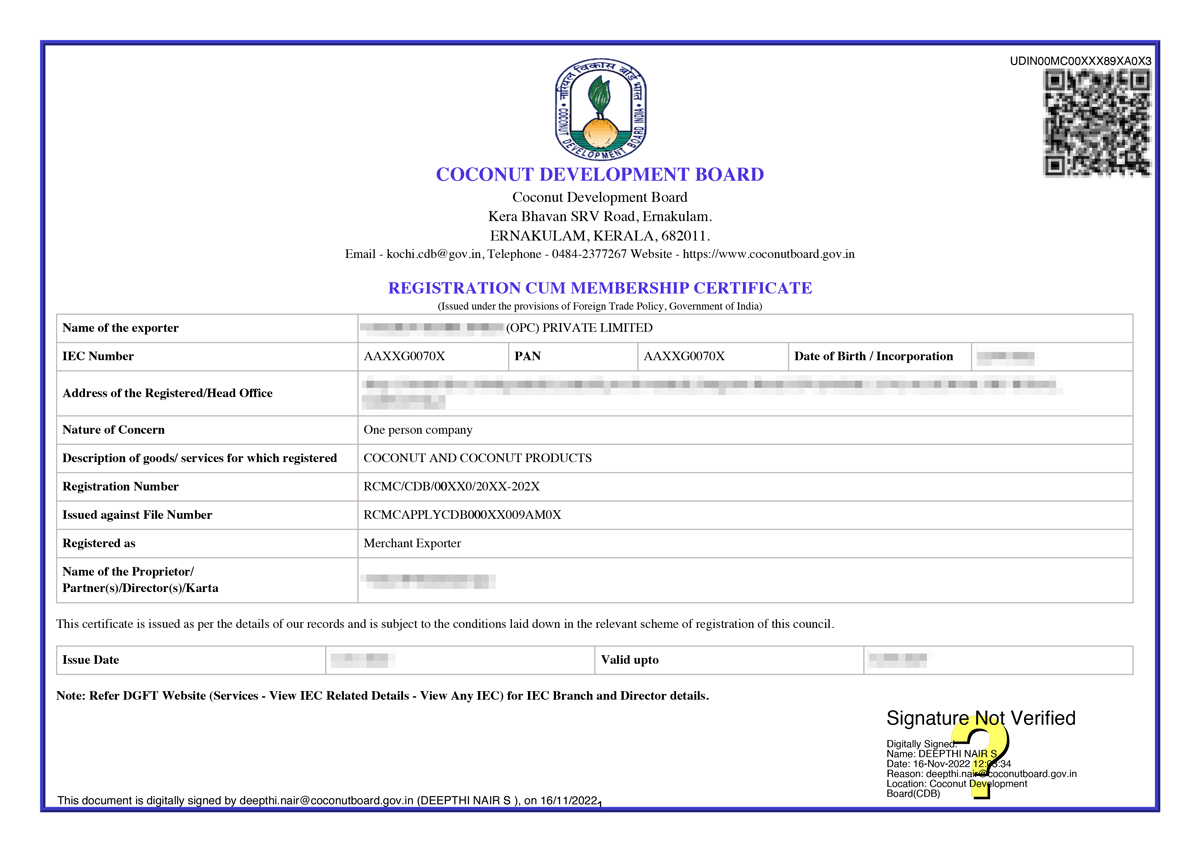
Coconut Board Certificate Sample
How to Apply for RCMC Registration with the Coconut Development Board (CDB)
The applicant shall fulfill three requirements before filing the CDB application: an active IEC, an updated IEC profile on the DGFT portal, and a valid DSC or Aadhaar e-Sign linked to the DGFT account. The system runs a check on each before letting the application progress.
- Sign In to dgft.gov.in and Open the e-RCMC Service: The application is filed online through the DGFT portal at dgft.gov.in. After login, the applicant opens the e-RCMC service to begin a fresh application.
- Verify the Pre-Filled Business Records: The first section of the form auto-pulls firm data from the IEC profile. This covers the IEC, PAN, firm name, registered address, bank details, director information, and branch records. Each entry needs careful inspection, since the RCMC form locks these fields once the next section opens. Errors must be corrected on the IEC profile before continuing.
- Choose CDB and Add Coconut Export Product Details: In the RCMC Details section, the applicant chooses the Coconut Development Board (CDB) as the registering authority, then enters the office for filing, the branch GSTIN, the membership tenure (1 to 5 years), the financial year, the MSME status, the exporter category (Merchant Exporter or Manufacturer Exporter), the zone (EOU or SEZ where applicable), and the relevant fee slab. Coconut export products are added with their ITC (HS) Codes, covering raw coconut, copra, coconut oil, virgin coconut oil, desiccated coconut, coconut milk and cream, coconut water, coconut chips, etc., along with the destination countries. The annual turnover, previous-year export performance, firm profile, and authorized representative details are also added in this section.
- Upload Documents, Pay Fees, and Digitally Sign-Off: TDS data is filled in if applicable, supporting documents are uploaded as PDFs, the membership fee is paid through the DGFT payment gateway, and the applicant completes the application with a DSC or Aadhaar e-Sign. The full document set is described in the Documents Required section below. Once the e-sign is completed, the declaration is accepted, and the application summary is reviewed before final submission.
- CDB Verification and Issuance of the Digital RCMC: The Coconut Development Board takes up the application for review. CDB checks the business credentials, IEC and GST records, coconut product list with ITC (HS) Codes, supporting documents, and fee payment. Where clarification is needed, CDB posts a query through the portal, which the applicant resolves before resubmission. Once approved, the digital RCMC is dispatched to the DGFT dashboard, in the usual 7 to 10 working days. Validity covers a span of 1 to 5 financial years, counted from 1 April of the issuance year up to 31 March of the fifth year, regardless of the actual month of issue.

Documents Required for CDB RCMC Registration
The Coconut Development Board RCMC application needs two categories of documents: common documents required across all DGFT e-RCMC filings, and CDB-specific documents tied to the Board's mandate over coconut and coconut-based exports. Below is a clean breakdown of each.
1. Common Documents
These are the standard documents required for any RCMC application on the DGFT portal:
- Import Export Code (IEC) issued by DGFT
- Permanent Account Number (PAN) of the firm
- GST Registration Certificate of the registered office and branches
- Certificate of Incorporation, Partnership Deed, or LLP Agreement depending on entity type
- Memorandum and Articles of Association (MoA and AoA) for companies
- List of Directors, Partners, or Proprietors with their PAN and DIN, where applicable
- Board Resolution or Authorisation Letter for the authorised signatory
- Aadhaar of the authorised signatory
- Cancelled cheque or Bank Performance Letter for bank verification
- Proof of office address, such as a recent electricity bill or rental agreement
- FSSAI Licence, since coconut and coconut-based food products fall under food category
- Self-Declaration or Undertaking in the prescribed format
- Last RCMC Certificate (only for renewal applications)
- Digital Signature Certificate (DSC) or Aadhaar e-Sign linked to the DGFT account for final submission
2. CDB-Specific Documents
In addition to the common set, CDB requires the following documents based on the official RCMC Application Form available at coconutboard.in/ExportPromotionCouncil/Forms/Appln-Form-RCMC.pdf:
- Self-certified copy of the IEC Number issued by the licensing authority
- Self-certified or attested copy of the Partnership Deed or MoA and AoA (not applicable to proprietorship firms)
- Demand Draft for Rs. 1,000 drawn in favour of the Chairman, Coconut Development Board, payable at Ernakulam (fee once paid is non-refundable)
- Self-certified or attested evidence of being a Manufacturer Exporter, including details of products manufactured, plant and machinery, and annual production capacity (mandatory for Manufacturer Exporters; not required for Merchant Exporters)
- List of Coconut Export Products with HS Codes, covering raw coconut, copra, coconut oil, virgin coconut oil, desiccated coconut, coconut milk and cream, coconut water, coconut chips, coconut sugar, coconut flour, neera, defatted coconut, and coconut shell-based products (excluding coir products, which fall under the Coir Board)
- Undertaking to Submit Quarterly Export Returns to the registering authority by the 15th day of the month following each quarter (post-issuance compliance requirement)
- Star Export House Certificate issued by DGFT, where applicable
Note: All documents must be uploaded in PDF format during the Attachments section of the application.
Fee & Validity of Coconut Board RCMC Certificate
Registration with the Coconut Development Board (CDB) requires a single RCMC fee of ₹5,900 (inclusive of 18% GST). Professional Utilities charges ₹7,499 + 18% GST for Coconut Board registration assistance, subject to eligibility and applicable category.
| Applicant Category | Amount | GST @ 18% | Total Payable |
|---|---|---|---|
| New RCMC Registration | ₹5,000 | ₹900 | ₹5,900 (Govt. Fees) |
| Professional Fees | ₹7,499 | ₹1,350 | ₹8,849 (Exclusive Govt. Fees) |
What applicants should keep in mind while applying for RCMC
- Applicants are required to declare their main line of business while applying for RCMC for coconut board.
- The Coconut Development Board applies to anyone who indulged in coconut business, & hence it is required for such business to obtain RCMC certificate for their exports.
- If an RCMC holder fails to comply with the rules & guidelines of the board they shall be delisted as per the regulations.
- Delisted members will be given appropriate time to represent their case in front of authorities and a show cause notice before the acceleration of the-listing process.
Note: It is important for interested applicants to know all the rules & guidelines governing RCMC membership.
Introduction (Coconut)
In India, the Coconut Board is a statutory body created under the Coconut Development Act 1995. Promoting the development of the coconut industry in India is the primary goal of the Coconut Board. Moreover, it is registered under the Companies Act, of 1956.
It has regional offices in Guwahati, Assam; Chennai, Tamil Nadu; and Patna, Bihar. Its head office is in Kochi, Kerala.
Importance of Coconut Board RCMC
Obtaining an RCMC can be important for businesses involved in the coconut industry for several reasons:
- It helps businesses to access the benefits and subsidies offered by the CDB, which can improve their profitability and competitiveness.
- It can serve as a form of recognition and validation for businesses, demonstrating their commitment to the coconut industry.
- It can help businesses to establish and maintain good relationships with the CDB and other stakeholders in the coconut industry.
- It can be a requirement for businesses that want to participate in certain tenders or contracts.
Overall, obtaining an RCMC can be beneficial for businesses that are looking to grow and succeed in the coconut industry.

How to get Coconut Board RCMC with Professional Utilities
You can register your export business with the coconut board in just 3 simple steps:-



Step 1:
Contact us
Step 2:
Provide necessary details
Step 3:
Get coconut board RCMC certificate
Products covered under Coconut Board
These are the following coconut based products which are covered under Coconut development board (CDB)
- Kernel based coconut products
- Coconut water based product
- Coconut Inflorescence based products
- Coconut convenience food products
- Coconut shell based products
Kernel based coconut products
- Copra
- Coconut oil
- Coconut Milk
- Coconut cream
- Virgin coconut oil
- Desiccated coconut
- Coconut skimmed milk
- Spray dried coconut milk powder
Coconut water based product
- Nata-de-coco
- Coconut squash
- Tender coconut water
- Coconut based vinegar
Coconut Inflorescence based products
- Neera
- Coconut jaggery
- Coconut palm sugar
- Coconut flower syrup
Coconut convenience food products
- Coconut burfi
- Coconut candy
- Coconut biscuits
- Coconut chocolate
Coconut shell based products
- Activated carbon
- Coconut shell powder
- Coconut shell charcoal

Function of the Coconut Development Board

- Adopting measures for the development of the coconut industry, inter alia.
- Imparting technical advice to those engaged in coconut cultivation and industry.
- Providing financial and other assistance for the expansion of the area under coconut.
- Encouraging adoption of modern technologies for processing of coconut and its products.
- Adopting measures to get incentive prices for coconut and its products.
- Recommending measures for improving marketing of coconut and its products.
- Recommending measures for regulating imports and exports of coconut and its products.
- Fixing grades, specifications and standards for coconut and its products.
- Financing suitable schemes to increase the production of coconut and to improve the quality and yield of coconut.
- Assisting, encouraging, promoting and financing agricultural, technological, industrial or economic research on coconut and its products.
- Collecting statistics on coconut and its products and publishing them.
- Undertaking publicity activities and publishing books and periodicals on coconut and its products.
Conclusion
Coconuts, are indeed the main agricultural product regulated by the coconut board registration in India. To obtain coconut coir registration, an applicant needs to register with the CDB (Cocunut Development Board), and submit the required documents. The coconut board promotes quality standards in coconut production and processing, which can benefit registered businesses.
The documents required for RCMC, which are chiefly issued by the Coconut Development Board (CDB), should be properly submitted by the applicant. For more queries related to the Coconut Development Board (CDB), we, the team of professionals, help you obtain your RCMC certificate for the Coconut Development Board (CDB).
FAQ’s On Coconut Board Registration
How do I register for a Coconut Board?
Process for Coconut Board Registration
- Register your business with the CDB by completing the RCMC application form and submitting it with the necessary documents, which usually include proof of identity, business address, and PAN card.
- The CDB will review and verify your documents upon receiving your application.
- If your application is approved, the CDB will issue an RCMC valid for five years.
- To renew your RCMC, apply for renewal before the current certificate expires. The renewal process mirrors the initial application, requiring the submission of documents and payment of the renewal fee.
Which Government Certificate is required for Coconut Export?
As per India's Foreign Trade Policy, an RCMC (Registration and Cumulative Membership Certificate) is required to claim any export benefits. Exporters with this certificate can also avail customs and excise advantages. This ensures compliance with legal requirements.
Which Ministry is the Coconut Board under?
The Coconut Development Board (CDB) is a statutory body under The Ministry of Agriculture and Farmers Welfare, Government of India. It aims at the integrated development of coconut cultivation and industry, emphasizing productivity enhancement and product diversification.
What is the role of the Coconut Board?
Supporting, encouraging, promoting, and funding research on agricultural, technological, industrial, or economic aspects of Coconut and its products. Gathering and publishing statistics on Coconut and its products.


Disclaimer:The information provided on this website is intended for general information purposes only. Although all reasonable efforts are made to ensure that the information provided is correct and reliable, it is not advised to be used as a substitute for professional advice. The information herein is not to be used in place of seeking professional services, counsel, or guidance. We highly advise that you consult a professional before you make any business or legal decisions regarding the information presented on this website. This website and its contents are given "as is", and we do not take any responsibility for any action that is taken based on information given on this website.

- Written by: Anuja Sahi
- Fact-checked: Sahil Singh
- Updated on: June 13, 2026
Testimonials
"Explore how Professional Utilities have helped businesses reach new heights as their trusted partner."





It was a great experience working withProfessional Utilities. They have provided the smoothly. It shows the amount of confidence they are having in their field of work.

Atish Singh


It was professional and friendly experience quick response and remarkable assistance. I loved PU service for section 8 company registration for our Vidyadhare Foundation.

Ravi Kumar
I needed a material safety data sheet for my product and they got it delivered in just 3 days. I am very happy with their professional and timely service. Trust me you can count on them.

Ananya Sharma
Great & helpful support by everyone. I got response & support whenever I called to your system. Heartly thanx for Great & Super Service. Have a Great & Bright future of team & your company.

Prashant Agawekar
Thank you so much Professional Utilities team for their wonderful help. I really appreciate your efforts in getting start business. Pvt Ltd company registration was smooth yet quick.
Abhishek Kumar
I applied for Drug licence and company registration and their follow-up for work and regular updates helped me a lot. They are happily available for any kind of business consultancy.

Vidushi Saini
Great experience went to get my ITR done, process was quite convenient and fast. Had a few queries, am happy about the fact those people explained me all things I wanted to know.

Taniya Garyali
Great services provided by Professional Utilities. They are best in this industry and the best part is their prices are so affordable. Kudos to you. Now you guys are my full-time consultant.

Aftab Alam
Trusted By