MSDS Certificate for Ethanol



MSDS Delivered

Years of Experience
What’s Included?
MSDS/SDS physical & PDF file MSDS Drafting (16 sections) Global Compliance Alignment Shipping / Custom Documentation Support DG / HAZMAT Classification Support Revision support & Version control Hazard classification & Compliance check Label & Packaging guidance Information collection & Product assessment
Get Expert Consultation

MSDS Certificate for Ethanol - Process, Fees, and Documents
The MSDS (Material Safety Data Sheet) certificate for C2H6O is an important document that contains comprehensive safety information about the handling, storage, transportation, and disposal of ethanol. Ethanol, or ethyl alcohol, is a highly volatile and flammable chemical widely utilized in the manufacture of pharmaceuticals, cosmetics, food, fuel, and industrial chemicals.
Ethanol (CAS 64-17-5), also known as Ethyl Alcohol, Grain Alcohol, or Absolute Alcohol, is a volatile liquid with a molecular weight of 46.07 g/mol. It is a highly flammable organic liquid and can easily cause fire. Because of its combustibility and health risks, handling and safety procedures are required. The MSDS certificate contains essential information, including physical and chemical properties, hazard classification, fire precautions, first aid measures, and environmental hazards. It provides OSHA (Occupational Safety and Health Administration), REACH (Registration, Evaluation, Authorization, and Restriction of Chemicals), and GHS (Globally Harmonized System) compliance.
An MSDS certificate for ethanol is necessary for industries to avoid workplace accidents, guarantee worker safety, and comply with legal requirements. By observing the safety procedures provided in the MSDS, companies can reduce risks, minimize health hazards, and maintain proper chemical management, making it a part of industrial safety regulation fundamentals.
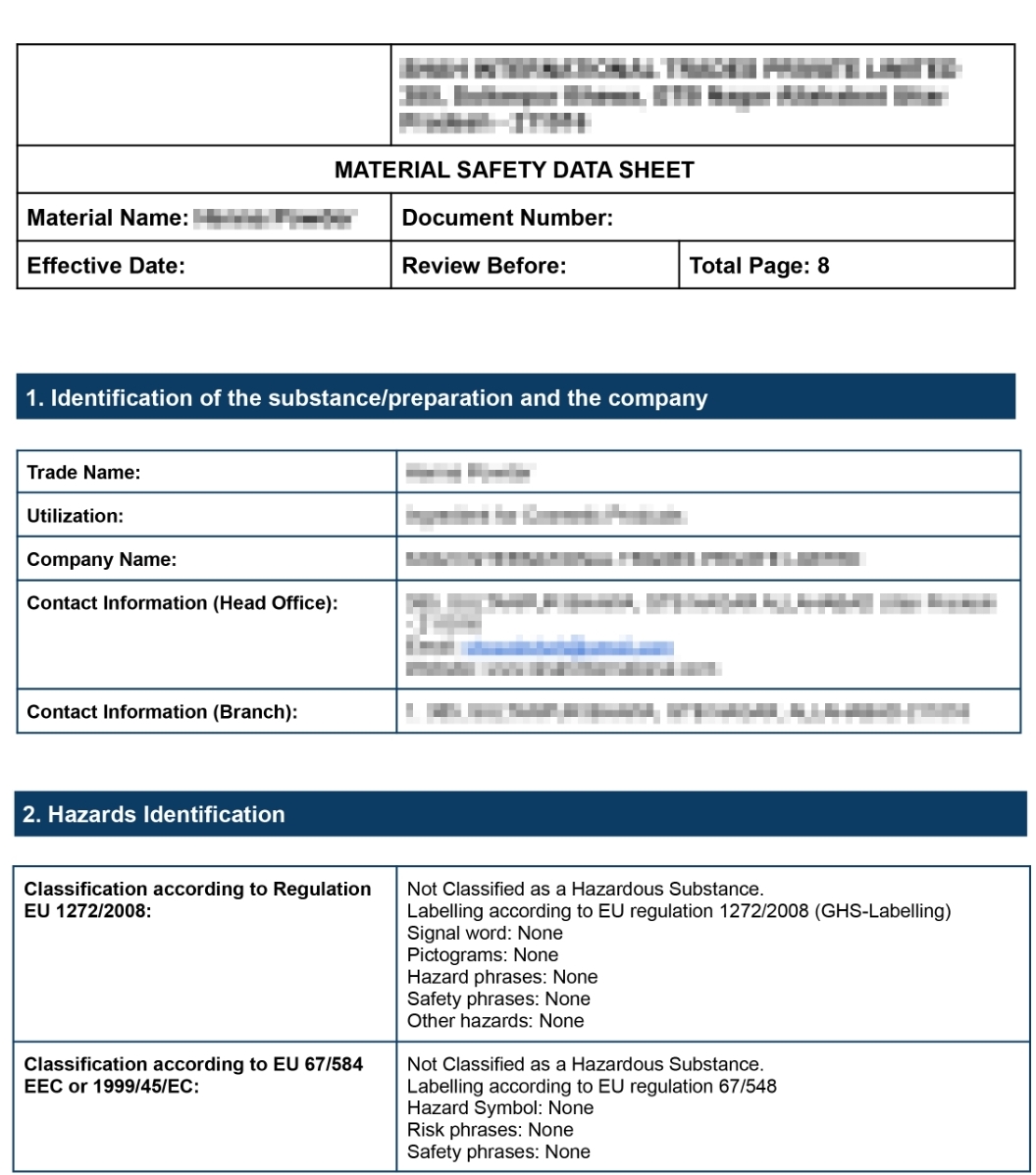
MSDS Certificate for Ethanol [Sample]
Application Process for MSDS Certificate for Ethanol
MSDS (Material Safety Data Sheet) Certificate For Ethanol requires a formal process to abide by international safety standards such as OSHA, GHS, and REACH.
Gather Required Information & Documents
- Retrieve product information such as chemical composition, safety protocols, and hazard classifications.
- Procure relevant documents like company information, product parameters, and analytical test reports.
Hazard Classification & Data Review
- For standard chemicals like ethanol, no physical lab testing is required MSDS is drafted from verified chemical data and existing certificate of Analysis (COA).
Preparation of MSDS Report
- A trained safety professional drafts the Material Safety Data Sheet as per international standards of safety.
- The report incorporates hazard identification, first aid procedures, handling recommendations, and guidelines for disposal.
Review & Finalization
- The completed MSDS is reviewed by a senior EHS expert for GHS compliance, hazard classification accuracy, and all 16-section completeness.
- The finalized certificate is delivered to the applicant
Approval & Issuance of MSDS Certificate
- Once successfully verified, the MSDS certificate is issued to the applicant.
- Enterprises can utilize the MSDS report for regulatory compliance, international trade, and workplace safety guidelines.

Documents Required for MSDS Certificate for Ethanol
These documents are required to obtain an MSDS certificate for Ethanol, ensuring safe usage, regulatory compliance, and workplace hazard management for ethanol.

- Company Information
- GST Registration Certificate
- Ethanol specification & details
- Ethanol Image
- Percentage wise composition of ingredients
- Certificate of Analysis / Test Report
- Emergency Contact details like Phone number & Email address
Fees for MSDS Certificate for Ethanol
The total cost of obtaining an MSDS/SDS certificate for Ethanol is RS. 4,499 including GST. For multiple MSDS certificates, contact our experts now.
| No of MSDS Certificate | Fees For MSDS Certificate for Ethanol (₹) |
|---|---|
| 1 MSDS Certificate | ₹4,499 (Including GST) |
| 2 MSDS Certificate | ₹8,999 (Including GST) |
What is MSDS Certificate for Ethanol?
A Material Safety Data Sheet (MSDS) certificate for Ethanol (Chemical Formula: C2H5OH) is a formal document that contains comprehensive safety and hazard data regarding a chemical substance. Ethanol is classified as UN1170 (ethanol solution, >24% by volume), Class 3 Flammable Liquid, Packing Group II under IMDG/IATA/ADR transport regulations. For absolute ethanol and high-concentration industrial ethanol, MSDS Section 14 must specify UN1170 and Packing Group II. It is necessary for the safe handling, storage, transportation, and disposal of chemicals in industrial and commercial environments.
The MSDS certificate contains information like chemical structure, physical and health risks, first aid procedures, fire-fighting procedures, handling precautions, storage conditions, spill treatment, and regulatory compliance information. It enables companies to maintain OSHA (Occupational Safety and Health Administration), REACH (Registration, Evaluation, Authorization, and Restriction of Chemicals), and GHS (Globally Harmonized System) regulations.
Importance of MSDS Certificate for Ethanol
MSDS (Material Safety Data Sheet) certificate for ethanol is required to ensure safe handling, storage, and transportation of this extremely flammable and volatile chemical. Ethanol is used extensively in pharmaceuticals, cosmetics, food processing, fuels, and industry, so safety precautions are necessary.
- Workplace Safety - Offers guidelines for protecting oneself from fire hazards, inhalation hazards, and skin contact using Personal Protective Equipment (PPE).
- Regulatory Compliance - Provides industries with the compliance to safety standards established by OSHA, GHS, and REACH, minimizing legal liabilities and fines.
- Emergency Preparedness - Consists of first aid procedures, fire-fighting measures, and spill containment techniques to respond effectively to accidents.
- Proper Storage & Handling - Describes storage conditions under safety, avoiding accidental ignition, evaporation, or contamination.
- Environmental Protection - Establishes disposal methods to avoid soil and water pollution, maintaining environmentally friendly practices.
Physical and Chemical Properties of Ethanol
Listed below are the physical and chemical properties of Ethanol:
- Flash Point: Ethanol has a flash point of approximately 13°C for absolute ethanol (Packing Group II), indicating that it can ignite easily at temperatures slightly above room temperature. For ethanol solutions, the flash point varies depending on concentration — 70% ethanol has a flash point of around 16°C, while 95% ethanol remains close to 13°C. Solutions below 24% ethanol may not qualify as Class 3 flammable liquids. MSDS Section 9 specifies the flash point for the particular ethanol grade or concentration.
- Boiling Point, Vapour Density & Explosive Limits: Ethanol has a low boiling point of 78.4°C, which allows it to evaporate rapidly at room temperature and form flammable vapours. The Lower Explosive Limit (LEL) of ethanol is 3.3% and the Upper Explosive Limit (UEL) is 19%, showing its wide explosive range in air. Ethanol vapour is heavier than air with a vapour density of 1.6, causing vapours to accumulate in drains, pits, and low-lying areas and increasing the risk of fire or explosion even at ambient temperatures. MSDS Section 9 contains complete physical and chemical property details.
- GHS Classification, H-Codes & P-Codes for Ethanol: Signal Word: Danger. Hazard Statements include H225 (Highly flammable liquid and vapour), H319 (Causes serious eye irritation), and H302 (Harmful if swallowed — applicable to industrial grades). Precautionary Statements include P210 (Keep away from heat, sparks, and open flames), P264 (Wash hands thoroughly after handling), P280 (Wear protective gloves and eye protection), and P370+P378 (In case of fire: use CO₂, dry chemical powder, or alcohol-resistant foam for extinction).
India Ethanol MSDS Compliance and Export Requirements
India is one of the world’s largest producers of ethanol, with production mainly derived from sugarcane and grain-based feedstocks. Under the National Biofuel Policy (NBP 2018) and the Ethanol Blending Programme (EBP), ethanol manufacturers, suppliers, and transporters are required to maintain complete safety documentation, including an MSDS Certificate for industrial ethanol handling and transportation. PESO license may be required for storage and transport above certain quantities.
Leading petroleum companies in India such as HPCL, BPCL, and IOC generally require ethanol suppliers to provide updated MSDS documentation before procurement for fuel blending purposes. Ethanol MSDS documentation is also important for businesses involved in ethanol export (under HS Code 2207 (undenatured ethyl alcohol) and HS Code 2207.20 (denatured ethanol) activities, ensuring compliance with international transport and chemical safety regulations.
Note: Professional Utilities assists businesses with Ethanol MSDS India export compliance and ethanol blending MSDS compliance by preparing professionally drafted MSDS certificates aligned with Indian industrial safety standards and international export requirements.
Validity of MSDS Certificate for Ethanol
An MSDS or SDS certificate for ethanol generally remains valid for 3 to 5 years depending on local laws. SDS certificate for ethanol does not have a strict expiration date.
MSDS Certificate for Ethanol must be updated when:
- Purity, chemical composition, or ratio of substance changes.
- New information on toxicity, carcinogenic properties, or environmental effects becomes available.
- New handling, storage, or emergency response information becomes available.
Note: If there is any change in regulations within 6 months from the date of issuance of MSDS certificate, Professional Utilities issues the updated MSDS certificate on a complimentary basis.
Get Your MSDS Certificate for Ethanol with Expert Assistance
The MSDS certificate for Ethanol is a crucial document that ensures safe handling, storage, and transportation of this extremely flammable and volatile chemical. With such widespread application in pharmaceuticals, cosmetics, food manufacturing, fuels, and industrial usage, it is important to have proper safety precautions in place.
A revised MSDS certificate assists companies in following OSHA, REACH, and GHS guidelines, minimizing workplace risks and legal liabilities. Professional Utilities, with more a decade of experience assist companies in obtaining MSDS certificate in Vadodara and across PAN-India. The certificate contains essential information regarding fire protection, first aid, spill control, and protective measures, thereby safeguarding workers and the environment.
FAQ’s On MSDS Certificate for Ethanol
Why should an MSDS certificate be mandatory for ethanol?
It guarantees proper handling, storage, and disposal and gives regulations on fire hazards, health risks, and emergency response.
How long is an ethanol MSDS certificate valid?
In most cases, it is effective for 3 to 5 years, though it must be revised if the safety regulation or ethanol characteristics evolve.
What are ethanol's primary hazards?
Ethanol is extremely flammable and may cause skin irritation, eye injury, and respiratory problems if not handled correctly.
Who requires an MSDS certificate for ethanol?
Manufacturers, suppliers, and industries use ethanol in pharmaceuticals, cosmetics, fuel manufacturing, and chemical processing.
How should ethanol be stored safely?
Store in a tightly closed, fire-resistant container in a cool, well-ventilated area, away from heat, sparks, and open flames.
What to do in the event of ethanol exposure?
In case of contact with skin or eyes, flush with a large amount of water. In case of inhalation, get to fresh air. If irritation occurs, get medical treatment.
Is an MSDS certificate mandatory for transporting ethanol?
Yes, it is required to comply with hazardous material transport regulations and ensure proper safety measures during transit.
Can an expired MSDS certificate be used?
No, an expired MSDS certificate must be updated to reflect current safety regulations and chemical property changes.
Speak Directly to our Expert Today

Reliable

Affordable

Assured
Industries Served by
Professional Utilities

Apparels

Footwear

Furniture

Gems and Jewellery

Tourism & Hospitality

Consumer Electronics

Chemicals

Telecom

Oils & Gas

Hotel

Railways

Liquor

Health & Medical

Food Processing

Dangerous/ Haz. Goods

Tea & Coffee

Capital Goods

Recycling

Rubber

NGOs

Silk

Handloom

IT & BPM

Steel

Automobile

Tobacco

Constructions


MSDS Certificate in Other States
Related Articles
MSDS Certificate for Chemicals
Disclaimer:The information provided on this website is intended for general information purposes only. Although all reasonable efforts are made to ensure that the information provided is correct and reliable, it is not advised to be used as a substitute for professional advice. The information herein is not to be used in place of seeking professional services, counsel, or guidance. We highly advise that you consult a professional before you make any business or legal decisions regarding the information presented on this website. This website and its contents are given "as is", and we do not take any responsibility for any action that is taken based on information given on this website.

- Written by: Anuja Sahi
- Fact-checked: Sahil Singh
- Updated on: May 27, 2026
Testimonials
"Explore how Professional Utilities have helped businesses reach new heights as their trusted partner."





It was a great experience working withProfessional Utilities. They have provided the smoothly. It shows the amount of confidence they are having in their field of work.

Atish Singh


It was professional and friendly experience quick response and remarkable assistance. I loved PU service for section 8 company registration for our Vidyadhare Foundation.

Ravi Kumar
I needed a material safety data sheet for my product and they got it delivered in just 3 days. I am very happy with their professional and timely service. Trust me you can count on them.

Ananya Sharma
Great & helpful support by everyone. I got response & support whenever I called to your system. Heartly thanx for Great & Super Service. Have a Great & Bright future of team & your company.

Prashant Agawekar
Thank you so much Professional Utilities team for their wonderful help. I really appreciate your efforts in getting start business. Pvt Ltd company registration was smooth yet quick.
Abhishek Kumar
I applied for Drug licence and company registration and their follow-up for work and regular updates helped me a lot. They are happily available for any kind of business consultancy.

Vidushi Saini
Great experience went to get my ITR done, process was quite convenient and fast. Had a few queries, am happy about the fact those people explained me all things I wanted to know.

Taniya Garyali
Great services provided by Professional Utilities. They are best in this industry and the best part is their prices are so affordable. Kudos to you. Now you guys are my full-time consultant.

Aftab Alam
Trusted By