
MSDS Certificate for Batteries



MSDS Delivered

Years of Experience
What’s Included?
MSDS/SDS physical & PDF file MSDS Drafting (16 sections) Global Compliance Alignment Shipping / Custom Documentation Support DG / HAZMAT Classification Support Revision support & Version control Hazard classification & Compliance check Label & Packaging guidance Information collection & Product assessment
Get Expert Consultation

MSDS Certificate for Batteries - Fee, Process & Documents
Material Safety Data sheet for Battery is an important technical document required for safe transportation of batteries from India. MSDS Certificate is required for export of batteries along with UN Mark IIP Certificate to ensure that not only the battery is complying with the requirement of occupational safety but also the packaging of the battery is as per the global standards.
MSDS certificate helps manufacturers, importers, exporters, buyers, transporters, freight forwarders, employees & workers to get better understanding about the hazards, storage, safe handling, transport precautions, packaging, labelling & safety management of the hazardous battery.
The process of issuance of SDS certificate may take 3 - 5 days depending upon the type & capacity of the battery, also it must be noted that the existing test report of the battery can be used for the purpose of physical & chemical properties of the MSDS certificate. OSHA HCS, GHS, REACH, WHMIS, UN 38.3 Testing, IATA Dangerous Goods Regulations are some common regulations which are being referred by the author of MSDS Certificate for battery.
Professional Utilities team assist businesses in obtaining Material Safety Data Sheets for compliance with the current regulatory standards. With over years of experience & expertise in the organisational safety domain, PU team ensure that the technical data sheet is accurate, correct & in compliance with the requirement of the importing country.
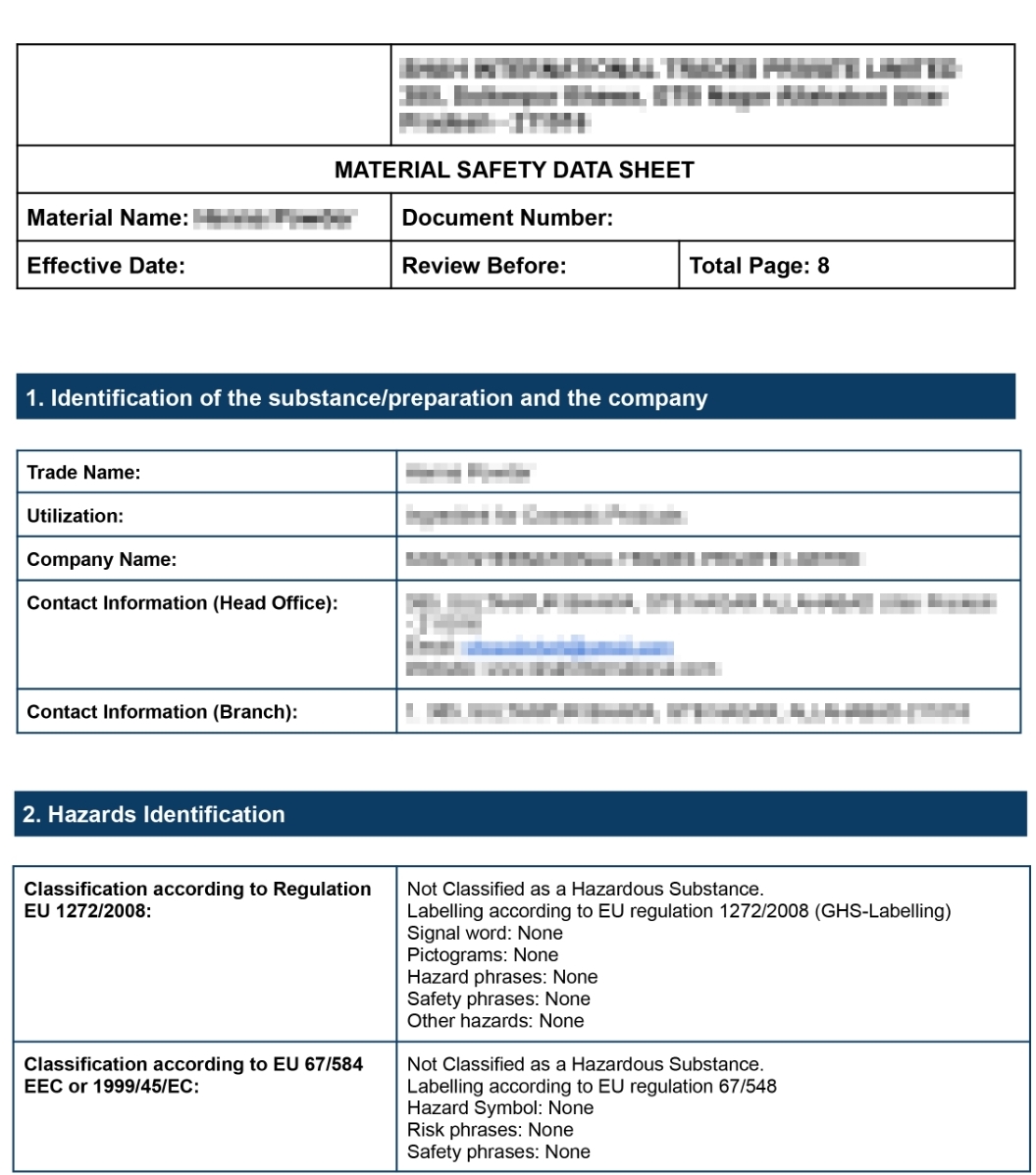
MSDS Certificate for Batteries [Sample]
Process of MSDS Certificate for Battery
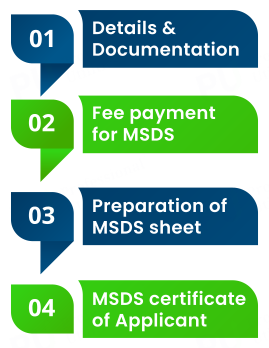
The process of obtaining an MSDS (Material Safety Data Sheet) certificate for batteries involves several key steps to ensure compliance with safety regulations and proper handling guidelines. Below is a step-by-step guide to acquiring the certification.
Details and documentation
Applicants must submit all the necessary details and documents regarding their product to initiate preparation for their MSDS certificate.
Submission of fee
The applicant must pay the processing fees after successfully submitting the documents and information regarding their product.
Preparation of MSDS/SDS certificate
This process involves gathering all relevant information and making it in a predetermined format. The MSDS Sheet will be prepared based on the standard set by the European Union.
Issuance of certification
When the safety data sheet (SDS) is completed, it will be sent to the applicant. The applicant needs to sign the MSDS and use it with the material, packaging, and labeling.

MSDS Certificate Documents Required for Battery
The list of documents required for MSDS certificate of Battery is mention below:

- Company Information
- Import Export Code (IEC)
- GST Registration Certificate
- Battery Specification & Details
- Battery Image
- Percentage-wise Composition of Ingredients
- Test Report of Battery
- Emergency Contact Details (Phone Number & Email Address)
- Chemical Abstracts Service Number (CAS No.)
- Destination / Export Country
MSDS /SDS Certification Cost for Battery
The total cost of obtaining an MSDS/SDS certificate for batteries is as follows:
| No. of MSDS or SDS certificate : | MSDS Fees for Battery |
|---|---|
| For 1 MSDS certificate | INR 4,499/- only (including GST) |
| For 2 MSDS certificate | INR 8,999/- only (Including GST) |
Contact us for further details if you require more than 1 MSDS certificate.
Why is an MSDS Certificate Required for Battery?
Battery MSDS is Mandatory because of Thermal Runaway Risk in Lithium Batteries:
- Fire Risk and Safety Criticality of Lithium Batteries: Lithium batteries are hazardous because of their capability of developing thermal runaway, which is an uncontrollable self-heating process leading to explosions or fires. The phenomenon is caused by overcharging, internal short circuiting, mechanical damage, and/or exposure to high temperatures.
- Emergency Response Guidance in MSDS: MSDS provides essential information necessary for dealing with emergencies particularly in Section 5 (Firefighting Measures) and Section 10 (Stability and Reactivity). The information shows that water should not be used to suppress any flames resulting from lithium battery fires and recommends dry powder or CO2 extinguisher as a means of controlling such fires. This information plays an important role in ensuring proper hazard communication and reducing severity of accidents.
As per UN regulations, every packaging of hazardous products or products made by chemicals/hazardous materials should ensure UN MARK IIP Certificate before exporting to UN member countries.
MSDS Review Requirements for Batteries
When reviewing an MSDS for batteries, the following key compliance checks are generally required:
- The SDS certificate should be valid for 3 years from the date of issuance
- All 16 sections, except "Other Information." must be completed as per the GHS guidelines
- Sections 2 and 3, Hazards Identification and Composition respectively, must reflect 100% of product composition.
- Section 14 must include the UN Number and Hazard Classification wherever applicable for transportation
- The manufacturer mentioned in the MSDS must match the details in the transportation appraisal or supporting documentation, or the relationship must be clearly justified
Battery MSDS vs TDS (Technical Data Sheet)
Technical Data Sheet or TDS highlights performance characteristics such as capacity, voltage, cycle life, discharge rate, physical dimensions, and operation specifications. On the other hand, MSDS for Battery (Material Safety Data Sheet) deals with safety aspects like hazardous ingredients, fire and explosion hazards, first aid measures, and transportation classes.
Both documents serve different purposes and are often required together by international buyers for compliance and procurement evaluation. In many cases, buyers requesting a TDS from Chinese or international suppliers should also separately request the MSDS to ensure both technical performance and safety compliance documentation are available, especially for e-commerce platforms like Amazon where MSDS requirements are strictly enforced.
Types of Batteries Requiring MSDS Certificate
Battery Categories Covered Under MSDS Preparation are:
- Lithium-Ion Batteries (UN3480 / UN3481): Rechargeable batteries used in electronics and energy storage systems. Lithium-ion batteries are considered dangerous goods in the Class 9 category because of fire hazards, thermal runaway, and explosive potential.
- Lithium Metal Batteries (UN3090 / UN3091): These are non-rechargeable high-energy batteries with strict transport regulations. They are classified as hazardous goods due to flammability and short-circuit risk during shipment.
- Lithium Polymer Batteries: A sub-category of lithium-ion batteries with a gel or polymer electrolyte. Needs an MSDS due to similar thermal instability and fire hazard characteristics.
- Lead-Acid Batteries (UN2800 / UN2794): Includes sealed (UN2800) and flooded or wet (UN2794) variants. Corrosive acid and heavy metal content makes strict safety, handling and spillage control procedures mandatory.
- Nickel-Metal Hydride (NiMH) Batteries: Rechargeable batteries with moderate hazard profile. MSDS required for safe handling, transport documentation, and recycling compliance.
- Alkaline Batteries: Generally considered non-hazardous when transported under ordinary conditions. MSDS may, however, be required for large scale shipments.
- Button / Coin Cell Batteries: Small-sized batteries used in electronics and medical devices. MSDS required due to ingestion risk, leakage potential, and presence of lithium or other reactive materials.
Additional Air Freight Compliance Requirement
Effective from 1 January 2026, IATA Dangerous Goods Regulations (DGR) require standalone lithium-ion batteries transported by air freight to be shipped at not more than 30% State of Charge (SoC), unless packed with equipment. Therefore, battery rated capacity, watt-hour details, and applicable SoC limitations may also be required during MSDS preparation for air freight compliance, especially for power banks, EV battery packs, and laptop batteries exported from India.
Sea Freight Requirements for Battery Transportation
For sea transportation, batteries are governed by the International Maritime Dangerous Goods (IMDG) regulations. MSDS Section 14 must include transport-related information such as UN number, IMDG hazard classification, packing group, and marine pollutant status wherever applicable.
Additional requirements related to package and quantity limitations apply to lithium batteries during ocean transport, particularly when shipped on passenger vessels. Compliance with IMDG requirements ensures safe transportation and customs acceptance for international shipments.
Validity & Renewal of MSDS/SDS Certificate
An MSDS/SDS certificate is generally valid for 3 years from the date of issuance, and it must be renewed every 3 years. However, any changes must be updated within 90 days. An updated SDS certificate helps avoid customs delays, as authorities often consider certificates that are not older than 3–5 years.
MSDS Certificate must be updated when:
- Battery chemistry or composition changes
- New safety data (thermal runaway incidents, new test data) becomes available
- IATA DGR is updated (annual edition) with new battery transport requirements
- Export is initiated to a new market with distinct regulatory compliance requirements and documentation standards
Purpose of obtaining MSDS certificate for batteries
Batteries such as lithium ion batteries are made from various chemical compositions and materials. Therefore getting an MSDS certificate for such shipment is required to ensure safe handling.
The following information on the MSDS certificate is prepared on 16 parameters per the global standard established by various international organisations, such as the EU and OSHA guidelines.
- Identification
- Hazard(s) identification
- First-aid measures
- Composition/Information on ingredients
- Fire-fighting measures
- Other information
- Handling and storage
- Exposure controls/Personal protection
- Stability and reactivity
- Toxicological information
- Ecological information
- Physical and chemical properties
- Disposal considerations
- Transportation information
- Regulatory information
- Accidental release measures
How to get MSDS/SDS for batteries
Get your MSDS Certificate Online with Professional Utilities in three simple steps:



Step 1: Fill the Form
Get in touch via call or
contact form
Step 2: Submit Documents
Provide necessary documents
Step 3: Get Your IEC Code
Get your MSDS certificate for Batteries within 3-5 working days
Get Your Battery MSDS Certificate with Expert Assistance
A well-drafted MSDS for batteries is essential for ensuring product safety, regulatory compliance, and seamless transportation of battery products both domestically and internationally. With evolving global standards under IATA, IMDG, and ADR regulations, manufacturers and exporters must maintain accurate and current Safety Data Sheet documentation to avoid shipment delays, customs rejections, or regulatory penalties.
Professional Utilities provide complete documentation support for battery MSDS preparation, review, and compliance alignment, ensuring your documentation meets all applicable regulatory and shipping requirements. Businesses seeking to further strengthen their compliance standing may also explore GEM Vendor Assessment for Battery Cell, which validates battery products for government procurement under the GeM platform.
FAQ’s On MSDS Certificate for Batteries
How to get an MSDS certificate for a battery?
MSDS (Material Safety Data Sheet) certificate for a battery can be obtained from the battery manufacturer, supplier, or an authorized MSDS service provider. The document is prepared based on the battery type, chemical composition, and safety requirements.
What is the MSDS document for a battery?
A battery MSDS is a safety document that provides information about the battery’s chemical composition, hazards, handling, storage, transportation, and emergency measures. It helps ensure safe usage and regulatory compliance.
Do batteries have MSDS?
Yes, most batteries have an MSDS/SDS document, especially rechargeable and chemical-based batteries. It is commonly required for transportation, import-export, workplace safety, and regulatory purposes.
Are SDS required for lithium-ion batteries?
Yes, SDS (Safety Data Sheet) is generally required for lithium-ion batteries because they contain chemicals and may pose risks such as fire, leakage, or thermal hazards. The SDS provides safety and handling guidelines.
How much does an MSDS/SDS certificate for batteries cost in India?
MSDS/SDS certificate for batteries in India is INR 4,499 including GST for one certificate and INR 8,999 including GST for 2 MSDS certificates for batteries.
Is an MSDS certificate mandatory for battery export from India?
Yes, MSDS certificate also known as SDS certificate is mandatory for battery export from India. It ensures easy customs clearance and emergency handling protocols.
Why is an SDS certificate required for lithium-ion batteries?
An SDS (Safety Data Sheet) is required for lithium-ion batteries to provide essential safety information about their chemical composition, hazards, handling, storage, transportation, and emergency procedures. It helps manufacturers, suppliers, and users ensure safe handling and regulatory compliance.
What is UN 38.3 and how is it related to battery SDS?
UN 38.3 is a safety testing standard that lithium-ion batteries must pass before being transported by air, sea, or road. It verifies battery safety against conditions like vibration, impact, temperature changes, and short circuits, while the SDS provides chemical safety and handling information for the battery.
Speak Directly to our Expert Today

Reliable

Affordable

Assured
Industries Served by
Professional Utilities

Apparels

Footwear

Furniture

Gems and Jewellery

Tourism & Hospitality

Consumer Electronics

Chemicals

Telecom

Oils & Gas

Hotel

Railways

Liquor

Health & Medical

Food Processing

Dangerous/ Haz. Goods

Tea & Coffee

Capital Goods

Recycling

Rubber

NGOs

Silk

Handloom

IT & BPM

Steel

Automobile

Tobacco

Constructions