
Factory License Registration



Factory License Registration

Years of Experience
What’s Included?
Detailed Eligibility Assessment Accurate Documentation Guidance Compliance Review Ensure Regulatory Accuracy and Approval Assistance to Minimize Delays and Rejections Liaison with Factory Inspector & Department Factory License Application Management Factory Site Plan and Layout Guidance Advisory on Safety, Health, and Welfare Renewal and Amendments guidance
Get Expert Consultation

Factory License Registration Online - Process, Documents & Fees
Operating a manufacturing unit without a factory license registration in India can lead to imprisonment and penalties. One of the primary requirements for factories should be a legal certificate rather than production capacity, machinery, and workforce management.
The government of India introduced the Factories Act 1948 on September 23, 1948, to protect employees' rights and ensure that employers provide for health, safety, environmental protection, and basic welfare. A factory registration certificate is a mandatory certification granted to MSME’s through authorised bodies to commence manufacturing operations.
The factory license in India is governed under the Factories Act, 1948, and granted by the Chief Inspector of Factories under each State’s Factories Rules (the Directorate of Factories and the Department of Factories and Boilers.
Businesses must clear strict adherence to legal and safety procurement requirements set by the government entities. It is essential to understand certain rules and regulations and the right steps to obtain a license.
Professional Utilities plays a vital role in accessing certification online without any complications at a competitive price. The professional fees for registration is ₹35,399 /- only, exclusive of government fees.
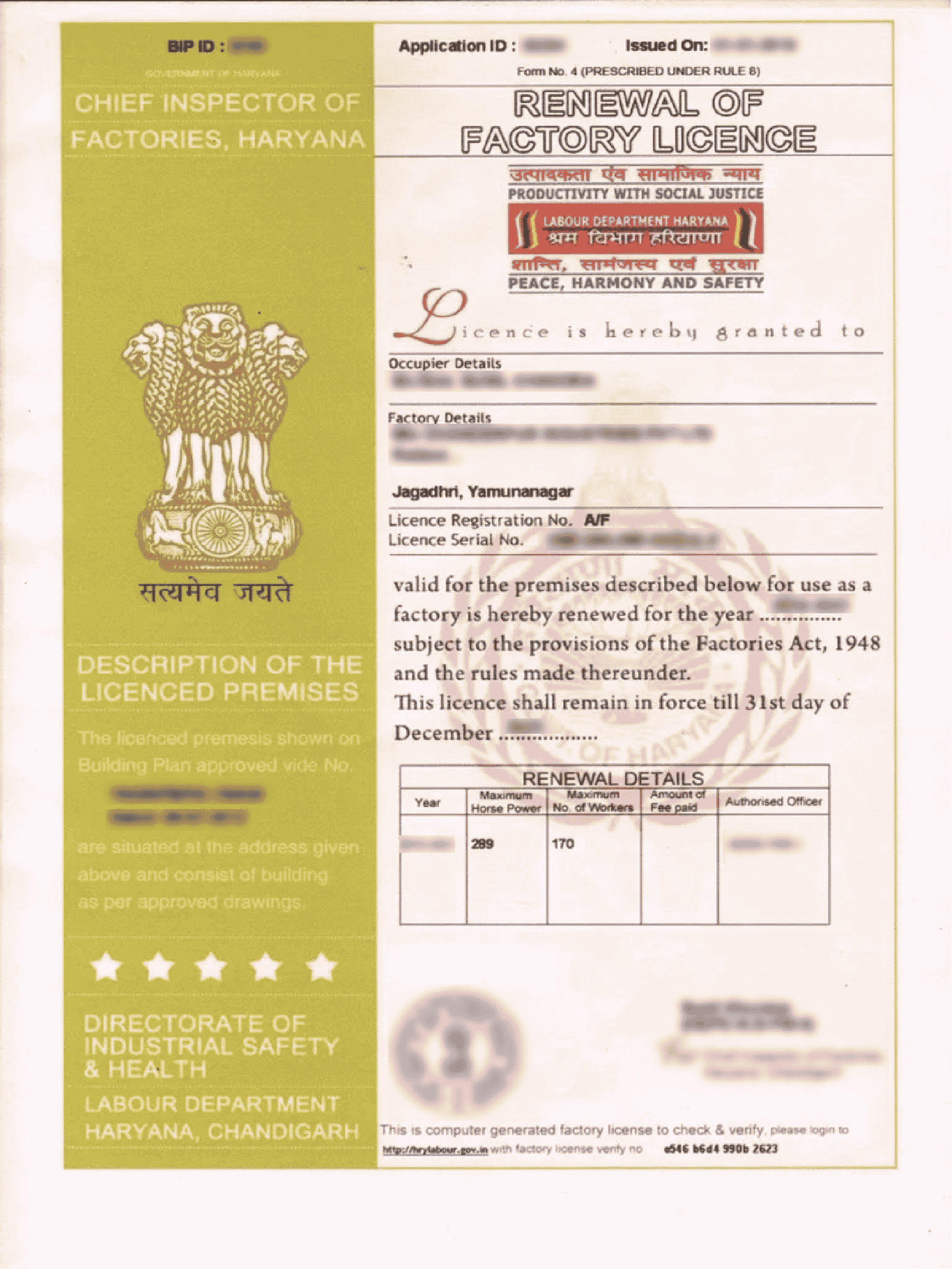
Factory License Certificate [Sample]
Process for Factory License Registration in India
To apply for a factory license registration in India online, determine the specific state and follow the steps accordingly. Below are the steps for online registration:
- Step 1: Portal Registration - Complete the portal registration by navigating to the state-specific labour portal and creating an account to initiate the process further.
- Step 2: Form Submission - Fill out the registration and license application form, such as (Form-2), based on worker count, power house power (HP), along with the manufacturing unit. Attach the required documents and submit the form.
- Step 3: Fee Payment - Pay the auto-calculated fee via credit/debit or net banking based on accessibility, worker strength, and power capacity.
- Step 4: Inspection - A factory inspector will visit the premises physically and review machine placement, safety standards, and waste management. In case a inspection is delayed, the Chief Insoector of Factories conduct a re-insoection or renew the submitted proof of correction after 15-30 days.
- Step 5: Obtain License - The authority will grant a certificate upon successful verification. The download option will be shown on the specific portal. Download the e-factory license.

Process for Building Plan Approval - Factory License Registration in India
To get a factory license in India, occupiers have to get a building plan approval before the registration process. The process includes building layout and No-Objection Certificates, file submissions, and inspection. Read the steps below:
- Step 1: Draft Layout - Appoint a professional architect and create a building layout, site plans, building elevations, and machinery layouts.
- Step 2: Obtain NOCs - Apply for No-Objection Certificates from the Fire, Water, and Electricity Department. To get a Pollution NOC, occupiers must submit an application form to the state-specific pollution control board.
- Step 3: Gather Documents - Collect all the important documents, including factory address, location, and NOCs for submission at the time of form filing.
- Step 4: File Form 1 - Fill the statutory application forms, including Form 1 and Form 1-A, online through a state single window portal or labour portal.
- Step 5: Technical Evaluation - The Chief Inspector of Factories will technically evaluate the drawings for compliance with safety and the National Building Code.
Documents Required for Factory Registration in India
Under the Factories Act 1948, applicants are required to submit the following documents for factory license registration in India:
Site Plan Stage
- Form 1-C / Form 1
- Notice of Intention
- Machinery Layout
- Local NOC, Process Flow Chart
- Address Proof of Factory (utility bills)
- Partnership Deed or Board Resolution (as applicable)
- Information Regarding Equipment and Raw Material
- Occupier Declaration
License Stage
- Stability Certificate
- Pollution Control Board Consent (CTE/CTO)
- Fire NOC
- Equipment List
- Pollution NOC from Water Department
- Tax Receipt of Municipal Corporation
- Consent to Establish & Consent to Operate (State Pollution Control Board)
- Directors or Partners details
- Owner's ID and Identity Proof
- PAN Card Details of Business
Factory License Registration Fees in India
The factory license fees in India may vary from state to state and depend upon several factors, such as the number of employees, size and scale, validity timeline, and machinery capacity.
Here is a table representing a state-wise registration cost with a specific portal and validity:
| State | Portal | Government Fees Range |
|---|---|---|
| Delhi | e-District Delhi | ₹100- ₹20000 |
| Uttar Pradesh | Nivesh Mitra Single Window System | ₹150- ₹35000 |
| Himachal Pradesh | OFRIS (Online Factory Registration Information System) | two variables, i.e., the maximum number of workers employed, the amount of power installed |
| Haryana | Haryana Labour Department | ₹1500-₹108000 |
| Maharashtra | Directorate of Industrial Safety & Health | ₹385-₹231000 |
| Andhra Pradesh | AP Industries Single Desk Portal | ₹250-₹250000 |
| Professional Fees | 18% GST on Professional Fees | Total (Exclusive Govt. Fees) |
|---|---|---|
| ₹29,999.00 | ₹5,400 | ₹35,399 |
Note: Government fees vary by state and depend on factors such as workforce, power capacity, and factory scale. Professional fees and applicable GST are separate and will be charged in addition to government fees.
Secure Your Factory License Today
Stay compliant with the Factories Act and safeguard your business from penalties and shutdowns.
Call Us
What is a Factory License?

A factory license is a legal document or certification granted by the competent authority, Assistant Director/ Deputy Director/ Director of the Factories, under the Factories Act of 1948.
Under Section 2(m) of the Factories Act, 1948, a “factory” is defined as any premises including the following:
- Factories consisting of 10 or more workers operating with power
- Factories operating with more than 20 workers without the aid of power
- Businesses engaged in hazardous activities
Why is a Factory License Required?
In India, the factories are classified under two broad categories based on their operating process, such as hazardous and non-hazardous factories. The sectors which needs a factory license are alcohol, tobacco, defence, explosives, and hazardous chemicals.
Under the Factories Act, 1948, it is compulsory for premises that are engaging in manufacturing activities. Factory license registration in India is essential for manufacturing units that fall under the following:
- Employees with 10 or more workers who use electrical power for operating their business.
- Employees with 20 or more employees without the involvement of an electricity supply.
- Handles hazardous processes regardless of the total employee count.
- An occupier/manager who is responsible for commencing the manufacturing unit.
- If no manager is named, the occupier is deemed a manager by default.
Old vs New Labour Laws for Factory Workers in 2026
The Government of India replaced 29 fragmented central labour laws with a unified four labour codes on 8th May, 2026, including the Code of Wages, Occupational Safety, Health and Working Conditions Code, Industrial Relations Code, and Social Security Code, which were implemented in 2025.
The earlier system operated under various labour rules and regulations, which led to inaccuracies in handling compliance and workers' safety. Compliance was heavily reliant on manual registers and local practices. This led to delayed salary payments, an informal hiring process, and inaccurate basic pay to workers. But the new labour code has changed all the old patterns and impacted factory workers in numerous ways.
Let's understand the difference between the old labour code and the new with the help of a concise table:
| Category | Old Labor Code | New Labor Code |
|---|---|---|
| Scope & Purposes | Applied only to organised/factory sectors. It excludes informal sectors and gig workers outside core protections. | Recognises gig workers, platform workers and fixed-term employees under the Factories Act, 1948. |
| Wages & Benefits | Minimum wages and payment rules were under distinct acts and laws. | Consolidates under the Code of Wages, including minimum wages, payments, and bonuses, with a written contract under standard compliance. |
| Shift Hours | 8-hour shift for workers. | Extend working hours to 12 hours with a limit of 48 hours in a week. |
| Industrial Relations & Layoffs | Firms with 100+ employees needed permission for layoffs and administrative shutdowns. | Raised a limitation with 300+ workers that provides a latitude for firms. |
| Social and Gig Workers | EPF/ESI/Social Security were applicable for organised sectors. | Social security for gig and platform workers, including pensions and gratuity. |
| Occupational Safety & Health Working Hours | Multiple sectoral safety measures, specifically from factories, mines, and the construction department. | Safety and health welfare, inspections, medical facilities for workers. |
Note: To review detailed notifications and guidance on the Ministry of Labour and Employment Portal, click here
Key Difference - Factory License vs Trade License in India
Here is the main difference between a factory license and a trade license, including its primary aim, issuing authority, and eligibility criteria:
| Category | Factory License | Trade License |
|---|---|---|
| Purpose | Ensures workers' safety, health, and welfare in production and manufacturing units. | Permits commercial operations and ensures that businesses are not causing any hazardous activities that affect public health. |
| Governing Authority | Issued by the State Labour Department & Factories Inspectorate under the National Labour Legislation. | Governed by Local Municipal authorities and corporations. |
| Applicability | As per the Factories Act of 1948, any manufacturing entity employing 10+ workers with the aid of power and 20+ workers without the aid of power is eligible to get a license. | Compulsory for almost all units involved in commercial activity (retail, shops, eating houses, warehouses, and commercial offices) |
Occupiers must obtain a trade license even after getting a factory license to trade or operate legally from that specific local ward or zone.
Factory License Registration in India - Timeline, Validity & Renewal
The following details cover the processing time, validity, and renewal period of a Factory License.
Timeline
The total time to obtain a license depends upon different factors, including building time approval and the registration process.
It takes 15-60 days from the file submission to the grant of the license.
Validity
The validity of a factory license in India typically depends upon the specific state’s rules and the renewal period.
It is commonly for 1 year and can be extended to 5 or 10 years, which varies by state rules.
Renewal
A factory license renewal can be processed at regular intervals to ensure that all rules and regulations are followed under legal terms.
It depends upon the state-specific rules. Apply by 31st October; otherwise, the late fee may apply, which involves 10-25% based on the state.
Penalties for Operating without a Factory License
As per Section 92 of the Factories Act, 1948, violation of rules can lead to a legal and compliance risk for an occupier.
- Hefty monetary fines around ₹1,00,000 or ₹2,00,000 depending on state amendments under section 92.
- Section 2 (n) states that both occupiers and managers are liable for violating laws regulated under the Factories Act.
- If the violation continues after conviction, ₹1,000 will be charged on a daily basis.
- The authorities can shut down the manufacturing unit on an immediate basis.
- Authorities can disconnect the vital supplies, such as electricity and water.
Advantages of Factory License Registration in India
In India, a factory license is a legal requirement for entities and establishments involved in manufacturing processes and certain other specified activities. There are several benefits of factory license registration for both the government and the business owners:
- Legal Compliance & Safety - It ensures the business complies with the legal and safety standards of factories. Businesses can avoid legal issues and penalties.
- Employee Welfare - By obtaining a factory license, businesses contribute to employees' welfare, including working hours, leave policies, and various permit amenities.
- Access to Government Incentives - With an authorised license, businesses become eligible for incentives, subsidies, and supporting programs for industrial growth and compliance with regulations.
- Environmental Compliance - Factory license ensures that industrial activities don’t adversely impact the environment and promotes sustainable and responsible business practices.
- Facilitates Expansion - When the business expands, a legal certification streamlines the process of obtaining approvals and permits for expansion.
- Consent to Establish - Before building construction, the site layout is cleared, and work on the pollution control framework is initiated.
- Tender Eligibility - Public sector and government procurement portals treat a valid factory license and a valid Consent to Operate (CTO) as mandatory pre-qualified criteria
Compliances After Factory License Certification
Getting a certificate, after a factory license registration in India, occupiers must follow certain rules and regulations to ensure safety and preventive measures.
- Maintain health and safety standards by keeping emergency clear exits, supplying clean drinking water, clean rooms, and toilets.
- Provide safety equipment and medical facilities to workers.
- In case a factory employs more workers, then Keep lunch room or canteen open.
- Record workers' details, shift hours, and overtime records.
- Share yearly reports with the state department; renew fire and pollution NOC papers on time.

Obtain Factory License in India with the Help of Professional Utilities
Factory license registration in India is a compulsory stage for establishing any manufacturing unit, factory, or industry. It ensures that a business is following rules stated under the Factories Act, 1948. It provides legal authorization to operate a factory without any legal issues or shutdown.
If businesses are looking for a factory license consultant in India, Professional Utilities simplifies the complete factory registration process for occupiers and directors. With years of experience, we automate approvals, renewables, and filings along with legal protection, so that factory owners can prioritise their business operations.
Factories that are dependent on an expert for documentation, filings, renewable and regulatory compliance can consult our team of professionals to regulate their business operations.
FAQ’s On Factory License Registration
Is a factory license mandatory in India?
Yes, a valid license is mandatory in India to operate manufacturing units. Operating a factory without a legal certification is a punishable offence. It often leads to a monetary legal risk (One Lakh fine or Two Years imprisonment or both as per section 92 of the Factories Act, 1948).
Who is eligible for a factory license in India?
An individual who runs a "factory" either in owned or rented premises shall be the "Occupier" and needs to obtain a "factory" license.
How to get a factory license in India?
Get a factory license in India by navigating to the State's Labour Departmental Portal. Provide the necessary credentials, upload documents in PDF, and complete the payment. Get in touch with Professional Utilities to apply for a license.
What are the essential documents required for factory license
registration?
The essential documents for factory license registration in India are a filed application form, approved factory layout building plans, proof of identity, address, and premises ownership.
What are the fees for factory license online certification in India?
The fees for registration in India start from ₹29,999/- only, exclusive of GST and government fees. However, it is required to pay government fees. This fee is based on eligibility criteria and the respective states.
Why should I hire a factory license renewal consultant in India?
Hiring a factory license renewal consultant in India helps ensure timely renewal, accurate documentation, compliance with state factory laws, and avoidance of penalties. A consultant manages the entire process efficiently and coordinates with authorities.
Can I renew a factory license?
Yes, it can be renewed for durations of one, five, or ten years based on the state-specific rules.
Who issues a factory license in India?
A factory license in India is issued by the State Government through the State Labour Department, by the Directorate of Industrial Safety and Health (DISH), or by the Chief Inspector of Factories under the Factories Act of 1948.
Speak Directly to our Expert Today

Reliable

Affordable

Assured
Industries Served by
Professional Utilities

Apparels

Footwear

Furniture

Gems and Jewellery

Tourism & Hospitality

Consumer Electronics

Chemicals

Telecom

Oils & Gas

Hotel

Railways

Liquor

Health & Medical

Food Processing

Dangerous/ Haz. Goods

Tea & Coffee

Capital Goods

Recycling

Rubber

NGOs

Silk

Handloom

IT & BPM

Steel

Automobile

Tobacco

Constructions


Disclaimer:The information provided on this website is intended for general information purposes only. Although all reasonable efforts are made to ensure that the information provided is correct and reliable, it is not advised to be used as a substitute for professional advice. The information herein is not to be used in place of seeking professional services, counsel, or guidance. We highly advise that you consult a professional before you make any business or legal decisions regarding the information presented on this website. This website and its contents are given "as is", and we do not take any responsibility for any action that is taken based on information given on this website.

- Written by: Richa Thakur
- Fact-checked: Sahil Singh
- Updated on: August 27, 2026
Testimonials
"Explore how Professional Utilities have helped businesses reach new heights as their trusted partner."





It was a great experience working withProfessional Utilities. They have provided the smoothly. It shows the amount of confidence they are having in their field of work.

Atish Singh


It was professional and friendly experience quick response and remarkable assistance. I loved PU service for section 8 company registration for our Vidyadhare Foundation.

Ravi Kumar
I needed a material safety data sheet for my product and they got it delivered in just 3 days. I am very happy with their professional and timely service. Trust me you can count on them.

Ananya Sharma
Great & helpful support by everyone. I got response & support whenever I called to your system. Heartly thanx for Great & Super Service. Have a Great & Bright future of team & your company.

Prashant Agawekar
Thank you so much Professional Utilities team for their wonderful help. I really appreciate your efforts in getting start business. Pvt Ltd company registration was smooth yet quick.
Abhishek Kumar
I applied for Drug licence and company registration and their follow-up for work and regular updates helped me a lot. They are happily available for any kind of business consultancy.

Vidushi Saini
Great experience went to get my ITR done, process was quite convenient and fast. Had a few queries, am happy about the fact those people explained me all things I wanted to know.

Taniya Garyali
Great services provided by Professional Utilities. They are best in this industry and the best part is their prices are so affordable. Kudos to you. Now you guys are my full-time consultant.

Aftab Alam
Trusted By