Drug License Registration for Manufacturers

4.9


Drug Manufacturing License Registration in India — Form 25 & Form 28
Drug License registration for manufacturers is an essential licensing requirement for the entities engaged in the manufacture of pharmaceuticals, and other relevant products as listed in the Drugs and Cosmetics Act of India. The primary idea behind the Drug License registration for manufacturers is to ensure the quality checks in the manufacture of generic as well as non-generic products. It further elevates the confidence of the consumers, both at the national and international level. As per Section 3(b) of the Drugs and Cosmetics Act, 1940, the term “drug” refers to any medicine used internally or externally on humans and animals, substances intended for diagnosis, treatment, mitigation, or prevention of diseases, and certain medical devices notified by the government. The 1964 amendment to the Drugs and Cosmetics Act, 1940 brought Ayurvedic, Siddha, and Unani drugs also under the purview of national regulatory framework. The amendment made Drug License registration mandatory for AYUSH manufactures as well.
For manufacturing units, obtaining approval from the concerned authority is mandatory before starting any production activities in India. As per the provisions of the Drugs and Cosmetics Act, 1940, certain standards are prescribed by the authorities regarding premises, equipment, qualified technical staff, testing facilities, and documentation practices. These standards are mandatory to be followed to ensure that the products are safe to use. The Drugs and Cosmetics Rules, 1945, including Schedule M (Good Manufacturing Practices standards), govern the operational and quality requirements applicable to pharmaceutical manufacturing units in India. These provisions prescribe detailed standards related to manufacturing premises, hygiene, equipment validation, quality systems, documentation, and storage conditions. Further, amendments in Schedule M guidelines notified in 2023 made it mandatory for all pharmaceutical manufacturers in India to upgrade their GMP standards.
Depending on the category of products being manufactured, different licensing authorities may be involved. License for non-biological drugs and allopathic medications falls under the purview of State Licensing Authority (SLA) or State FDA under Form 25. However, biological products such as vaccines, blood, sera, and other specified medicines, are regulated by CDSCO and licenses are issued in Form 28. Timely registration prevents regulatory interruptions, penalties, or setbacks. If you are looking to set up or expand a pharmaceutical manufacturing unit, obtaining the required Drug License is the first step you need to take. Professional Utilities, with over a decade of experience, assist you throughout the entire process to ensure that you obtain the necessary approvals and comply with all legal requirements.
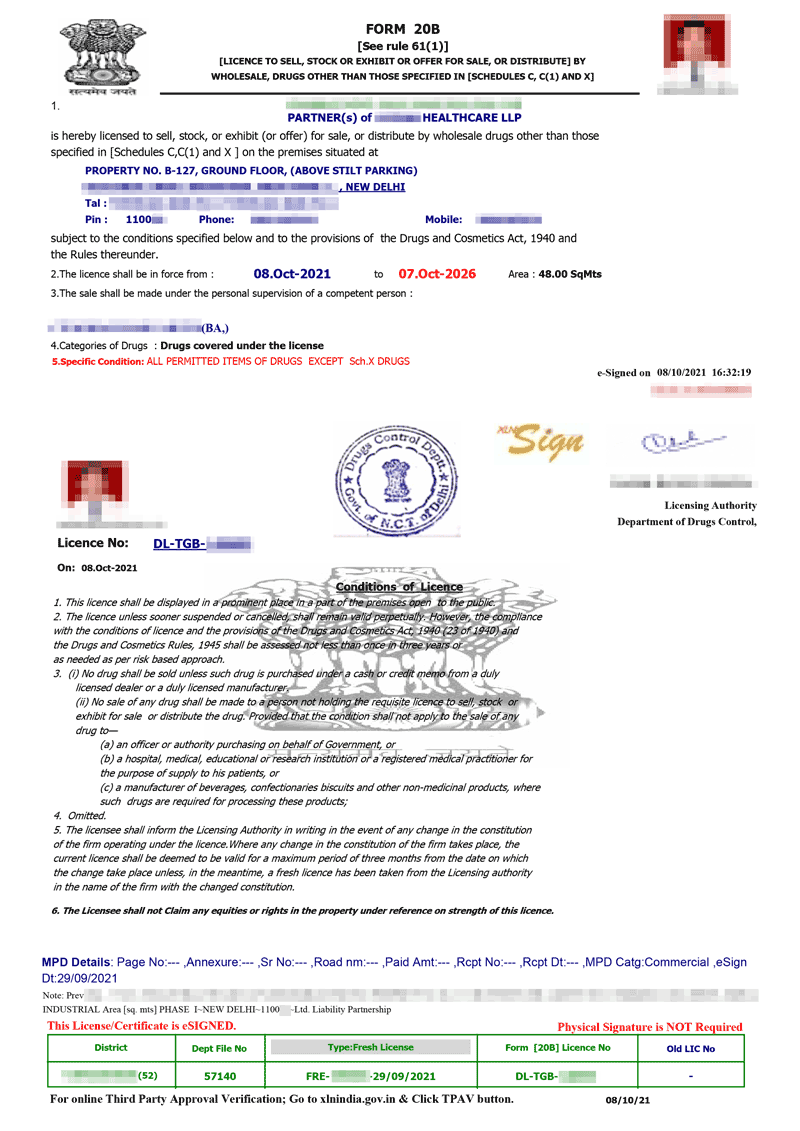
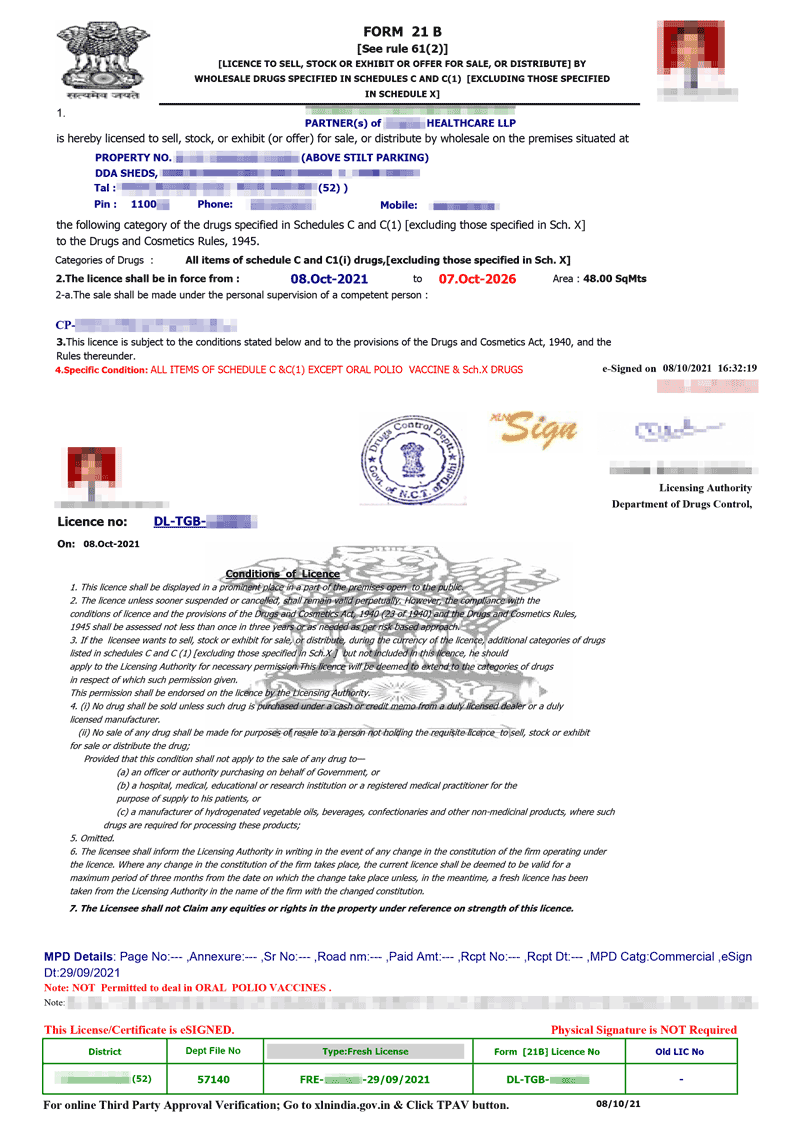
Manufacturing Drug License Certificate Sample
- Form-20B
- Form-21B
How to Apply for Drug Manufacturing License in India?
Manufacturers must obtain license through the government process, as listed below:
- Step 1: Online Application Filing: It is necessary for the applicant to register an account on the CDSCO SUGAM Portal to obtain login credentials and access the online application system for filing the manufacturing license application.
- Step 2: Submission of Required Documents: Requisite documents must be uploaded for a preliminary check by the authority.
- Step 3: Manufacturing License Application Processing: A duly filled application form must be filed (e.g., Form 25/28 for non-biological/biological drugs), along with detailed facility and personnel info.
- Step 4: Premises Inspection by Drug Authority: The Drug Inspector performs a physical inspection of the premises to check the documents, site information, and compliance.
- Step 5: Grant of Manufacturing License: An official inspection would be carried out by licensing authorities to give approval for a drug certificate. The registration process takes about 35 working days.

Documents Required for Drug Manufacturing License Registration
The following documents are required to be submitted while applying for a drug manufacturing license:
- Covering Letter
- Authorization Letter and duly filled Form 27
- Identity and Address Proof of the Applicant
- Approved Manufacturing Premises Layout
- Key Plan and Site Plan Blueprint
- Proof of Possession of Premises (Owned/Rented/Leased)
- Affidavit of Non-Conviction as per prescribed format
- Details of Competent and Qualified Technical Staff for Manufacturing
- Details of Technical Staff for Testing and Quality Control
- Site Master File
- Device Master File (applicable only for medical device manufacturers)
- Details of Standards followed for Product Evaluation and Quality Control
- ISO Certificate, if applicable
- Quality Assurance Certificate/Documents
- Acceptance Letter from Approved Testing Laboratory for specialized or advanced testing
- Details of Specific Environmental and Storage Requirements, wherever applicable
- Particulars of Medical Devices, if applicable
- NOC from Pollution Control Board
How much does a drug license cost in India?
The total fee for obtaining a Drug Manufacturing License is INR 1,31,400, inclusive of GST and applicable government fees.
| Particulars | Fees |
|---|---|
| Professional Fees | ₹1,05,000 |
| GST on Professional Fees | 18% (₹18,900) |
| Govt. Fees (Drugs other than Schedule C/C1/X) | ₹6,000 license fee + ₹1,500 (Inspection fee) |
| Schedule C/C1/X drugs | ₹6,000 license fee + ₹1,500 (Inspection fee) |
Drug License Registration for Manufacturers
Drug License Registration for Manufacturers is an obligatory legal approval under the Drugs & Cosmetics Act, India. This kind of license allows a firm to produce pharmaceutical items with an absolute adherence to the highest quality standards right from the beginning of the production process. Applicants need to submit their applications in Form 24, Form 24A, and Form 24B to obtain a drug manufacturing license.
Types of Drug License
Drug Licenses in India are classified based on the type of pharmaceutical activities including manufacture, sale, distribution, import, and retail or wholesale operations. The applicable license type depends on the category of drugs, type of business, and regulatory requirements prescribed under the Drugs and Cosmetics Act, 1940.
- Manufacturing Drug License: Manufacturing Drug License is an essential licensing requirement for the entities engaged in the manufacture of pharmaceuticals, and other relevant products as listed in the Drugs and Cosmetics Act of India.
- Loan License: CDSCO loan license is provided to drug manufacturers who utilize the manufacturing facility of a registered licensed manufacturer, without owning their own factory.
- Multi-Drug License: Multi-Drug license is issued to organizations involved in drug trade across multiple states of India under the same organizational name. Under the Drugs & Cosmetics Act, 1940 it is mandatory to have separate licenses for each location.
- Import License: Companies importing pharmaceuticals and their raw substances in India must register for an import license with the CDSCO.
- Retail Drug License: Medical or pharmacy stores involved in selling drugs directly to consumers are required to obtain a retail drug license.
- Wholesale Drug License: Wholesale drug licenses are required for businesses that distribute bulk quantities to retailers or hospitals. It is mandatory to meet the required premise size and storage standards. Obtaining a Wholesale Drug License in India ensures legal distribution, storage, and adherence to pharmaceutical regulations.
Types of Drug Manufacturing Licenses in India
Drug manufacturing licenses in India are primarily classified as Form 25 and Form 28 depending upon the type of pharmaceuticals products being manufactured. These licenses ensure that all manufacturers of conventional and biological drugs follow the necessary guidelines as prescribed in the Drugs and Cosmetics Act, 1940.
- Form 25 License : Form –25 license is issued to manufacturers aiming to produce non-biological medicines including tablets, capsules, ointments, and other non-biological formulations. The license ensures that production facilities adhere to the standards set by the regulatory authorities, guaranteeing the safety, efficacy, and quality of the medicines produced. Manufacturers intending to sale or distribute non-biological medicines must obtain this license.
- Form 28 License : Form 28 is mandatory for entities intending to sell, produce, or distribute biological products, including vaccines, blood products, and other biologically derived medicines in India. The license ensures that manufactured biological products are produced under stringent conditions, ensuring their safety, efficacy, and adherence to the quality standards set by the regulatory bodies.
Key Requirements to Establish a Drug Manufacturing Unit in India
Listed below are the key requirements for a drug manufacturing business:
- Appointment of qualified and competent technical staff with qualifications in pharmacy, pharmaceutical chemistry, microbiology, or similar fields.
- Proof of premises which must comply with Good Manufacturing Practices (GMP) as per Schedule M of the Drugs and Cosmetics Rules. The premises must be clean, well-ventilated, and equipped with proper machinery.
- Must have proper equipment for manufacturing, testing, and storage.
- A separate lab with qualified staff for testing raw materials and finished products.
- If manufacturing certain drugs like Schedule X drugs (narcotics and psychotropic substances), additional approvals are needed from the Drug Controller General of India (DCGI).
Post-License Compliance Obligations for Drug Manufacturers
Drug manufacturers are required to maintain continuous compliance with regulatory, quality, and operational standards even after obtaining the manufacturing license
- GMP Surveillance: Revised schedule M has mandated Good Manufacturing Practices (GMP) for license holders. GMP refers to keeping quality systems active, training staff regularly, validating equipment, and maintaining clean, well-segregated facilities. CDSCO and state inspectors carry out joint audits, and any repeated lapse can lead to license suspension.
- ADR Reporting: Every manufacturer must report adverse drug reactions (ADRs) to the Pharmacovigilance Programme of India (PvPI). Serious reactions must be reported within 15 days, and non-serious ones within 90 days.
- Annual Returns: Licensed units must file yearly production returns with the State Licensing Authority. This includes details of how much was manufactured, sold, and stocked.
Penalties for Manufacturing Drugs Without a License
Manufacturing pharmaceutical products without obtaining the required Drug Manufacturing License is a violation of the Drugs and Cosmetics Act, 1940. Non-compliance can lead to regulatory action such as fines, temporary closure of business operations, seizure of products, revocation of licenses, and legal proceedings by the concerned authorities.
Under Section 27(b)(ii) of the Drugs and Cosmetics Act, 1940, any person involved in the manufacture, sale, or distribution of drugs without a valid license may face imprisonment for a term not less than one year, extendable up to three years, along with fine often exceeding ₹1 lakh, or three times the value of seized products.
Common Reasons for Drug Manufacturing License Rejection
Drug Manufacturing License applications may be rejected due to non-compliance with regulatory requirements, inadequate infrastructure, incomplete documentation, lack of qualified technical staff, or failure to meet the prescribed standards under the Drugs and Cosmetics Act, 1940.
- Incomplete Site Plan: Plans submitted without proper scale, dimensions, or clear zoning are rejected immediately.
- Unqualified Staff: Production head and quality control head must each meet the qualifications under Rules 71 and 76. The same person cannot hold both roles. Missing degrees, unattested documents, or part-time staffing are quick grounds for rejection.
- Missing GMP Documents: Applications often fail due to missing or generic paperwork — no Validation Master Plan, unsigned SOPs, no vendor qualification list, or expired calibration certificates.
- Premises Issues: Common problems include insufficient floor area, rough or unwashable surfaces, poor water and air systems, missing HEPA filters, and a quality control lab that shares space with production instead of being separate.
Validity and Renewal of Drug Manufacturing License
As per the 2017 amendment (GSR 1337), a drug manufacturing license is valid for a lifetime, subject to payment of a license retention fee every 5 years from the date of issuance. It can be renewed before expiry by logging into the respective drug control portal, submitting the license number, filling up the renewal application, and submitting the required documents along with the renewal fees.
Benefits of Drug Manufacturing License Registration
There are several benefits of obtaining manufacturer drug license certification in India:
- Statutory Authorization: A valid manufacturing drug license enables your company to manufacture pharmaceuticals under the Drugs and Cosmetics Act, 1940, safeguarding you against any actions by authorities.
- Improved Brand Reliability: Drug license certification assures healthcare providers, distributors, and consumers about the authenticity of your brand.
- Expanded Business Opportunities: Obtaining the drug license helps the companies quote for government and other large sources of supplies.
- Regulatory Guidance & Industry Recognition: The licensed manufacturers have the benefit of being governed by the law, getting the requisite information regarding the aspect of compliance, and even being right in line with the best practices
Get Expert Assistance for Manufacturing Drug License Registration with Professional Utilities
Drug License registration for manufacturers is an important step in setting up a drug manufacturing unit in India that is compliant with the regulations and quality conscious. Getting approval from the CDSCO, as per the Drugs and Cosmetics Act, 1940, ensures that the company is following the laid-down standards of safety, quality, and operation.
Getting the license at the appropriate time will help you avoid complications with the law, delays in production, and financial losses. With expert support from Professional Utilities, you can smoothly register your manufacturing unit and run your business with complete confidence.
FAQ's on Drug Manufacturing License Registration in India
What is a drug manufacturing license?
A drug manufacturing license is a legal permission granted under the Drugs and Cosmetics Act, 1940 and the Drugs and Cosmetics Rules, 1945 that allows a business to manufacture pharmaceutical products in India.
How can I start a drug manufacturing company in India?
To start a drug manufacturing company in India you must register your business, choose a suitable industrial location, design the plant as per Schedule M norms appoint qualified technical staff, install approved machinery, and apply for the manufacturing license with the State Drug Controller. Upon successful inspection and approval, a license is issued.
What is the difference between a drug license and a
manufacturing license?
A drug license is a broad term covering retail, wholesale, and manufacturing permissions. A manufacturing license is a specific type of drug license that allows actual production of medicines.
How do I get a drug manufacturing license?
Apply online through the State Drug Control portal or the SUGAM portal (for CDSCO categories) with the required forms, fees, site plan, and staff credentials. Upon successful inspection by the drug inspection license is issued within 60 to 90 working days.
Which forms are used for a drug manufacturing license?
The most common forms are Form 24 (application for non-Schedule C drugs) leading to Form 25 (license grant), and Form 27 (application for Schedule C and C1 drugs) leading to Form 28 (license grant). Form 24A and 27A apply to loan licenses.
Is WHO-GMP certification mandatory in India?
WHO-GMP is not mandatory for the domestic Indian market, where Schedule M compliance is sufficient. However, it is mandatory for exports to most regulated markets and is strongly preferred by institutional buyers.
How long does it take to obtain a drug manufacturing license?
It usually takes 60-90 working days to obtain a drug manufacturing license in India.
What are the penalties for manufacturing drugs without a license?
Under Section 27 of the Drugs and Cosmetics Act, manufacturing without a license can result in imprisonment of up to 3 to 5 years and a fine starting from ₹1 lakh.
Do I need a separate license for each drug category?
Yes. Manufacturing premises must be physically segregated for sensitive categories such as beta-lactams (penicillin, cephalosporins), hormones, cytotoxics, and biologicals — and each segregated section requires its own approved license and dedicated air handling system.
Can I manufacture drugs without owning a factory?
Yes, loan license allows for manufacturing drugs without owning a factory. A loan license allows you to use an existing licensed manufacturer's facility to produce your own branded drugs.
What is the validity of a drug manufacturing license?
As per the 2017 amendment (GSR 1337), the license is valid for a lifetime, subject to payment of a license retention fee every five years.
What is GMP compliance?
GMP, or Good Manufacturing Practice, is a quality system that ensures medicines are produced consistently and meets safety, purity, and efficacy standards.
What is the cost of setting up a pharma manufacturing unit in India?
A small-scale formulation unit (tablets, capsules) typically requires ₹1 crore to ₹2 crore as a starting investment, while a mid-scale GMP-compliant facility costs ₹5 crore to ₹15 crore. Sterile, injectable, or API plants can exceed ₹50 crore due to advanced HVAC, cleanroom, and validation requirements.
What are the basic requirements for a manufacturing license?
You need a properly designed and segregated premises that meet Schedule M, qualified technical staff (separate heads for production and quality control), validated machinery, a quality control laboratory, and complete GMP documentation.
Testimonials
"Explore how Professional Utilities have helped businesses reach new heights as their trusted partner."





It was a great experience working withProfessional Utilities. They have provided the smoothly. It shows the amount of confidence they are having in their field of work.

Atish Singh


It was professional and friendly experience quick response and remarkable assistance. I loved PU service for section 8 company registration for our Vidyadhare Foundation.

Ravi Kumar
I needed a material safety data sheet for my product and they got it delivered in just 3 days. I am very happy with their professional and timely service. Trust me you can count on them.

Ananya Sharma
Great & helpful support by everyone. I got response & support whenever I called to your system. Heartly thanx for Great & Super Service. Have a Great & Bright future of team & your company.

Prashant Agawekar
Thank you so much Professional Utilities team for their wonderful help. I really appreciate your efforts in getting start business. Pvt Ltd company registration was smooth yet quick.
Abhishek Kumar
I applied for Drug licence and company registration and their follow-up for work and regular updates helped me a lot. They are happily available for any kind of business consultancy.

Vidushi Saini
Great experience went to get my ITR done, process was quite convenient and fast. Had a few queries, am happy about the fact those people explained me all things I wanted to know.

Taniya Garyali
Great services provided by Professional Utilities. They are best in this industry and the best part is their prices are so affordable. Kudos to you. Now you guys are my full-time consultant.

Aftab Alam
Trusted By