


Extended Producer Responsibility (EPR) Registration Online in India
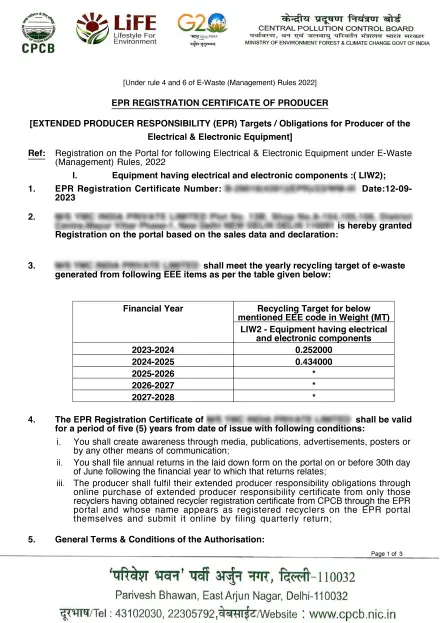
EPR, full form is Extended Producer Responsibility, is a government-led initiative, that requires businesses to take responsibility for managing the waste generated by their products and packaging materials. The process begins with EPR registration, which is a formal stage where businesses obtain authorization to handle the waste produced by their products. This responsibility covers waste generated at both pre-consumer and post-consumer stages, ensuring proper waste management throughout the product life cycle.
As per the guidelines of CPCB waste products classified under four categories and PIBOs i,e. Producers, Importers and Brand Owners must secure EPR Registration for PIBOs to ensure compliance for their business. EPR is very crucial for such businesses.
The objective of EPR is to create a sustainable and eco-friendly development model in India. The Authorization process takes up to 30 business days to complete and respective applicants are required to fulfill their EPR commitment annually as per the predefined parameters of the central pollution control board or state pollution control board respectively.
EPR Registration Online
Process for EPR Registration
Follow these simple steps to complete your EPR Registration quickly and efficiently.
- Step 1: Assessment and Documentation - Applicants are required to provide complete details for their EPR pollution certificate. Our team of experts will assess all the details and documents for any discrepancies.
- Step 2: Filing of EPR Registration Form - Once all documents are verified by our experts, an application will be filed with CPCB authorities for online EPR registration.
- Step 3: CPCB Assessment of Application - The CPCB will evaluate the online application for EPR registration. If any inconsistencies arise, necessary adjustments will be made.
- Step 4: Issuance of EPR Authorization - The certificate of authorization will be granted within 30 days of filing the application. Producers must implement an EPR action plan to meet yearly targets.

Documents Required for EPR Registration
To get an Extended Producer Responsibility (EPR) registration in India, you'll need to provide the following documents:
- Verification of Business Address
- Legal Papers of Manufacturer/Exporter
- Incorporation Certificate
- IE Code Verification
- Directorate of Industries
- Certificate by Municipal Corporations or Local Authorities
- Contact and Product details
- Copy of PAN Card
- Details and Documents of the Authorized Person
- BIS License (Optional)
- RoHS Compliance Details
- Recycler Information
- E-Waste Management Estimate
- Budget for Extended Producer Responsibility
- Details of Awareness Initiatives
- EPR Plan
- Copy of Agreements
Note: You may require some other documents as well, except for the above-mentioned list, as per your specific product type.
Fee for EPR Registration
The CPCB online registration fee for EPR is subject to the quantum of waste and kind of waste produced by PIBOs / Manufacturers annually.
For instance: Plastic EPR authorization fees is as:
| Waste in TPA | Plastic EPR registration fees |
|---|---|
| ✅ Less than 1000 | ₹10,000 |
| ✅ Between 1000-10000 | ₹20,000 |
| ✅ More than 10000 | ₹50,000 |
Note : The government fee for EPR registration can vary depending on the quantity of waste generated & The aformentioned Fees is exclusive of GST.
What is EPR Registration
Extended Producer Responsibility (EPR) Registration is a required law-based approval by the Central Pollution Control Board (CPCB) under the Plastic Waste Management Rules, 2016 and other related waste management rules. It demands producers, importers, and brand owners (PIBOs) to take full responsibility for the whole lifecycle of their products, including collection, recycling, and safe disposal of waste created by their products and packaging materials.
EPR Registration make sures of that businesses obey environmental laws while adding to sustainable waste management. The registration process is conducted online through the CPCB portal and applies to waste types such as plastic, e-waste, battery, and tyre waste. By getting EPR Registration, companies not only meet legal requirements but also show environmental responsibility, improve brand reputation, and avoid penalties for disobedience.
Producers Responsibility under EPR Authorisation
The Registered Producers are required to comply with following conditions:
- The Producers are not allowed to carry any business without having EPR registration through an online centralized portal developed by CPCB.
- The Producers must not deal with any entity not registered through an online centralized portal developed by CPCB to meet EPR targets.
- Producers are required to meet their EPR target and shall provide completion certificate from CPCB authorized waste processor units.

Benefits of EPR Registration
Registration for EPR provides a sustainable environment to handle the environmental problems following the legal regulation by offering a better managing system to businesses.

- Efficient Waste Management: EPR registration ensures a streamlined waste management process. Producers are accountable for setting up collection systems, collaborating with recycling facilities, and promoting recycling initiatives. This leads to improved waste segregation, higher recycling rates, and a reduction in the amount of waste ending up in landfills.
- Cost Reduction: Implementing EPR registration can result in cost savings for businesses. By optimizing waste management practices, companies can minimize waste disposal expenses, explore revenue-generating opportunities through recycling, and improve overall operational efficiency.
- Positive Brand Image: Consumers today prefer eco-friendly and socially responsible businesses. EPR registration demonstrates a company's commitment to environmental stewardship and sustainable business practices. By obtaining EPR registration, businesses can enhance their public image and build trust among environmentally conscious consumers, leading to increased brand loyalty and market competitiveness.
Types of EPR Registration
The Central Pollution Control Board (CPCB) separates and labels EPR Registration into four main types based on the kind of waste: Plastic, Battery, Tyre, and E-Waste. Producers, importers, and brand owners (PIBOs) dealing with any of these wastes must protect EPR Registration Online in India, except for micro and small MSMEs.
- Plastic Waste : Applies to all producers, importers, and brand owners of plastic products and packaging materials.
- Battery Waste : For businesses manufacturing, importing, or selling batteries, including lithium-ion, lead-acid, and other rechargeable or single-use batteries.
- Tyre Waste : Covers manufacturers, importers, and sellers of tyres used in vehicles, motorcycles, or industrial uses.
- E waste : Includes electronic and electrical equipment such as computers, mobile phones, appliances, and other electronic products.
Classifying EPR by waste type helps CPCB to secure compliance and responsible waste management.
Renewal of Online EPR Registration
Any entity that falls into below mentioned criteria are eligible to get EPR registration for plastic except micro and small MSMEs.
- Producers/Manufacturers shall submit the application for renewal 60 days Prior to expiry of the registration along with all the documents.
- Producers must file annual returns by June 30th of the following year for the coming registration period. Application for renewal will not be entertained unless all due annual reports are filed.
- EPR Registration is granted to Producers and will be renewed for the much extended period by CPCB within 15 working days
Other Types of Registration For Extended Producer Responsibility


Cancellation of EPR License
The EPR certification for plastic can be canceled by their respective authorities on the basis of the following:-
- In the case of false information & document given to authorities and the application fee will be fortified.
- If Importers are found in violation of plastic waste management (PWMs) rules 2016
- PIBOs /importer shall not deal with any unauthorized or unregistered entities
- The PIBO must fulfill the year-wise and category-wise EPR Target as specified in the registration certificate for the year in which EPR registration is granted

Key EPR Compliance Rules
EPR (Extended Producer Responsibility) registration mandates the producer, importer, and brand owner to take up the responsibility of properly managing waste arising from the products they manufacture, supply, or market, to ensure compliance with the laws and encourage the principles of circular economy.
- Renewal can be filled 60 days prior to the due date.
- The Registration process could take up-to 30 days to complete.
- Producers are required to fulfill their EPR targets on time to avoid penalties/ cancellation.
- Cancellation of EPR authorization is subject to CPCB, if any discrepancy is found then the license can be canceled any time.
Conclusion
EPR registration is a crucial step towards sustainable waste management and environmental stewardship. It offers numerous benefits, including efficient waste management, cost reduction, a positive public image, and legal protection. By embracing EPR registration, businesses contribute to a circular economy, conserve resources, and meet the expectations of environmentally conscious consumers. It is essential for businesses to understand the steps involved in obtaining EPR registration and proactively integrate sustainable practices into their operations.
FAQ’s On Online EPR Registration
What is EPR Registration in India?
EPR Registration makes producers, importers, and brand owners responsible for managing waste created from their products as per CPCB guidelines.
Who is eligible for an EPR certificate?
Producers, importers, and brand owners (PIBOs) whose products generate regulated waste such as plastics, electronics, batteries, or packaging.
How can I apply for EPR Registration online in India?
Apply via the CPCB portal by submitting business details, documents, and payment; the certificate is issued after verification.
How much does EPR Registration cost in India?
EPR registration fees in India differ by waste type and annual waste generation: less than 1,000 TPA –₹10,000, 1,000–10,000 TPA - ₹20,000, above 10,000 TPA - ₹50,000 (exclusive of GST). Fees may vary by state and waste category.
Is EPR Registration mandatory for MSMEs in India?
Micro and small enterprises are generally exempt from EPR obligations, but medium and large MSMEs producing plastic or electronic waste must obey with EPR Registration rules in India.
Which PIBOs are required to register with SPCB/PCC?
All Producers, Importers, and Brand Owners generating regulated waste must register with the SPCB/PCC as per CPCB rules.
What is the purpose of an EPR?
To make producers responsible for collecting, recycling, and safely disposing of waste, supporting sustainable practices.
How to get an EPR Certificate?
Apply online through CPCB/SPCB portals by submitting demanded documents and fees, the certificate is issued after verification.
Speak Directly to our Expert Today

Reliable

Affordable

Assured
Industries Served by
Professional Utilities

Apparels

Footwear

Furniture

Gems and Jewellery

Tourism & Hospitality

Consumer Electronics

Chemicals

Telecom

Oils & Gas

Hotel

Railways

Liquor

Health & Medical

Food Processing

Dangerous/ Haz. Goods

Tea & Coffee

Capital Goods

Recycling

Rubber

NGOs

Silk

Handloom

IT & BPM

Steel

Automobile

Tobacco

Constructions


EPR Registration for Battery Waste in Other States
Testimonials
"Explore how Professional Utilities have helped businesses reach new heights as their trusted partner."







It was a great experience working withProfessional Utilities. They have provided the smoothly. It shows the amount of confidence they are having in their field of work.

Atish Singh


It was professional and friendly experience quick response and remarkable assistance. I loved PU service for section 8 company registration for our Vidyadhare Foundation.

Ravi Kumar
I needed a material safety data sheet for my product and they got it delivered in just 3 days. I am very happy with their professional and timely service. Trust me you can count on them.

Ananya Sharma
Great & helpful support by everyone. I got response & support whenever I called to your system. Heartly thanx for Great & Super Service. Have a Great & Bright future of team & your company.

Prashant Agawekar
Thank you so much Professional Utilities team for their wonderful help. I really appreciate your efforts in getting start business. Pvt Ltd company registration was smooth yet quick.
Abhishek Kumar
I applied for Drug licence and company registration and their follow-up for work and regular updates helped me a lot. They are happily available for any kind of business consultancy.

Vidushi Saini
Great experience went to get my ITR done, process was quite convenient and fast. Had a few queries, am happy about the fact those people explained me all things I wanted to know.

Taniya Garyali
Great services provided by Professional Utilities. They are best in this industry and the best part is their prices are so affordable. Kudos to you. Now you guys are my full-time consultant.

Aftab Alam
Trusted By