CCF Scheme MCA Amnesty 2026

4.9


Companies Compliance Facilitation Scheme (CCFS) 2026 – MCA's ROC Amnesty
The Ministry of Corporate Affairs (MCA) has introduced the company compliance facilitation scheme 2026 ( CCFS 2026 ), providing an opportunity for the non-compliant companies to regularise their annual filing & compliances at reduced fee up to 90%. It is not only a fee concession but also an opportunity for the defaulting companies to complete their compliance formalities in order to reduce the litigation exposure.
The scheme comes at the time when thousands of companies are attracting lacs of late & additional fee under the companies act 2013. Since 1st July 2018, companies delayed in filing their annual compliances attract an additional fee amounting Rs. 100 per Day on forms such as AOC-4 & MFT-7 without any upper limit. Companies that have defaulted more than 1 year have attracted hefty additional fees that would benefit from CCFS 2026 as it will provide a significant financial & compliance reset option.
Fee structure under CCFS Scheme, 2026
Under the CCFS Scheme 2026, companies can regularise pending ROC filings by paying only a fraction of the normal fees. Here's the complete fee structure applicable for each type of filing.
| Particulars | Fees payable |
|---|---|
| Normal Form filing fee | As prescribed under the MCA Rules |
| Late fee for delayed filings | Only 10% of the additional fee |
| Fee for dormant application (MSC-1) | 50% of normal form fee |
| Fee for strike-off application (STK-2) | 25% of normal form fee |

Who Can Avail the CCFS 2026 Scheme?
Any company with pending ROC compliances & filings can avail the CCFS 2026 scheme, except those specifically excluded under the circular No. 01/2026 dated 24th February 2026, has
- Companies against which final notice for strike-off (u/s 248) has already been issued
- Companies that have already filed for strike-off forms on MCA portal
- Companies that have already filed for dormant status before CCFS 2026 on MCA.
- Companies dissolved under amalgamation
- Vanishing companies as per Companies Act, 2013.
Forms Covered Under Companies Compliance Facilitation Scheme, CCFS 2026
The CCFS 2026 applies to relevant e-forms related to delayed Annual Filings, Financial Statements, Auditor appointment, and other compliances.
- MGT-7 - Annual Return
- MGT-7A - Annual Return (for OPC & Small Companies)
- AOC-4 - Financial Statements
- AOC-4 CFS - Consolidated Financial Statements
- AOC-4 NBFC (Ind AS) - Financial Statements (for NBFCs following Ind AS)
- AOC-4 CFS NBFC (Ind AS) - Consolidated Financial Statements (for NBFCs following Ind AS)
- AOC-4 (XBRL) - Financial Statements in XBRL format
- ADT-1 - Appointment of Auditor
- FC-3 - Annual Accounts (for Foreign Companies)
- FC-4 - Annual Return (for Foreign Companies)
Period of Operation (Scheme Validity)
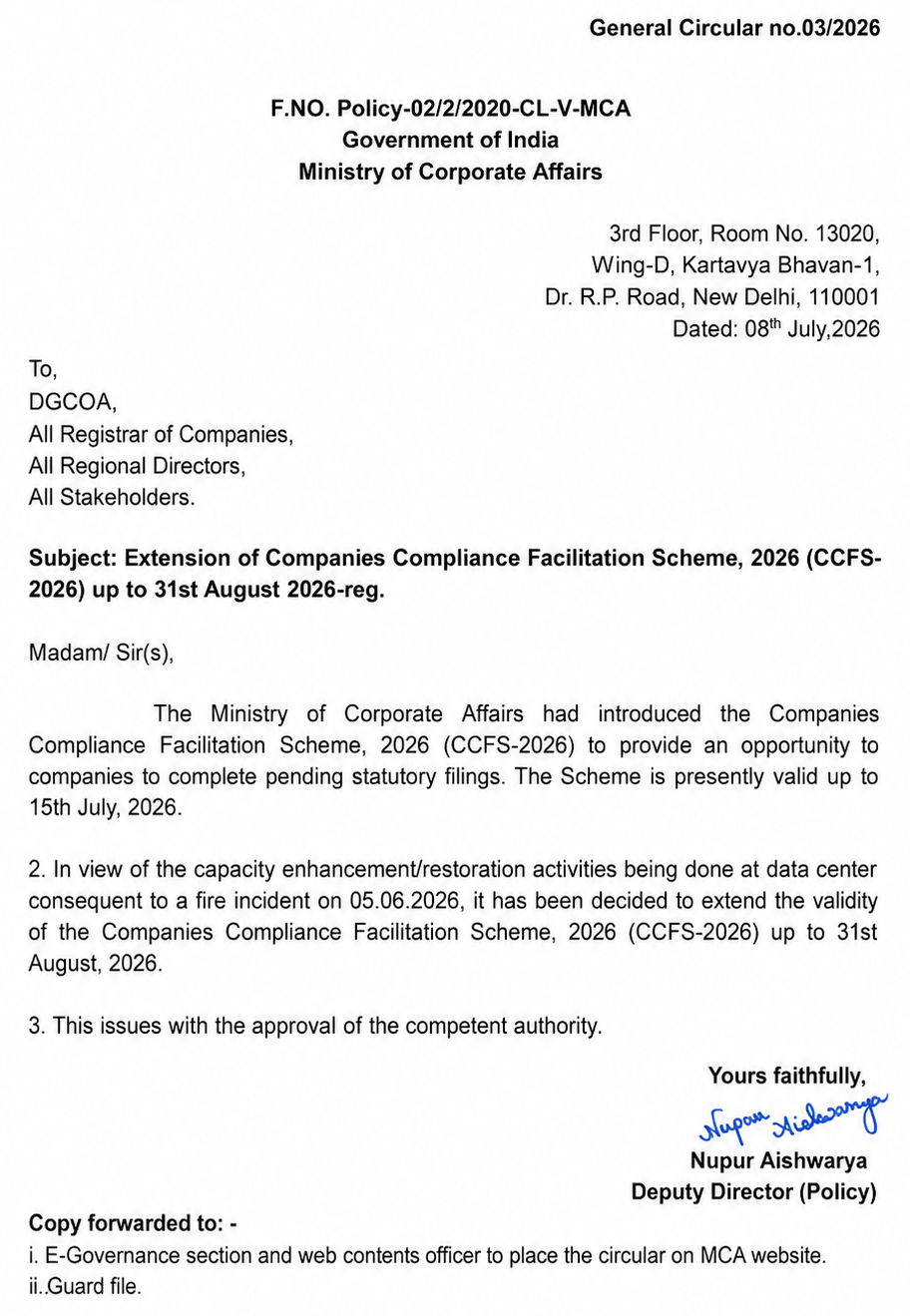
The CCFS 2026 Scheme is valid for a limited period only starting from 15 April 2026 to 15 July 2026 . According to the F.NO. Policy-02/2/2020-CL-V-MCA by the Ministry of Corporate Affairs, the deadline to the scheme is now changed from 15th July to 31st August 2026.
This is strictly time-bound one-time opportunity available for non compliant companies. Companies should complete their pending ROC filings & compliances within this window to avail the benefits of reduced additional fees under CCFS 2026 scheme.
Important Note:
After 31 August 2026, the scheme will be closed & normal MCA rules will be applied. This means defaulting companies will have to pay complete additional fees and may also attract penalties provisions for non-compliances.
Limited-Time Compliance Opportunity under CCFS 2026
The Companies Compliance Facilitation Scheme (CCFS) 2026 provides a time-bound opportunity for defaulting companies to regularise their pending ROC compliances & filings at reduced additional fees.
At Professional Utilities, we assist companies in availing the benefits under CCFS 2026 scheme by ensuring the complete and accurate filing of all pending e-forms within the allowed
By availing our professional assistance, defaulting companies can:
- Improve credibility
- Reduce financial burden
- Restore compliance status
- Avoid potential penal provisions
FAQs under CCFS Scheme 2026
What is the Companies Compliance Facilitation Scheme, 2026?
The Companies Compliance Facilitation Scheme, 2026 (CCFS-2026) is a one-time relief introduced by the Ministry of Corporate Affairs (MCA). It allows companies to file pending e-forms at reduced additional fees, providing immunity from penalty proceedings under specific provisions of the Companies Act, 2013.
When does the CCFS-2026 Scheme come into force?
The CCFS 2026 circular was issued on 24th Feb 2026 & Scheme is effective from 15th April 2026 and will remain intact till 15th July 2026. This provides companies with a three-month compliance window to regularise their pending ROC filings.
What is the objective of CCFS 2026 Scheme?
The Scheme aims to:
- Provide financial relief to companies burdened with heavy additional filing fees
- Improve overall corporate compliance levels
- Ensure that MCA records reflect updated and accurate information
- Facilitate inactive companies to opt for dormant status or strike-off at concessional fees
What is the reduced fee structure under CCFS-2026?
Under the CCFS 2026 Scheme:
- Normal filing fees - Payable as per prescribed MCA rules
- Additional fees - Reduced to only 10% of the total additional fees payable earlier as per MCA rules.
Is there any benefit for dormant company status under CCFS 2026 ?
Yes. Companies may apply for Dormant Status under Section 455 by filing Form MSC-1 and paying only 50% of the normal filing fee. This is particularly beneficial for inactive companies wishing to retain their corporate status with minimal compliance requirements.
Is strike-off allowed at concessional fees under CCFS 2026 scheme ?
Yes. Companies may apply for strike-off by filing Form STK-2 during the Scheme period by paying only 25% of the applicable filing fees.
Does the CCFS 2026 Scheme provide immunity from penalty?
Yes, immunity is granted in specific cases. Where filings are made under the CCFS 2026 Scheme:
- Proceedings under Section 92 (Annual Return)
- Proceedings under Section 137 (Financial Statements)
shall be concluded and no penalty shall be levied, subject to the prescribed conditions.
What are the conditions for immunity?
Immunity is available only if:
- Filing is done before issuance of adjudication notice; or
- Filing is completed within 30 days of issuance of notice; and
- No prosecution has already been initiated (for specified forms).
If an adjudication order imposing a penalty has already been passed, the liability to pay such penalty will continue.
Speak Directly to our Expert Today

Reliable

Affordable

Assured
Industries Served by
Professional Utilities

Apparels

Footwear

Furniture

Gems and Jewellery

Tourism & Hospitality

Consumer Electronics

Chemicals

Telecom

Oils & Gas

Hotel

Railways

Liquor

Health & Medical

Food Processing

Dangerous/ Haz. Goods

Tea & Coffee

Capital Goods

Recycling

Rubber

NGOs

Silk

Handloom

IT & BPM

Steel

Automobile

Tobacco

Constructions


Testimonials
"Explore how Professional Utilities have helped businesses reach new heights as their trusted partner."







It was a great experience working withProfessional Utilities. They have provided the smoothly. It shows the amount of confidence they are having in their field of work.

Atish Singh


It was professional and friendly experience quick response and remarkable assistance. I loved PU service for section 8 company registration for our Vidyadhare Foundation.

Ravi Kumar
I needed a material safety data sheet for my product and they got it delivered in just 3 days. I am very happy with their professional and timely service. Trust me you can count on them.

Ananya Sharma
Great & helpful support by everyone. I got response & support whenever I called to your system. Heartly thanx for Great & Super Service. Have a Great & Bright future of team & your company.

Prashant Agawekar
Thank you so much Professional Utilities team for their wonderful help. I really appreciate your efforts in getting start business. Pvt Ltd company registration was smooth yet quick.
Abhishek Kumar
I applied for Drug licence and company registration and their follow-up for work and regular updates helped me a lot. They are happily available for any kind of business consultancy.

Vidushi Saini
Great experience went to get my ITR done, process was quite convenient and fast. Had a few queries, am happy about the fact those people explained me all things I wanted to know.

Taniya Garyali
Great services provided by Professional Utilities. They are best in this industry and the best part is their prices are so affordable. Kudos to you. Now you guys are my full-time consultant.

Aftab Alam
Trusted By