
Factory License Registration in Haryana



Factory License Registration

Years of Experience
What’s Included?
Detailed Eligibility Assessment Accurate Documentation Guidance Compliance Review Ensure Regulatory Accuracy and Approval Assistance to Minimize Delays and Rejections Liaison with Factory Inspector & Department Factory License Application Management Factory Site Plan and Layout Guidance Advisory on Safety, Health, and Welfare Renewal and Amendments guidance
Get Expert Consultation

Factory License Registration in Haryana - Process, Fees & Timeline
Getting a factory license registration is a mandatory process required by manufacturing units, SMEs, and factories. To set up a manufacturing unit in industrial areas such as IMT Manesar, Sonipat, Rewari, and Ambala, business owners must obtain a certification from the State Government through the Chief Inspector of Factories, Labour Department of Haryana.
Businesses need to adhere to the laws that are set up under the Factories Act of 1948 in Haryana. The department regulates workers' safety, health, and welfare. It checks whether the factories are following the standards stated under the Factories Act, 1948, including power supply, consumption, and production, to ensure compliance.
Important Note: Factories involved in hazardous processes require an HSPCB Consent to Establish and a Fire NOC to start commencing operations.
Factory License Certificate [Sample]
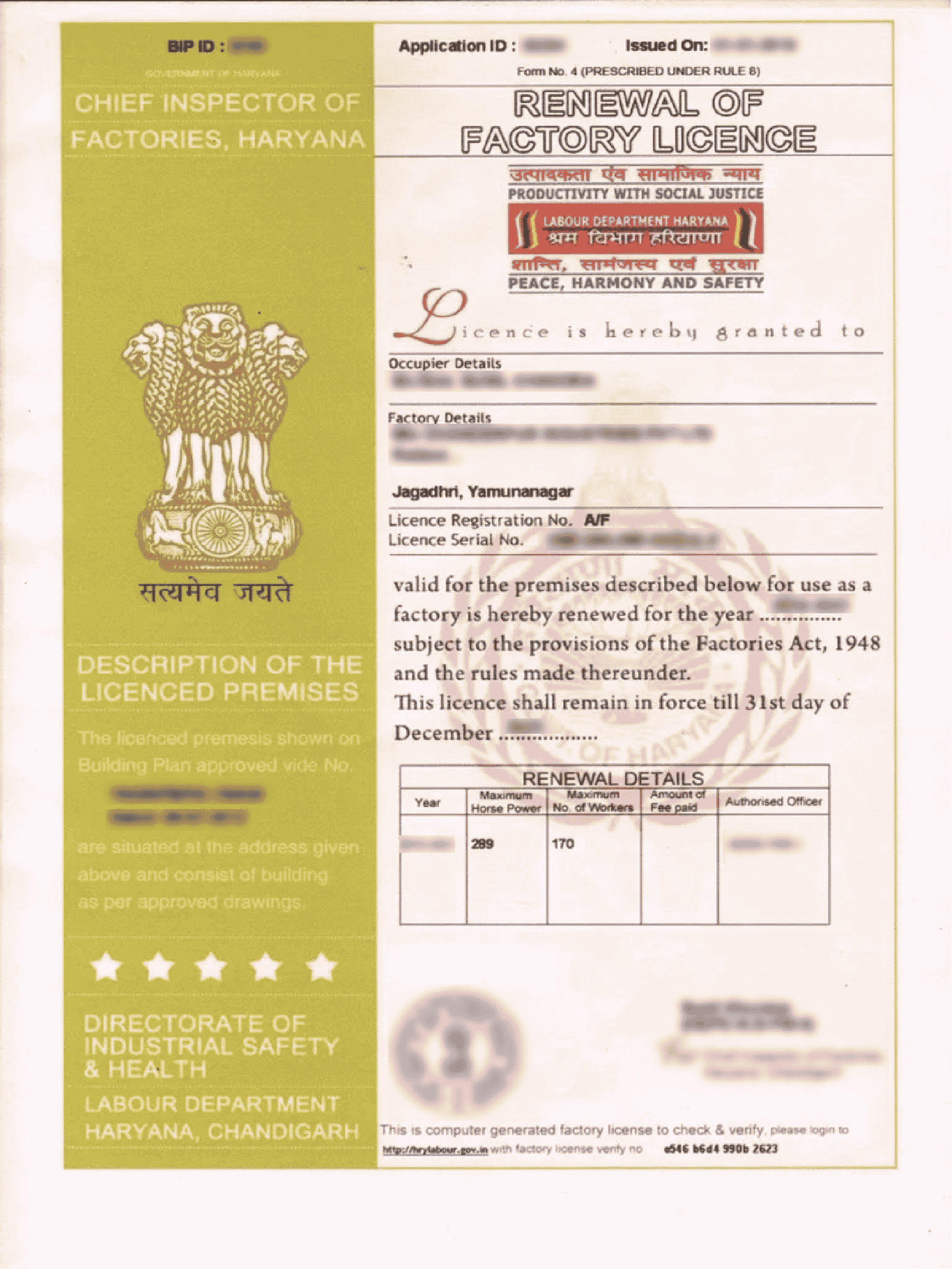
Step-by-Step Factory License Registration Process in Haryana
To apply for a factory license registration, the occupiers must read the process in detail and follow the steps correctly to ensure a license:
- Step 1: Building Plan Approval - Plans are submitted in Form 1 for approval by the Chief Inspector of Factories under Rule 3 of the Punjab Factory Rules, 1952, together with a certificate of stability under Rule 4.
- Step 2: Gather Documents - Prepare all the documents properly before registering online. The absence of any documents can hold up the registration and cause avoidable delays.
- Step 3: Log-in/Register - Visit the web portal of the Labour Department Haryana e-Governance Portal. Log in using a working mobile number and email ID. In case of new registration, create a BIP (Basic Information Proforma).
-
Step 4: Complete Application Form 2 -
Form 2 is a system-generated form that requires the basic details about the factory and the
occupier, including installed maximum horsepower, number of workers, along with a BIP.
Submit the documents in the prescribed way, which is in PDF format with a size not exceeding 2 MB. - Step 6: Application Tracking - Users can track application status online along with relevant updates on their registered mobile number or email ID. The users can verify the factory license through a third party using the 16-digit number provided on the documents.
- Step 7: Investigation and Inspection - After a successful verification, the Chief Inspector of Factories will schedule a physical inspection of the premises to examine health and environmental safety measures under the Factories Act.
-
Step 8: Issuance of Factory License -
Once the Chief Inspector of Factories grants a license, applicants can download it directly from the
Labour Department Haryana e-Governance Portal.
After processing the application, users will get a 16-digit number and an option to download the e-certificate from the portal. - Step 9: Third Party Verification - The users can verify the factory license through a third party using the 16-digit number provided on the documents.
Note: Most common rejections based on IMT Manesar, Sonipat, and Faridabad filings were caused due to documentation errors that most often lead to re-submission and delays

Documents for Factory License Registration in Haryana
To apply for a factory license registration in Haryana, submit the scanned copies of the required documents listed below:
- ID Proof of the Owner/Manager
- Copy of factory building plans
- Fire NOC
- Building Plan Approval Letter (Issued under Rule 3)
- List of Director/Partners
- AOA/MOA/Partnership Deed (only relevant pages)
- Board Resolution authorizing the Occupier
- Certificate of Stability signed by a competent person (Under Rule 4)
- Sanctioned load from HVPNL/Latest Electricity Bill
- NOC from Haryana State Pollution Control Board

Fee Structure for Factory License Registration in Haryana
The government fee for a factory license in Haryana starts from ₹1,500 and varies based on the maximum H.P. installed and the number of workers. If occupiers are willing to hire a legal partner throughout the complete registration process, they have to pay a professional fee for further assistance. The Professional fees is ₹35,399 inclusive of 18% GST.
Below is the table representing the government fee for factory license registration in Haryana:
| Horse Power Install(Max HP) | Up to 20 (₹) | From 21 to 40 (₹) | From 41 to 150 (₹) | From 151 to 250 (₹) | From 251 to 500 (₹) | From 501 to 1000 (₹) | From 1001 to 2000 (₹) | From 2001 to 3000 (₹) | From 3001 & above |
|---|---|---|---|---|---|---|---|---|---|
| Without Horse Power | ₹1500 | ₹3000 | ₹4500 | ₹6000 | ₹7500 | ₹9000 | ₹10500 | ₹12000 | ₹13500 |
| Upto 10 | ₹3000 | ₹6000 | ₹9000 | ₹12000 | ₹15000 | ₹18000 | ₹21000 | ₹24000 | ₹27000 |
| Above 10 Up to 50 | ₹4500 | ₹9000 | ₹13500 | ₹18000 | ₹22500 | ₹27000 | ₹31500 | ₹36000 | ₹40500 |
| Above 50 Up to 100 | ₹6000 | ₹12000 | ₹18000 | ₹24000 | ₹30000 | ₹36000 | ₹42000 | ₹48000 | ₹54000 |
| Above 100 Up to 500 | ₹7500 | ₹15000 | ₹22500 | ₹30000 | ₹37500 | ₹45000 | ₹52500 | ₹60000 | ₹67500 |
| Above 500 Up to 1000 | ₹9000 | ₹18000 | ₹27000 | ₹36000 | ₹45000 | ₹54000 | ₹63000 | ₹72000 | ₹81000 |
| Above 1000 Up to 2000 | ₹10500 | ₹21000 | ₹31500 | ₹42000 | ₹52500 | ₹63000 | ₹73500 | ₹84000 | ₹94500 |
| Above 2000 | ₹12000 | ₹24000 | ₹36000 | ₹48000 | ₹60000 | ₹72000 | ₹84000 | ₹96000 | ₹108000 |
| Professional Fees | 18% GST on Professional Fees | Total (Exclusive Govt. Fees) |
|---|---|---|
| ₹29,999.00 | ₹5,400 | ₹35,399 |
Note: Occupiers can check the government fee for factory license registration in Haryana through Rule 14 of the Punjab Factory Rules, 1952, as applicable in Haryana.
What is Factory License Registration in Haryana?
A factory license in Haryana is a legal permit granted by the Labour Department, Government of Haryana. It certifies that the unit meets the safety, health, and worker-welfare standards prescribed by the State. A valid factory license confirms that a Haryana manufacturing unit operates lawfully under Section 6 of the Factories Act, 1948.

According to the Factories Act, 1948, Section 2(m), a “factory” is defined as any premises, including its precincts, where a manufacturing process is carried out.
It includes:
- Any factory employing 10 or more workers engaged in manufacturing units with the aid of power.
- Any factory employing 20 or more workers involved in manufacturing units without the aid of power.
With Professional Utilities, businesses can get a factory license without any inconvenience or hassle. We assist in registration, documentation, and licensing to help businesses set up a manufacturing unit in Haryana and all over India.
Benefits of Factory License Registration in Haryana
In Haryana, a Factory License is a legal requirement under the Factories Act, 1948, for establishments engaged in manufacturing processes and certain other specified activities. Obtaining a Factory License offers several benefits to both the government and the business owner:
- Provides a legal certification to occupiers and managers who are willing to start business operations in conforming areas of Haryana.
- It mandates that the safety and health standards in Haryana are met with the requirements mentioned under the Factories Act of 1948.
- By obtaining a license, it demonstrates that the business is committed to the welfare of its employees.
- It acts as an insurance coverage, which is a pre-requisite for providing an additional license in the future.
It's important for businesses to be aware of the specific requirements and conditions associated with Factory Licenses in Haryana, as there are variations in regulations in different states.
Eligibility Criteria for Factory License Registration in Haryana
The eligibility criteria for a factory license registration in Haryana 2026 are set by the State Government under Section 85 of the Factories Act of 1948. Below are the categories of businesses which requires a license to run a factory:
- Factories with 10 or more workers, who are working or were working on any day of the preceding 12 months in any part of which a manufacturing process is being carried out with the aid of power.
- Factories with 20 or more workers who are working or were working on any day of the preceding 12 months that process manufacturing activities without the aid of power.
Secure Your Factory License Today
Stay compliant with the Factories Act and safeguard your business from penalties and shutdowns.
Call Us
Factory License Registration in Haryana - Timeline, Validity & Renewal
The Haryana Right to Service Act, 2014 sets statutory timelines for approval of factory plans and issuance of the licence. Read the table given below to understand the processing timeline, validity, and renewal period:
Processing Time
- Granted within 45 days under the Haryana Right to Service Act, 2014
Validity
- The validity of a factory license is for one, five, or ten years, depending on the option selected by the occupier.
Renewal
- Renew an application file 30 days before expiration. For a 5-year license, pay 5 times the annual fee, and for a 10-year license, pay 10 times
How to Renew Factory License in Haryana?
It is necessary to file the renewal before the deadline. However, under Rule 10 (Order No. 2/22/2020-2 Lab), auto-renewal has been approved by the Labour Department. Follow the steps below to renew a factory license in Haryana:
- Step 1: Register on the Portal - Access the HEPC portal and register as a new investor. Move forward to the section “Account Link” shown on the navigation bar and sign in. A new page will be shown on the screen by clicking on the " Sign” button. Choose the “New Investor Registration” link.
- Step 2: Create CAF - A new registration page will appear; the applicant has to fill in the details and create a new CAF as shown in the navigation menu. In the pop-up, select the option “Renewal of Factory Registration/CTO/Boiler. A new page will be redirected, and the applicants will be shown the option to provide basic details.
- Step 3: Fill out the Service Form - Provide a BIP ID (factory details, workforce, power usage, details of occupier and manager, and manufacturing process description), which was earlier already mentioned on https://hrylabour.gov.in. This is a one-time process. Once the applicants enter the BIP ID, there will be two modes available, including the mobile and email registered on Hrylabour to receive a notification.
- Step 4: Pay the Required Fee - Pay the auto-calculated fee shown on the screen. This fee will be calculated on the basis of the total number of workers and the maximum horsepower installed.
- Step 5: Print & Download - Download and print the application and acknowledgement Form No. 2. Send the physical copies to the Chief Inspector of Factories within 15 days of online submission.
What is the Difference between an Occupier and Manager?
Under the Factories Act, 1948, Section 2 (n) intends to show the specific roles for better accountability, governance, and compliance. Here are the main differences between them.
| Category | Occupier | Factory Manager |
|---|---|---|
| Meaning | An individual who has ultimate control over the affairs of the factories. | A person who is designated to manage day-to-day operations [Section 7(1) (f)] |
| Authority |
A firm/Association of individuals: Any partner can be an occupier.
A Company: One of the Directors shall be deemed to be the occupier. Government-Based Factory: The appointed managing authority will be an occupier. Under Section 2(n) |
Appointed by the occupier, their name should be notified to the Chief Inspector of Factories. |
| Functions | Factories' policies and compliance at the senior or highest level. | Checking the daily operations in the factory and reporting to the occupier about workers' Proformance and business profits. |
| Worker Safety & Welfare |
Being in a higher position, they may not always be present on site. | Expected to be present at the site daily to ensure operational work and safety. |
| Separation of Power | Policy making, legal compliance, and financial control | Day-to-day operations, workers' safety, and implementation of policies. |
However, under section 92 of the Factories Act of 1948, both the occupiers and the managers are liable for violating safety, health, or welfare provisions.
Factory vs Trade License vs Shop & Establishment Registration in Haryana
Read the table given below to understand the core difference between the factory, trade, and shop and establishment registration :
| Category | Factory License | Trade License | Shop & Establishment License |
|---|---|---|---|
| Overview | A factory license is a legal authorisation by state government authorities to start a manufacturing facility. | A trade license is an authority given to a person to conduct certain business or trade, | A shop establishment license is a legal permission for anyone starting a business or shop with the local government. |
| Issuing Authority | Governed by the Factories Act of 1948 and issued by the State Labour Department | Granted by the local municipal corporations such as MCG (Gurugram) and MCF (Faridabad) under the Haryana Municipal Corporation Act, 1994. | The Punjab Shops and Commercial Establishments Act, 1958, as applicable in Haryana, is administered by the same Labour Department. |
| Requirement | Mandatory for manufacturing units, plants, or businesses using heavy machinery and employing a specific number of workers (10 or more workers with the aid of power and 20 or more workers without the aid of power. | Legal authorization to conduct special commercial activities within the jurisdiction. | Required essentially for all shops, retail stores, and commercial service providers like hotels and offices. |
| Primary Focus | Prioritize worker health, safety, industrial hygiene, and hazardous protection. | Verify that commercial activity aligns with local zoning laws and doesn’t cause public nuisance and meets basic civic health and sanitation standards. | Regulate employees' working conditions, daily/weekly working hours, wages, leaves, and holidays |
| Examples | Power-using manufacturing units, non-power-using units, factories with hazardous operations, and export-oriented units | For restaurants, canteens, food stalls, and manufacturing enterprises, etc., a trade license | Every shop and commercial institution requires a shop and establishment registration. |
Operating a Factory without a Factory License - Legal Risk & Penalties
One of the mandatory tasks is to obtain a factory license to construct, extend, or commence a manufacturing unit in Haryana. Breaching the law results in legal consequences and hurdles for a factory.
Here are the consequences of operating a factory without a license:
| Offence/ Violation | Legal Section | Penalty Details |
|---|---|---|
| Without a valid factory license | Section 92 |
Imprisonment up to 2 years or a fine up to ₹1,00,000 or both.
If the contravention continues, the charges will be ₹1,000 per day. |
| Subsequent Repeat Contravention | Section 94 | Imprisonment up to 3 years or a fine not less than ₹10,000, which can extend up to ₹2,00,000. |
| Safety Provision (Non-Compliance) | Section 92 | Fine up to 1 lakh and mandatory certification orders. |
| Fatal Accident | Section 92 | Fine not less than ₹25,000. |
| Severe Injury | Section 92 | Fine, not less than ₹5,000. |
| Obstructing an Inspector | Section 95 | Imprisonment up to 6 months OR fine up to ₹10,000 OR both. |
| Hazardous Process Contravention | Section 96A (Sections 41B, 41C, and 41H) | ₹5,000 for every day of the violation. |
| Use of Building, Plant or Machinery Involving Imminent Danger to Human Life or Safety | Section 40(2) | The Inspector may serve a written order prohibiting its use until it is properly repaired or altered. |
OSHW Code 2020 - Key Provisions for Factory Workers in Haryana
The OSHW (Occupational Safety, Health & Working Conditions) code came into force on 21 November 2025 and includes the Factories Act of 1948. It consolidates 13 major archaic central laws such as the Factories Act, 1948, and the Contract Labour Act, 1970.
Until Haryana notifies its state rules under the code, licensing was operated under the existing Punjab Factory Rules, 1952, as applicable in Haryana by virtue of the code’s saving provisions.
- The maximum working hours are 8 hours a day. However, overtime mandates flexibility in working hours but structured models with double pay for extra hours.
- Women are allowed to work on nights, but the employers must provide proper safety facilities and transportation.
- Under Section 22 of the OSHW Code 2020, the appropriate Government may require factories employing 500 or more workers to constitute a Safety Committee with an equal number of employer and worker representatives
- The definition of migrant workers is broadened to include those who migrate independently or through contractors.
- ISMW will get a journey allowance and expanded portability benefits under the Building & Other Construction Workers (BOCW) Cess fund and PDS ration.
- Workers are eligible for free annual health checkups. The plantation workers can avail of ESI facilities for medical services.
- The code provides social security funds for establishments for the welfare of the unorganised workers.
Factory License Categories and Applicable Requirements in Haryana
Haryana issues a single factory license. However, multiple types of industries are categorised based on their nature of operations, level of risk, and operational time frame. A factory license ensures safety protocols and site clearances, and welfare requirements under the Factories Act,1948. Read the table mentioned below to identify which category applies to your unit:
| Classification | Standard Factory License | Hazardous Factory License | Seasonal Factory License |
|---|---|---|---|
| Who needs it | General manufacturing unit employing 10 or more workers or 20 workers without power. | Handles dangerous chemicals or processes (First Schedule of the Act). | Issued to industries that operate only during a specific period of the year. |
| Applicability | Conventional manufacturing units, which are carried out throughout the year | Factories engaged in “hazardous processes” listed under Schedule 1 of the Factories Act. | Businesses that operate only during a specific period of the year. |
| Key Requirements | Requires Building Plan Approval, Certificate of Stability, and Fire NOC. |
Occupiers must submit emergency disaster plans and on-site safety reports and conduct
health monitoring.
Along with that, State Pollution Control Board (SPCB) clearances & PESO (Petroleum and Explosives Safety Organization) clearances |
The applicability threshold applies just as they do for standard factories based on 10+
or 20+ workers.
They must notify the Chief Inspector 30 days before the season starts and 30 days after the operation closes. |
| Examples | Engineering workshops, plastic moulding units, packaging and assembly plants, textile units. | Chemicals, Explosives, Radioactive Substances | Sugar Mills, Rice Mills, Fruit Processing Units, and Salt Works. |
Compliance to Follow After Obtaining Factory License in Haryana
After getting a factory license, maintain continuous compliance under the Factories Act of 1948 and Haryana Factories Rules by managing health, safety, welfare, and statutory record keeping.
- Ensure proper cleanliness, ventilation, comfortable temperatures, and lighting to prevent overcrowding and unhealthy conditions.
- Maintain machinery safety by securing encing and inspecting on a regular basis.
- Keep Form 12 (Register of Adult workers and Form 17 for updating health registers of workers.
- Conduct periodic statutory returns on time, including Form 21 for annual return and Form 22 for half-yearly return to Haryana Labour Department.
- Track license validity and apply again promptly for renewal before the deadline.
These are all important aspects of employment that should be considered for the health, safety, and well-being of workers.

Secure a Factory License in Haryana with Professional Utilities
Factory License registration is a mandatory certification required by manufacturing units in Haryana, Gurugram, Faridabad, Panipat, Panchkula, Sonipat, Ambala, Bhiwani, Jhajjar, Rohtak, and Hisar. It acts as a legal basis for the business in the market and among stakeholders.
At Professional Utilities, the process of factory license registration starts at ₹35,399 /- only. We assist our clients with utmost dedication and trust. From receiving building approval to registration, our team of professionals guides with the entire process. For any queries related to registration and fee structure, contact us.
FAQ’s On Factory License Registration in Haryana
How to get a factory license in Haryana?
Occupiers can get a factory license in Haryana by preparing a building plan approval signed by the Chief Inspector of Factories. Gather the documents and register a user profile via the Haryana Labour Department e-government portal. After that, complete application form 2, submit the document, and pay the applicable fee.
Verify the application form, and the inspector will examine the premises by visiting the place physically. Once the inspector gets satisfied, they will issue a license.
Can I transfer a factory license to another individual in Haryana?
A factory license is not transferred between individuals. As per the Rule, when the occupier changes, the license can be amended, and ₹100 will be charged.
Who issues the factory license in Haryana?
In Haryana, building approval plans are granted by the Chief Inspector of Factories. Whereas the factory license is granted by the Labour and Employment Department under the Factories Act of 1948.
How long is a factory license valid in Haryana?
The factory licence is generally valid for one calendar year, which expires on 31st December. As per the updated state provisions, the validity period has been extended up to five and ten years.
Can I apply for a factory license for 10 years in Haryana?
Yes, occupiers can apply for a factory license for 10 years in Haryana. But if opting for 10 years, they must pay a fee 10 times the standard annual fee.
Is a factory license auto-renewal available in Haryana?
Yes, auto-renewal is available in Haryana. It is available for up to 10 years, but there should be no changes in the factory details such as occupier name, address, maximum horsepower, and employee headcount.
Are HSPCB and Fire NOC mandatory before applying in Haryana?
Yes, HSPCB (Haryana State Pollution Control Board) and Fire NOC are mandatory in Haryana for most commercial and industrial businesses. It is not immediately required at the time of registering, but for approving building plans and inspection, HSPCB and Fire NOC are essential documents.
What is the 16-digit number on the factory license in Haryana?
The 16-digit number is a unique verification number available on the Haryana factory license. It is also referred to as a unique identification number provided by the State Ease of Doing Business and Labour Department portals.
What happens if I renew the factory license late in Haryana?
In case of renewing the factory license after the deadline, pay an additional charge of 25% of the regular renewal fee.
Speak Directly to our Expert Today

Reliable

Affordable

Assured
Industries Served by
Professional Utilities

Apparels

Footwear

Furniture

Gems and Jewellery

Tourism & Hospitality

Consumer Electronics

Chemicals

Telecom

Oils & Gas

Hotel

Railways

Liquor

Health & Medical

Food Processing

Dangerous/ Haz. Goods

Tea & Coffee

Capital Goods

Recycling

Rubber

NGOs

Silk

Handloom

IT & BPM

Steel

Automobile

Tobacco

Constructions


Factory License Registration in Other States
Factory License Registration in Rajasthan
Explore the factory license registration process, requirements, documents, fees, eligibility criteria, and important compliance requirements for factories.
Factory License Registration in Himachal Pradesh
Check the factory license registration process in Uttar Pradesh, including its criteria and documents, fees, penalties, and requirements for obtaining a factory license.
Factory License Registration in Uttar Pradesh
Check the process for a factory license registration in Uttar Pradesh, total fees, required documents, compliance requirements, along with benefits.
Factory License Registration in Uttarakhand
Learn the complete process for factory license registration in Uttarakhand, including required documents, applicability, fee components, and penalties for non-compliance.
Disclaimer:The information provided on this website is intended for general information purposes only. Although all reasonable efforts are made to ensure that the information provided is correct and reliable, it is not advised to be used as a substitute for professional advice. The information herein is not to be used in place of seeking professional services, counsel, or guidance. We highly advise that you consult a professional before you make any business or legal decisions regarding the information presented on this website. This website and its contents are given "as is", and we do not take any responsibility for any action that is taken based on information given on this website.

- Written by: Richa Thakur
- Fact-checked: Sahil Singh
- Updated on: August 06, 2026
Testimonials
"Explore how Professional Utilities have helped businesses reach new heights as their trusted partner."





It was a great experience working withProfessional Utilities. They have provided the smoothly. It shows the amount of confidence they are having in their field of work.

Atish Singh


It was professional and friendly experience quick response and remarkable assistance. I loved PU service for section 8 company registration for our Vidyadhare Foundation.

Ravi Kumar
I needed a material safety data sheet for my product and they got it delivered in just 3 days. I am very happy with their professional and timely service. Trust me you can count on them.

Ananya Sharma
Great & helpful support by everyone. I got response & support whenever I called to your system. Heartly thanx for Great & Super Service. Have a Great & Bright future of team & your company.

Prashant Agawekar
Thank you so much Professional Utilities team for their wonderful help. I really appreciate your efforts in getting start business. Pvt Ltd company registration was smooth yet quick.
Abhishek Kumar
I applied for Drug licence and company registration and their follow-up for work and regular updates helped me a lot. They are happily available for any kind of business consultancy.

Vidushi Saini
Great experience went to get my ITR done, process was quite convenient and fast. Had a few queries, am happy about the fact those people explained me all things I wanted to know.

Taniya Garyali
Great services provided by Professional Utilities. They are best in this industry and the best part is their prices are so affordable. Kudos to you. Now you guys are my full-time consultant.

Aftab Alam
Trusted By