MSDS Certificate for Acetone



MSDS Delivered

Years of Experience
What’s Included?
MSDS/SDS physical & PDF file MSDS Drafting (16 sections) Global Compliance Alignment Shipping / Custom Documentation Support DG / HAZMAT Classification Support Revision support & Version control Hazard classification & Compliance check Label & Packaging guidance Information collection & Product assessment
Get Expert Consultation

MSDS Certificate for Acetone - Process, Fees, and Documents
An MSDS Certificate (Material Safety Data Sheet) for Acetone is an important document that gives explicit safety, handling, and emergency details of this popular chemical. Acetone is a very combustible, volatile, colorless liquid with a pungent odor. It is widely used as a solvent in industries including pharmaceuticals, cosmetics, paint production, and laboratory research.
Acetone (CAS 67-64-1) also known as propanone or dimethyl ketone by its IUPAC name is a colourless volatile liquid having molecular weight of 58.08 g/mol and C₃H₆O as its molecular formula evaporates rapidly and can cause fire and health threats. An MSDS/SDS Certificate becomes necessary for secure application, suitable storage, and preparatory safety procedures. The paper supplies fundamental information on chemical behavior, potential threats, first aid procedures, measures to extinguish fire, procedures to handle spilling, and ways to discard it.
Regulatory agencies like OSHA (Occupational Safety and Health Administration), REACH (Registration, Evaluation, Authorization, and Restriction of Chemicals), and GHS (Globally Harmonized System) mandate an MSDS for Acetone to provide for workplace safety and environmental compliance.
Acetone is classified as UN1090 (Class 3 — Flammable Liquid) under the UN Dangerous Goods transport regulations. IATA DGR, IMDG Code, and ADR all classify acetone as Class 3 dangerous goods (DG). An MSDS Certificate for Acetone is needed by companies to prevent risks, secure employees from exposure, and satisfy health and safety laws. Export shipments containing acetone require DG-compliant packaging with UN Mark IIP Certification.
MSDS Certificate for Acetone [Sample]
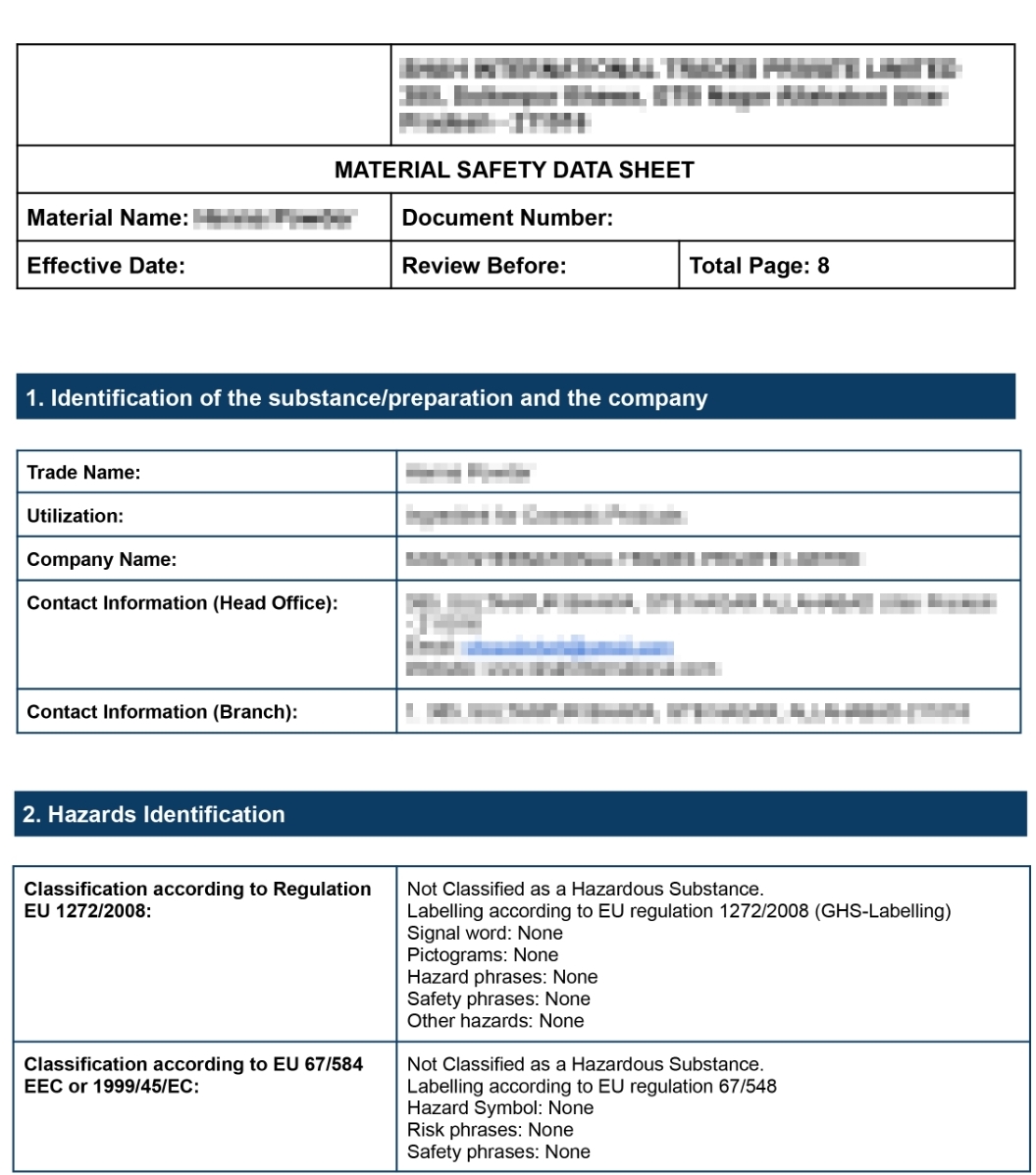
Application Process for MSDS Certificate for Acetone
MSDS (Material Safety Data Sheet) Certificate For Acetone requires a formal process to abide by international safety standards such as OSHA, GHS, and REACH.
Gather Required Information & Documents :
- Retrieve product information such as chemical composition, safety protocols, and hazard classifications.
- Procure relevant documents like company information, product parameters, and analytical test reports.
Hazard Classification & Data Review :
- Our EHS expert analyzes acetone composition data (CAS 67-64-1), physical-chemical properties, and GHS hazard classification
- For standard chemicals like acetone, no physical lab testing is required MSDS is drafted from verified chemical data and existing certificate of Analysis (COA)
Preparation of MSDS Report :
- A trained safety professional drafts the Material Safety Data Sheet as per international standards of safety.
- The report includes all 16 GHS sections with: CAS 67-64-1 identification, UN1090/Class 3 transport data, flash point (-20°C), LEL/UEL values, first aid for inhalation/skin/eye/ingestion exposure and appropriate firefighting media (CO₂, dry powder — NOT water)
Review & Finalization :
- The completed MSDS is reviewed by a senior EHS expert for GHS compliance, hazard classification accuracy, and all 16-section completeness.
- The finalized certificate is delivered to the applicant
Approval & Issuance of MSDS Certificate :
- Once successfully verified, the MSDS certificate is issued to the applicant.
- Enterprises can utilize the MSDS report for regulatory compliance, international trade, and workplace safety guidelines.

Documents Required for MSDS Certificate for Acetone
The following documents are essential for obtaining an MSDS Certificate for Acetone, ensuring workplace safety, regulatory compliance, and responsible chemical management.

- Company Information
- GST Registration Certificate
- Import Export Code
- CAS No.
- Acetone specification & details
- Photograph of Product Container / Packaging Material with Label
- Percentage wise composition of ingredients
- Certificate of Analysis / Test Report
- Emergency Contact details like Phone number & Email address
Fees for MSDS Certificate for Acetone
For Acetone, the cost of an MSDS/SDS certificate starts at Rs 4,499 for one certificate and Rs 8,999 for two. You can get Multiple MSDS certificates at discounted prices.
| No of MSDS Certificate | Fees For MSDS Certificate for Acetone (₹) |
|---|---|
| 1 MSDS Certificate | ₹4,499 (Including GST) |
| 2 MSDS Certificate | ₹8,999 (Including GST) |
| Multiple Certificates | Get Pricing by Contacting Us |
What is MSDS Certificate for Acetone?
A Material Safety Data Sheet (MSDS) certificate for Acetone is a formal document that contains comprehensive information regarding a chemical's properties, risks, safe handling practices, and emergency procedures. It is necessary for workplace safety and regulatory compliance when handling dangerous substances.
MSDS certificate contains important information like chemical composition, hazard classification, first aid measures, fire-fighting, safe storage conditions, handling procedures, and disposal practices. It provides workers, manufacturers, and industries with information on potential hazards and helps them take necessary safety precautions.
Government regulatory bodies like OSHA (Occupational Safety and Health Administration), GHS (Globally Harmonized System), and REACH (Registration, Evaluation, Authorization, and Restriction of Chemicals) mandate that companies have a current MSDS certificate to be in line with safety guidelines.
Importance of MSDS Certificate for Acetone
The MSDS Certificate (Material Safety Data Sheet) for Acetone is a requirement to maintain safe handling, storage, and use of the extremely volatile and flammable chemical. Acetone finds extensive application in various industries such as pharmaceuticals, cosmetics, paint production, and laboratory studies, and therefore correct safety documentation becomes important to avoid hazards.
- Identifies Hazards: Acetone is extremely flammable and can induce skin, eye, and breathing irritation. The MSDS lists all possible hazards and safety measures.
- Safe Storage & Handling: The MSDS documents in detail Acetone storage safely, the temperature requirements, ventilation needs, and proper housing to prevent fires.
- Emergency First-Aid Measures: If accidental exposure, inhalation, or ingestion occurs, the MSDS lists prompt first-aid actions to limit health hazards.
- Fire & Spill Control: Because Acetone is extremely flammable, the MSDS lists fire-fighting measures and spill control procedures to ensure workplace safety.
- Regulatory Compliance: The MSDS helps companies comply with global safety standards like OSHA, REACH, and GHS, preventing legal action.
- Workplace Safety: The MSDS serves as a workers' safety guide, manufacturers' safety guide, and emergency responders' safety guide, aiding in a safer workplace.
Physical and Chemical Properties of Acetone
- Flash Point: Acetone's flash point of -20°C (4°F) depicts that it ignites temperatures well below room temperature — making it one of the most commonly flammable industrial chemicals. Obtaining MSDS certificate for such chemical products is mandatory for all acetone storage and transport
- Boiling Point & Auto-Ignition Temperature: Acetone evaporates rapidly at room temperature (boiling point 56°C), forming explosive vapor-air mixtures (LEL 2.5%, UEL 12.8%). These properties make MSDS documentation essential for storage areas and transport vehicles carrying acetone
- Vapour Density: Acetone vapour is denser than air (vapour density 2.0), meaning vapours accumulate in drains, pits, and low-lying areas creating risk of explosion.
- H – Codes & P- Codes for Acetone- Hazard Statements: H225 (Highly flammable), H319 (Eye irritation), H336 (CNS effects). Precautionary Statements: P210 (Keep away from heat/sparks/flame), P243 (Take precautions against static discharge), P261 (Avoid breathing vapours), P303+P361+P353 (If on skin or hair: remove clothing, rinse skin)
Validity & Renewal of MSDS Certificate for Acetone
An MSDS/SDS certificate is generally valid for 3 years from the date of issuance, and it must be renewed in case of any changes in GHS guidelines or every 3 years, whichever is earlier. However, any changes must be updated within 90 days. An updated SDS certificate helps avoid customs delays, as authorities often consider certificates that are not older than 3–5 years.
MSDS Certificate must be updated when:
- Purity, chemical composition, or ratio of substance changes.
- New information on toxicity, carcinogenic properties, or environmental effects becomes available.
- New handling, storage, or emergency response information becomes available.
Note: If there is any change in regulations within 6 months from the date of issuance of MSDS certificate, Professional Utilities issues the updated MSDS certificate on a complimentary basis.
Get Your MSDS Certificate for Acetone with Expert Assistance
MSDS Certificate for Acetone is an important certificate that guarantees safe handling, storage, and disposal of the very volatile and combustible chemical known as Acetone. It is commonly applied in industrial, pharmaceutical, and laboratory use, so there should be adequate safety measures in place.
Through presenting detailed information about possible hazards, first-aid measures, fire safety, and regulatory compliance, the MSDS protects workers, manufacturers, and emergency responders against risks of exposure to Acetone. Professional Utilities with more than a decade of experience assist you in smooth and hassle-free preparation of MSDS certificate in Surat and across PAN-India. We ensure that OSHA, REACH, and GHS, among other international safety standards, are followed to promote workplace safety, maintain regulatory compliance, and support the risk-free handling, storage, and transportation of Acetone across all industrial applications.
FAQ’s On MSDS Certificate for Acetone
What is an MSDS Certificate for Acetone?
An MSDS Certificate (Material Safety Data Sheet) for Acetone is a document that gives safety data regarding the chemical, such as hazards, handling precautions, first-aid measures, and emergency procedures to guarantee safe use.
Why is an MSDS Certificate needed for Acetone?
Acetone is extremely combustible and can be hazardous to health through skin and eye irritation or respiratory complications. The MSDS must be made available for safe handling, workplace safety, and compliance with regulations.
Who requires an MSDS Certificate for Acetone?
These industries include pharmaceuticals, cosmetics, paint production, printing, and laboratories, and they need an MSDS to adhere to safety laws and avoid accidents.
How can I get an MSDS Certificate for Acetone?
You can get an MSDS from chemical suppliers, manufacturers, or regulatory agencies that offer safety information based on laboratory testing and compliance requirements.
Is an MSDS the same as an SDS (Safety Data Sheet)?
Yes. The MSDS (Material Safety Data Sheet) is the previous format, whereas the SDS (Safety Data Sheet) conforms to the revised Globally Harmonized System (GHS) for standardized safety reporting.
How frequently should the MSDS Certificate be revised?
The MSDS is to be revised whenever there is new safety information or according to regulatory requirements, normally every three to five years.
Is an MSDS Certificate legally necessary for Acetone?
Yes, it is required by regulatory agencies such as OSHA (USA), REACH (EU), and GHS (Global) for all hazardous chemicals used in a commercial or industrial environment to provide an MSDS/SDS.
How do I obtain an MSDS Certificate for Acetone?
You may get an MSDS from your chemical supplier, manufacturer, or online databases that offer certified safety documentation.
Speak Directly to our Expert Today

Reliable

Affordable

Assured
Industries Served by
Professional Utilities

Apparels

Footwear

Furniture

Gems and Jewellery

Tourism & Hospitality

Consumer Electronics

Chemicals

Telecom

Oils & Gas

Hotel

Railways

Liquor

Health & Medical

Food Processing

Dangerous/ Haz. Goods

Tea & Coffee

Capital Goods

Recycling

Rubber

NGOs

Silk

Handloom

IT & BPM

Steel

Automobile

Tobacco

Constructions


MSDS Certificate in Other States
Related Articles
MSDS Certificate for Chemicals
Disclaimer:The information provided on this website is intended for general information purposes only. Although all reasonable efforts are made to ensure that the information provided is correct and reliable, it is not advised to be used as a substitute for professional advice. The information herein is not to be used in place of seeking professional services, counsel, or guidance. We highly advise that you consult a professional before you make any business or legal decisions regarding the information presented on this website. This website and its contents are given "as is", and we do not take any responsibility for any action that is taken based on information given on this website.

- Written by: Anuja Sahi
- Fact-checked: Sahil Singh
- Updated on: May 27, 2026
Testimonials
"Explore how Professional Utilities have helped businesses reach new heights as their trusted partner."





It was a great experience working withProfessional Utilities. They have provided the smoothly. It shows the amount of confidence they are having in their field of work.

Atish Singh


It was professional and friendly experience quick response and remarkable assistance. I loved PU service for section 8 company registration for our Vidyadhare Foundation.

Ravi Kumar
I needed a material safety data sheet for my product and they got it delivered in just 3 days. I am very happy with their professional and timely service. Trust me you can count on them.

Ananya Sharma
Great & helpful support by everyone. I got response & support whenever I called to your system. Heartly thanx for Great & Super Service. Have a Great & Bright future of team & your company.

Prashant Agawekar
Thank you so much Professional Utilities team for their wonderful help. I really appreciate your efforts in getting start business. Pvt Ltd company registration was smooth yet quick.
Abhishek Kumar
I applied for Drug licence and company registration and their follow-up for work and regular updates helped me a lot. They are happily available for any kind of business consultancy.

Vidushi Saini
Great experience went to get my ITR done, process was quite convenient and fast. Had a few queries, am happy about the fact those people explained me all things I wanted to know.

Taniya Garyali
Great services provided by Professional Utilities. They are best in this industry and the best part is their prices are so affordable. Kudos to you. Now you guys are my full-time consultant.

Aftab Alam
Trusted By