GSTP Certificate Registration

GSTP Certificate

Years of Experience
What’s Included?
GSTP Certificate of Origin Rules of Origin & Tariff Concession Assessment HS Code Classification Support IEC & GST Verification Facilitation in DGFT Coordination & Liaison Application on Authorised Issuing Portal Expert Filing & Follow-Up
Get Expert Consultation

Global System of Trade Preferences (GSTP) Registration - Process & Fees
GSTP also referred to as Global System of Trade Preferences among Developing Countries is a multilateral trade agreement aimed at developing and advancing trading relations between developing countries. Introduced on 13 April 1988, is a trade strategy aimed at establishing better trade cooperation with preferential tax reductions, improved market access, and enhanced economic relations. Started by the G77 and negotiated under UNCTAD, GSTP is important in the process of trade liberalization and development.
By joining GSTP, participating countries get access to trade opportunities facilitating exporters and manufacturers with better access to markets at more desirable tariff rates and taxes. Reduced import taxes and easier procedures for global trade allow holders of the GSTP Certificate to take advantage of improved opportunities for exporting their products. The agreement also focuses on trade liberalization of products under the south-south division, thus providing developing countries with a chance to diversify with traditional trading partners.
GSTP certificate of Origin has gone through several negotiation rounds, and countries have actively added new areas to the agreement. It not only helps increase the flow of imports and exports but also strengthens international relations and trade ties among member countries. It is also useful for countries that are still developing their trade relations and want to expand their reach.
The case for engaging with GSTP is stronger now than at any point since the agreement entered into force. South-South trade, the trade GSTP is specifically designed to facilitate has grown from $500 billion in 1995 to $6.8 trillion in 2025. Today, 57% of developing country exports go to other developing markets, up from 38% in 1995. India, as a major GSTP member with ratification of the São Paulo Round Protocol in 2010, is well positioned to capture this growing demand across pharmaceuticals, chemicals, textiles, and engineering goods precisely the sectors where Indian exporters are globally competitive. Once the Protocol enters into force (pending Mercosur group ratification), Indian exporters will gain preferential access on over 47,000 tariff lines across GSTP member markets. India ratified the São Paulo Round Protocol in 2010, making it one of the earliest signatories to commit to the expanded GSTP tariff concessions. Once the Protocol enters into force (pending Mercosur group ratification), Indian exporters will gain preferential access on over 47,000 tariff lines across GSTP member markets. Professional Utilities provides detailed explanation on how to get GSTP, its benefits, and the process of getting GSTP certification.
Process for GSTP Certificate of Origin
To obtain a GSTP Certificate of Origin, applicants must complete the registration process on the DGFT Trade Connect ePlatform and submit the required documents. Here are the steps to apply:
- Step 1: Account Registration Create an account on the DGFT Trade Connect ePlatform using an Organisation-based Digital Signature Certificate (DSC — Class 2 or Class 3) with embedded IEC or Aadhaar e-sign. First-time users must register their IEC on the portal before proceeding.
- Step 2: Verify Member Country Eligibility Before initiating the application, verify that the destination country is a GSTP member. GSTP currently has 42 member countries including Algeria, Argentina, Bangladesh, Brazil, Chile, Cuba, Egypt, Ghana, India, Indonesia, Iran, Malaysia, Mexico, Morocco, Nigeria, Pakistan, Philippines, Republic of Korea, Singapore, Sri Lanka, Thailand, Trinidad and Tobago, Tunisia, Uruguay, Venezuela, Vietnam, and Zimbabwe, along with Mercosur as a trading bloc.
- Step 3: Online Application Log in to the portal and initiate an online application by selecting Global System of Trade Preferences (GSTP) as the applicable trade agreement for export to the destination GSTP member country.
- Step 4: Fill Application Form Fill in the application form accurately with product details including HS Code, FOB value, origin compliance declaration, consignee information, and shipment details along with supporting documents.
- Step 5: Upload Documents Attach all mandatory documents including Commercial Invoice, Packing List, Bill of Lading or Airway Bill, Export Declaration Form, Purchase Bill with details on raw material origin, IEC certificate, RCMC, and Manufacturer Exporter Declaration.
- Step 6: Pay Registration Fee Submit the applicable government fee as shown on the screen. The fee is auto-calculated based on the invoice value. Payment is made online through the DGFT portal payment gateway.
- Step 7: Issuance of Certificate Upon verification of the application and documents, the Export Inspection Council (EIC) issues the GSTP Certificate of Origin, typically within 3 to 5 working days from the date of complete submission, as designated in Appendix 2B of the Handbook of Procedures (HBP) under the Foreign Trade Policy 2023.

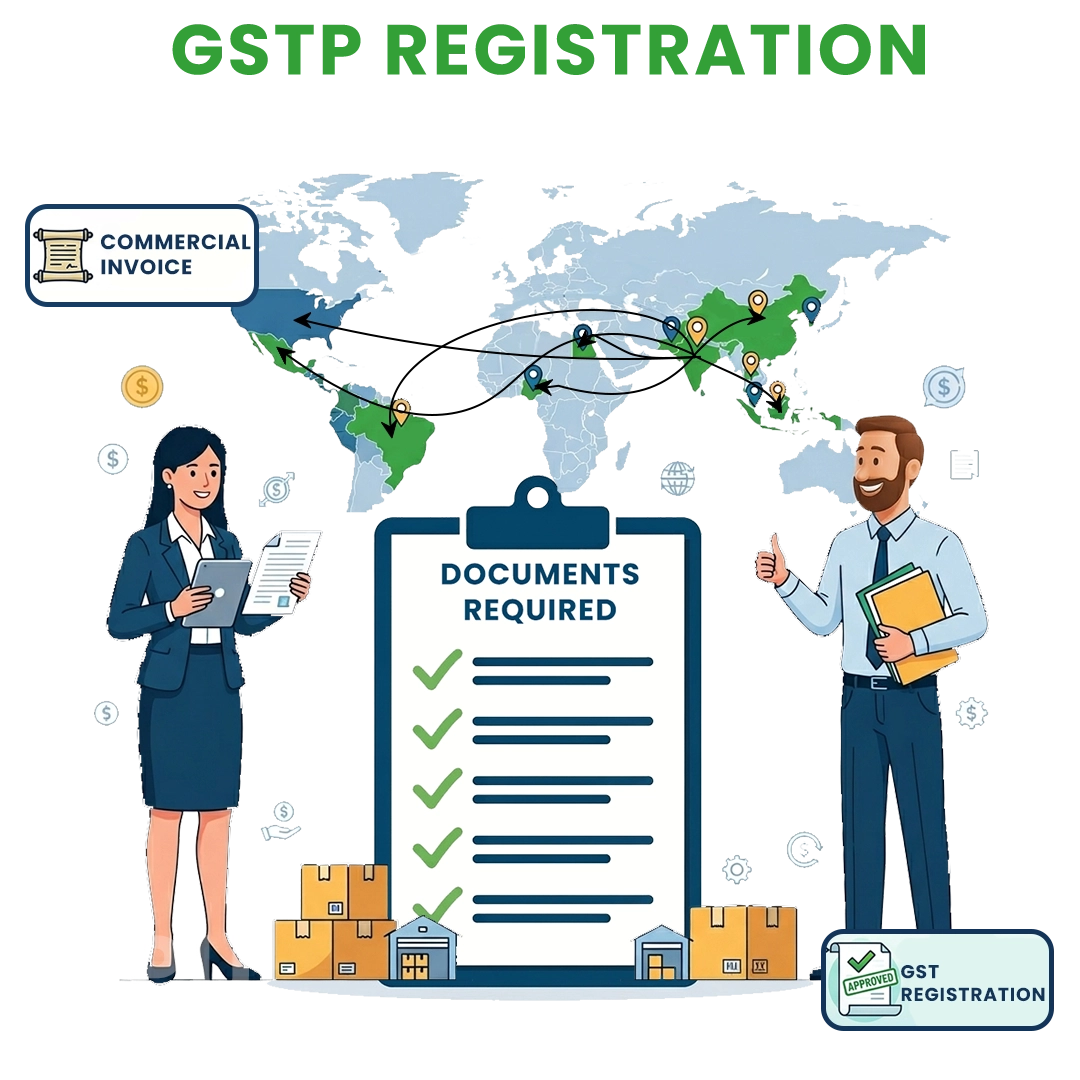
Documents Required for GSTP Registration
GSTP registration requires specific documents to ensure your business complies with export regulations. Here's a list of the essential documents needed for the process.
- IEC (Importer Exporter Code)
- Registration Cum Membership Certificate (RCMC)
- Commercial Invoice
- Packing List
- Bill of Lading or Airway Bill
- Export Declaration Form
- Purchase Bill with raw material origin details
- Manufacturer Exporter Declaration
Fees for GSTP Registration
Applicable fee for obtaining GSTP registration and certification assistance is as follows:
| Types of Fees | Fees |
|---|---|
| One Time Portal Registration Fee | ₹1,500/- |
| Professional Fee | ₹2,000/- |
| GST @ 18% on Professional Fees | ₹360/- |
| Total Fees | ₹3,860/- (All Inclusive) |
Note GSTP Certificate of Origin is issued per shipment and valid for the duration of that shipment's customs clearance. A new certificate is required for each separate invoice or shipment.
What is Global System of Trade Preferences (GSTP) Certificate?
The Global System of Trade Preferences (GSTP) is a trade agreement among developing nations aimed at enhancing economic cooperation by reducing taxes and trade barriers. Established on 13 April 1988 under the United Nations Conference on Trade and Development (UNCTAD), it seeks to promote trade liberalization by improving market access for developing countries. Member nations negotiate agreements to lower taxes on the import and export of goods and services, fostering trade and economic development. The GSTP supports emerging economies by encouraging industrialization, diversifying exports, and strengthening regional integration. With 42 member countries, including India, Brazil, Indonesia, Egypt, Malaysia, Argentina, Nigeria, Vietnam, Pakistan, South Korea, Cuba, Chile and others it plays a crucial role in expanding global trade opportunities. As per UNCTAD 2024 report, GSTP member economies collectively represent a market of over $18 trillion, generating $4.4 trillion in annual import demand representing 18% of global merchandise imports. GSTP operates under the legal framework of the 1979 Enabling Clause of the WTO (GATT), which permits developing countries to grant preferential tariff treatment to each other without extending the same preferences to developed countries. This is the same legal framework that underpins GSP and other South-South preferential arrangements.
Role of Committee of Participants (COP)
In the GSTP, the highest decision-making body is the Committee of Participants (COP). Implementation of the agreement is supervised by the COP, with assistance from the UNCTAD. The principal responsibilities of the COP include the evaluation of the functioning of the agreement, the making of decisions regarding the terms of the agreement, and supervision of the efficient functioning of the agreement within the participating developing countries. COP meets periodically (34th session was scheduled for 20 July 2026 per UNCTAD) and India participates in COP sessions as a founding GSTP member.
Key Components of GSTP Certificate
The GSTP agreement encompasses various arrangements to facilitate trade, including:
- Tariffs: Preferential tariff reductions on goods traded between member countries.
- Para-Tariffs: Arrangements concerning fees imposed on imports, separate from traditional tariffs. Para-tariffs are charges imposed on imports that are separate from traditional customs duties — such as licence fees, consular fees, and statistical levies.
- Non-Tariff Measures: Measures to address non-tariff barriers, such as quotas, licensing requirements, or other trade restrictions.
- Direct Trade Measures: Includes provisions for medium- and long-term trade contracts between countries.
- Sectoral Agreements: Agreements that focus on specific sectors to facilitate targeted trade cooperation.
Benefits of GSTP Certificate
A GSTP enrollment provides several benefits for exporters and businesses in participating developing countries. Here are the key advantages:
- Reductions - Allows the exporters to obtain lower taxes on the goods traded between the member countries of the GSTP.
- Market Access - It provides an easy opportunity for entry into foreign markets hence creating more trade opportunity.
- Competitive Advantage - Beneficial for businesses as it assists them in competing for customers by providing lower prices as a result of lower taxes.
- Enhanced Trade Relations - Enhances economic integration of developing nations, which will boost their cooperation within the region.
- Industrial Growth - This encourages the process of manufacturing and industrialization since it avails cheap raw materials and components.
India's Trade Agreements with Other Countries
Check out other Free Trade Agreements India participates in to enhance trade opportunities and reduce customs duties.


APTA Certificate
Get information on APTA Certificate requirements .
SAPTA Registration
Learn about SAPTA trade documentation .


SAFTA Certificate
Explore SAFTA Certificate of Origin .
GSP Registration
Learn about GSP export documentation .
Certificate of Origin
Get information on Certificate of Origin requirements .


India-Mercosur PTA
Explore India-Mercosur trade preferences .
GSTP Certificate
Learn about GSTP Certificate requirements .


Apply for Global System of Trade Preferences (GSTP) Registration with Professional Utilities
Global System of Trade Preferences (GSTP) registration offers significant advantages to exporters, including preferential tariffs, extended market access, and other competitive advantages in international markets. For easy registration, consult Professional Utilities. Businesses seeking registration under the Generalised System of Preference (GSP) can obtain a valid GSP Form A Certificate of Origin by contacting our team of experts. Our team assists you at every step of the process, from collecting the required documents and completing the online application to obtaining the Certificate of Origin, making the necessary payments, and submitting the application for approval. The GSTP certificate is crucial for companies interested in international market penetration and obtaining privileged trading conditions within the group of developing states. GSTP Certificate of Origin is issued per shipment and valid for the duration of that shipment's customs clearance. A new certificate is required for each separate invoice or shipment.
FAQ's on GSTP Certificate
What is the difference between GSTP and GSP?
GSTP refers to tariff cutting among developing countries while GSP enables industrialised countries give special trade concessions to developing countries on certain products.
What is the system of global trade?
International trade can be defined as the exchange of goods and services from one country to another through several trading agreements, such as WTO, bilateral treaties with other nations, and multilateral agreements such as the GSTP.
How can GSTP Registration benefit my business?
GSTP offers trade benefits, including concessions in tariffs, market access, favoured trade opportunities, and improved trade relations, to the businesses that participate in international trade, thereby promoting the trade relations and industrial growth of the region.
How long is the GSTP Certificate valid for?
The GSTP Certificate is typically valid for one year from the date of issuance. After one year, exporters need to renew the certificate to maintain its benefits for international trade.
How can I renew my GSTP Certificate?
To renew your GSTP Certificate, submit a renewal application with updated documents and pay the required fees. Renewal is required annually.
Can GSTP registration benefit small businesses?
Yes, small businesses can benefit from GSTP by accessing international markets at reduced tariffs, making their products more competitive globally.
Is GSTP registration mandatory for exporters?
GSTP registration is not mandatory but highly beneficial for exporters aiming to enhance market access and reduce tariff costs in member countries.
How long does it take to get the GSTP Certificate?
The GSTP registration process typically takes 1-2 weeks, depending on the accuracy of the submitted documents and processing speed of the issuing authority.
Speak Directly to our Expert Today

Reliable

Affordable

Assured
Industries Served by
Professional Utilities

Apparels

Footwear

Furniture

Gems and Jewellery

Tourism & Hospitality

Consumer Electronics

Chemicals

Telecom

Oils & Gas

Hotel

Railways

Liquor

Health & Medical

Food Processing

Dangerous/ Haz. Goods

Tea & Coffee

Capital Goods

Recycling

Rubber

NGOs

Silk

Handloom

IT & BPM

Steel

Automobile

Tobacco

Constructions


Disclaimer:The information provided on this website is intended for general information purposes only. Although all reasonable efforts are made to ensure that the information provided is correct and reliable, it is not advised to be used as a substitute for professional advice. The information herein is not to be used in place of seeking professional services, counsel, or guidance. We highly advise that you consult a professional before you make any business or legal decisions regarding the information presented on this website. This website and its contents are given "as is", and we do not take any responsibility for any action that is taken based on information given on this website.

- Written by: Sailee Dey
- Fact-checked: Sahil Singh
- Updated on: August 25, 2026
Testimonials
"Explore how Professional Utilities have helped businesses reach new heights as their trusted partner."







It was a great experience working withProfessional Utilities. They have provided the smoothly. It shows the amount of confidence they are having in their field of work.

Atish Singh


It was professional and friendly experience quick response and remarkable assistance. I loved PU service for section 8 company registration for our Vidyadhare Foundation.

Ravi Kumar
I needed a material safety data sheet for my product and they got it delivered in just 3 days. I am very happy with their professional and timely service. Trust me you can count on them.

Ananya Sharma
Great & helpful support by everyone. I got response & support whenever I called to your system. Heartly thanx for Great & Super Service. Have a Great & Bright future of team & your company.

Prashant Agawekar
Thank you so much Professional Utilities team for their wonderful help. I really appreciate your efforts in getting start business. Pvt Ltd company registration was smooth yet quick.
Abhishek Kumar
I applied for Drug licence and company registration and their follow-up for work and regular updates helped me a lot. They are happily available for any kind of business consultancy.

Vidushi Saini
Great experience went to get my ITR done, process was quite convenient and fast. Had a few queries, am happy about the fact those people explained me all things I wanted to know.

Taniya Garyali
Great services provided by Professional Utilities. They are best in this industry and the best part is their prices are so affordable. Kudos to you. Now you guys are my full-time consultant.

Aftab Alam
Trusted By