UN Mark IIP Certificate for Toxic & Infectious Substances



IIP Certificates

Years of Experience
What’s Included?
Eligibility Assessment for UN Mark IIP Certification UN Mark IIP Certificate Issuance Documentation Checklist Legal Document Validation & MSDS Verification Coordination with Laboratory for Testing Liaison with Concerned Authorities Packaging Compliance Guidance UN Specification Code Identification Test Report Review & Rectification Application Filing & Submission Product Classification & Packaging Category Finalisation
Get Expert Consultation

UN Mark IIP Certificate for Toxic & Infectious Substances
The Indian Institute of Packaging (IIP) issues the IIP UN Mark Certificate, also known as the UN Certificate, for packaging used to transport Class 6 toxic and infectious substances. These substances include medical waste, industrial chemicals, and biological samples, which are harmful because they can cause poisoning, infections, or contamination. The UN Mark IIP Certification confirms that these goods are securely sealed in packaging that is well-protected against any possible accidents during shipment or handling. This certification is very important for factories, hospitals, medicine companies, and labs that handle or produce dangerous goods.
The UN IIP Certificate process includes several important tests, like drop tests, pressure tests, leakproof checks, and compatibility tests, to make sure the packaging can safely hold and carry toxic and infectious goods. It follows the guidelines given by the United Nations (UN) for the handling and transportation of dangerous goods. Companies that transport Class 6 toxic and infectious substances by air, sea, or road are required to use UN-certified packaging to prevent health risks, environmental pollution, and legal problems. IIP Certification also makes customs clearance faster and helps to avoid delays or rejections due to not following the rules for transporting hazardous goods.
The UN Mark IIP Certificate for Class 6 toxic and infectious substances shows that a company cares about safety, follows the rules, and protects the environment. It also builds trust with customers and government authorities by proving the packaging is safe and reliable.
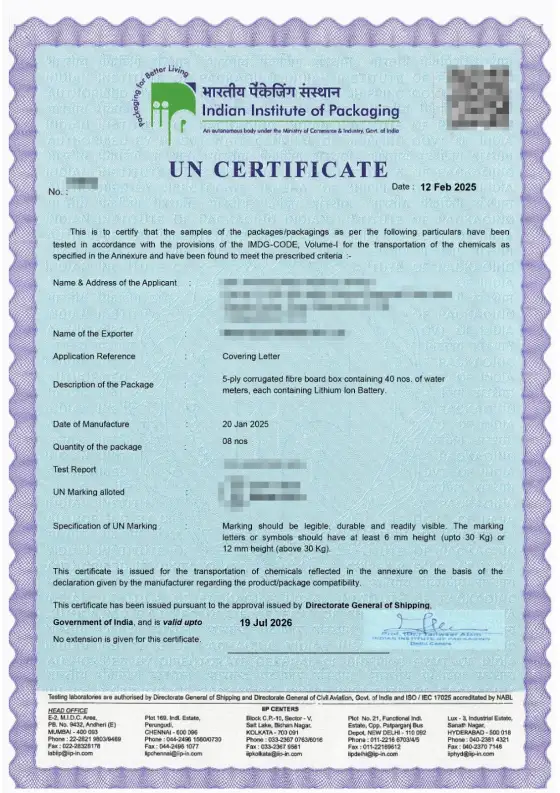
IIP Certificate Sample
- UN Mark IIP Certificate IMDG
- UN Mark IIP Certificate ICAO

Process to Obtain IIP Certificate for Toxic & Infectious Substances
Obtaining a UN approved certificate for Class 6 Toxic and Infectious Substances involves a structured process to ensure compliance with international packaging regulations for hazardous materials. Below is the step-by-step UN certification procedure:
- Application Submission: Submit an online application on the IIP portal with all the required information and supporting documents.
- Payment: During the application process, payment details must be updated on the portal including payment mode, cheque number, and UTR number as applicable.
- Packaging Material Sample Testing: The packaging sample must be sent to the IIP laboratory in Mumbai or Chennai for testing based on specific packaging parameters to verify compliance with UN standards. Samples can be sent via courier, transport, or through customer or marketing channels. The sample will be retained for up to 30 days after testing.
- Certificate Issuance: Generation of UN Marking Number as specified. Test report & UN certificate is issued by the department. After the certificate is issued, login to LIMS (Laboratory Information Management System) to download the digital certificate.

Documents for IIP Certificate for Toxic & Infectious Substances
To obtain IIP Certificate for Class 6 Toxic and Infectious Substances, the following documents must be submitted to the certifying authority:
1. Business & Legal Documents
- GST Registration Certificate and PAN
- Import Export Code (IEC)
- Certificate of Incorporation (if applicable)
- MOA & AOA or Partnership Deed (if applicable)
- ISO Certificate (optional)
2. Company & Manufacturer Information
- Product Manufacturing Company Details (GST, IEC, Contact No., Email)
- Packaging Manufacturer Details (GST, MSME, ISO, Email, Contact No.)
- Exporter's Name
3. Product & Packaging Details
- Type & dimensions of Outer Packages with images
- Net Weight & Gross Weight of Product
- Mode of Shipment (Air or Sea)
- Photograph of Product with Packaging Material
- Type or State of Product (Solid, Liquid, Gas)
4. Additional Requirements
- MSDS Certificate of the Goods
- Identity Proof of Authorized Person(s)
- Contact Details of Company & Authorized Person
- Copy of cancelled cheque
- Quantity of Sample for Testing
Fees for IIP Certification for Toxic & Infectious Substances
The table below shows the IIP UN Mark Certification fees for packaging materials under Normal, Combine, and Tatkal modes. These fees are particularly helpful for businesses seeking IIP Certification for Class 6 Toxic and Infectious Substances, allowing them to plan and understand the certification costs clearly in advance.
| Types of Packaging Material | Normal Mode | Combine Mode | Tatkal Normal Mode |
|---|---|---|---|
| Metal Drum | ₹ 21,000 | ₹ 31,500 | ₹ 31,500 |
| Plastic Drum | ₹ 24,500 | ₹ 36,750 | ₹ 36,750 |
| Composite Drum | ₹ 27,500 | ₹ 41,250 | ₹ 41,250 |
| CFB Box / Fiber Board Drum | ₹ 20,000 | ₹ 30,000 | ₹ 30,000 |
| CFB with Plastic Container | ₹ 26,000 | ₹ 39,000 | ₹ 39,000 |
| Wooden Boxes | ₹ 18,500 | ₹ 27,750 | ₹ 27,750 |
| FIBC / IBC | ₹ 29,000 | ₹ 43,500 | ₹ 43,500 |
Note: The above fee structure represents the Normal Mode, Combined Mode, and Tatkal Mode charges for testing and certification of packaging materials for UN Certificates. If you obtain Combined Tatkal Mode Certification, the Government fee will be 1.5x the Normal Mode charges.
Note: Professional Fee for IIP UN Mark certification Registration Normal mode starts from ₹24,999 whereas the Combine mode (Air & Sea) Fee is ₹37,499.
What is IIP Certificate for Toxic and Infectious Substances?
The packaging used to transport hazardous materials, specifically toxic substances (Class 6.1) and infectious substances (Class 6.2), must meet the strict safety requirements set by the United Nations Recommendations on the Transport of Dangerous Goods. A UN Mark IIP Certificate for Toxic and Infectious Substances is an internationally recognized certification that attests to this.
Infectious substances contain pathogens such as bacteria, viruses, or other microorganisms that can cause diseases in humans or animals, whereas toxic substances are chemicals that can be harmful or fatal if inhaled, consumed, or come into contact with the skin. The UN requires that these materials be transported in certified, secure packaging because of the significant health risks they pose.
For the safe handling of toxic and infectious materials during air, road, sea, or rail transportation, as well as for customs clearance and legal compliance, the UN Mark IIP Certificate is necessary.
Benefits of IIP Certification for Toxic & Infectious Substances
The UN Mark IIP Certification is a globally recognized packaging certification used to transport hazardous goods. It ensures compliance with United Nations (UN) regulations for the safe handling, storage, and transportation of dangerous materials. Here are the key benefits:
- Enhanced Safety: Certified packaging passes the actual tests such as dropping, pressure, and leakproof efficacy in handling hazardous products that may result in spills, leaks, or contamination.
- International Trade Facilitation: UN certification is accepted by most of the regulatory bodies around the world and reduces the time taken to complete the customs formalities for transporting hazardous materials across borders with minimum legal complications.
- Increased Market Credibility:Certification shows the company’s dedication to quality, safety, and reliability, improving the overall image and perception of the business by its customers, suppliers, and other authorities while enhancing the overall market access.
- Cost Savings: UN approved packages help to avoid fines, legal consequences, and rejected shipments, certification lowers general expenses that are related to compliance violations, damaged goods, and potential danger.
- Competitive Advantage: Obtaining an IIP UN Mark certificate allows businesses to become more competitive and find more customers and partners due to compliance with the requirements for operating at a high level of safety and quality.
Packaging Groups for Class 6.1 and 6.2
Packing groups (PG) denote the degree of danger presented by the substance. It defines packaging strength and test performance required during shipment. Class 6.2, however, is not divided by packing groups but instead uses Category or Group A based on risk of infection.
Packing Group Criteria for Class 6.1 Toxic Substances.
- Packing Group I : Substances with high toxicity, e.g. cyanides) requires the strongest packaging.
- Packing Group II : Moderate toxicity levels. Requires UN-approved packaging with intermediate performance tests.
- Packing Group III : Low toxicity levels. Minimum strength requirements still apply.
Classification criteria for Class 6.2 (Infectious Substances):
Unlike Class 6.1, Class 6.2 infectious substances are not classified by packing groups. Instead, they are assigned to one of two categories based on the risk of infection:
Category A Infectious substance capable of causing permanent disability, life-threatening illness, or fatal disease in otherwise healthy humans or animals on exposure. Category A includes two UN numbers depending on the host affected:
- UN2814 affects humans (or both humans and animals). Examples: Ebola virus, Variola (smallpox), Mycobacterium tuberculosis cultures, Bacillus anthracis cultures.
- UN2900 affects animals only. Examples: African swine fever virus cultures, Foot-and-mouth disease virus cultures, Classical swine fever virus cultures.
Category B Infectious substances that do not meet the criteria for Category A. Assigned UN3373. Commonly includes patient diagnostic specimens, clinical samples, and laboratory specimens transported for routine testing or analysis.
List of Toxic & Infectious Substances in Dangerous Goods
Class 6 includes substances that pose serious health risks. Toxic substances can cause harm or death when inhaled, ingested, or absorbed, while infectious substances contain pathogens that can cause disease in humans or animals.
- Toxic Substances (Poisonous or harmful to humans and animals even in small amounts)
- Heavy Metals & Compounds: Arsenic, Mercury Compounds, Lead Compounds, Thallium Compounds, Barium Compounds
- Cyanides & Toxic Gases: Hydrogen Cyanide, Potassium Cyanide, Sodium Cyanide, Phosgene
- Organic & Industrial Chemicals: Chloroform, Carbon Tetrachloride, Formaldehyde, Phenol, Methanol (Highly Toxic if Ingested), Tetrachloroethylene, Ethylene Oxide, Acrylonitrile
- Agricultural & Biological Toxins: Nicotine, Parathion (Agricultural Pesticide), Strychnine, Dioxins
- Infectious Substances (Contain pathogens that cause disease in humans or animals)
- Viruses: Ebola Virus, Hepatitis B and C, HIV (Human Immunodeficiency Virus), COVID-19 (SARS-CoV-2), Influenza Virus (Highly Pathogenic Strains), Dengue Virus, Poliovirus, Smallpox (Variola Virus), SARS Virus
- Bacteria & Pathogens: Anthrax (Bacillus anthracis), Tuberculosis (Mycobacterium tuberculosis), Foot-and-Mouth Disease Virus, Cholera Bacteria (Vibrio cholerae), Brucella Species (Brucellosis), Plague (Yersinia pestis)
WHO Biological Risk Groups for Class 6.2 Infectious Substances
The World Health Organization (WHO) classifies infectious agents into four biological risk groups based on their pathogenicity, mode of transmission, and the availability of preventive or therapeutic measures.
- Risk Group 1: Includes microorganisms that present little or no risk to human or animal health and generally comprise common environmental organisms.
- Risk Group 2: Includes pathogens that can cause disease in humans or animals but are unlikely to pose a serious hazard to the community. Examples include Salmonella spp., Hepatitis B virus, and certain strains of Escherichia coli.
- Risk Group 3: Consists of pathogens capable of causing serious disease in individuals but which generally present a lower risk of widespread community transmission when effective control measures are implemented. Examples include Human Immunodeficiency Virus (HIV), Mycobacterium tuberculosis, and West Nile Virus.
- Risk Group 4: Includes highly dangerous pathogens that cause severe or fatal diseases, and for which effective treatment or preventive measures may be limited or unavailable. Examples include Ebola virus, Marburg virus, and Variola virus (Smallpox).
Classification of Category A and Category B Infectious Substances
Class 6.2 infectious substances are further categorized under international transport regulations based on their potential to cause disease during transportation.
- Category A Infectious Substances: Are materials known or reasonably expected to contain pathogens capable of causing permanent disability, life-threatening illness, or fatal disease in otherwise healthy humans or animals upon exposure. Infectious substances affecting humans are assigned UN2814, while those affecting animals only are assigned UN2900. Due to the significant hazards associated with these materials, Category A substances are subject to the most stringent packaging, testing, and transport requirements, including compliance with applicable IIP UN Mark certification standards.
- Category B Infectious Substances: Are infectious materials that do not satisfy the criteria for Category A classification. These substances are assigned to UN3373 and commonly include diagnostic specimens, clinical samples, laboratory samples, and biological materials transported for testing or analysis. Although Category B substances are considered less hazardous than Category A materials, they must still be packaged, marked, and transported in accordance with applicable regulatory requirements to ensure safety throughout the transport chain.
IATA Packaging Instructions for Class 6.2 Infectious Substances: PI 620 (Category A) and P650 (Category B)
- PI 620 – Category A Infectious Substances: Category A infectious substances include those having the potential to cause permanent disability and/or serious life-threatening illness in both animals and humans after exposure. PI 620 requires triple packaging that includes primary packages consisting of an absorbent layer within them, secondary packaging, and third packaging that is rigid. The primary packaging should be constructed using either glass, metal, or plastic.
- P650 – Category B Infectious Substances: Category B infectious substances are those not meeting Category A criteria but still pose a health hazard. P650 allows simple packaging with dual-layer containment: primary leak-proof receptacles combined with secondary packaging that is rigid and absorbent. Primary containers must be plastic or glass; secondary packaging ensures puncture resistance. Outer packaging requirements are less stringent than Category A.
UN Numbers for Class 6.1 & 6.2 Toxic & Infectious Substances
Class 6.1 refers to toxic substances which are hazardous in nature and can lead to death, injury, or harm to human health if swallowed, inhaled, or absorbed. These toxic substances are identified by 4-digit UN numbers to ensure safe handling, storage, and emergency response.
Common Class 6.1 UN numbers include:
- UN2810 Toxic organic liquid, NOS
- UN2811 Toxic organic solid, NOS
- UN2902 Pesticides, liquid, toxic
- UN3286 Flammable liquid, toxic
- UN1583 Chloropicrin mixtures
Key Class 6.2 UN numbers are:
- UN2814 Infectious substance, affecting humans — Category A
- UN2900 Infectious substance, affecting animals only — Category A
- UN3373 Biological substance, Category B — most common for diagnostic samples/clinical specimens
Validity of UN Mark IIP Certification for Class 6 Toxic and Infectious Substances
Validity of toxic substances (class 6.1) and infectious substances (class 6.2) depends on the manufacture’s ISO status. Extension beyond 18 or 9 months is strictly non-extendable. Upon expiration of the certificate, manufacturers must submit new samples and repeat testing processes to obtain a fresh IIP certificate for Toxic and Infectious Substances.
- ISO 9000 Certified Manufacturers: Valid for 18 months
- General Category (Non-ISO) Manufacturers: Valid for 9 months
Secure Your IIP UN Mark Certificate for Toxic & Infectious Substances
The UN Mark IIP Certificate for Class 6 Toxic and Infectious Substances can be obtained online through the Indian Institute of Packaging (IIP) website. For an easy and hassle-free registration process, consult Professional Utilities. Our team of experts with more than a decade of experience provide expert assistance at every step, from handling the paperwork to arranging the necessary packaging tests, making the entire process simple for you. After a successful assessment, the IIP issues UN certificate allowing the transportation of Class 6 toxic & infectious substances. This certification is very important for manufacturers, exporters, and logistics providers, as it helps them avoid legal issues and comply with international standards for handling dangerous goods.
FAQ’s On UN Mark IIP Certificate for Toxic & Infectious Substances
Why is certified packaging mandatory for toxic and infectious
substances?
Class 6 substances pose serious risks such as poisoning, contamination, or infection. UN-certified packaging prevents leakage, exposure, or accidental release during transport, ensuring compliance with IMDG, ICAO, ADR, and UN transport regulations.
What is the purpose of the UN Mark IIP certificate?
The UN Mark IIP certificate ensures that the packaging used for the transport of dangerous goods is compliant with international regulations. It helps prevent accidents, protect people, and minimize environmental hazards during transportation.
Who needs to register for the UN Mark IIP certificate?
Manufacturers, packers, and distributors involved in the transportation of dangerous goods that fall under the UN classification system typically need to register for the UN Mark IIP certificate.
How can I register for the UN Mark IIP certificate?
To Register for IIP Certificate, you need to file an application online on IIP Portal, provide necessary documents, pay the required Fees, Testing of Packaging Material, and then issuance of IIP Certificate.
Speak Directly to our Expert Today

Reliable

Affordable

Assured
Disclaimer:The information provided on this website is intended for general information purposes only. Although all reasonable efforts are made to ensure that the information provided is correct and reliable, it is not advised to be used as a substitute for professional advice. The information herein is not to be used in place of seeking professional services, counsel, or guidance. We highly advise that you consult a professional before you make any business or legal decisions regarding the information presented on this website. This website and its contents are given "as is", and we do not take any responsibility for any action that is taken based on information given on this website.

- Written by: Anuja Sahi
- Fact-checked: Sahil Singh
- Updated on: May 27, 2026
Testimonials
"Explore how Professional Utilities have helped businesses reach new heights as their trusted partner."





It was a great experience working withProfessional Utilities. They have provided the smoothly. It shows the amount of confidence they are having in their field of work.

Atish Singh


It was professional and friendly experience quick response and remarkable assistance. I loved PU service for section 8 company registration for our Vidyadhare Foundation.

Ravi Kumar
I needed a material safety data sheet for my product and they got it delivered in just 3 days. I am very happy with their professional and timely service. Trust me you can count on them.

Ananya Sharma
Great & helpful support by everyone. I got response & support whenever I called to your system. Heartly thanx for Great & Super Service. Have a Great & Bright future of team & your company.

Prashant Agawekar
Thank you so much Professional Utilities team for their wonderful help. I really appreciate your efforts in getting start business. Pvt Ltd company registration was smooth yet quick.
Abhishek Kumar
I applied for Drug licence and company registration and their follow-up for work and regular updates helped me a lot. They are happily available for any kind of business consultancy.

Vidushi Saini
Great experience went to get my ITR done, process was quite convenient and fast. Had a few queries, am happy about the fact those people explained me all things I wanted to know.

Taniya Garyali
Great services provided by Professional Utilities. They are best in this industry and the best part is their prices are so affordable. Kudos to you. Now you guys are my full-time consultant.

Aftab Alam
Trusted By