Get Your FSSAI Food License for E-commerce

4.9


FSSAI License for E-commerce 2026: Process, Documents & Fees
Due to the growing number of individuals using e-commerce and expansion being led by international corporations like Amazon and Flipkart, etc., the market for food products is potentially growing. Because of this, e-commerce growth is hampered by the present regulatory approach, which requires food business operators (FBOs) to guarantee the safety of their products advertised online and enforces regulatory compliance.
In simple terms, an e-commerce food business operator is any person or company who owns, operates, or manages a digital or electronic facility or platform for an online food business.
To ensure food safety and regulatory compliance in this rapidly expanding sector, the Food Safety and Standards Authority of India (FSSAI) requires every e-commerce food business operator (FBO), online marketplace, and seller offering food products through websites or mobile applications to obtain an FSSAI Central Licence, irrespective of annual turnover.
Professional utilities has been assisting clients for over a decade with Central FSSAI Licenses for online food brands, including e-commerce platforms, marketplace sellers, cloud kitchens, home-based food businesses, and direct-to-consumer brands, including license selection, documentation, FoSCoS filing, query handling, and post-license compliance.
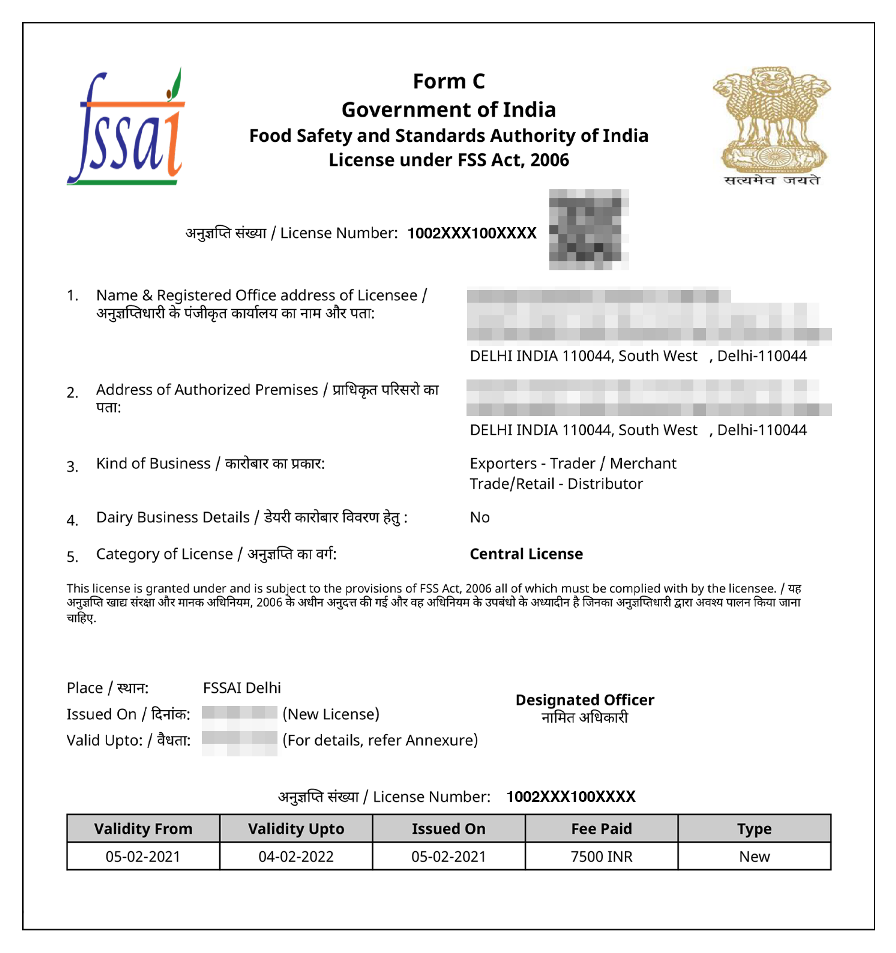
FSSAI Food License [Sample]
Process of Obtaining FSSAI License for E-commerce
To apply/register for an FSSAI license for an e-commerce business, you can directly apply through the Food Safety Compliance System (FoSCoS) portal maintained by FSSAI.
Or you can connect on the Professional Utilities website for a quick and easy process.
Given below are the processes to apply for an FSSAI license for e-commerce.
-
Step 1: Create an Account on FoSCos Portal
- Go to the FoSCos FSSAI Portal.
- Click "Login Food Businesses"-> User Sign In, enter your mobile number, email ID, and required details, and create your FoSCoS.
- Log in to your account.
- Choose Apply for New License/Registration.
-
Step 2: Select the correct Kind of Business (KoB)
This step is important because your FSSAI license depends on the type of food business you run.
- Select the State where your registered office is situated.
- Choose Trade/Retail from the categories listed.
- Click on e-Commerce (if you sell food online)
NOTE: FoSCoS requires a Central FSSAI License irrespective of turnover.
-
Step 3: Fill in the Application Details of Form B
- Premises Detail
- Product Selection
- Communication Details
-
Step 4: Upload the Required Documents
- Identity and Address Proof
- Premises Proof
- Recall Plan
- Marketplace NOC
-
Step 5: Pay the Application Fee
- Select the license validity period and make payment through FoSCoS.
- The fee for a Central FSSAI License is ₹7,500 per year, plus applicable charges/GST shown by the portal. (Ammounting Rupees) After successful payment, FoSCoS generates an application receipt containing a 17-digit reference number.
-
Step 6: FSSAI Inspection
As per the FSS Act, an FSSAI officer may inspect your business premises to check hygiene, safety standards, and the details provided in your application.
-
Step 7: FSSAI Approval
FSSAI will approve the application if all requirements are met.
-
Step 8: Get Your FSSAI License
Once approved, your FSSAI license/registration certificate will be issued.

Documents Required for FSSAI Registration for E-Commerce
The key documents required for FSSAI registration for e-commerce include:
- List of Directors / Partners / Proprietor / Society or Trust Members: Name of the Authorized Signatory along with Full Address & Contact Details of Each Person
- Photo ID and address proof: Aadhaar Card, PAN Card, or Passport of the proprietor, partners, or directors.
- Proof of Possession of Premises
- Partnership Deed, Self-Declaration, Memorandum Articles of Association (MOA & AOA), Cooperative Registration Certificate
- Form IX: Nomination of Person as per Clause 2.5 of FSS Rules, 2008 (Not applicable in case of Proprietor) View Sample
- Food Safety and Compliance Documents: List of food products, Food Safety Management System (FSMS) plan or declaration, Food recall and traceability plan, Import Export Code (IEC) for businesses involved in food import or export.
- Trade License Certificate
For the Manufacturing/Repacker category, the following additional documents are required:
- Photos of the manufacturing unit
- Plant layout
- Machinery details on company letterhead, including capacity and horsepower
- Product details on company letterhead
FSSAI Fees, License Validity, and Renewal for E-Commerce Businesses
E-commerce FBOs are generally required to obtain an FSSAI Central Licence for conducting online food business operations.
Refer to the table below for a clear and concise understanding.
| Particular | Required Fees |
|---|---|
| FSSAI Central License Govt Fees (E-commerce) | ₹8850 (inclusive of GST) |
| Professional Fees | ₹10,000 |
| GST at 18% on Professional Fees | ₹1800 |
| TOTAL FEES | ₹20,650 (All Inclusive) |
IMPORTANT: The applicant shall first pay a total amount of ₹1,180 (inclusive of 18% GST). Once the FSSAI application is approved, the remaining license fee and GST must be paid within 30 working days. If the payment is not made on time, the application will be automatically rejected.
License Validity :
The FSSAI license is valid for 1 to 5 years from the date of issue, based on the validity period selected during application or renewal.
Renewal Process :
Apply for the renewal on the FoSCOS Portal by making an application in Form B (at least 30 days prior to expiry).
Update the food product list, address proof, turnover details, and compliance declaration, wherever required.
On the FoSCOS Portal again, click “Apply for Renewal” and pay the required renewal fee.
IMPORTANT: A penalty of ₹100 per day applies if the FSSAI license renewal application is filed after the due date.
E-commerce Food Business Operator vs. E-commerce Food Trader
To keep it simple, an e-commerce food business operator runs/facilitates the online food-selling channel while an e-commerce food trader actually trades or sells food using an online channel.Here’s a simple breakdown:
| Parameter | E-Commerce Food Operator / E-Commerce FBO | E-Commerce Food Trader |
|---|---|---|
| Meaning | An entity/business that provides or operates the online system/platform through which food is sold. | Can be a retailer, wholesaler, distributor, marketer, or importer of food who sells through a platform |
| Does it own the food? | Not necessarily. It may simply connect sellers and customers. | Usually, yes. The trader/seller holds/procures food as a part of its business. |
| FoSCoS KoB | Trade/Retail → E-commerce | Trade/Retail → Wholesaler/Distributor/RetailerDirect Seller/Importer |
| License Required | Central License (regardless of turnover) | Depends on turnover (Basic, State, Central) |
IMP: A food seller/trader who merely uses the e-commerce platform to sell products does not become an e-commerce FBO just because it sells online.
Mandatory Compliance for E-commerce Food Operators (FBOs)
Food Business Operators operating online (including marketplace operators and ONDC participants) are required to follow certain regulations set by FSSAI to maintain food safety and integrity. The compliance is mandatory starting 1 April 2026.
- FSSAI Central License Required: Online platforms enabling food ordering or listing of food business shall obtain valid FSSAI Central License.
- FSSAI License and Details Display: The platform is required to display FSSAI license/registration number and hygiene rating of listed food business on its platform.
- Seller Compliance & Agreement: E-commerce operators should make sure that sellers/ brands / manufacturers follow the FSSAI regulation by means of appropriate agreements.
- Mandatory Product Information: There should be mandatory food labels (ingredients, nutritional, allergens, veg/non-veg logo, etc.) without any additional price.
- Image Display (Pre-packaged Foods):Customers should be provided with a clear and readable image of the main display panel of the product.
- Shelf Life Requirement: Food products must have at least 30% shelf life or 45 days left until expiry on delivery (unless they are fresh foods).
- No Misleading Information: The online platforms must not post any misleading claims, descriptions, or pictures about the food products.
- Removal of Non-Compliant Food Products: Any food item that does not meet the FSSAI standards should be delisted from the website.
- Proper Invoices/Receipts: All receipts must contain the FSSAI license number/registration number of the seller.
- Delivery Safety: Last-mile delivery should be managed by trained staff who do not interfere with food safety.
- Grievance Redressal System: Online platforms must have a mechanism in place for filing complaints, tracking complaints, and resolving complaints.
- Traceability & Collective Accountability (ONDC Model): Responsibility is shared by buyers’ apps, sellers’ apps, and delivery partners in transactions involving multiple entities (ONDC model); however, it is the collective responsibility of all FBOs involved in the transaction.
Mandatory FSSAI Compliance for E-Commerce Food Businesses
All e-commerce food businesses, including marketplaces, aggregators, and online sellers, must follow FSSAI requirements for food safety, hygiene, licensing, and product compliance.
The compliance is mandatory starting wef 18th March 2026 as per the FSSAI portal.
The key compliance requirements are listed below:
- Display the 14-digit FSSAI number on the platform, invoices, and packaging, wherever applicable.
- Show the valid FSSAI license details of every listed food seller.
- Remove sellers with expired, suspended, or invalid licenses.
- Provide clear product images and complete label information before purchase.
- Display the FSSAI Hygiene Rating, wherever applicable.
- Ensure delivery personnel follow food safety standards and are medically fit.
- Maintain the prescribed minimum shelf life at the time of delivery.
- Pay applicable FSSAI fees within the prescribed timeline.
FORM D1- Annual Return IMPORTANT NOTE:
An e-commerce FBO is not required to file Form D1 only because it holds an e-commerce FSSAI license.
It is only applicable where the FBO is licensed as a:
- Manufacturer (both Repacker and Relabbeler)
- Exporters and Importers
- Due Date: By May 31st of each year
- Penalty: A charge of ₹100 per day
- Filing Platform: Through FoSCos Portal.
Ecommerce Food Business Operators
E-Commerce refers to the sale of food products online, but it can also be described as any commercial transaction that happens online.
Such as;
- Ecommerce businesses that provide storage facilities to their sellers for their food products, such businesses are required to have an FSSAI license.
- Online businesses such as zomato and swiggy, which provide listing facilities to dhaba owners, hotels, or any such food manufacturers such online platforms are also required to have Fssai registration.
- Individual food manufacturers sell their products on their online portals. Such businesses are also termed E-Commerce food businesses, such as BurgerFi.
- Businesses that provide transportation facilities to their sellers and vendors, and manufacturers.
Buyer App vs Seller App Responsibilities (ONDC)
Under the FSSAI order dated 18 March 2026, the seller app provides the information, and the buyer app shows it to users. Both apps must have a Central License.
| Responsibilities | Seller App | Buyer App |
|---|---|---|
| FBO’s license details and hygiene rating | Provide and ensure the accuracy of the information | Display the provided information |
| Agreement with sellers/brand owners/manufacturers | Agreement required | Not applicable |
| Display image of any pre-packed food | Provide a clear and easy-to-read picture | Display the provided information |
| Shelf life (at least 30% remaining or 45 days before expiry at the time of delivery.) | Provide and ensure the accuracy of the information at the time of placement | Ensure that no food product is listed after its use-by or expiry date. |
| Mandatory food information before purchase | Provide and ensure the accuracy of the information | Display the provided information |
| Trained delivery staff | The delivery company or app is responsible. | Not Applicable |
| No false or misleading claims | The obligation is with the seller app | Not Applicable |
| Delist non-compliant food products | Delist | Inform the seller app to take action |
| Display the seller app name and FSSAI license number | Provide the information | Display the provided information |
| Display FSSAI license number on bills/invoices | Ensure the information appears on the invoice | Provide a downloadable digital invoice with the same details |
| Display calories, allergens, veg/non-veg, and nutrition details | Provide and ensure accuracy | Display the provided information |
| Handling customer queries | Resolve complaints related to its own duties |
Allow users to:
|
Requirements and Guidelines of FSSAI License for Ecommerce
All E-commerce food operators must get a central license irrespective of their limits and turnover.
Shall provide mandatory food information mentioned by FSS Act rules and regulations made thereunder be provided to the consumers without charging any supplementary cost.
Any food article delivered to consumers must have a shelf life of upto 30% or 45 days before expiry.
Online FBOs are required to comply with these guidelines.
- E-commerce FBOs must take queries of their customers on an urgent basis if the consumers register any complaints regarding their services and Food product.
- All the products must be printed with visible and readable license numbers.
All online FBOs, including catering businesses, dhabas, hotels, petty food sellers, hawkers, and vendors, must follow these guidelines of FSSAI for E-commerce businesses.
- Maintain hygiene and standards laid down by FSSAI for E-commerce.
- Food Business operators selling cooked or prepared food online shall display a notice board containing the nature of articles being exposed for sale.
- E-commerce to make mandatory declarations Rule 10 of the Amended legal metrology rules requires e-commerce entities to make declarations mandatorily.
- Food products offered for sale by Ecommerce FBO shall be liable to sampling at any supply chain point.
- Ecommerce FBO must ensure that there must be no mislabelling or misbranding of the food product.
- The Ecommerce entity shall immediately delist any food products listed on their platforms that are not in compliance with FSS Act.
Benefits of Obtaining an FSSAI License for E-commerce Business
Benefits of Obtaining an FSSAI License for E-commerce builds consumers’ trust and credibility, proving your food items are safe to consume. Additional key benefits include:
- Avoid Legal Trouble: Proper FSSAI compliance reduces the risk of penalties, notices, or regulatory action.
- Get Approved Faster: A valid license makes seller verification and marketplace onboarding smoother.
- Stay Active on Online Platforms: A valid FSSAI number helps avoid listing removal or account-related issues.
- Build Customer Confidence: Displaying the FSSAI logo and license number reassures customers about food safety.
- Grow with Confidence: The right FSSAI license supports expansion into new markets and locations.
Penalties for Operating Without an FSSAI License
Operating an online food business without a valid FSSAI license will cost you:
| Offence | Section | Penalty |
|---|---|---|
| Food not of the nature, substance, or quality demanded | 50 | Penalty up to ₹5 lakh Persons covered by Section 31(2) up to ₹25,000 |
| Manufacturing or selling substandard food. | 51 | Penalty up to ₹5 lakh |
| Manufacturing or selling misbranded food | 52 | Penalty up to ₹3 lakh |
| Publishing any misleading advertisement | 53 | Penalty up to ₹10 lakh |
| Food containing extraneous matter | 54 | Penalty up to ₹1 lakh |
| Failure to comply with the directions of the Food Safety Officer | 55 | Penalty up to ₹2 lakh |
| Unhygienic or unsanitary processing | 56 | Penalty up to ₹1 lakh |
| Possession of an adulterant | 57 | Penalty up to ₹10 lakh (injurious to health) Penalty up to ₹2 lakh (not injurious to health) |
| Contraventions with no separate/specific penalty | 58 | Penalty up to ₹2 lakh |
| Manufacturing or selling unsafe food | 59 (i), (ii), (iii), (iv) | Penalty Up to:
|
| Interfering with Seized Items | 60 | Penalty up to 6 months’ imprisonment and also with a fine, which may extend to ₹2 lakh |
| Providing False Information | 61 | Penalty up to 3 months’ imprisonment + fine up to ₹2 lakh |
| Obstructing or impersonating a food safety officer | 62 | Penalty up to 3 months’ imprisonment + fine up to ₹1 lakh |
| Carrying out business without a license | 63 | Penalty up to 6 months’ imprisonment + fine up to ₹5 lakh |
Common Reasons FSSAI Applications Get Rejected
There are several reasons why an FSSAI application may be rejected or sent back for correction. The most common ones include
- Mismatched Details: Name, address, or business details do not match across documents.
- Missing or Unclear Documents: Required files are missing, blurred, cropped, or invalid.
- Wrong License Type: Incorrect Basic, State, or Central license category is selected.
- Wrong Business Activity: The selected activity or food category does not match actual operations.
- Operating before Grant of License: A license must be obtained before commencing business. Any active platform or live listings without the license shall be seized.
- Unlicensed sellers listed on the platform: Listings without a valid seller license indicate failure to meet platform obligations.
- Warehouse or fulfillment center not mentioned on the license: Every storage location, dark store, and fulfillment center must appear in the application. Undeclared premises are treated as unlicensed food business activity.
- Missed Query Deadline: FSSAI queries or corrections are not answered on time (within 30 days).
- Premises Issues: Hygiene, layout, signage, or inspection requirements are not met.
Worried your FSSAI application will be rejected?
Professional Utilities handles your e-commerce FSSAI Central License end to end — correct category selection, complete documentation, and timely replies to FSSAI queries, so your application clears the first time.
Call Us
Who Is an E-commerce Food Business Operator?
An e-commerce Food Business Operator means any Food Business Operator carrying out any of the activities specified in Section 3(n) of the Food Safety and Standards Act, 2006, through the medium of e-commerce.
E-commerce FBOs include, but are not limited to:
- Platforms that list food sellers, brands, manufacturers, or restaurants and enable online sales.
- Sellers, brands, manufacturers, vendors, importers, processors, or packers offering food or food services online.
- Businesses providing storage or distribution services for food products sold through e-commerce platforms.
- Businesses providing food transportation or last-mile delivery to customers.
FSSAI has also confirmed a second point in the same 18 March 2026 order. Any e-commerce entity that provides a listing or directory of FBOs or food products and facilitates orders or transactions on its website needs a Central FSSAI license. This is the rule that covers marketplaces and aggregators.
The requirement may apply where the business operates through:
- A website with an online checkout facility
- A mobile application
- A marketplace platform
- An ONDC buyer or seller application
- A social media store that accepts and processes orders
- A subscription or recurring food delivery platform
- An inventory-led grocery or food application
Always remember, once the platform enables ordering, payment, or commercial fulfillment, the e-commerce licensing requirement generally applies.
Why a Central License Is Mandatory Regardless of Turnover
Food Safety and Standards Authority of India (FSSAI) treats e-commerce food business operators as a mandatory Central licensing category.
Since products are sold online, a Central FSSAI License is required regardless of the business's annual turnover.
But why did FSSAI make this rule?
Unlike physical stores, online businesses can operate and sell across multiple locations. Therefore, stricter compliance requirements apply for the following reasons:
- Inter-State Online Sales: Online businesses can sell and deliver food across multiple states. Therefore, they require a Central FSSAI license instead of a turnover-based Basic or State Licence.
- Better Supply Chain Tracking : E-commerce involves marketplaces, warehouses, delivery partners, and dark stores. A Central License helps FSSAI track products, sellers, and deliveries more effectively.
- Wider Consumer Reach : Online sellers can reach thousands of customers across India, even with limited turnover. This wider reach increases food safety risks and requires stricter regulatory control.
- Platform-Level Verification : Platforms such as Amazon, Blinkit, and other food marketplaces must verify and display the seller’s FSSAI license number. A Central License makes verification and compliance easier.
IMPORTANT: Check this before applying.
Your FSSAI requirement depends on which of these two situations applies to your business.
Situation 1: Registration Under the E-commerce Kind of Business (KoB)
This category applies to marketplaces, aggregators, ONDC buyer or seller apps, quick-commerce platforms, and businesses operating their own online food platform. Here a Central FSSAI license is mandatory, regardless of turnover.
Situation 2: Selling Through Another Marketplace
Suppose you manufacture packaged snacks in Jaipur and list them for sale on Amazon. In this case, your Kind of Business (KoB) is “Manufacturer”, not “E-commerce”, because Amazon operates the online marketplace.
Your FSSAI license category will depend on your manufacturing capacity, turnover, business locations, and product category.
You may qualify for a State License or Basic Registration if:
When Is a Central FSSAI License Not Required?
You may qualify for a State License or Basic Registration if:
- You operate from only one premises in one state.
- You ship orders through your own courier arrangement.
- You do not store stock in another state.
- You do not import or export food products.
- Your turnover remains within the applicable limit.
In this case, the license will be issued under your actual Kind of Business (KoB), such as Manufacturer, Trader or Retailer.
Applying for a lower license can lead to rejection and marketplace suspension.
Applying for a higher license may cost you ₹7,500 every year unnecessarily.
Basic vs State vs Central Licence for E-commerce Businesses
FSSAI revised the general turnover thresholds for Registration, State Licence and Central Licence through an Order dated 13 March 2026. The revised limits became effective from 1 April 2026.
| Scale | Basic FSSAI Registration | State FSSAI License | Central FSSAI License |
|---|---|---|---|
| Turnover Eligibility | Up to ₹1.5 crore per year | Above ₹1.5 crore and up to ₹50 crore | Above ₹50 crore, or mandatory categories irrespective of turnover |
| Licensing Authority | Registering Authority/Food Safety Officer (FSO) | State Licensing Authority | Central Licensing Authority (FSSAI) |
| Import/Export | No | No | Yes. Mandatory for importers |
| Validity | Perpetual Validity (Pay the Annual Fee) | Perpetual, for licences issued on or after 1 April 2026 | Perpetual, for licences issued on or after 1 April 2026 |
| Government Fee | ₹100 per year | ₹2,000 to ₹5,000 per year, depending on activity and capacity | ₹7,500 per year |
| Application Form | Form A | Form B | Form B |
NOTE: If your Kind of Business (KoB) is e-commerce, Basic and State are simply not available to you on the FoSCoS portal. The system will not let you proceed.
Types of E-commerce Business Models
The Food Safety and Standards Authority of India (FSSAI) classifies e-commerce Food Business Operators (FBOs) into two main operational models under its regulatory framework, alongside a third one, known as the Hybrid Approach.
Inventory-Based Model
Under an inventory model, the e-commerce company owns or controls the food inventory and sells it directly to customers.
Examples include:
- An online grocery company buying and holding packaged foods
- A D2C food brand storing its products in its own warehouse
- A beverage company selling directly from its website
- A subscription snack company controlling its stock and fulfillment
The business may need the following:
- Central License under E-commerce
- Retailer, distributor, or wholesaler of KoB, as applicable
- Storage license for each controlled warehouse
- Manufacturing or relabeling license where it makes or relabels products
- Importer license where it imports food
Marketplace Model
A marketplace provides a digital platform through which independent food sellers offer products to customers. Marketplace support may include:
- Product listings
- Order placement
- Payment processing
- Warehousing
- Fulfilment
- Logistics
- Customer support
- Delivery coordination
The marketplace requires a Central E-commerce Licence when it facilitates food transactions. Individual sellers, restaurants, manufacturers, and brand owners must also hold valid licenses for their own food activities and premises.
Hybrid or Service Model
Under FSSAI e-commerce regulations, these are the models that:
- Offers food storage, packaging, warehousing, or last-mile delivery.
- Must equally follow applicable FSSAI licensing requirements.
A hybrid model usually needs a wider license assessment. Each storage, manufacturing, retail, e-commerce, and delivery activity should be mapped before filing.
Other important segments that FSSAI recognizes and an e-commerce food business operator must comply with include:
Warehouses, Fulfillment Centers, and FBA Operations
Location-Specific License: If the food products are stored in a warehouse or storage unit, that location must be covered under the “Storage and Warehousing” or “Distributor” business category in the FSSAI license.
The Fulfillment Rule: If the food products are sold through platforms like Amazon FBA or Blinkit, you need a separate FSSAI license for every warehouse or fulfillment center where your products are stored.
For example, if the food products are stored in warehouses in Delhi, Mumbai, and Bengaluru, the required FSSAI license must be available for each of those locations. A license registered only at your home or company office is not enough when the actual stock is stored at other locations.
Cloud Kitchens
Listing on Swiggy or Zomato: To sell food on platforms like Swiggy or Zomato, a cloud kitchen must have a valid 14-digit FSSAI number.
FSSAI License for Cloud Kitchens: Since customers order food without visiting or checking the kitchen themselves, such kitchens may be required to obtain a State FSSAI License instead of only a Basic Registration.
This helps ensure that the kitchen follows proper food safety, hygiene, and kitchen setup requirements.
Home Bakers and Home Chefs
FSSAI Registration Mandatory: If the food is prepared at home and sold only through Instagram, WhatsApp, or direct orders, an FSSAI registration is still needed. Selling from home does not give you an exemption.
Basic Registration Required for Small Home Businesses: If there is a small food business from home with limited sales, one can usually apply for FSSAI Basic Registration (Form A).
The process is simple, costs ₹100 per year, and can be completed online through the FSSAI FoSCoS portal.
D2C (Direct-to-Consumer) Brands
D2C Brands need to follow FSSAI rules for both manufacturing/branding and online selling.
FSSAI License Number: D2C brands must clearly display their 14-digit FSSAI license number on their website, app, or online product page, along with the product information.
Shelf life guarantee: D2C brands' food must have enough shelf life (at least 30% of its total shelf life or 45 days remaining) left when it reaches the customer
FSSAI License for Amazon, Flipkart, and Marketplace Sellers
Amazon, Flipkart, BigBasket, Blinkit, Zepto, and the rest all require a valid FSSAI number before they activate food listings. There is no grace period and no workaround. Listing food before your license is issued is an offense under Section 63 of the FSS Act, and platforms suspend accounts for it.
Selling food, supplements, or grocery products on e-commerce platforms such as Amazon or Flipkart in India requires a valid 14-digit FSSAI license or registration number. This is a mandatory legal requirement for selling food-related products online.
Your FSSAI license number is 14 digits. It must be entered in your seller account, not just kept in a folder.
- Amazon Seller Central: Settings → Your Info & Policies → About Seller → enter the FSSAI license number
- Flipkart Seller Hub: Business Details → Compliance/License section
- Other platforms: usually under Business or Compliance settings during onboarding
FSSAI License Renewal for E-commerce
- Applicants can file for FSSAI renewal 180 days before the due date.
- In the case renewal of a license is not filed till 30 days before the expiry date, a late fee of INR 100 per day is to be paid by FBO, along with the renewal fee.
- In the case of FBOs filling for FSSAI renewal from the 1st to 90th-day after the day of expiry, then they shall be charged 3 times the original annual fee respectively and 5 times if they appear after the 90th day from the day of expiry.
FBOs who fail to renew their license shall be deemed void to carry any food business, to avoid such circumstances you can check the exact validity of your FSSAI registration using our FSSAI license status checker tool.
FAQ’s On FSSAI License for E-commerce
How to Get an FSSAI License for an E-commerce Business?
To get an FSSAI License for an E-commerce Business, apply online through FoSCos portal.
Which FSSAI license is required for E-commerce?
An E-commerce requires a Central FSSAI License, regardless of turnover.
Is a FSSAI license mandatory for an ecommerce business?
Yes, an FSSAI License is mandatory for an E-commerce Business that sells, stores, manufactures, or distributes food online.
What Documents Are Required for FSSAI License for
E-commerce?
Documents required for FSSAI License for E-commerce generally include Form B, business constitution documents, identity and address proof, proof of business premises, and other documents based on the type of food business.
How Much Does an FSSAI License Cost for an E-commerce
Business?
An FSSAI License cost for an E-commerce Business is ₹8850 (inclusive of GST). Fees can be paid for multiple years at once.
Do E-commerce Food Sellers Need an FSSAI License?
Yes, E-commerce Food Sellers need an FSSAI License and the details must be visible on E-commerce Platform.
What Are the FSSAI Rules for E-commerce Food Businesses?
FSSAI Rules for E-commerce Food Business require:
- Mandatory FSSAI License or Registration.
- Proper Product Information
- Display of the Seller's FSSAI Details on the Platform
- Compliant Food Products
What Is the Validity of an FSSAI License for an
E-commerce
Business?
Under the 2026 FSSAI rules, an FSSAI License for an E-commerce Business has perpetual validity.
Speak Directly to our Expert Today

Reliable

Affordable

Assured
Industries Served by
Professional Utilities

Apparels

Footwear

Furniture

Gems and Jewellery

Tourism & Hospitality

Consumer Electronics

Chemicals

Telecom

Oils & Gas

Hotel

Railways

Liquor

Health & Medical

Food Processing

Dangerous/ Haz. Goods

Tea & Coffee

Capital Goods

Recycling

Rubber

NGOs

Silk

Handloom

IT & BPM

Steel

Automobile

Tobacco

Constructions


FSSAI Registration for FBO's
FSSAI Registration in other states
Other FSSAI Articles
Disclaimer:The information provided on this website is intended for general information purposes only. Although all reasonable efforts are made to ensure that the information provided is correct and reliable, it is not advised to be used as a substitute for professional advice. The information herein is not to be used in place of seeking professional services, counsel, or guidance. We highly advise that you consult a professional before you make any business or legal decisions regarding the information presented on this website. This website and its contents are given "as is", and we do not take any responsibility for any action that is taken based on information given on this website.

- Written by: Archana Singh
- Fact-checked: Sahil Singh
- Updated on: May 21, 2026
Testimonials
"Explore how Professional Utilities have helped businesses reach new heights as their trusted partner."







It was a great experience working withProfessional Utilities. They have provided the smoothly. It shows the amount of confidence they are having in their field of work.

Atish Singh


It was professional and friendly experience quick response and remarkable assistance. I loved PU service for section 8 company registration for our Vidyadhare Foundation.

Ravi Kumar
I needed a material safety data sheet for my product and they got it delivered in just 3 days. I am very happy with their professional and timely service. Trust me you can count on them.

Ananya Sharma
Great & helpful support by everyone. I got response & support whenever I called to your system. Heartly thanx for Great & Super Service. Have a Great & Bright future of team & your company.

Prashant Agawekar
Thank you so much Professional Utilities team for their wonderful help. I really appreciate your efforts in getting start business. Pvt Ltd company registration was smooth yet quick.
Abhishek Kumar
I applied for Drug licence and company registration and their follow-up for work and regular updates helped me a lot. They are happily available for any kind of business consultancy.

Vidushi Saini
Great experience went to get my ITR done, process was quite convenient and fast. Had a few queries, am happy about the fact those people explained me all things I wanted to know.

Taniya Garyali
Great services provided by Professional Utilities. They are best in this industry and the best part is their prices are so affordable. Kudos to you. Now you guys are my full-time consultant.

Aftab Alam
Trusted By