
GST Return Filing

4.9


GST Return Filing - File Your GST Returns Online Easily
GST Return Filing is the process of submitting a detailed statement that contains information about sales (output), purchases (input), output tax, and input tax. It is mandatory for businesses, traders, companies, and individuals registered under GST. Filing returns ensures that the correct tax liability is determined and paid to the government. Timely GST Return filing brings multiple benefits such as promoting compliance, claiming Input Tax Credit (ITC), avoiding penalties and late fees, preventing GST registration cancellation, and tracking overall business performance.
Filing GST Returns regularly not only helps businesses remain compliant with Indian taxation laws but also strengthens their financial credibility. It enables organizations to manage tax liabilities efficiently while maintaining transparency in financial transactions. A well-maintained return history builds trust with investors, stakeholders, and government authorities, thereby improving the ease of doing business. Moreover, filing correctly and on time protects businesses from legal complications and unnecessary scrutiny.
Additionally, GST Return Filing improves cash flow management as companies can claim eligible ITC seamlessly, reducing overall tax burdens. It ensures smooth functioning for businesses of all sizes—whether startups, SMEs, or large corporations. Filing returns also helps track financial growth by monitoring revenue, expenses, and tax performance. With the right professional guidance, businesses can avoid errors, save time, and achieve hassle-free compliance. Get effortless and smooth GST Return Filing with Professional Utilities - your trusted partner for end-to-end compliance services.
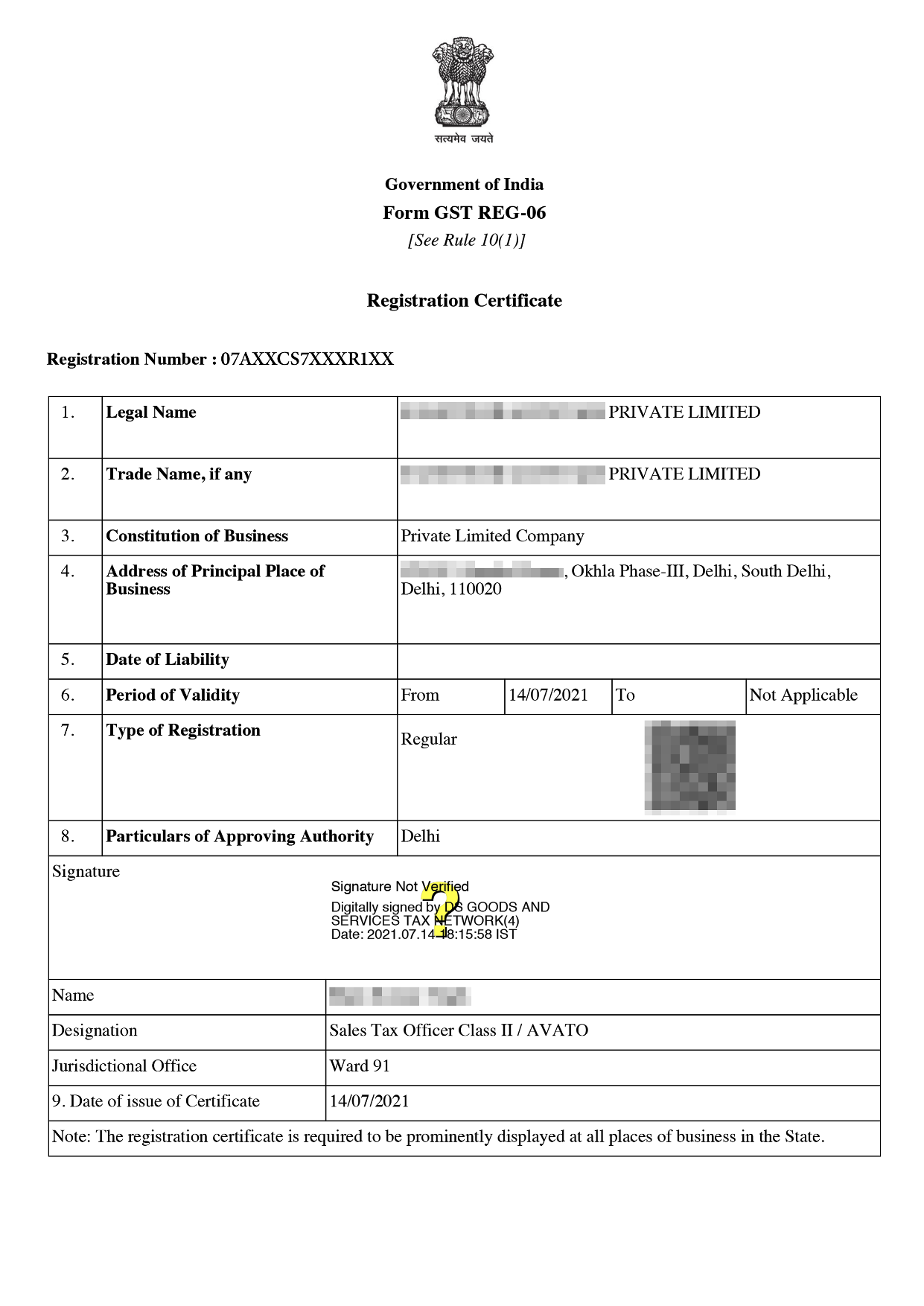
GST Registration Certificate Sample
Process of GST Return filing
Filing a GST Return online is a simple process when done correctly. Taxpayers need to log in to the GST portal and submit details of their sales, purchases, output tax, and input tax. Below are the steps to file a GST Return (for example, GSTR-3B):
- Login to the GST Portal using your GSTIN and password.
- Go to the Returns Dashboard and select the appropriate filing period (monthly/quarterly).
- Choose the form you want to file - e.g., GSTR-3B.
- Enter details of outward supplies (sales) and inward supplies (purchases) or select NIL Return if applicable.
- Preview the return summary to check all details before submission.
- Submit the return and confirm the liability.
- Make the payment (if required) through available payment modes.
- Digitally sign the return using a Digital Signature Certificate (DSC) or EVC (Electronic Verification Code).

Documents Required for GST Return Filing
To file GST Returns, businesses and individuals must keep certain documents and details ready. These documents help in verifying identity, financial records, and business registration, ensuring smooth and error-free GST compliance. The following documents are generally required:
- Certificate of Incorporation or Business Registration Proof
- PAN Card of the Business or Proprietor
- Aadhaar Card of the Owner/Authorized Signatory
- Bank Account Details (Bank Statement/Cancelled Cheque)
- Digital Signature Certificate (DSC) of Authorized Signatory
- Address Proof of Business (Electricity Bill, Rent Agreement, etc.)
GST Registration Fee for Individual
GST Registration is a mandatory requirement for individuals, businesses, and professionals whose annual turnover exceeds the prescribed limit under GST law or who meet specific eligibility criteria. Without GST registration, individuals are not legally allowed to collect GST from customers or claim Input Tax Credit (ITC). Therefore, timely registration is essential to remain compliant with tax regulations and avoid penalties.
Professional Utilities offers affordable and hassle-free GST Registration services at just ₹1499/-. Our experts handle the complete process, from document preparation to final approval, ensuring quick and error-free registration. By choosing Professional Utilities, individuals can save time, avoid rejections, and get their GSTIN approved smoothly.
What is GST Return filing?
GST Return Filing is a mandatory process for every GST-registered taxpayer in India. It involves submitting a statement to the tax authorities that records details of a business’s sales, purchases, output tax (GST collected on sales), and input tax (GST paid on purchases). Based on these details, the government calculates the net tax liability of the taxpayer. Filing GST Returns accurately and on time ensures compliance with GST laws, smooth claiming of Input Tax Credit (ITC), and helps avoid penalties or cancellation of GST registration.

Types of the GST
Under the Goods and Services Tax (GST) system in India, tax is divided into different categories depending on the nature of supply and the location of the transaction. The main types of GST are:
- Integrated Goods and Services Tax (IGST): Levied on interstate transactions of goods and services, and collected by the Central Government.
- State Goods and Services Tax (SGST): Levied on intrastate transactions (within the same state) and collected by the respective State Government.
- Central Goods and Services Tax (CGST): Levied on intrastate transactions along with SGST, but collected by the Central Government.
- Union Territory Goods and Services Tax (UTGST): Applicable on transactions within Union Territories (without legislature) and collected by the Union Territory administration.
These different types of GST ensure fair distribution of tax revenue between the Central and State Governments, while maintaining a uniform taxation system across India.
Who needs to file GST Return?
Every GST-registered business or individual in India is required to file GST Returns as per the prescribed schedule. The frequency and number of returns depend on the taxpayer’s turnover and category of registration. Businesses with an annual turnover of more than ₹5 crores must file two monthly returns (GSTR-1 and GSTR-3B) along with one annual return (GSTR-9), making it a total of 25 returns in a year.
For businesses with turnover up to ₹5 crores, the government offers the QRMP (Quarterly Return Filing and Monthly Payment) Scheme. Under this scheme, taxpayers need to file four quarterly GSTR-1, four GSTR-3B, and one annual return, totaling 9 returns in a year.
Apart from regular taxpayers, the following categories are also required to file GST Returns:
- Casual taxable persons
- Regular taxpayers
- TDS deductors
- Composition scheme taxpayers
- Input Service Distributors (ISD)
- Non-resident taxable persons
- E-commerce operators
Filing GST Returns on time is crucial to maintain compliance, claim Input Tax Credit (ITC), and avoid penalties or cancellation of GST registration.
Penalties for the late filing of the GST Return
Failure to file the GST Return can result in penalties like late fee and interest. 18% outstanding tax. Under CGST and SGST Late fee is 100 paid per day for both and the total comes to 200 per day.
Benefits of the GST Return
- There are many benefits of the GST return as mentioned below -
- Claiming Input Tax Credit - By filing a return on time they can claim the input tax credit which reduces the tax liability of the taxpayer.
- Avoid late fees - With the filing of the GST Return late fee of 100 per day and a maximum of 5000 can be adjusted in Input Tax Credit.
- Avoid GST Cancellation - Cancellation of the GST Registration can be avoided by filling out the GST Return.
- Performance of business is tracked - The performance of the business can be tracked by filling out GST Return. With the filing of the return summary of sales and purchases can be made for a specific period.
- Credibility increases - Regular filing of the return helps in getting credit facilities and loans from financial institutions. This all helps in increasing the creditworthiness of the businesses.
- Promote Compliance - Compiling with the law is done by Filling out the GST. This ensures the protection of the business from the legal issue in the future.
Conclusion
The revenue you earn from conducting business transactions must be reported in your GST return as a taxpayer, business owner, or any other eligible person. There are many benefits to filling out the GST return like GST compliance, claiming Input Tax Credit, avoiding cancellation of GST Registration, and many others. To avoid penalties GST returns need to be filled on the due date and claim the input tax credit.
FAQ’s On GST Return Filing
How much does it cost to not fill out the GST return?
200 rupees per day, or Rs. 100 under the CGST and Rs. 100 under the SGST. A yearly interest rate of 18% must be paid in addition to the late fee.
What are ITR and GST returns?
While income tax is a direct tax paid on the income received by people and businesses, GST (products and Services Tax) is an indirect tax imposed on the provision of products and services.
What does GSTR 2A and 2B Means?
The GSTR-2A is an automatically filled, read-only document that offers a thorough account of purchases. On the other side, the GST site generates GSTR-2B, which is a condensed version of the input tax credit that is accessible to taxpayers for a certain tax period.
Where can I file my GST returns efficiently?
You can manage your tax compliance and file returns easily through our GST Return Filing service page.
Speak Directly to our Expert Today

Reliable

Affordable

Assured
Disclaimer:The information provided on this website is intended for general information purposes only. Although all reasonable efforts are made to ensure that the information provided is correct and reliable, it is not advised to be used as a substitute for professional advice. The information herein is not to be used in place of seeking professional services, counsel, or guidance. We highly advise that you consult a professional before you make any business or legal decisions regarding the information presented on this website. This website and its contents are given "as is", and we do not take any responsibility for any action that is taken based on information given on this website.

- Written by: Abhishek Yadav
- Fact-checked: Sahil Singh
- Updated on: March 31, 2026
Testimonials
"Explore how Professional Utilities have helped businesses reach new heights as their trusted partner."






It was a great experience working withProfessional Utilities. They have provided the smoothly. It shows the amount of confidence they are having in their field of work.

Atish Singh


It was professional and friendly experience quick response and remarkable assistance. I loved PU service for section 8 company registration for our Vidyadhare Foundation.

Ravi Kumar
I needed a material safety data sheet for my product and they got it delivered in just 3 days. I am very happy with their professional and timely service. Trust me you can count on them.

Ananya Sharma
Great & helpful support by everyone. I got response & support whenever I called to your system. Heartly thanx for Great & Super Service. Have a Great & Bright future of team & your company.

Prashant Agawekar
Thank you so much Professional Utilities team for their wonderful help. I really appreciate your efforts in getting start business. Pvt Ltd company registration was smooth yet quick.
Abhishek Kumar
I applied for Drug licence and company registration and their follow-up for work and regular updates helped me a lot. They are happily available for any kind of business consultancy.

Vidushi Saini
Great experience went to get my ITR done, process was quite convenient and fast. Had a few queries, am happy about the fact those people explained me all things I wanted to know.

Taniya Garyali
Great services provided by Professional Utilities. They are best in this industry and the best part is their prices are so affordable. Kudos to you. Now you guys are my full-time consultant.

Aftab Alam
Trusted By