
Online Spices Board Registration
Spice Board Registration Starts @ ₹7,499

4.9


Spice Board Registration in India - Process, Fees & Documents
The Spice Board Registration is mandatory for companies which are engaged in the export of spices. The Spice Board of India, which comes under the Ministry of Commerce & Industry, has the authority to regulate and promote export of Indian spices to other countries. Spice Board Registration also helps in making access of Indian spice exporters directly with the buyers around the world with the assurance that only quality spices are being marketed. The Spice Board Registration is compulsory for all manufacturer and merchant exporters who are into the business of spices covered under the Spices Board Act of 1986. Professional Utilities offer expert assistance to obtain the Spice Board Certificate in India seamlessly in a timely manner.
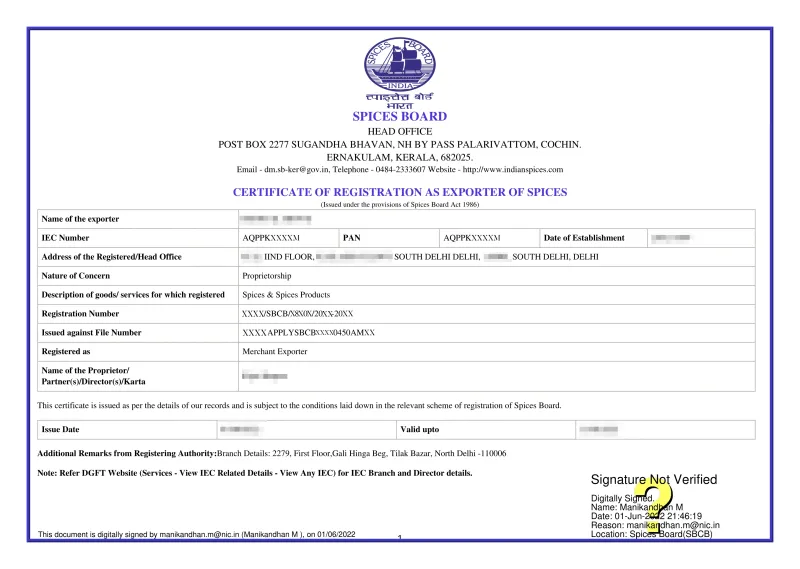
Spice Board Registration Certificate Sample
How to Apply for CRES (Spice Board RCMC) Registration with the Spices Board
The Spices Board CRES application needs to have three requirements fulfilled: an active IEC, an updated IEC profile on the DGFT portal, and a valid DSC or Aadhaar e-Sign linked to the DGFT account. The system runs a check on each before letting the application progress.
- Reach the DGFT Portal and Begin the CRES Application: The application is filed online through the DGFT portal at dgft.gov.in. After login, the applicant reaches the e-RCMC service to begin a fresh CRES application.
- Review the Auto-Filled IEC Profile Details: The first section of the form auto-fetches firm data from the IEC profile. This covers the IEC, PAN, firm name, registered address, bank details, director information, and branch records. Each entry needs careful walk-through, since the form locks these fields once the next section opens. Any errors must be corrected on the IEC profile before continuing.
- Pick the Spices Board and List Spice Export Products: In the RCMC Details section, the applicant picks the Spices Board as the registering authority, then enters the office for filing, the branch GSTIN, the membership tenure, the financial year, the MSME status, the exporter category (Merchant Exporter or Manufacturer Exporter), the zone (EOU or SEZ where applicable), and the relevant fee slab. Spice export products are listed with their ITC (HS) Codes, taken from the 52 scheduled spices under the Spices Board Act, 1986, including cardamom (small and large), pepper, chilli, ginger, etc. along with the destination countries. The annual turnover, previous-year export performance, firm website, firm profile, and authorised representative details are also listed in this section.
- Upload Documents, Pay the required Fees, and Sign Off Digitally: Applicants shall fill in the TDS data if applicable then supporting documents are uploaded as PDFs, and the registration fee is paid through the DGFT payment gateway. The complete document checklist is mentioned in the Documents Required section below. Once the fee is cleared, the Declaration is accepted, the Application Summary is reviewed, and the applicant signs the application with a DSC or Aadhaar e-Sign before final submission.
- Spices Board Verification and Issuance of the CRES: The Spices Board takes up the application for review. The Board checks the business credentials, IEC and GST records, spice product list with ITC (HS) Codes, supporting documents, and fee payment. Where clarification is needed, the Spices Board posts a query through the portal, which the applicant resolves before re-submission. Once approved, the CRES is made available on the DGFT dashboard, in a span of 7 to 10 working days. CRES validity typically runs for 3 financial years, after which renewal is required to continue exporting scheduled spices.
Note : Under DGFT FTP 2023 Para 2.94, the Certificate of Registration as Exporter of Spices (CRES) issued by the Spices Board is treated as an RCMC. Spice exporters holding a valid CRES do not need to apply for a separate RCMC.

Documents Required for Spices Board CRES (RCMC) Registration
The CRES (Spices Board RCMC) application brings together two sets of documents: a common DGFT set required across all e-RCMC filings, and a Spices Board-specific set tied to the council's mandate over spice exports. Below is a clean breakdown of each.
1. Common Documents
These are the standard documents required for any RCMC application on the DGFT portal:
- Import Export Code (IEC) issued by DGFT
- Permanent Account Number (PAN) of the firm
- GST Registration Certificate of the registered office and branches
- Certificate of Incorporation, Partnership Deed, or LLP Agreement depending on entity type
- Memorandum and Articles of Association (MoA and AoA) for companies
- List of Directors, Partners, or Proprietors with their PAN and DIN, where applicable
- Board Resolution or Authorisation Letter for the authorised signatory
- Aadhaar of the authorised signatory
- Cancelled cheque or Bank Performance Letter for bank verification
- Proof of office address, such as a recent electricity bill or rental agreement
- Self-Declaration or Undertaking in the prescribed format
- Last CRES Certificate (only for renewal applications)
- Digital Signature Certificate (DSC) or Aadhaar e-Sign linked to the DGFT account for final submission
2. Spices Board-Specific Documents
In addition to the common set, the Spices Board requires the following documents. The exact set differs based on whether the applicant is a Merchant Exporter or a Manufacturer Exporter.
For Merchant Exporters
- Copy of GST Registration
- Bank Report in Annex II format (Spices Board's prescribed bank report format)
- Copy of Central FSSAI Licence (mandatory for spice exporters as spices fall under food category)
For Manufacturer Exporters
- Copy of GST Registration
- Bank Report in Annex II format
- Copy of Central FSSAI Licence
- Copy of MSME (UDYAM) Certificate
- Valid Copy of Consent to Operate issued by the Pollution Control Board (PCB)
- Proof of Ownership of the Building of the Processing Unit (copy of valid Lease Agreement, Rent Agreement, or recent Property Tax Receipt)
Common Spices Board Items (Both Categories)
- List of Spice Export Products with HS Codes, drawn from the 52 scheduled spices under the Spices Board Act, 1986, including cardamom (small and large), pepper, chilli, ginger, turmeric, coriander, cumin, fennel, fenugreek, garlic, saffron, cinnamon, cloves, mace, nutmeg, and other listed spices
- Star Export House Certificate issued by DGFT, where applicable
- Settlement of Analytical Charges with the concerned Spices Board Regional Office (mandatory for renewal applications)
Note: All documents must be uploaded in PDF format during the Attachments section of the application.
Fee for Spice Board Registration
The Spice Board Registration Fee is the official government charge (excluding GST) applicable to both manufacturers and merchants, covering new registration, renewal, and modifications of the certificate.
| Particulars | Manufacturers | Merchants |
|---|---|---|
| Registration | Rs 15,000 | Rs 10,000 |
| Renewal | Rs 10,000 | Rs 7,500 |
| Modification | Rs 5,000 | Rs 5,000 |
Note: The aforementioned Fees is exclusive of GST. Professional Fee for Spice Board Registration: ₹25,000 for Manufacturers and ₹7,500 for Merchants.
What is Spice Board Registration
The Spices Board Registration Certificate, issued by the Export Promotion Council of India, is required for all producers and merchant exporters dealing in any of the 52 listed spices. India, the world's leading spice exporter, is well-known for its high quality and broad assortment of spices. The Spices Board certificate guarantees adherence to export legislation, quality standards, and worldwide market needs. To apply for Spices Board Registration , exporters must have a valid Import Export Code (IEC) obtained from the Directorate General of Foreign Trade (DGFT) portal. Obtaining the Spices Board Registration not only makes trading more efficient, but it also increases trust, allowing enterprises to expand their reach in worldwide spice markets.
Benefits of Spice Board Registration
The Spice Board Registration involves a lot of benefits for manufacturers and exporters which found new opportunities for growth and successful businesses at commercial level. Here are the key benefits:
- Global Recognition: The Spice Board Registration increases credibility of your company allowing the buyers and suppliers worldwide to place their trust in your company.
- Business Expansion Opportunities: The Spice Board certificate permits you to interact with potential business associates, consumers and policy makers across the globe to establish associations that will serve your long-term interests.
- Market Insights and Data Access: This is important for international importers and exporters, who can register in order to obtain important market information that includes trends, customer taste, and contact information.
- Simplified Export Procedure: CRES Spice Board certificate enables enterprises to escape from RCMC registration for export which in turn reduces their administrative burdens and time consumption.
- Brand Promotion and Visibility: Membership with the Spice Board enables one to participate in international trade fairs, showcases and promotions.
- Quality Certification and Compliance: The Spice Board Registration also ensures that all the spices meet standard quality across the globe thus reassuring Indian spices to its foreign customers.
Validity of Spice Board Registration
Certificate of Registration as Exporter of Spices (CRES) issued by the Spices Board of India provides legal endorsement that a spice exporter is duly listed with the regulatory body in the Ministry of Commerce, and Industry, Government of India.
The Spice Board Certificate is valid up to a period of three years from the date of issuance and it needs to be renewed once the validity expires in order to continue with the export business.Regular updates and compliance with renewal of the license ensures continuous exports and eliminates fines and lapses in certification.
List of Spices In Spices Board Act (Schedule 2)
Following 52 Spices are included in the Schedule 2 of the Spices Board Act.
All-Spice
Aniseed
Asafoetida
Basil
Bay Leaf
Bishop's Weed
Cambodge
Bishop's Weed
Caper
Caraway Seeds
Cardamom Large
Cardamom Small
Cassia
Celery
Chilli
Cinnamon
Clove
Coriander
Cumin
Curry Leaf
Dill
Fennel
Fenugreek
Garlic
Ginger
Greater Galanga
Horseradish
Hyssop
Juniper Berry
Kokam
Lovage
Marjoram
Mint
Mustard
Nutmeg & Mace
Oregano
Parsley
Pepper Long.
Pepper
Pomegranate
Poppy Seed
Rosemary
Saffron
Sage
Star Anise
Sweet Flag
Savory
Tamarind
Tarragon
Tejpat
Thyme
Vanilla
Penalties for Not Having Spice Board Registration
Under Section 11 of the Spices Board Act, 1986, exporting spices without a valid Spice Board Registration is a punishable offense. Businesses without this mandatory registration may face the following penalties:
- Confiscation of Spice Stock: The entire stock of spices for exportation may be seized by the authorities.
- Imprisonment: Offenders may face imprisonment for up to one year.
- Fines: A penalty of up to Rs 1,000 may be imposed.
To avoid these consequences, businesses must complete Spice Board Registration before engaging in the spices export.
Conclusion
Spice Board Registration is an important certification for traders who export spices from India to importing countries. Besides compliance with the given legal requirements, Spice Board Registration offers several benefits such as global recognition, business expansion opportunities, and quality assurance. The Certificate of Registration as Exporter of Spices (CRES) helps exporters to streamline their operations, access valuable market insights, and build credibility with international buyers. With proper documentation and adherence to the application process, the process to get the Spice Board Registration becomes easier, empowering exporters to establish a strong presence in the global spice market.
FAQ’s On Spice Board Registration
What is Spice Board Registration?
Spice Board Registration is required for all manufacturers and merchants exporting spices from India. It is issued by the Spices Board of India to guarantee compliance with export legislation, quality standards, and worldwide market needs, hence increasing the exporter's credibility.
What is the fee for Spice Board Registration?
The Spice Board Registration fee is the official government charge (excluding GST) that covers new registration, renewal, or modification of the Spice Board Certificate (CRES).
- For Merchants (Traders/Exporters): ₹7,500 (Professional Fee) + ₹5,000 (Govt. Fee)
- For Manufacturers (Processing/Export Units): ₹25,000 (Professional Fee) + ₹15,000 (Govt. Fee)
Why is Spice Board Registration important?
It ensures legal compliance, helps maintain quality standards, builds buyer trust, enables participation in government schemes, and facilitates smooth international trade of spices.
What are the benefits of obtaining Spice Board Registration?
It provides legal recognition, access to export opportunities, government support for spice exporters, eligibility for export incentives, quality testing, and participation in promotional programs.
Can I apply online for Spice Board Registration?
Yes, you can apply online through the official Spices Board of India website. However, many businesses prefer professional assistance to avoid delays and ensure proper compliance.
What is the validity of the Spice Board Certificate?
The Spice Board Certificate is valid for three years from the date of issue and it must be renewed after this term in order to continue exporting spices under the legal framework.
What documents are required for Spice Board Registration?
Documents required for Spice Board Registration include the IEC certificate, PAN card, GST registration, FSSAI license, bank certificate, and a passport-size photo of the CEO or officer. Manufacturers may additionally require an SSI certificate and other paperwork, depending on their business structure.
Speak Directly to our Expert Today

Reliable

Affordable

Assured
Industries Served by
Professional Utilities

Apparels

Footwear

Furniture

Gems and Jewellery

Tourism & Hospitality

Consumer Electronics

Chemicals

Telecom

Oils & Gas

Hotel

Railways

Liquor

Health & Medical

Food Processing

Dangerous/ Haz. Goods

Tea & Coffee

Capital Goods

Recycling

Rubber

NGOs

Silk

Handloom

IT & BPM

Steel

Automobile

Tobacco

Constructions


Testimonials
"Explore how Professional Utilities have helped businesses reach new heights as their trusted partner."







It was a great experience working withProfessional Utilities. They have provided the smoothly. It shows the amount of confidence they are having in their field of work.

Atish Singh


It was professional and friendly experience quick response and remarkable assistance. I loved PU service for section 8 company registration for our Vidyadhare Foundation.

Ravi Kumar
I needed a material safety data sheet for my product and they got it delivered in just 3 days. I am very happy with their professional and timely service. Trust me you can count on them.

Ananya Sharma
Great & helpful support by everyone. I got response & support whenever I called to your system. Heartly thanx for Great & Super Service. Have a Great & Bright future of team & your company.

Prashant Agawekar
Thank you so much Professional Utilities team for their wonderful help. I really appreciate your efforts in getting start business. Pvt Ltd company registration was smooth yet quick.
Abhishek Kumar
I applied for Drug licence and company registration and their follow-up for work and regular updates helped me a lot. They are happily available for any kind of business consultancy.

Vidushi Saini
Great experience went to get my ITR done, process was quite convenient and fast. Had a few queries, am happy about the fact those people explained me all things I wanted to know.

Taniya Garyali
Great services provided by Professional Utilities. They are best in this industry and the best part is their prices are so affordable. Kudos to you. Now you guys are my full-time consultant.

Aftab Alam
Trusted By