
BEE Registration for Room Air Conditioner

4.9


BEE Registration for Room Air Conditioner (Fixed Speed)
Room Air Conditioners (RACs) are mandated with energy-efficient norms overseen by the Bureau of Energy Efficiency (BEE). The appliance is marked with a star rating as per BEE regulation, which checks conformity to the government guidelines on energy efficiency and performance. RACs supplied by manufacturers also have to go through some certification and testing processes to check their compliance with these rigorous standards. This ensures that only those products that meet the necessary energy performance requirements are allowed to carry the BEE star rating label.
Subsequent to gaining compliance and BEE Registration, manufacturers are authorized to display the corresponding star rating labels on their products. The registration of BEE is therefore very important in the fight against inefficiency and excessive power consumption, helping to promote sustainability and environmental protection. It encourages manufacturers to design energy-efficient products and serves as a key tool in reducing overall energy demand. When buying products, consumers need to select those that are rated higher in terms of energy efficiency so they can be able to make informed decisions that will lower their expenses on electricity. Additionally, purchasing energy-efficient appliances helps reduce the overall environmental impact caused by energy consumption, making the effects of human activities on the environment minimal. BEE registration not only supports consumers but also plays a crucial role in shaping a greener, more sustainable future.
BEE Registration Certificate Sample
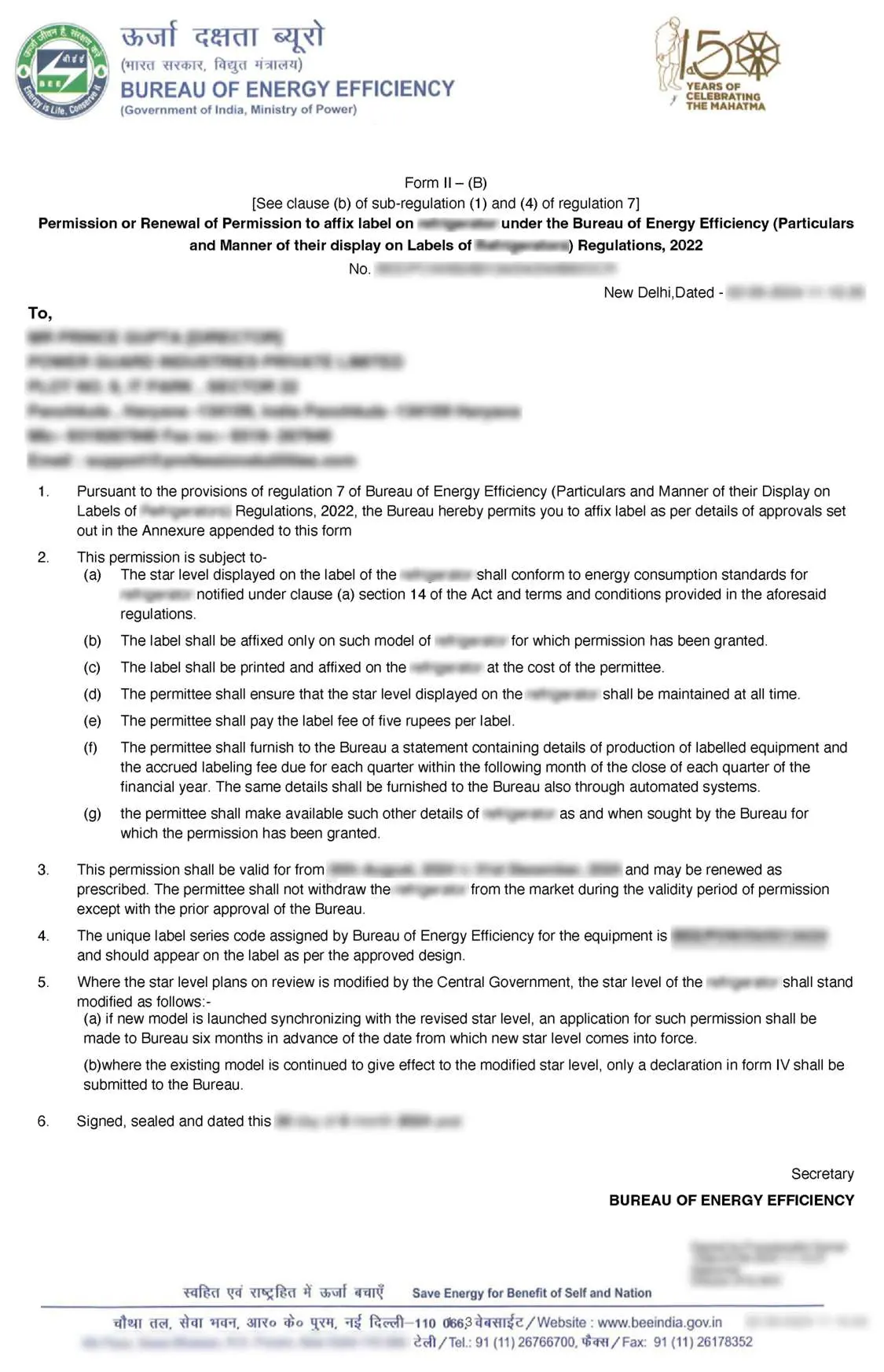
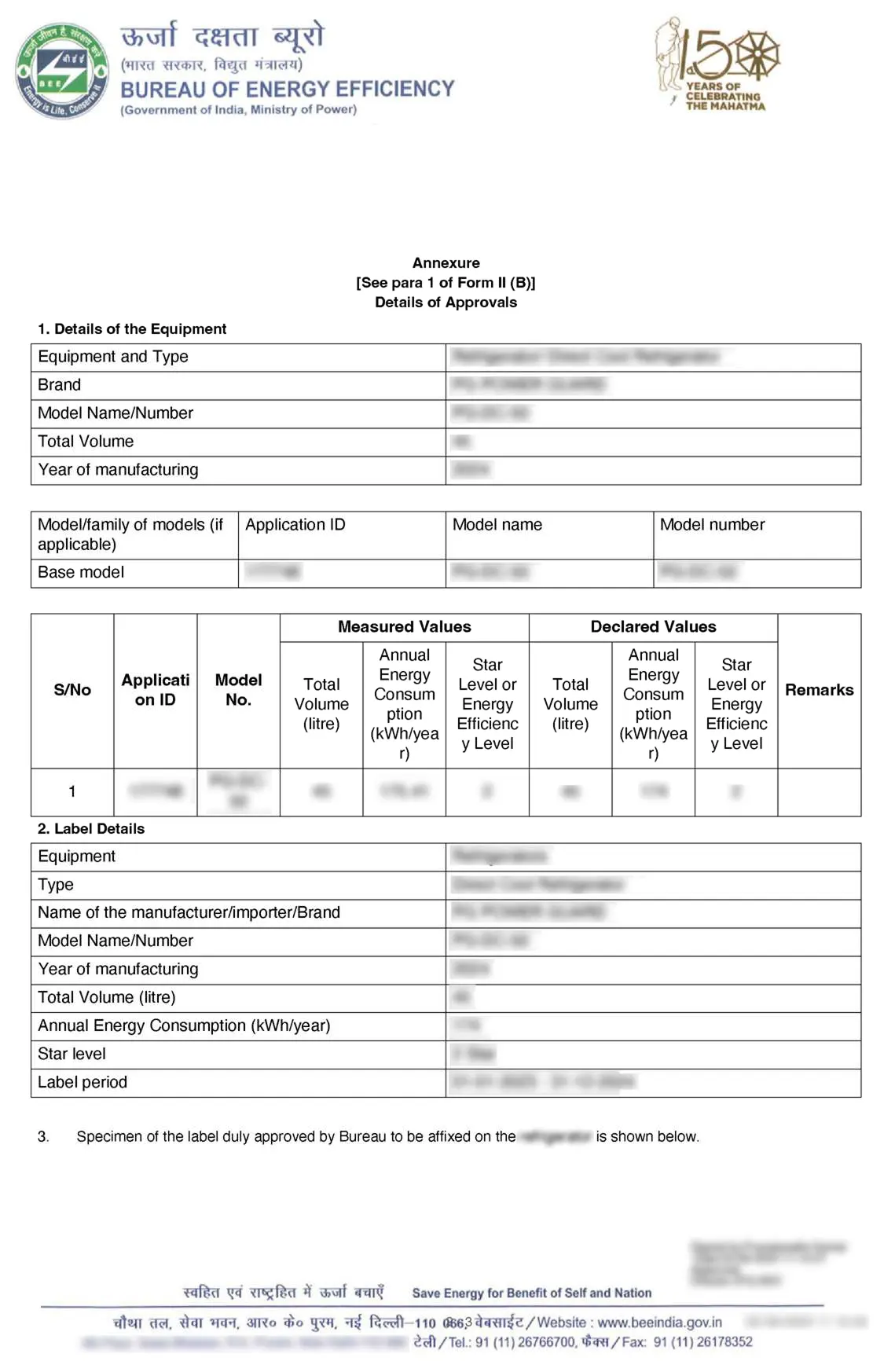
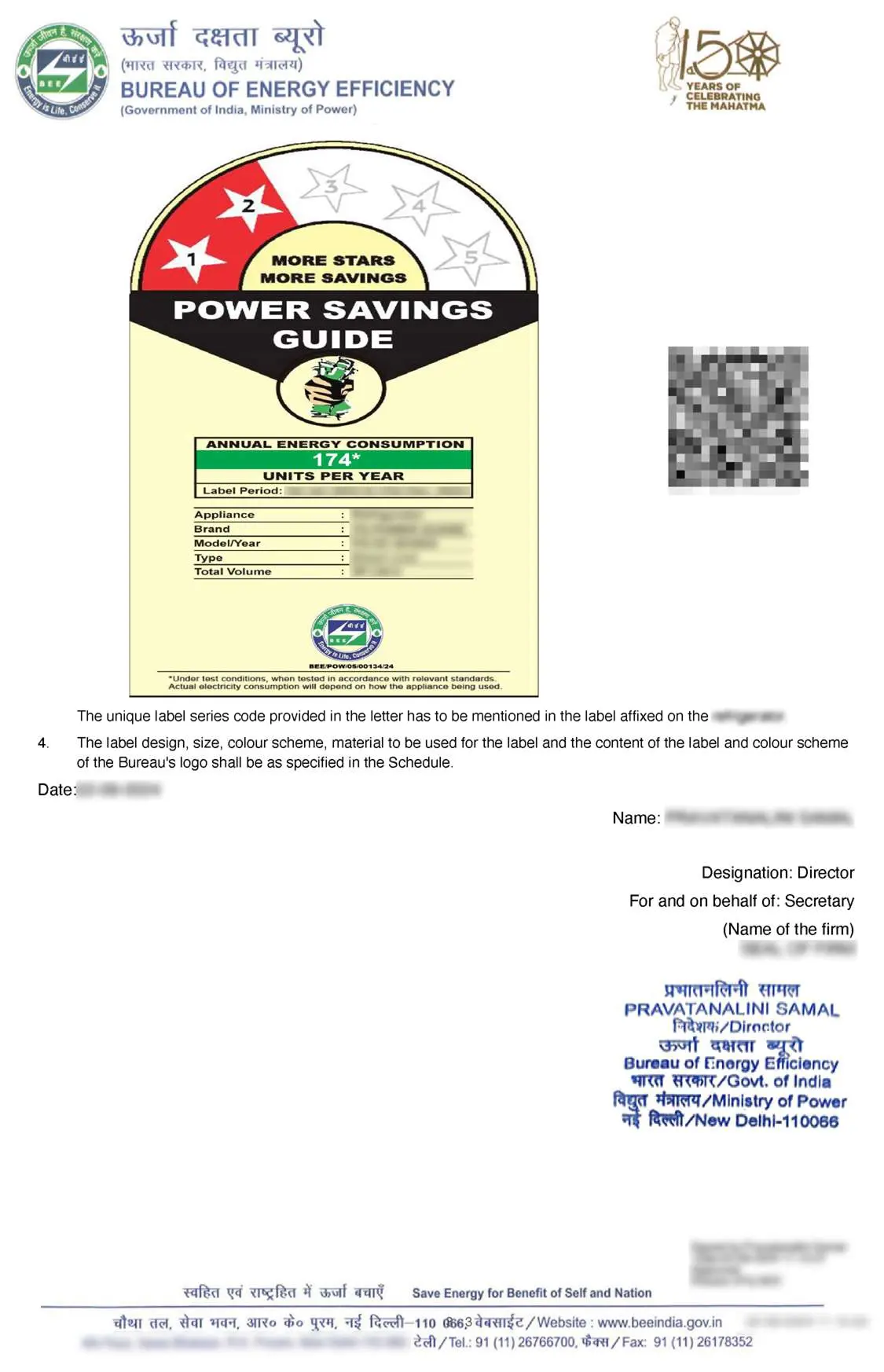
Registration process for Room Air Conditioner’s BEE Registration (Fixed Speed)
The registration process for Room Air Conditioners (RACs) under the Bureau of Energy Efficiency (BEE) typically involves the following steps:
-
Step 1: Manufacturer Eligibility
For registration of their product, the producer of the room air conditioners need to ensure that they meet the prescribed eligibility criteria set out by the BEE. This could include ensuring that all the necessary certifications are renewed and adhering to the energy efficiency recommendations under BEE.
-
Step 2: Testing
Regulations regarding energy efficiency rating of any model of Room Air Conditioner ensure that the product can only be tested in accredited laboratories established by BEE. This testing usually involves evaluating characteristics such as cooling capacity, power consumption and other factors.
-
Step 3: Submission of Data
At the end of the testing procedure, the manufacturer is obliged to share with BEE all the collected data. This information includes the cooling capacity of RAC model, energy consumption of RAC model, the specific details of working principles etc.
-
Step 4: Application Submission
The manufacturer submits the application for the BEE registration of the room air conditioner together with test reports, data, and documents required by the authority in all circumstances.
-
Step 5: Verification and Approval
To ensure that the test results and data provided are conforming to energy efficiency provisions, BEE has conducted validation. BEE recognizes the registration of the RAC model provided that all the requirements have been met.
-
Step 6: Issuance of BEE Label
When the registration is approved, BEE attaches a label showing the energy efficiency rating of the concerned model of the Room Air Conditioner. This label should be placed on the packaging material and the product’s advertisements easily visible by the general public.
-
Step 7: Renewal and Compliance
Manufacturers have the responsibility of continuously conforming to the set energy efficiency rules. As for the BEE requirements most of the registrations must be renewed at set intervals in order.

Documents Required for BEE Registration of Room Air Conditioner (Fixed Speed)
To obtain Bureau of Energy Efficiency (BEE) certification for room air conditioners, the following documents are required:
- Product Test Reports: Indicating the energy efficiency ratings.
- Product Specifications: Detailed technical specifications of the room air conditioner.
- Manufacturer Details: Company registration documents and address proof.
- Compliance Declaration: A statement from the manufacturer/importer confirming adherence to BEE standards.
- Quality Management Proof: Evidence of compliance with relevant quality management systems.
- BEE Application Form: Completed BEE-provided application form for certification.
- Payment Proof: Receipts for the certification process fee.


Fees Charges for BEE Registration of Room Air Conditioner (Fixed Speed)
The structure of fees that is charged during BEE Registration is divided into several parts. These include Company Registration Large scale is ₹1,00,000 while that of Small scale is ₹ 25000, Model registration fee is ₹2,000 per model while the Label fee differs in accordance to the particular appliance.
| Subject | Fees |
|---|---|
| Company registration(Large scale) | ₹1,00,000 |
| Company registration(Small scale) | ₹25,000 |
| Model registration(Per model) | ₹2,000 |
| Label fees(Per label) | Changes depending upon the appliance |
Note: The aforementioned Fees is exclusive of GST.
What is the BEE certificate for air conditioners?
The BEE certificate for air conditioners is issued by the Bureau of Energy Efficiency (BEE) to ensure AC models meet defined energy efficiency standards. It is part of BEE’s Standards & Labeling Program under the Ministry of Power.
Air conditioners are tested in BEE-approved labs and rated from 1 to 5 stars, with 5 stars being the most energy-efficient. The BEE star label helps consumers choose energy-saving models, reduce electricity bills, and support eco-friendly practices.
This certification also promotes responsible manufacturing and contributes to India’s energy conservation goals.
Importance of BEE Registration for Room Air Conditioner (Fixed Speed)
For room air conditioners, particularly the fixed-speed ones, it is mandatory that they must be registered with the Bureau of Energy Efficiency (BEE) for several reasons:
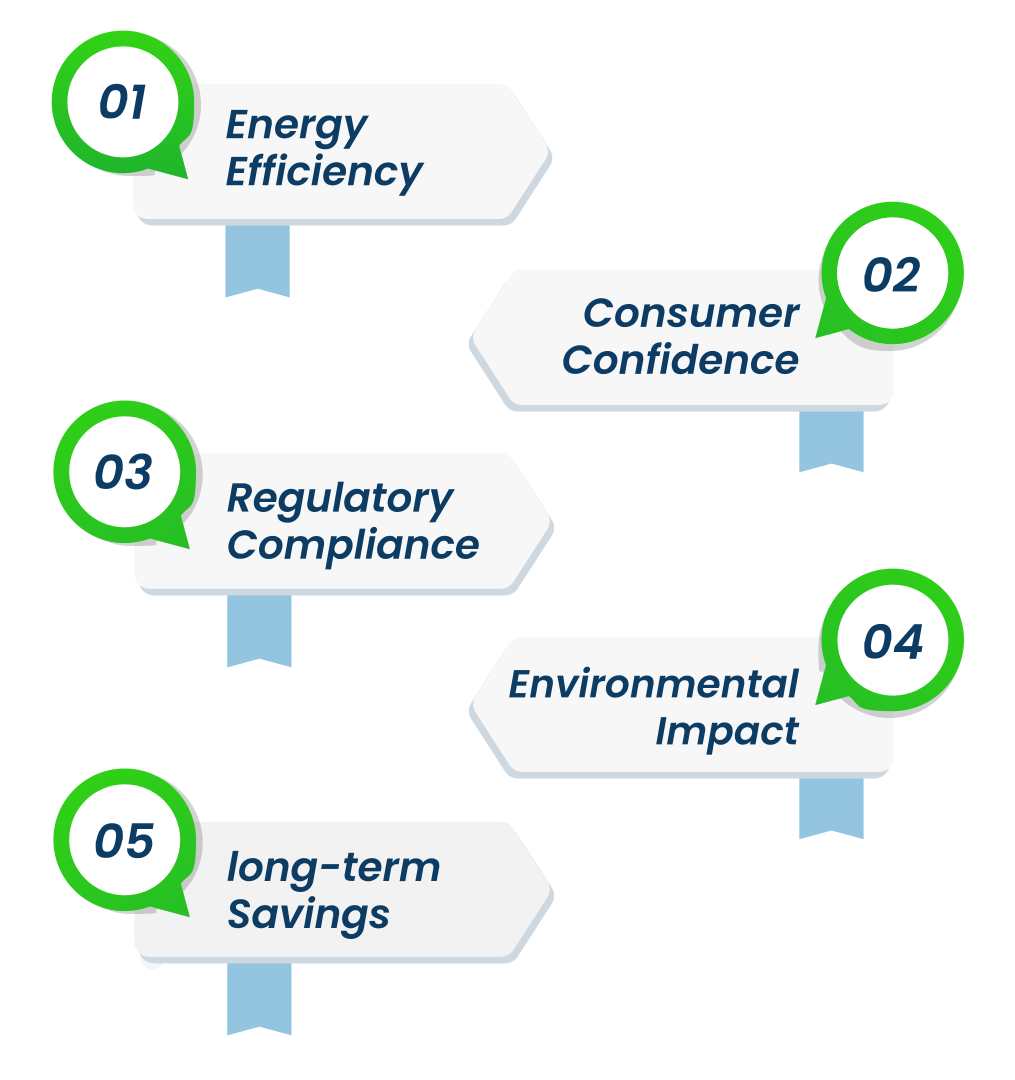
- Energy Efficiency: This makes it mandatory that air conditioners to be registered with BEE adhere to energy efficiency with the government regulations for fixed-speed models. Inverter air conditioners are said to be generally more energy-efficient than fixed-speed models but the registration under BEE secures the supply of the most energy-efficient air conditioners to minimize energy cost on electricity bills and energy consumption.
- Consumer Confidence: The BEE registration is a quality mark that provides the customer with an assurance that an air conditioner that meets the prescribed energy efficiency test is being sold in the market.
- Regulatory Compliance: BEE registration is mandatory for some products such as air conditioners in most countries including India, whereby manufacturers are mandated to meet certain restrictions on the lawful offers for the product with those not meeting the standard facing fines and prosecution.
- Environmental Impact: Such registered air conditioners have a smaller carbon footprint and governments strive to increase energy efficiency while lowering greenhouse gas emissions and energy consumption.
- Long-term Savings: While BEE-registered air conditioners can be slightly more expensive than those not registered, over the lifespan of an air conditioner, it is common for electricity savings by customers with lower tariffs to exceed the cost and provide options for cost recovery.
In summary, BEE registration is advisable for room air conditioners - more so the fixed-speed ones because consumers are assured of buying only efficient, compliant air conditioners that have been labeled safe for the environment and could save them money in the long run.
BEE Star Ratings For Air Conditioners
| Window Air Conditioning System (ISEER) | Split Air Conditioning System (ISEER) | ||||
|---|---|---|---|---|---|
| Validity till 31 December 2024 | Validity till 31 December 2024 | ||||
| Star Level | Minimum | Maximum | Star Level | Minimum | Maximum |
| 1-Star | 2.7 | 2.89 | 1-Star | 3.3 | 3.49 |
| 2-Star | 2.9 | 3.09 | 2-Star | 3.5 | 3.79 |
| 3-Star | 3.1 | 3.29 | 3-Star | 3.8 | 4.39 |
| 4-Star | 3.3 | 3.49 | 4-Star | 4.4 | 4.99 |
| 5-Star | 3.5 | 5-Star | 5.0 | ||
Conclusion
RACs imported and used in the country are governed by energy conservation regulations headed by the Bureau of Energy Efficiency in India. BEE registration assists in guaranteeing manufacturers meet laid down governmental energy efficiency requirements, thus cutting electricity consumption and costs while preserving the environment. As for the registration process, it includes manufacturer eligibility, testing of products, submission of testing data and application, verification and approval of application, issuance and labeling and renewal of labels. BEE certificate requirements, product test reports, details of manufacturer and OEM, and quality management documents are some of the documents needed. The registration fees that are charged depend on the BEE level that different appliances fall under.
FAQ's on BEE Registration of Room Air Conditioner
Why is BEE registration important for Room Air Conditioners?
The registration of BEE guarantees that the room air conditioners meet certain energy efficiency benchmarking promoting consumer choices and energy preservation.
Who needs to register their Room Air Conditioners with BEE?
According to the energy efficiency standards of fixed speed room air conditioners in India, manufacturers and importers have been required to file their products with BEE.
How is the energy efficiency of Room Air Conditioners determined?
The testing is done in a BEE accredited laboratory, to measure the efficiency of the Room air conditioners. Energy efficiency rating can be defined on the basis of specific criteria such as cooling ability and power consumption.
Is BEE registration required for all Room Air Conditioner models?
Due to energy consumption regulation standards, all the models and makes of room air conditioners sold or imported into the country need to be BEE registered.


BEE Registration for Other Appliances
Testimonials
"Explore how Professional Utilities have helped businesses reach new heights as their trusted partner."





It was a great experience working withProfessional Utilities. They have provided the smoothly. It shows the amount of confidence they are having in their field of work.

Atish Singh


It was professional and friendly experience quick response and remarkable assistance. I loved PU service for section 8 company registration for our Vidyadhare Foundation.

Ravi Kumar
I needed a material safety data sheet for my product and they got it delivered in just 3 days. I am very happy with their professional and timely service. Trust me you can count on them.

Ananya Sharma
Great & helpful support by everyone. I got response & support whenever I called to your system. Heartly thanx for Great & Super Service. Have a Great & Bright future of team & your company.

Prashant Agawekar
Thank you so much Professional Utilities team for their wonderful help. I really appreciate your efforts in getting start business. Pvt Ltd company registration was smooth yet quick.
Abhishek Kumar
I applied for Drug licence and company registration and their follow-up for work and regular updates helped me a lot. They are happily available for any kind of business consultancy.

Vidushi Saini
Great experience went to get my ITR done, process was quite convenient and fast. Had a few queries, am happy about the fact those people explained me all things I wanted to know.

Taniya Garyali
Great services provided by Professional Utilities. They are best in this industry and the best part is their prices are so affordable. Kudos to you. Now you guys are my full-time consultant.

Aftab Alam
Trusted By