FSSAI License for Proprietary Food

4.9


FSSAI License for Proprietary Food: Process, Fees, and Documents
A proprietary food is, however, defined as those foods which are not standardized under the FSSAI but are prepared using approved ingredients and additives. Proprietary foods include unique or innovative products such as energy bars, health drinks, and customised snacks which do not fall in any of the pre-defined categories of foods set by FSSAI.
It is a must to have an FSSAI license for manufacturers and sellers of proprietary foods so that such products are aligned with food safety and quality requirements. The license ensures that the food is safe for consumption and meets the requirements in terms of regulatory guidelines for ingredients, labeling, and packaging. It is required for all business sizes, be it small-scale startups or large-scale manufacturers.
An FSSAI license is acquired by submitting necessary documents such as business registration, product details, and a food safety management plan. This certification boosts consumer confidence and allows businesses to legally market their products while being transparent and accountable in the food supply chain.
In today's competitive market, an FSSAI license is not only a regulatory requirement but also a valuable asset that boosts brand credibility and helps proprietary food manufacturers gain a competitive edge while adhering to food safety norms.
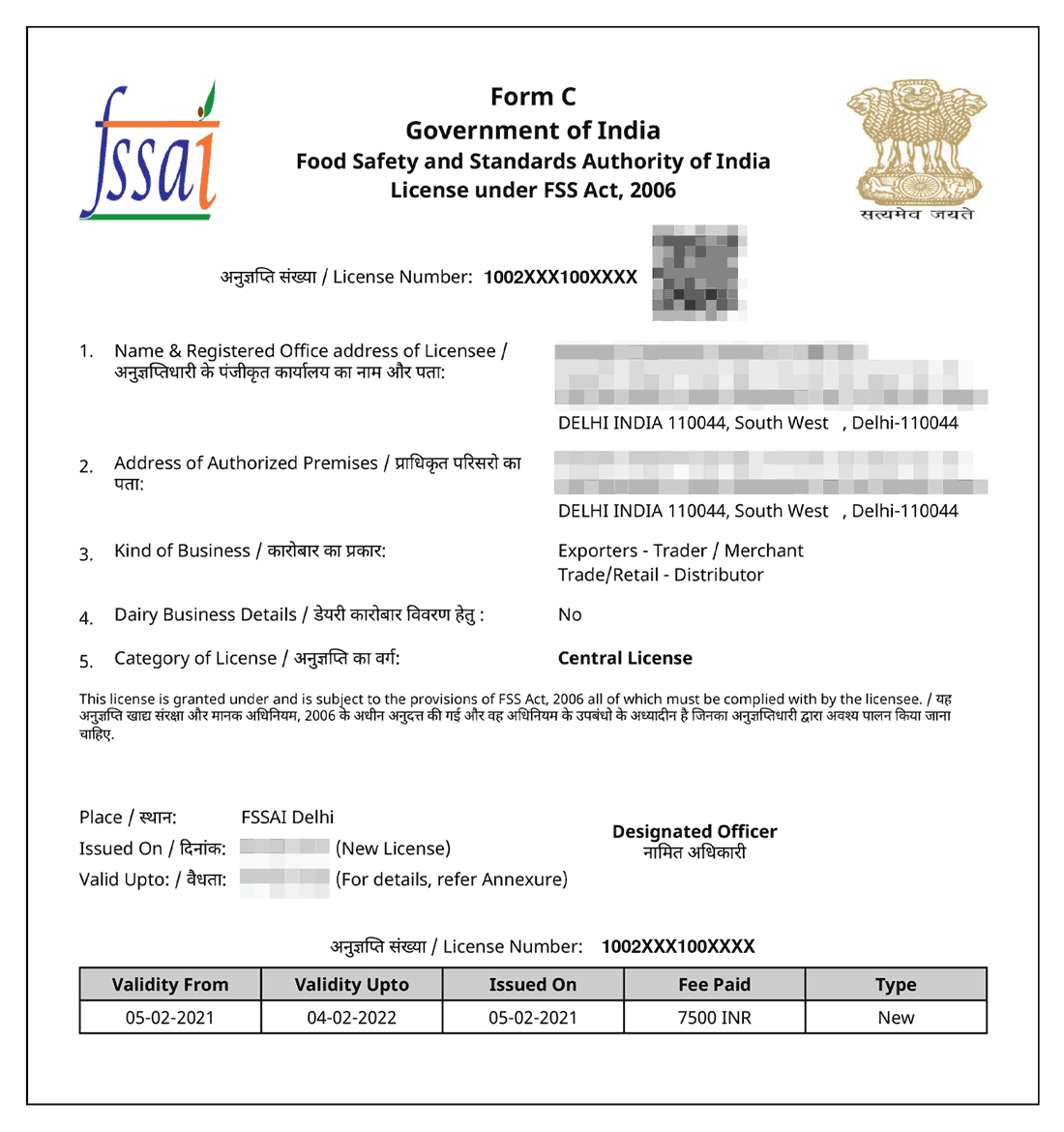
FSSAI License for Proprietary Food [Sample]
- Central License
How to Apply for FSSAI License for Proprietary Food?
Acquiring an FSSAI License for Proprietary Food: A Step-by-Step Guide
- Access the FoSCOS Official Website The first thing that the applicant needs to do is to access the official website of FoSCOS, the Food Safety Compliance System..
- Choose License Type Before applying, it is very important to decide whether a Central or State License is to be obtained. Each location should be separately entered to decide on its eligibility.
- Registration on FoSCOS Once the website is loaded, click "Sign-up" for the desired license type. Fill in the registration form with contact details, whereby the phone number and email address provided will be active and accessible.
- Create Username and Password Choose a unique username and set up a password during registration. Upon completion of the form, click 'Register' to finalize the sign-up.
- Confirmation of Account Activation Confirmation of account activation via an SMS and email to the applicant after successful registration.
- Log in and Submit the FSSAI Registration Application Form Use your new credentials to log into the system and fill out the FSSAI Registration online Application Form. All details should be correct and complete.
- Print and Submit Application Before submitting online, print a copy of it. Once submitted online, a reference number would appear on the screen, very important for tracking the application process.
- Offline Submission Within 15 days of applying online, a photocopy of the filled application form should be sent to the respective regional or state FSSAI office. This is so that the application is considered and processed.

Documents Required for FSSAI License for Proprietary Food
FSSAI Registration For Proprietary Food, it is mandatory to have various documents that depend on the type of registration or license applied. For
| Documents Required | FSSAI Central License |
|---|---|
| Personal Details | ID proof (Aadhaar, PAN, or Voter ID) |
| Passport-sized photograph | |
| Business Details | Proof of business premises (rent agreement or utility bill) |
| Food Safety | Food safety management plan |
| List of equipment and machinery used | |
| Additional Documents | Employee health and training certificates |
| NOC from local municipal authority (if required) | |
| Turnover statement verified by CA | |
| Import/export code (if applicable) | |
| Proprietary Food-Specific | Product formulation details (ingredients and process) |
| Product testing report (if required) |
FSSAI License for Proprietary Food Fees
FSSAI License Fees for Proprietary Food vary based on the license type. The government fee starts at ₹7,500 for a Central License. Additionally, professional fees for application processing and documentation support are ₹20,000 for a Central License.
| Type of License | Government Fee (INR) | Professional Fee (INR) |
|---|---|---|
| FSSAI Central License | ₹7,500 | ₹20,000 |
Note: The aforementioned fees are exclusive of GST
What is FSSAI License for Proprietary Food?
A proprietary food is, however, defined as those foods that are not standardized under the FSSAI but are prepared using approved ingredients and additives. Proprietary foods include unique or innovative products such as energy bars, health drinks, and customized snacks which do not fall into any of the pre-defined categories of foods set by FSSAI.
It is a must to have an FSSAI license for manufacturers and sellers of proprietary foods so that such products are aligned with food safety and quality requirements. The license ensures that the food is safe for consumption and meets the requirements in terms of regulatory guidelines for ingredients, labeling, and packaging. It is required for all business sizes, be it small-scale startups or large-scale manufacturers.
An FSSAI license is acquired by submitting necessary documents such as business registration, product details, and a food safety management plan. This certification boosts consumer confidence and allows businesses to legally market their products while being transparent and accountable in the food supply chain.
In today's competitive market, an FSSAI license is not only a regulatory requirement but also a valuable asset that boosts brand credibility and helps proprietary food manufacturers gain a competitive edge while adhering to food safety norms.
Benefits of FSSAI License for Proprietary Food
Obtaining an FSSAI License offers numerous advantages for Proprietary Food, ensuring not only legal compliance but also operational efficiency, customer trust, and business growth. Here are the key benefits:
- Legal Compliance: Makes certain that all food safety requirements are complied with, thus avoiding fines or even lawsuits.
- Customer Trust: Gives more credibility by assuring customers that food products are safe for consumption.
- Improved Reputation: Enhances business image, which equates to more customers and business opportunities.
- Market Access: Partnerships with suppliers are done and large markets will be opened for the business.
- Business Continuity: Prevention of halting business from the legal laws set by authorities.
- Eligibility for Schemes: Access to grants from the government to engage in different initiatives.
- Competitive Advantage: Provides distinction for their businesses in a highly competitive market.
- Export /Import Eligibility: The international trade reference ensures that food safety standards are constituted.
Conclusion
A proprietary food is, however, defined as those foods that are not standardized under the FSSAI but are prepared using approved ingredients and additives. Proprietary foods include unique or innovative products such as energy bars, health drinks, and customized snacks which do not fall into any of the pre-defined categories of foods set by FSSAI. These products are also commonly referred to as non-specified foods under the FSSAI regulations, and businesses dealing with such products are required to obtain an FSSAI License for Non-Specified Food to ensure compliance with food safety standards.
It is a must to have an FSSAI license for manufacturers and sellers of proprietary foods so that such products are aligned with food safety and quality requirements. The license ensures that the food is safe for consumption and meets the requirements in terms of regulatory guidelines for ingredients, labeling, and packaging. It is required for all business sizes, be it small-scale startups or large-scale manufacturers.
An FSSAI license is acquired by submitting necessary documents such as business registration, product details, and a food safety management plan. This certification boosts consumer confidence and allows businesses to legally market their products while being transparent and accountable in the food supply chain.
In today's competitive market, an FSSAI license is not only a regulatory requirement but also a valuable asset that boosts brand credibility and helps proprietary food manufacturers gain a competitive edge while adhering to food safety norms.
FAQ’s On FSSAI License for Proprietary Food
What is a proprietary food?
A proprietary food is a food product that is not defined or standardized under the Food Safety and Standards (FSS) Regulations but is made using approved ingredients and additives.
Is an FSSAI license mandatory for proprietary food manufacturers?
Yes, an FSSAI license is mandatory for all proprietary food manufacturers to ensure compliance with food safety regulations and legal requirements.
Can I apply for an FSSAI license for proprietary food online?
Yes, the application can be submitted online through the FoSCoS (Food Safety Compliance System) portal.
How long is the FSSAI license valid?
The license is valid for 1 to 5 years, depending on the duration selected during application. Renewal is required before expiration.


Testimonials
"Explore how Professional Utilities have helped businesses reach new heights as their trusted partner."







It was a great experience working withProfessional Utilities. They have provided the smoothly. It shows the amount of confidence they are having in their field of work.

Atish Singh


It was professional and friendly experience quick response and remarkable assistance. I loved PU service for section 8 company registration for our Vidyadhare Foundation.

Ravi Kumar
I needed a material safety data sheet for my product and they got it delivered in just 3 days. I am very happy with their professional and timely service. Trust me you can count on them.

Ananya Sharma
Great & helpful support by everyone. I got response & support whenever I called to your system. Heartly thanx for Great & Super Service. Have a Great & Bright future of team & your company.

Prashant Agawekar
Thank you so much Professional Utilities team for their wonderful help. I really appreciate your efforts in getting start business. Pvt Ltd company registration was smooth yet quick.
Abhishek Kumar
I applied for Drug licence and company registration and their follow-up for work and regular updates helped me a lot. They are happily available for any kind of business consultancy.

Vidushi Saini
Great experience went to get my ITR done, process was quite convenient and fast. Had a few queries, am happy about the fact those people explained me all things I wanted to know.

Taniya Garyali
Great services provided by Professional Utilities. They are best in this industry and the best part is their prices are so affordable. Kudos to you. Now you guys are my full-time consultant.

Aftab Alam
Trusted By