Copyright Registration in India



Copyright Registered

Years of Experience
What’s Included?
Copyright registration consultation Work eligibility assessment Copyright class/category selection Preparation of copyright application Filing of copyright application Government fee challan support Document drafting & submission Diary number generation Follow-up with Copyright Office Handling objections (if any) Copyright registration certificate support Copyright status tracking & updates Digital copyright file pack
Get Expert Consultation

Copyright Registration in India - Process, Fees & Benefits
Copyright registration is a legal procedure that allows creators to safeguard their works in literature, music, art, or drama. Under the Indian Copyright Act of 1957, copyright grants owners complete authority over their creations, preventing others from copying, distributing, or reproducing them without consent. While the law automatically protects a work upon its creation, submitting an application for copyright to the Copyright Office in India provides formal registration and enhances legal protections.
The copyright process involves filing Form XIV along with a statement of particulars with the Register of Copyrights. This requires details such as the type of copyright being claimed, the copyright notice, and relevant supporting documents. Once the application and prescribed fee are submitted, it undergoes review as per the Copyright Act 1957 to establish legal ownership.
A registered copyright serves as automatic proof in court, strengthening the enforcement of copyright laws and safeguarding the owner's rights. In case of infringement, copyright holders can seek statutory damages as a legal remedy. Additionally, copyright protection aligns with international agreements like the Berne Convention, ensuring global recognition.
Copyright registration grants legal protection over creative works, allowing owners to license and franchise their rights—key avenues for generating income. It ensures long-term security by restricting unauthorized use and safeguarding ownership interests. This guide outlines the process of obtaining copyright protection in India.
Copyright Registration Certificate

Process for Copyright Registration
Understand the https://www.professionalutilities.com/copyright-registration-process.php in India to safeguard your creative works. Follow these essential steps to ensure your rights are legally protected.
-
Step 1: Access the Official Copyright Website
- Register your work officially through the Indian Copyright Office.
- If you are a first-time user, make sure you sign up as a new member.
-
Step 2: Submit Application
- Log in to your account.
- Click on "Online Copyright Registration."
- Complete the form, providing information about your work (title of work, type of work, etc.).
- You will be asked to upload a scanned copy of your signature and any other necessary papers.
- Step 3: Payment - Go to the online payment and process the required payment.
-
Step 4: Dairy Number Issuance
- Upon submission of the online application, you shall be provided with a dairy number signifying the beginning of your application.
- Wait for 30 days for any objections.
-
Step 5: Application Scrutiny
- If there is no opposition, your application will be handed over to a scrutinizer.
- If there are issues, then certain hearings will be held to sort it out.
-
Step 6: Obtain Copyright Registration Certificate
- When your application is approved, a copyright certificate shall be issued to you.
- The whole copyright process in general takes 2 to 3 months.

Documents Required for Copyright Registration
The following are the essential Documents Required for Copyright Registration to ensure a smooth and successful application process.

- Copy of the Work - 2 copies for unpublished work, 3 copies for published work
- Identity Proof - PAN card and Aadhaar card
- No Objection Certificates (NOCs) (if applicable) -
- Author
- Publisher
- Individuals appearing in the work
- Power of Attorney (if applicable)
- Work Details - Title, language, year, and country of publication
- Contact Information - Mobile number and email address
Fees for Copyright Registration
Copyright registration in India starts at just INR 500 for literary, artistic, musical, and dramatic works. Check the complete fee structure as per the Copyright Act.
| S. No. | Type of Application | Fee (INR) |
|---|---|---|
| 1 (a) | Application for copyright registration in a Literary, Dramatic, Musical, or Artistic work | Rs. 500/- |
| 1 (b) | Application for copyright registration of a Literary or Artistic work related to goods or services (Section 45) | Rs. 2,000/- |
| 2 (a) | Application for change in copyright particulars for a Literary, Dramatic, Musical, or Artistic work | Rs. 200/- |
| 2 (b) | Application for change in copyright particulars of a Literary or Artistic work related to goods or services (Section 45) | Rs. 1,000/- |
| 3 | Application for copyright registration of a Cinematograph Film (Section 45) | Rs. 5,000/- |
| 4 | Application for change in copyright particulars of a Cinematograph Film (Section 45) | Rs. 2,000/- |
| 5 | Application for copyright registration of Sound Recording (Section 45) | Rs. 2,000/- |
| 6 | Application for change in copyright particulars of a Sound Recording (Section 45) | Rs. 1,000/- |
Note:- Professional fees for the copyright registration is ₹2,000 only with Professional Utilities.

What is Copyright Registration ?
Copyright Registrationis the formal procedure of officially documenting your original creation with the copyright office. This process guarantees that your work is safeguarded by copyright laws and aids in preventing unauthorized usage by others.
In India, copyright is applicable to literary, artistic, musical, cinematographic, and software creations. Although your work automatically receives copyright protection upon its creation, registering it offers formal acknowledgment and serves as proof of ownership.
Possessing a registered copyright enhances your legal rights and assists in their enforcement in the event of infringement. It also serves as evidence in legal proceedings, facilitating the defense of your creative work and the pursuit of damages if someone utilizes it without authorization.
What are the types of Copyrights in India?
Copyright protection in India covers various creative works, ensuring legal rights for creators. Understanding these types helps safeguard your intellectual property effectively.
- Literary Works: These include literature such as books, novels, poems, essays, and articles of literature that make contributions to the intellectual and cultural background.
- Musical Works: Music relates to songs, tunes, and background compositions used for a piece of art.
- Artistic Works: Artistic works include images, paintings, sketches, drawings, and sculptures created to exhibit an artistic mind.
- Cinematographic Films: These categories include movies, short movies, documentaries, and animation movies as ideal tools for storytelling.
- Sound Recordings: This includes musical recordings in song format, narration, sound books, and instrumental records of audio artwork.
- Dramatic Works: Dramatic works includes plays, scripts of films, and choreographed pieces of performance that recreate the stories in dramatic sequences.
- Broadcast and Performers Rights: It covers television and radio broadcasts by providing protection and applying the principles of fair use.
Benefits of Copyright Registration
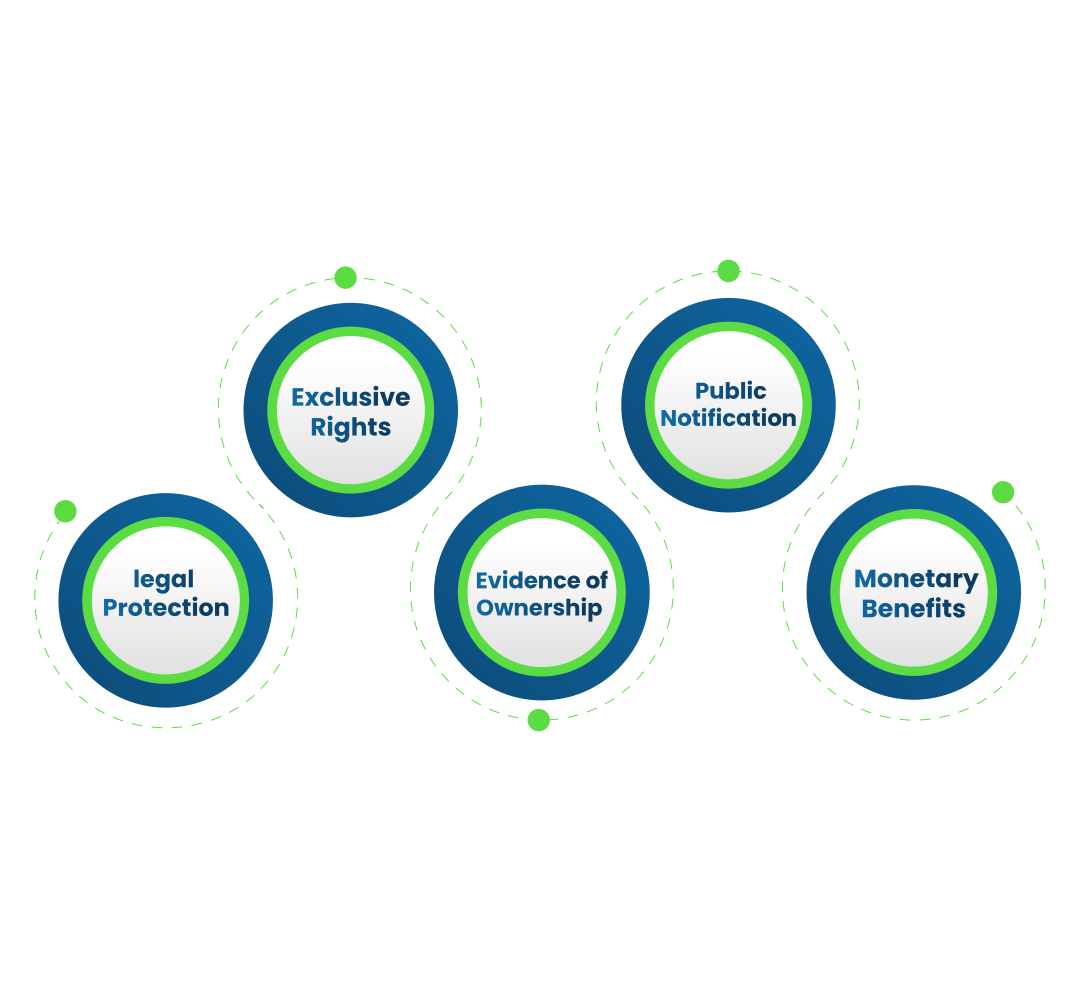
Copyright registration offers several benefits to creators and intellectual property owners, including the following:
- Legal Protection: The Copyrights Act provides an application for registration. the registration certificate gives the owner a public record to protect him against the infringers.
- Exclusive Rights: Registered copyrights provides legal ownership of the work to reproduce, distribute, or modify the piece of work the owner.
- Evidence of Ownership: It also plays the role of initial admissible evidence in the case where the creator involves himself or herself in a legal case.
- Public Notification: Registration informs the public of the copyright, hence preventing future infringement.
- Monetary Benefits: Contractors may license or sell a work, and they receive royalties or additional receipts as added products.
Eligiblity for Copyright Registration
Individuals and entities who create unique works in original form are eligible for copyright, which grants them exclusive rights to their creations.
- Authors and Creators
- Writers, poets, novelists, and content creators
- Artists, painters, and sculptors
- Photographers and graphic designers
- Musicians, composers, and lyricists
- Filmmakers, directors, and scriptwriters
- Companies and Organizations
- Businesses that create original content, software, or branding materials
- Media houses, publishing companies, and production studios
- Educational institutions for research papers, books, and learning materials
- Government Bodies
- Government agencies for reports, official publications, and creative works
- Software Developers
- Individuals or companies that create software, applications, and digital content
Copyright Symbol
The Copyright Symbol (©) is a unique mark that informs users that the content is protected under the copyright law. It also works as a warning to others not to use, copy, or distribute the work without permission from the author. It is primarily used in literary, artistic, musical, and digital works.
How to use Copyright Symbol?
The copyright symbol © needs to be placed before the name of the copyright holder and the year of creation; © 2025 Your Name/Company. It is not mandatory but is useful in enhancing the holding of title claims. It is commonly placed on books, websites, music, and other media to signify that the content has been protected under the Copyright India laws.
Conclusion
The Copyright Act of 1957 grants exclusive rights to authors, artists, and publishers over their original works, ensuring legal protection, preventing piracy, and enabling monetization through licensing. The copyright registration process in India involves filing Form XIV along with the required documents and fees at the Copyright Office. Copyright protection lasts for the creator’s lifetime plus 60 years after their death. Key benefits include legal ownership, public recognition, and protection from infringement. Essential documents for registration include identity proof, NOCs, and copies of the work. The process typically takes 2-3 months, with fees varying based on the type of work. Get hassle-free copyright registration in India with Professional Utilities for just ₹2,000!
FAQ’s On Copyright Registration in India
How can I register my copyright?
To register a copyright in India, fill out Form XIV and enclose the required documents along with the prescribed fees to the Copyright Office. After inspection and approval, the registration certificate is issued.
How long is a copyright registration valid in India?
Copyright protection for literary, dramatic, musical, and artistic works lasts for the entire life of the author and 60 years after the author’s death. Regarding works defined as anonymous, cinematographic, and posthumous, the duration differs according to provisions of the Copyright Act of 1957.
What is the cost of copyright registration in India?
The registration fees begin at ₹500 for a work and may even vary according to the type of work being registered. Professional services for copyright registration fee with Professional Utilities cost ₹2,000.
Is registration of copyright compulsory?
Under Indian law, copyright exists as soon as a work is created, and there is no formality required to get copyright. It is an important principle of the Berne Convention that the registration of copyright is not mandatory.
Speak Directly to our Expert Today

Reliable

Affordable

Assured
Copyright Registration in Other States
Copyright Registration for Creative & Digital Works
Testimonials
"Explore how Professional Utilities have helped businesses reach new heights as their trusted partner."





It was a great experience working withProfessional Utilities. They have provided the smoothly. It shows the amount of confidence they are having in their field of work.

Atish Singh


It was professional and friendly experience quick response and remarkable assistance. I loved PU service for section 8 company registration for our Vidyadhare Foundation.

Ravi Kumar
I needed a material safety data sheet for my product and they got it delivered in just 3 days. I am very happy with their professional and timely service. Trust me you can count on them.

Ananya Sharma
Great & helpful support by everyone. I got response & support whenever I called to your system. Heartly thanx for Great & Super Service. Have a Great & Bright future of team & your company.

Prashant Agawekar
Thank you so much Professional Utilities team for their wonderful help. I really appreciate your efforts in getting start business. Pvt Ltd company registration was smooth yet quick.
Abhishek Kumar
I applied for Drug licence and company registration and their follow-up for work and regular updates helped me a lot. They are happily available for any kind of business consultancy.

Vidushi Saini
Great experience went to get my ITR done, process was quite convenient and fast. Had a few queries, am happy about the fact those people explained me all things I wanted to know.

Taniya Garyali
Great services provided by Professional Utilities. They are best in this industry and the best part is their prices are so affordable. Kudos to you. Now you guys are my full-time consultant.

Aftab Alam
Trusted By