
GST Registration for Society
Get Your GST Registration for Society @ ₹1,499

4.9


GST Registration for Society - Process, Fees, and Documents
A society is a non-profit organization for a specific cause, like the distribution of education, culture, sports, religion, or social welfare. Although societies are not established to earn profit, they can still be under the GST routine if they conduct certain activities that are taxable.
According to Indian GST rules, a society has to register for GST if its annual revenue is above ₹20 lakh (or ₹10 lakh in special categories of states). It also has to register if it renders services such as training, consultancy, event management, or grants tied to given deliverables. Even if the revenue falls below the threshold, a society may register voluntarily to collect advantages such as input tax credit, legal compliance, and enhanced responsibility.
After the society is registered, it is allotted a GSTIN (Goods and Services Tax Identification Number), which it will use for all tax work. GST Registration also facilitates societies to operate in multiple states, deal with the government or business houses, and maintain transparent accounts. In short, GST registration keeps societies legally on the go and facilitates their smooth functioning.
Online GST Registration Sample
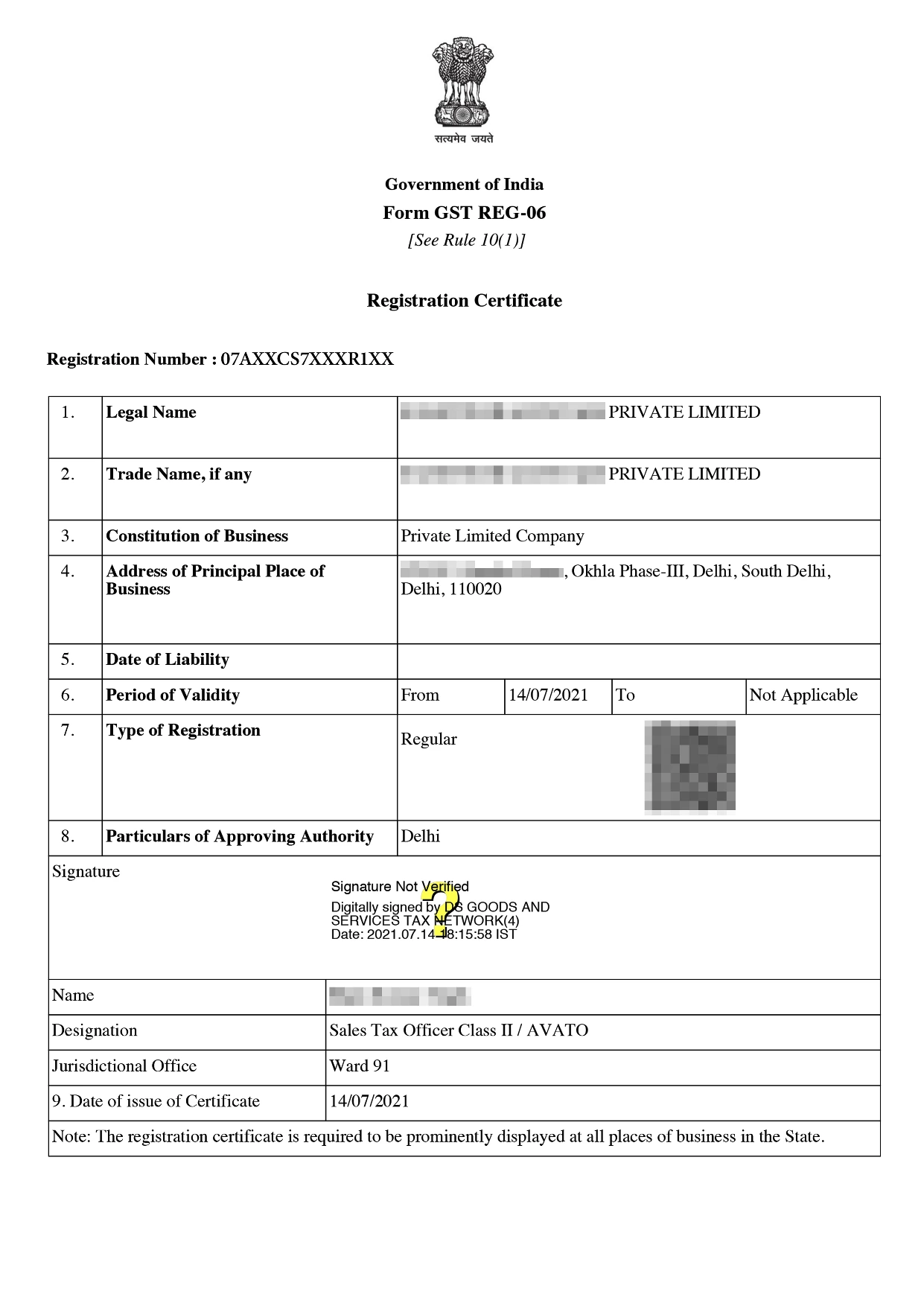
Application Process of GST Registration for Society
The GST registration process for a Society is completely online and can be completed through the official GST portal. Here’s a comprehensive 8-step guide to help you through the process:
- Visit the GST Portal: Start by visiting the official GST portal: www.gst.gov.in.
- Click on ‘Register Now’: Under the 'Taxpayers' tab on the homepage, click on ‘Register Now’ to begin a new GST application.
- Fill Part A (GST REG-01): Provide your PAN, mobile number, email ID, and state. You’ll receive OTPs for mobile and email verification. After verification, a Temporary Reference Number (TRN) will be generated.
- Fill Part B: Log in with your TRN and complete Part B of the form. Include business details, promoter/director information, the principal place of business, bank account details, and authorized signatory info.
- Upload Required Documents: Upload the necessary documents in the appropriate format (PDF or JPEG). Ensure documents are clear and legible before uploading.
- Submit the Application: Once everything is reviewed and verified, submit the application using a Digital Signature Certificate (DSC) or an Electronic Verification Code (EVC).
- Application Processing: Your application will be processed and verified by GST officials. You may be contacted if additional information or clarification is needed.
- GSTIN Issuance: After successful verification, you’ll receive a GST Registration Certificate and your unique 15-digit GST Identification Number (GSTIN) within 7 to 10 working days.

Documents Required for GST Registration for Society
To complete GST registration for a society, the following documents are required. These ensure legal identity, address proof, and authentication of the society and its authorized members:
| Document Type | Purpose/Details |
|---|---|
| PAN Card of the Society | Mandatory for GST registration and tax identification |
| Certificate of Registration | Proof of society’s legal formation under the Societies Registration Act |
| Memorandum of Association (MOA)/Byelaws | To outline the objectives and rules of the society |
| PAN & Aadhaar of Authorized Signatory | Identity proof of the person authorized to apply on behalf of the society |
| Photograph of Authorized Signatory | Passport-size photo of the authorized person |
| Address Proof of Registered Office | Electricity bill, rent agreement, or NOC from the owner of the premises |
| Bank Account Details | A cancelled cheque or bank statement/passbook showing the society’s name and account |
| Email ID and Mobile Number | For OTP verification and communication |
| Digital Signature Certificate (DSC) | Required especially for societies registered under state or central law |
Fees for GST Registration for Society
GST registration for a Society is an important but detailed process. If you choose to do it yourself on the GST portal, there are no government fees. However, if you want to save time and avoid hassle, you can go for Professional Utilities' expert service. They help you with the complete registration process for just ₹1499, making it quick and easy.
| Particulars | GST Registration Fees (INR) |
|---|---|
| Government Fees | ₹0 (No charges for self-registration under GST law) |
| Professional Fees | ₹1499 (charged by Professional Utilities for expert assistance) |
What is GST Registration for Society?
The GST Registration of a Society is the process by which a registered society joins the Goods and Services Tax (GST) regime in India. Even though societies are typically established as non-profit entities with charitable or social purposes, they can still be compelled to register for GST based on their activities and income patterns.
According to GST legislation, a society is required to register if its turnover for the year is over ₹20 lakh (or ₹10 lakh in special category states) or if it deals with taxable services or supplies of goods like consultancy, training programs, or conducting paid events. Even societies that are getting grants that are tied to specific services or deliverables are within the GST purview. Voluntary registration is also possible for societies wanting to increase transparency and benefit from input tax credit.

Benefits of GST Registration for Society
Though Societies are incorporated for not-for-profit objectives, GST registration provides various operational and financial advantages. Below are the key benefits of obtaining GST registration for Societies:

- Legal Compliance – Ensures the society complies with government tax legislation and avoids penalties or legal issues.
- Input Tax Credit (ITC) – Enables the society to claim credit for GST paid on purchases made towards its activities.
- Enhanced Credibility – Increases trust from donors, government agencies, and corporate sponsors through financial transparency.
- Eligibility for Government Tenders and CSR Projects – Most public and corporate partnerships demand GST-registered members for engagement.
- Professional Financial Management – Promotes structured invoicing, book-keeping, and open accounting.
- Access to E-commerce Platforms – Online selling societies for goods or services need GST registration to be listed on portals such as Amazon or Flipkart.
- Increased Transparency – Encourages accountability in the utilization of funds and income from different sources.
Conclusion
GST registration is important in ensuring societies remain transparent, legally compliant, and fiscally accountable. While societies are not-for-profit organizations, undertaking taxable services or obtaining connected grants subjects them to the purview of GST law.
Through GST registration, societies not only gain input tax credit but also become more credible, are eligible for government tenders, and can work in conjunction with CSR partners better. It makes operations smoother, particularly when operating between states or providing services online.

FAQ’s On GST Registration for Society
Do societies have to register under GST?
GST registration is compulsory if a society's turnover for the year crosses ₹20 lakh (₹10 lakh in special category states) or if it provides taxable goods or services.
Can a society voluntarily apply for GST registration?
Yes, even though not compulsory, a society can voluntarily apply for GST registration to benefit from input tax credit and enhanced credibility.
How is GSTIN utilized by a society?
GSTIN (Goods and Services Tax Identification Number) is a distinct 15-digit number employed to file GST returns and perform lawful business transactions.
Is a donation received by a society taxable under GST?
Voluntary donations in the absence of any service or goods in exchange are not subject to tax. Yet, donations connected with particular deliverables might attract GST.
What is suo moto cancellation of GST registration?
Suo Moto Cancellation of GST Registration refers to the cancellation of GST registration by the tax authorities on their own initiative due to reasons such as non-filing of returns, non-operation from the declared place of business, or violation of GST provisions. Understanding this helps taxpayers take timely corrective action and restore compliance.
What is the QRMP scheme under GST?
The QRMP scheme under GST allows small taxpayers with a turnover up to ₹5 crore to file GSTR-1 and GSTR-3B quarterly instead of monthly, simplifying compliance and reducing the frequency of filings.
Speak Directly to our Expert Today

Reliable

Affordable

Assured
Industries Served by
Professional Utilities

Apparels

Footwear

Furniture

Gems and Jewellery

Tourism & Hospitality

Consumer Electronics

Chemicals

Telecom

Oils & Gas

Hotel

Railways

Liquor

Health & Medical

Food Processing

Dangerous/ Haz. Goods

Tea & Coffee

Capital Goods

Recycling

Rubber

NGOs

Silk

Handloom

IT & BPM

Steel

Automobile

Tobacco

Constructions


Disclaimer:The information provided on this website is intended for general information purposes only. Although all reasonable efforts are made to ensure that the information provided is correct and reliable, it is not advised to be used as a substitute for professional advice. The information herein is not to be used in place of seeking professional services, counsel, or guidance. We highly advise that you consult a professional before you make any business or legal decisions regarding the information presented on this website. This website and its contents are given "as is", and we do not take any responsibility for any action that is taken based on information given on this website.

- Written by: Abhishek Yadav
- Fact-checked: Sahil Singh
- Updated on: June 13, 2026
Testimonials
"Explore how Professional Utilities have helped businesses reach new heights as their trusted partner."





It was a great experience working withProfessional Utilities. They have provided the smoothly. It shows the amount of confidence they are having in their field of work.

Atish Singh


It was professional and friendly experience quick response and remarkable assistance. I loved PU service for section 8 company registration for our Vidyadhare Foundation.

Ravi Kumar
I needed a material safety data sheet for my product and they got it delivered in just 3 days. I am very happy with their professional and timely service. Trust me you can count on them.

Ananya Sharma
Great & helpful support by everyone. I got response & support whenever I called to your system. Heartly thanx for Great & Super Service. Have a Great & Bright future of team & your company.

Prashant Agawekar
Thank you so much Professional Utilities team for their wonderful help. I really appreciate your efforts in getting start business. Pvt Ltd company registration was smooth yet quick.
Abhishek Kumar
I applied for Drug licence and company registration and their follow-up for work and regular updates helped me a lot. They are happily available for any kind of business consultancy.

Vidushi Saini
Great experience went to get my ITR done, process was quite convenient and fast. Had a few queries, am happy about the fact those people explained me all things I wanted to know.

Taniya Garyali
Great services provided by Professional Utilities. They are best in this industry and the best part is their prices are so affordable. Kudos to you. Now you guys are my full-time consultant.

Aftab Alam
Trusted By