Make in India Certificate for Tenders
Get Make in India certificate for Tenders @ ₹7,499/-

4.9


Make in India Certificate for Tenders - Benefits, Process and Fees
The Make in India Certificate is an important document that proves a company's products are made in India with the right amount of local materials. It is issued under the Public Procurement (Preference to Make in India) Order, 2017 and helps Indian businesses get preference when bid for government tenders.
This certificate allows manufacturers and suppliers to benefit from price advantages and priority in government contracts. It is especially useful for companies that want to sell their products to government departments, PSUs, and other public sector organizations. To qualify, businesses must ensure their products meet the minimum local content requirement, as set by the authorities.
By obtaining the Make in India Certificate for Tenders, companies can increase their chances of winning government bids, reduce competition from foreign suppliers, and contribute to India’s goal of boosting domestic manufacturing. This initiative helps create more jobs, strengthen local industries, and promote economic growth.
For businesses looking to expand in the public sector, MII Certificate is very important to support India’s vision of self-reliance in manufacturing.
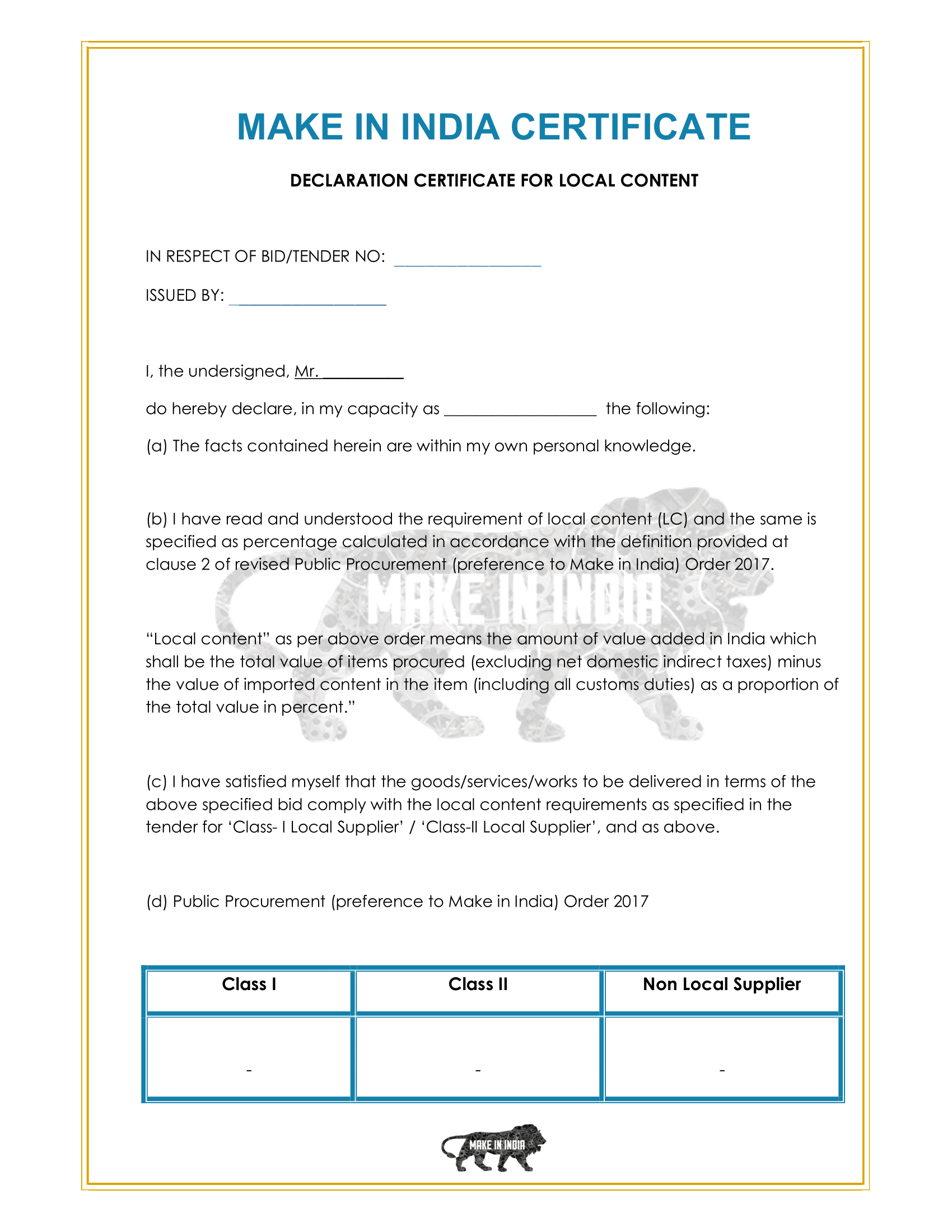
Make in India Certificate [Sample]
Process of Make in India Certificate for Tenders
To bid for "Make in India" reserved tenders, you'll have to obtain a Make in India (MII) certificate. Follow the given steps:
-
Determine Local Content
- Businesses must check if their product qualifies as a Class-I Local Supplier (more than 50% local content) or a Class-II Local Supplier (20%–50% local content).
-
Prepare Required Documents
- Company Registration Details
- Manufacturing Process Details
- Bill of Materials with local content percentage.
- Self-Certification or Third-Party Certification (if required).
-
Apply for Certification
- Self-Certification: For general tenders, businesses can certify local content on their own.
- Third-Party Certification: Some high-value tenders may require certification from an authorized body like the Quality Council of India (QCI) or a Chartered Accountant (CA).
-
Submit MII Certificate
- Once the Make in India Certificate is obtained, it must be submitted while bidding for government tenders.

Documents Required for Make in India Certificate for Tenders
To apply for the Make in India Certificate for Tenders, businesses must submit specific documents to prove their eligibility and compliance with local content requirements. Below is the list of required documents:
- Company Registration Certificate - Proof of business registration, such as
- GST Registration Certificate
- MSME Registration (if applicable)
- Incorporation Certificate (for Private Limited or LLP)
- Manufacturing Process Details
- Bill of Materials (BoM) with Local Content Percentage
- Self-Certification of Local Content
- Third-Party Certification (if required)
- Authorization Letter (if applicable)
- Past Work Orders or Tender Participation Proof (Optional)
Make in India Certificate for Tenders Fees
The professional fee for preparing a CA-certified Make in India Certificate for tenders on an urgent basis is ₹9,999, and the issuance of a regular MII Certificate for tender costs around ₹7,499.
| Particulars | Make in India Certificate Fees (₹) |
|---|---|
| On urgent basis | ₹ 9,999/- per certificate |
| On regular basis | ₹ 7,499/- per certificate |
What is Make in India Certificate for Tenders?
The Make in India for Tenders initiative promotes local manufacturing by giving Indian businesses priority in government and public sector procurement. This program ensures that Indian-made products are preferred in tenders, reducing reliance on imports and strengthening domestic industries.
To support this, the Public Procurement (Preference to Make in India) Order, 2017 (PPP-MII) was introduced. It classifies suppliers into:
- Class-I Local Supplier – Products with more than 50% local content (highest preference).
- Class-II Local Supplier – Products with 20-50% local content (lower priority).
To participate in government tenders under this initiative, businesses need a Make in India (MII) Certificate. This certificate verifies that their products are primarily manufactured in India and meet the required local content criteria. It serves as a self-declaration of compliance with government procurement policies and helps businesses qualify for tenders, gain bid preference, and secure more contracts.
Benefits of Make in India Certificate for Tenders
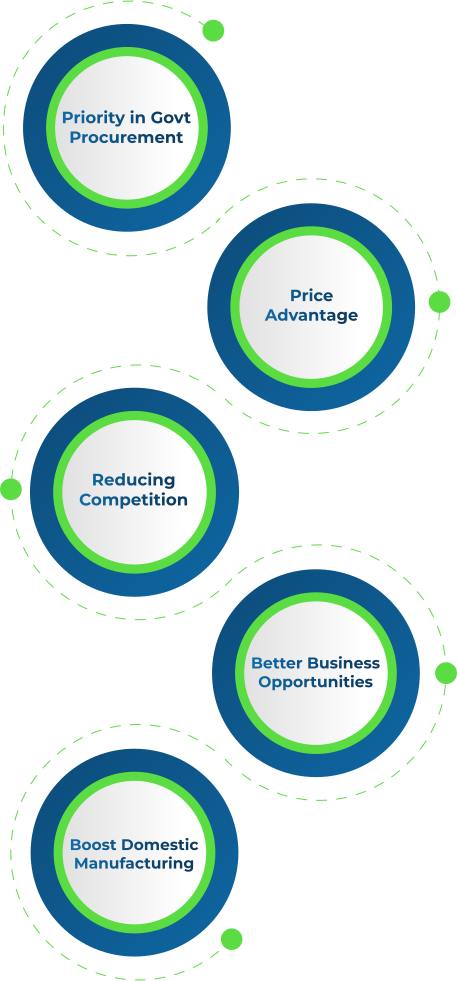
The Make in India Certificate for Tenders helps Indian businesses gain preference in government contracts, promoting local manufacturing and economic growth. Refre to the points below in detail:
- Priority in Government Procurement - Businesses with a Make in India Certificate receive preference in tender evaluation.
- Price Advantage - Certified companies get price preference, meaning their bid may be considered even if it is slightly higher than a foreign competitor’s bid.
- Reducing Competition - The certificate helps Indian manufacturers by reducing competition from international suppliers in government contracts.
- Better Business Opportunities - Government departments and public sector companies prefer to buy from local manufacturers, giving certified businesses more chances to grow.
- Boost Domestic Manufacturing - Encourages Indian production and reduces dependency on imports.
Conclusion
The Make in India Certificate for Tenders is an important certificate that helps Indian manufacturers secure government contracts, reduce competition from foreign suppliers, and gain financial benefits. By meeting the local content requirements, businesses can strengthen their position in public procurement and contribute to India’s goal of self-reliance.
If you need assistance in obtaining MII certificate, Professional Utilities can help you through the application process, documentation, and compliance with government regulations. So that, businesses can easily get certified and take full advantage of the Make in India initiative for government tenders.
FAQ’s On Make in India Certificate for Tenders
What is make in India certificate for tenders?
The Make in India Certificate is a self-certification that certifies that the product meets the requirements under the PPP-MII regulation, which is the Public Procurement (Preference to Make in India) Order, 2017. It assists the businesses to meet the government tender requirements.
Who needs Make in India Certificate for Tenders?
Any manufacturer or supplier who wants to bid for government tenders for the products that require products made in India under the Make in India campaign.
What are the benfetois of MII Certification for tenders?
- MII Certification offers several benefits-
- Higher preference in government tenders
- Competitive advantage over foreign suppliers
- Promotes domestic manufacturing.
What are the requirements of the local content for the MII
certificate?
- Requirements of the local content for the MII certificate are -
- Class-I Local Supplier: More than 50% local content (highest preference).
- Class-II Local Supplier: Between 20-50% local content (lower priority).
What are the procedures to obtain MII Certification for Tenders?
To get MII Certification Use self-certification in local content while tendering for contracts. If necessary, obtain an independent certification from an accredited organization.
What is the cost of getting a Make in India Certificate?
The cost for preparing a CA-certified Make in India Certificate for GeM Portal on urgent basis is ₹9,999, and the issuance of regular MII Certificate costs around ₹7,499.
What is the eTender process in Uttar Pradesh?
eTender Process in Uttar Pradesh explains the complete online tendering procedure followed by government departments in Uttar Pradesh. It helps contractors and businesses understand registration requirements, bid submission steps, document preparation, and compliance guidelines for participating in eTenders in Uttar Pradesh.
Speak Directly to our Expert Today

Reliable

Affordable

Assured
Industries Served by
Professional Utilities

Apparels

Footwear

Furniture

Gems and Jewellery

Tourism & Hospitality

Consumer Electronics

Chemicals

Telecom

Oils & Gas

Hotel

Railways

Liquor

Health & Medical

Food Processing

Dangerous/ Haz. Goods

Tea & Coffee

Capital Goods

Recycling

Rubber

NGOs

Silk

Handloom

IT & BPM

Steel

Automobile

Tobacco

Constructions


Make in India Initiative Across Key Sectors
Testimonials
"Explore how Professional Utilities have helped businesses reach new heights as their trusted partner."







It was a great experience working withProfessional Utilities. They have provided the smoothly. It shows the amount of confidence they are having in their field of work.

Atish Singh


It was professional and friendly experience quick response and remarkable assistance. I loved PU service for section 8 company registration for our Vidyadhare Foundation.

Ravi Kumar
I needed a material safety data sheet for my product and they got it delivered in just 3 days. I am very happy with their professional and timely service. Trust me you can count on them.

Ananya Sharma
Great & helpful support by everyone. I got response & support whenever I called to your system. Heartly thanx for Great & Super Service. Have a Great & Bright future of team & your company.

Prashant Agawekar
Thank you so much Professional Utilities team for their wonderful help. I really appreciate your efforts in getting start business. Pvt Ltd company registration was smooth yet quick.
Abhishek Kumar
I applied for Drug licence and company registration and their follow-up for work and regular updates helped me a lot. They are happily available for any kind of business consultancy.

Vidushi Saini
Great experience went to get my ITR done, process was quite convenient and fast. Had a few queries, am happy about the fact those people explained me all things I wanted to know.

Taniya Garyali
Great services provided by Professional Utilities. They are best in this industry and the best part is their prices are so affordable. Kudos to you. Now you guys are my full-time consultant.

Aftab Alam
Trusted By