Apparel Export Promotion Council



AEPC Certification

Years of Experience
What’s Included?
AEPC RCMC Certificate FTP Export Incentive Eligibility IIGF Trade Fair Participation Facilitation Expert Advice on Buyer Connect & Trade Mission Consultation on Common Service Provider Scheme Market Development Assistance Support IEC, GST & Factory Document Review Online AEPC Portal Application Filing 5-Year Validity with Renewal Reminder Expert Advisory
Get Expert Consultation

Apparel Export Promotion Council (AEPC) Certification
AEPC (Apparel Export Promotion Council) is a government-backed body established to promote and support Indian apparel exports. It plays a pivotal role in enhancing the Indian garment and textile manufacturing industry, both in domestic and international markets by offering structured support, resources, and exposure to global trade opportunities.
To avail benefits under the Foreign Trade Policy—such as Market Development Assistance (MDA) grants, financial aid, and export promotion schemes—textile exporters must obtain an AEPC e-RCMC (Registration-Cum-Membership Certificate). Exporters can apply either as registered exporters or member exporters under AEPC, depending on their eligibility and export performance.
In addition to certification, AEPC actively contributes to capacity building by organizing skill development programs, hands-on training workshops, and industry-specific awareness seminars. These initiatives help manufacturers remain globally competitive, improve product quality, and adapt to emerging market demands with better strategic planning.
AEPC also provides crucial support in navigating complex trade regulations, compliance requirements, and international quality standards. It serves as a vital link between exporters and the government, facilitating policy advocacy, export-related assistance, grievance redressal, and seamless trade operations through consistent engagement and expert advisory.
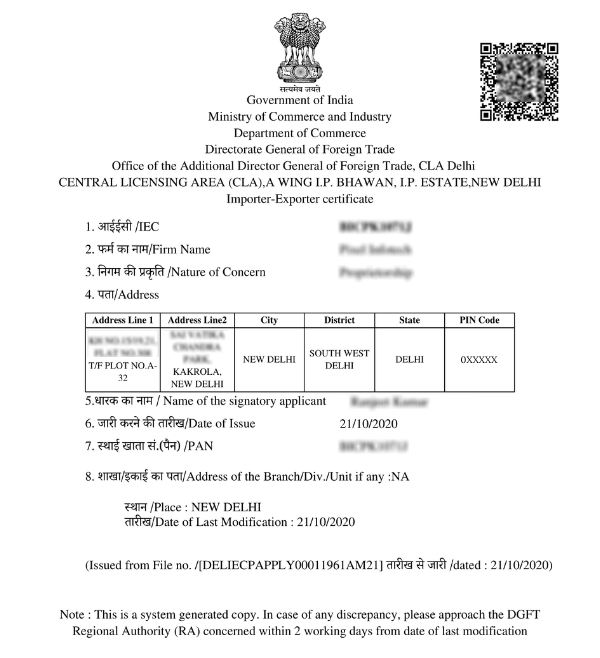
AEPC Certificate Sample
How to Apply for RCMC Registration with AEPC
Three things have to be sorted out before the e-RCMC form will accept the AEPC application: an active IEC, an updated IEC profile on the DGFT portal, and a valid DSC or Aadhaar e-sign linked to the DGFT account. Missing any one of these will cause the submission of the application to fail.
- Access the e-RCMC Module on the DGFT Site: The application is filed online through the DGFT portal at dgft.gov.in. Once logged in, the applicant moves into the e-RCMC service to begin a fresh application.
- Cross-Check the Pre-Filled Business Data: The first section of the form auto-pulls firm data from the IEC profile. This covers the IEC, PAN, firm name, registered address, bank details, director information, and branch records. Each field needs careful checking, since the RCMC form locks these entries once the applicant moves forward. Errors must be corrected on the IEC profile beforehand.
- Choose AEPC and Add Apparel Export Details: In the RCMC Details section, the applicant marks AEPC as the Export Promotion Council and then enters the office for filing, the branch GSTIN, the membership tenure (1 to 5 years), the financial year, the MSME status, the exporter category (Manufacturer, Merchant, or Merchant-cum-Manufacturer), the zone (EOU or SEZ where applicable), and the relevant fee slab. Apparel export products are listed with their ITC (HS) codes (such as denim jeans, jackets, shirts, blouses, knitwear, T-shirts, dresses, and kidswear), along with the countries shipped to. The annual turnover, previous-year export performance, firm profile, website, and contact details of authorized representatives are also entered here.
- Upload Attachments, Pay Fees, and e-Sign the application: If TDS applies, the applicant enters the tax deducted at source details first. The Attachments section follows, where supporting documents are uploaded in PDF format. The full document checklist is covered in the Documents Required section below. Fees are paid online through the DGFT payment gateway. The applicant then shall accept the declaration, go through the application summary, and authenticate the filing using a DSC or Aadhaar e-sign before final submission.
- AEPC Review and Digital RCMC Issuance: AEPC takes up the application for review. The Council verifies the business credentials, IEC and GST records, apparel product list with ITC (HS) codes, supporting documents, and fee payment. If anything needs further explanation, AEPC posts a query on the portal, which the applicant shall resolve before resubmission. Once cleared, the digital RCMC certificate becomes available on the DGFT dashboard, usually within 7 to 10 working days. The certificate is valid for 1 to 5 financial years, starting from 1 April and ending on 31 March of the fifth year, regardless of the actual month of issue.

Documents Required for AEPC RCMC Registration
The document set is split into common documents that every exporter submits and AEPC-specific documents.
1. Common Documents
These are the standard documents required for any RCMC application on the DGFT portal:
- Import Export Code (IEC) issued by DGFT
- Permanent Account Number (PAN) of the firm
- GST Registration Certificate of the registered office and branches
- Certificate of Incorporation, Partnership Deed, or LLP Agreement depending on entity type
- Memorandum and Articles of Association (MoA and AoA) for companies
- Board Resolution or Authorisation Letter for the authorised signatory
- Aadhaar of the authorised signatory
- Cancelled cheque or Bank Performance Letter for bank verification
- Self-Declaration / Undertaking in the prescribed format
- Last RCMC Certificate (only for renewal applications)
- Digital Signature Certificate (DSC) or Aadhaar e-Sign linked to your DGFT account for final submission
2. AEPC-Specific Documents
These are the documents specifically required by AEPC. The exact set depends on your membership category (Registered Exporter or Member Exporter) and your exporter type (Manufacturer Exporter or Merchant Exporter).
- AEPC Application Form, downloadable from the AEPC official website
- Self-certified copy of the IEC issued by DGFT
- Notarised Undertaking on non-judicial stamp paper (specific AEPC requirement)
- Self-attested copy of Memorandum and Articles of Association, Partnership Deed, or Certificate of Registrar of Firms, depending on entity type
- For Manufacturer Exporters: Self-attested copy of SSI Certificate, Letter of Intent, Industrial License, or Acknowledgement issued by the concerned authority
- For manufacturers of ready-made garments: Self-attested copies of the factory license issued by the State Government, Employee State Insurance (ESI) Certificate, Employees Provident Fund (EPF) Registration Certificate, along with a Chartered Accountant's Certificate
- For Member Exporter conversion: Proof of aggregate export turnover above Rs. 1 crore for the previous 3 financial years, along with a signed Code of Conduct Certificate approved by the AEPC Executive Committee
- List of apparel export products with HS Codes, covering ready-made garments, denim, jackets, shirts, blouses, knitwear, woven garments, casual wear, formal wear, T-shirts, trousers, dresses, kidswear, and fashion accessories
- Star Export House Certificate issued by DGFT, where applicable
- Authorised signatory details including name, designation, and contact information
Note: All documents must be uploaded in PDF format during the Attachments stage of the DGFT e-RCMC application.
Fees for AEPC Registration Certificate
Apparel Export Promotion Council (AEPC) allows concession to women and start-up entrepreneurs. Membership fees of AEPC range between ₹10,620 and ₹15,340 (inclusive of 18% GST). Professional Utilities charges ₹7,499 + 18% GST for registration assistance, subject to eligibility.
| Applicant Category | Amount | GST @ 18% | Total Payable |
|---|---|---|---|
| Standard New Member (all categories) ₹12,000 yearly fee + ₹1,000 one-time joining charge | 13,000 | 2,340 | 15,340 |
| Women & Start-up Entrepreneurs (all categories) ₹8,000 yearly fee + ₹1,000 one-time joining charge | 9,000 | 1,620 | 10,620 |
| Professional Fees | ₹7,499 | ₹1,350 | ₹8,849 (Exclusive Govt. Fees) |
Note:All exporter categories, including Manufacturer Exporters, Merchant-cum-Manufacturer Exporters, Merchant Exporters, and Service Providers, are covered under the same fee structure. The joining fee of ₹1,000 is a one-time payment.
What is AEPC Certification?
The Apparel Export Promotion Council (AEPC) is a government body established to promote Indian apparel exports, both domestically and internationally. AEPC works to develop the Indian garment manufacturing textile industry by assisting exporters with market access, regulatory compliance, and capacity building.
To benefit from government schemes under foreign trade policy, such as market development assistance, an exporter must obtain an AEPC e-RCMC (Exporter's Registration Cum Membership Certificate). AEPC supports exporters by providing skill development programs, organizing workshops, and ensuring that they comply with international trade regulations and quality standards.
Objectives of AEPC
AEPC works to help Indian apparel exporters grow their business and improve product quality. Here are the main goals of AEPC:
- Implementing a method to Increase Apparel Exports.
- Improve workforce skills and help improve quality.
- Collaboration with the government in setting export targets, planning for the future, and forecasting economic conditions.
- To facilitate exporters financially or technically, provide them with informative research data to boost exporters and the quality of their products.
- All ready-made garments (except leather, jute, and woolen knitwear) are to be promoted, increased, & developed for export.
- Maintaining efforts to inform business owners of market trends, product prices, government programs and subsidies.
Eligibility for AEPC certification
Exporters who wish to export garments through the Apparel Export Promotion Council (AEPC) can register as either a Registered Exporter or a Member Exporter, based on their eligibility and export history.
1. Registered Exporter
- The business must be a registered firm under the Companies Act or other recognized legal structure.
- A valid Importer-Exporter Code (IEC) issued by DGFT is required.
- The applicant must have a valid Digital Signature Certificate (DSC) .
- The applicant must not be an undischarged insolvent (i.e., must be legally free from unresolved loans or bankruptcy).
2. Member Exporter
- Must meet all the eligibility criteria listed for Registered Exporter.
- Must have an export turnover of at least ₹1 crore in the last three consecutive financial years, certified by a Chartered Accountant or a banker.

Renewal of AEPC certification
The registered members and exporters are required to renew their AEPC e-RCMC every year. The renewal cost for members and exporters are the same as the subscription.
If the applicant fails to renew their e-RCMC certificate, their registration will be canceled immediately.
| Particulars | Renewal validity |
|---|---|
| Validity of AEPC eRCMC | 1 year |
| Note: AEPC e-RCMC shall be renewed by the 31st May each year. | |
Benefits of AEPC certification
The Apparel Export Promotion Council (AEPC) offers a range of benefits to its certified members, designed to support and enhance the growth of apparel exporters. These benefits include:
- GST facilitation: AEPC is facilitating GST-related issues of the exporters.
- Trade facilitation: To help exporters in addressing their problems, AEPC actively pursues exporters complaints that are brought up with customs, Icegate, DGFT, ECGC, and other organizations involved in exports and imports.
- Advisory for labor law: The Legal Advisor will also help registered exporters by giving them legal opinions and day-to-day advice & clarifications on all applicable labor and employment laws when needed.
- Market access initiative: Apparel exporters exhibit their best items at domestic & international exhibitions. This also helps identify international partners for up-scaling and technological upgradation and provides textile and apparel industry market intelligence.
- Access to seminars & workshops: AEPC is responsible for organizing workshops, seminars, and webinars relevant to the garment sector. Registered members can benefit from such events to expand their knowledge and network about the industry.
- Access Skill assessment cell: The Skill Assessment Cell (SAC) was set up with the main goal of driving skill assessment initiatives in the Apparel/Garment, Khadi, and Carpet sectors to create jobs, grow the economy, and improve society. The cell helps boost morale, improve the candidates' social standing, and turn the workforce into a certified skill pool.
Conclusion
The AEPC certification offers significant benefits to exporters in the Indian apparel sector. It not only provides access to financial and technical assistance but also facilitates better trade practices and compliance with global standards. Through AEPC, exporters gain the opportunity to improve their skills, enhance the quality of their products, and expand their global market presence. By ensuring regular certification renewal and meeting the necessary criteria, exporters can fully utilize the resources and benefits offered by AEPC, further boosting their competitiveness in the international apparel market.
FAQ’s On AEPC
Is it Compulsory to obtain an RCMC certificate to export garments?
Registration cum membership certificate can help exports in terms of facilitation and getting the benefits of Foreign trade policies. Having an e-RCMC Certificate is beneficial for exporters of apparel.
How to apply online for AEPC e-RCMC registration?
You can apply for e-RCMC online with professional Utilities in 3 simple steps
- Provide documents
- Submission of application
- Issuance of e-RCMC
What is the export obligation period?
The export obligation period is the specified time limit within which an exporter must fulfill the required export commitment under schemes like EPCG or Advance Authorization. Its duration, extensions, and compliance rules are explained in detail in our guide on export obligation period.
What is the difference between AEPC and JPDEPC?
AEPC promotes apparel exports, while JPDEPC focuses on jute product exports. For more information, visit Jute Product Development & Export Promotion Council.


Disclaimer:The information provided on this website is intended for general information purposes only. Although all reasonable efforts are made to ensure that the information provided is correct and reliable, it is not advised to be used as a substitute for professional advice. The information herein is not to be used in place of seeking professional services, counsel, or guidance. We highly advise that you consult a professional before you make any business or legal decisions regarding the information presented on this website. This website and its contents are given "as is", and we do not take any responsibility for any action that is taken based on information given on this website.

- Written by: Anuja Sahi
- Fact-checked: Sahil Singh
- Updated on: June 13, 2026
Testimonials
"Explore how Professional Utilities have helped businesses reach new heights as their trusted partner."





It was a great experience working withProfessional Utilities. They have provided the smoothly. It shows the amount of confidence they are having in their field of work.

Atish Singh


It was professional and friendly experience quick response and remarkable assistance. I loved PU service for section 8 company registration for our Vidyadhare Foundation.

Ravi Kumar
I needed a material safety data sheet for my product and they got it delivered in just 3 days. I am very happy with their professional and timely service. Trust me you can count on them.

Ananya Sharma
Great & helpful support by everyone. I got response & support whenever I called to your system. Heartly thanx for Great & Super Service. Have a Great & Bright future of team & your company.

Prashant Agawekar
Thank you so much Professional Utilities team for their wonderful help. I really appreciate your efforts in getting start business. Pvt Ltd company registration was smooth yet quick.
Abhishek Kumar
I applied for Drug licence and company registration and their follow-up for work and regular updates helped me a lot. They are happily available for any kind of business consultancy.

Vidushi Saini
Great experience went to get my ITR done, process was quite convenient and fast. Had a few queries, am happy about the fact those people explained me all things I wanted to know.

Taniya Garyali
Great services provided by Professional Utilities. They are best in this industry and the best part is their prices are so affordable. Kudos to you. Now you guys are my full-time consultant.

Aftab Alam
Trusted By