EPR Registration For Battery Waste
EPR Registration for Battery Waste - Starting at ₹9,999

4.9


EPR Registration for Battery Waste - Process, Fees & Documents
The Battery Waste Management (BWM) Rules of 2022, which were introduced by the Ministry of Environment, Forest, and Climate Change on August 22, 2022 are a significant update to the management of battery waste in India. The rules focus on extended producer responsibility (EPR) and require battery producers, including importers and manufacturers, to supervise all phases of the duration of their product which will address health and environmental impacts that come with the disposal of batteries. This means that they must ensure that batteries are collected properly and recycled or reused regardless of their size, type, or chemical composition. The goal is to minimize the negative health and environmental effects associated with waste from batteries while promoting an environmentally sustainable approach to recycling and disposal of batteries.
According to the BWM Rules, 2022, producers must register at the Central Pollution Control Board (CPCB) through a centrally-operated online portal, by filling out form 1(A). The registration must be renewed before the expiration of the current registration as well as using form 1(A). The EPR framework requires that producers are responsible for sustainably managing the disposal of batteries, and protecting human health as well as the environment from risks posed by the waste of batteries. In this regard, EPR Registration for Industrial Battery Waste is also a crucial compliance step to ensure responsible recycling and disposal of batteries used in industrial applications.
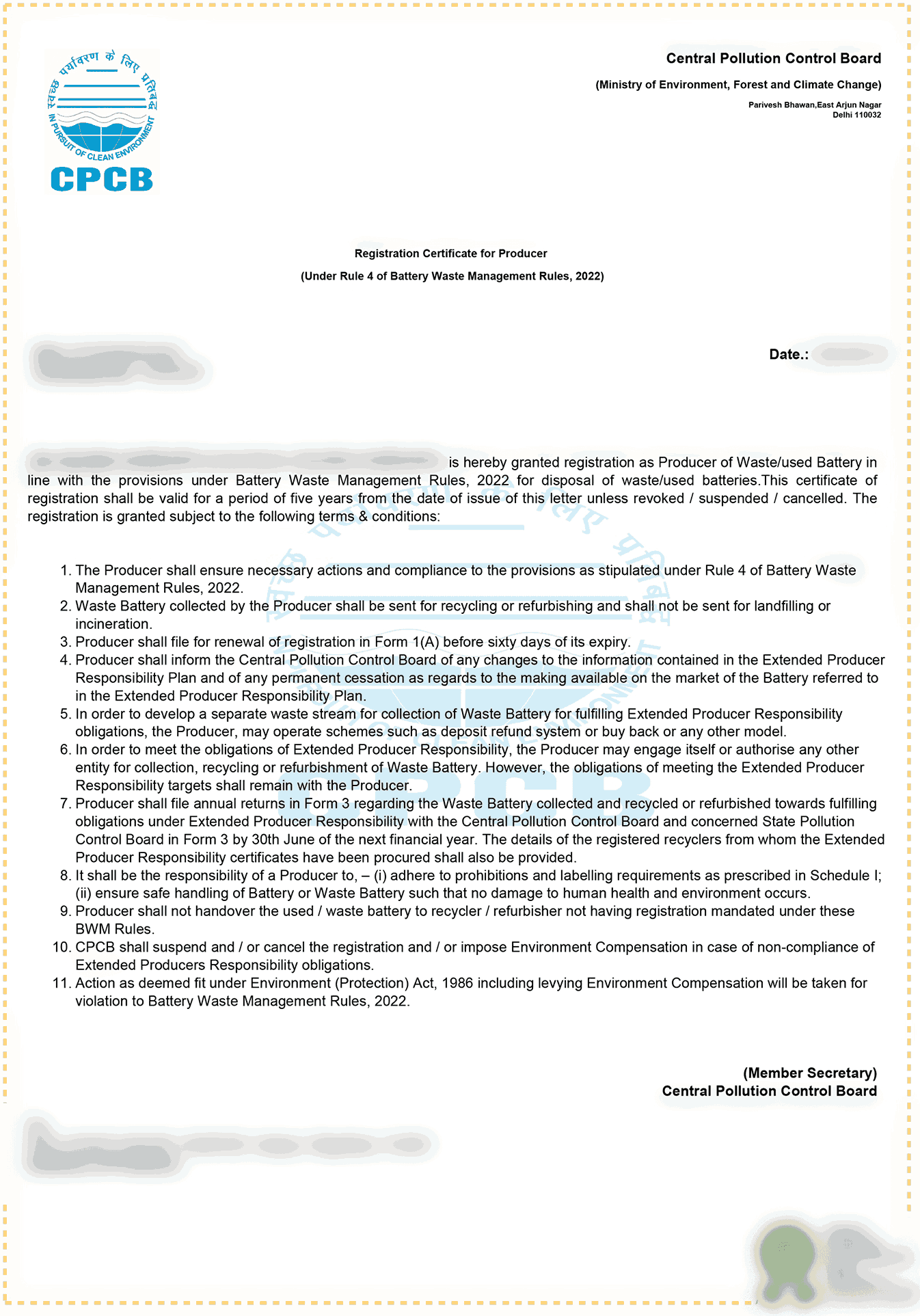
EPR Registration Certificate [Sample]
Process for Battery Waste EPR Registration
Battery Waste EPR registration is a compliance process under the Battery Waste Management Rules, 2022, managed by the Central Pollution Control Board (CPCB). Here’s the step-by-step procedure:
- Step 1: Assessment and Documentation: Applicants must provide complete details for their EPR Battery Waste certification. Our experts assess all documents for accuracy and completeness.
- Step 2: Filing of EPR Registration Form: After document verification, the application is filed online with CPCB authorities for EPR Registration for battery waste.
- Step 3: Assessment of Application by CPCB: The CPCB evaluates the online application. Any discrepancies or concerns are addressed and corrected as required.
- Step 4: Issuance of EPR Authorisation: The certificate of authorisation is issued within 30 days of filing. Producers must implement the EPR action plan to meet their yearly EPR targets.

Documents Required for Battery Waste EPR Registration
Battery Waste EPR Registration requires a set of essential documents to ensure compliance with regulations. The required documents are as follows:
- Sales details
- Phone Number
- Name of Email ID
- Capital Investment
- Company GST Certificate
- PAN Card of the Company
- Company Incorporation details
- Corporate Identification Number (CIN) document
- Copy of consent(CTE/CTO) for uploading with start date of operations
- PAN & Aadhar of authorized person with designation in Company
- District Industries Center(DIC) registration(if the unit is registered with DIC)
- Import Export Certificate issued by Ministry of Commerce & Industry (in case of importers)
- Consent Issued by SPCBs/PCCs under Air/Water Act and authorization under Hazardous Other Waste (Management&TransboundaryMovement)Rules, 2016.
- Or any entity that introduces batteries in the market are required to obtain EPR Registration for battery waste management.
Fee for Battery Waste EPR Registration
The Government Fee for EPR Registration for battery waste management is as:-
| Annual Turnover in Cr. | Battery EPR Registration fee |
|---|---|
| ✅ Less than 5 Cr | ₹10,000 |
| ✅ Between 5-50 Cr | ₹20,000 |
| ✅ More than 50 cr | ₹40,000 |
Note :- The government fee for EPR registration can vary depending on the quantity of waste generated & The aformentioned Fees is exclusive of GST.
What is EPR Registration for Battery Waste?
EPR Registration for Battery Waste is a compulsory requirement under India’s Battery Waste Management Rules, 2022. It makes battery producers, importers, and manufacturers responsible for collecting, reusing, or recycling used batteries in an environmentally safe way. This makes sure of that waste batteries are properly handled through CPCB-approved recyclers, helping prevent pollution and health risks caused by improper disposal.
EPR Registration promotes responsible and sustainable waste management by holding producers responsible for their products even after they’re sold. It supports eco-friendly recycling, reduces the load on landfills, and contributes to India’s vision of a cleaner and more circular economy.
Benefits of EPR Registration for Battery Waste
Battery Waste EPR registration offers several advantages for producers, importers, and manufacturers of batteries. These benefits include:

- Business Expansion:- EPR registration is mandatory for selling batteries in India. It enables businesses to operate and expand in regulated markets.
- Efficient Waste Management:- EPR registration ensures a streamlined waste management process where producers are accountable for establishing collection systems, collaborating with recycling facilities, and promoting recycling initiatives. This leads to improved waste segregation, higher rates of recycling, and a reduction in the amount of waste disposed of in the environment.
- Reduction In Cost:- Implementing EPR registration can result in cost savings for businesses. By optimizing waste management practices, companies can minimize waste disposal expenses, explore revenue-generating opportunities through recycling, and improve overall operational efficiency.
- Positive Brand Image:- Obtaining EPR registration enhances a business's public image, fosters trust among eco-conscious consumers, and boosts brand loyalty and market competitiveness.
Producers Responsibility under EPR Registration for Battery Wste
The Registered Producers are required to comply with following conditions:
- The Producers are not allowed to carry any business without having EPR registration through an online centralized portal developed by CPCB.
- The Producers must not deal with any entity not registered through an online centralized portal developed by CPCB to meet EPR targets.
- Producers are required to meet their EPR target and shall provide completion certificate from CPCB authorized waste processor units.
Renewal of EPR Registration for battery Waste
Make sure your Battery Waste EPR Registration stays up to date - here’s a simple guide to help you navigate the renewal process and stay compliant.
- Producers and manufacturers are required to submit the renewal application 60 days prior to the Battery EPR Registration's expiry date.
- Producers must make sure that Annual Returns are submitted by June 30th of the subsequent year for the Registration.
- The Battery waste EPR registration given to producers will be renewed by the Central Pollution Control Board (CPCB) for a duration of five years, and this renewal process will be completed within 15 working days.
Other Types of Registration For Extended Producer Responsibility


Cancellation of EPR Registration for Battery Waste
Here's what you need to know about the cancellation process for your Battery EPR Registration and how to ensure everything is handled correctly.
- EPR Registration for batteries is granted to Producers/Manufacturer can also be liable to cancellation at any point, if the document submitted by the applicant is found to be Incorrect.
- In case of non-compliance of Extended Producer Responsibility (EPR) obligations. CPCB can suspend and or cancel the battery EPR registration, and or impose Environmental Compensation on entities.
- An opportunity will be given to hear the applicant within 15 days from the date of issuance of notice, before considering the case for cancellation or suspension of Battery EPR registration by CPCB.

Key EPR Compliance Rules
Here are the key takeaways for EPR Registration for Battery Waste, highlighting its role in ensuring compliance:
- Renwal can be filled 60 days prior to the due date.
- The Registration process takes up-to 30 business days to complete.
- Producers are required to fulfill their EPR targets on time to avoid penalties or cancellation.
- Cancellation of EPR registration for batteries is subject to CPCB, if any discrepancy is found then the license can be canceled any time.
Conclusion
EPR registration for batteries is a crucial step towards sustainable Battery waste management and protection of the environment. It offers numerous benefits, including efficient waste management, cost reduction, a positive public image, and legal protection.
By taking EPR obligations, businesses contribute toward a sustainable economy, save resources, and meet the expectations of environmentally conscious consumers. It is essential for businesses to understand the steps involved in Online EPR Authorization and proactively integrate sustainable practices into their business operations.
FAQ’s On EPR Registration For Battery Waste
Who must register for EPR under the Battery Waste Management Rules,
2022?
All battery producers, importers, and brand owners, including those dealing in portable, industrial, automotive, or EV batteries, must get EPR registration from the CPCB before selling or distributing batteries in India.
What does EPR registration require from battery producers?
Producers need to register on the CPCB portal, set up proper systems for collecting and recycling used batteries, and ensure that all recycling is done through approved recyclers only.
What happens if a battery producer fails to meet EPR obligations?
If a producer does not fulfill EPR targets, the CPCB can suspend or cancel the registration and impose environmental compensation or penalties for disobedience.
Does EPR registration cover all types of batteries?
Yes, EPR registration applies to every type of battery: portable, industrial, automotive, and electric vehicle, regardless of size, use, or chemical form.


EPR Registration for Different Waste Categories
Testimonials
"Explore how Professional Utilities have helped businesses reach new heights as their trusted partner."





It was a great experience working withProfessional Utilities. They have provided the smoothly. It shows the amount of confidence they are having in their field of work.

Atish Singh


It was professional and friendly experience quick response and remarkable assistance. I loved PU service for section 8 company registration for our Vidyadhare Foundation.

Ravi Kumar
I needed a material safety data sheet for my product and they got it delivered in just 3 days. I am very happy with their professional and timely service. Trust me you can count on them.

Ananya Sharma
Great & helpful support by everyone. I got response & support whenever I called to your system. Heartly thanx for Great & Super Service. Have a Great & Bright future of team & your company.

Prashant Agawekar
Thank you so much Professional Utilities team for their wonderful help. I really appreciate your efforts in getting start business. Pvt Ltd company registration was smooth yet quick.
Abhishek Kumar
I applied for Drug licence and company registration and their follow-up for work and regular updates helped me a lot. They are happily available for any kind of business consultancy.

Vidushi Saini
Great experience went to get my ITR done, process was quite convenient and fast. Had a few queries, am happy about the fact those people explained me all things I wanted to know.

Taniya Garyali
Great services provided by Professional Utilities. They are best in this industry and the best part is their prices are so affordable. Kudos to you. Now you guys are my full-time consultant.

Aftab Alam
Trusted By