EPR Registration for Metal Waste
Start Your Metal Waste EPR Registration Now @₹9,999

4.9


Extended Producer Responsibility (EPR) Registration for Metal Waste
Extended Producer Responsibility (EPR) is a regulation plan that requires producers, importers, and brand owners (PIBOs) to manage the environmental effect of waste produced by their products. In the instance of metal waste, this implies that organizations involved in the manufacture, import, or sale of metal-based items or packaging materials are legally obligated to guarantee proper collection, recycling, and environmentally responsible disposal of the waste.
According to CPCB standards, qualified enterprises must get EPR registration for metal waste and adopt sustainable waste management techniques. This involves developing an EPR action plan, working with authorized recycling partners, and meeting annual waste processing objectives. Failure to comply can result in the suspension of the EPR certificate, in addition to penalties and environmental compensation.
Professional Utilities provides end-to-end support with EPR Registration for metal waste, whether through the Central Pollution Control Board (CPCB) or the appropriate State Pollution Control Board. From documentation and filing to post-registration compliance, our professionals guarantee that your company is entirely compliant and ecologically responsible.
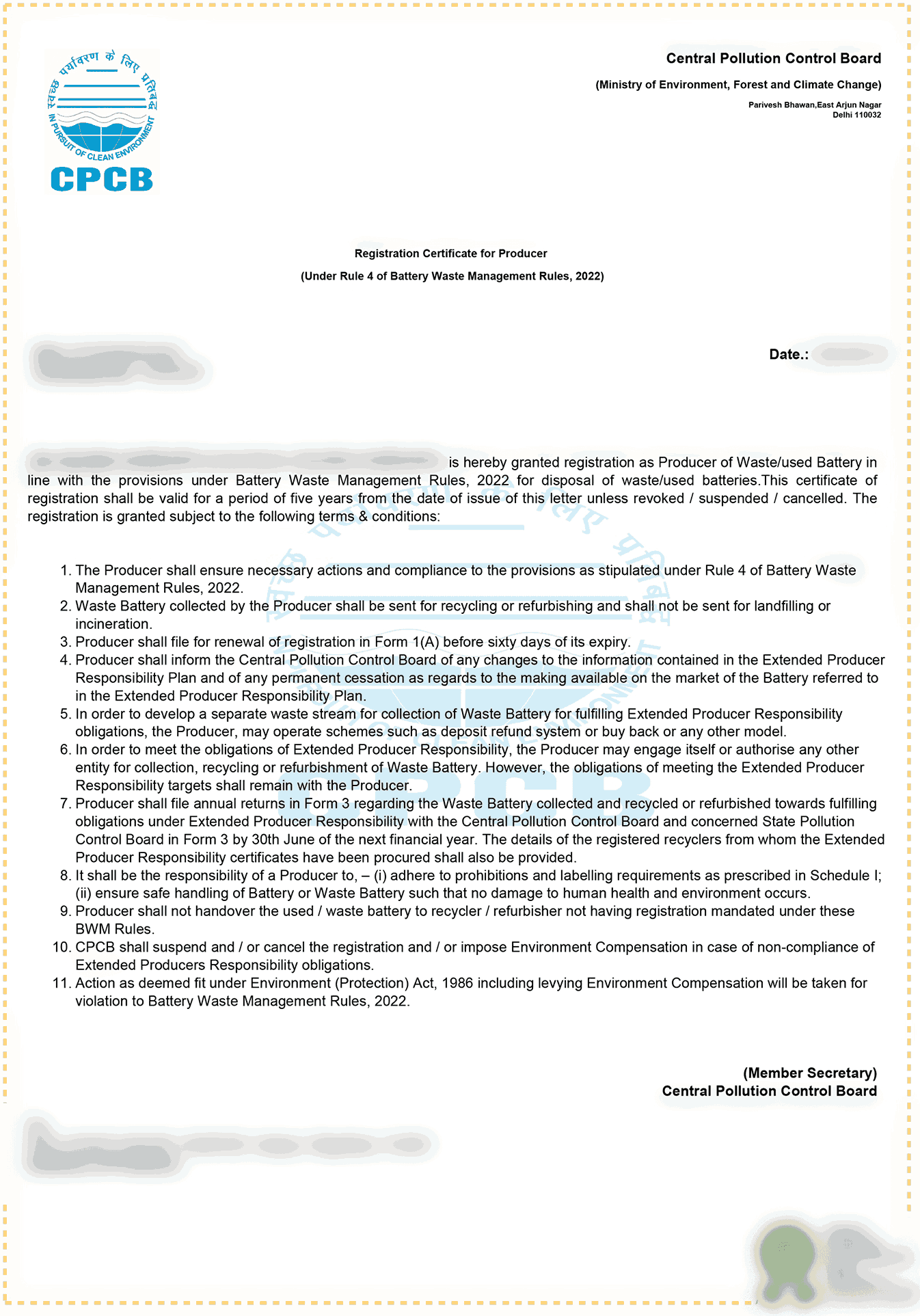
EPR Registration Certificate [Sample]
EPR Registration Process for Metal Waste
PIBOs can apply for CPCB EPR registration to manage metal waste by following these four simple steps:
- Step 1: Assessment and Documentation – Entities must provide complete details for their EPR registration. Our experts review all documents and information to ensure accuracy and consistency.
- Step 2: Filing for EPR Registration – After successful verification of documents, an application is filed online with the CPCB for EPR Authorization of Metal Waste.
- Step 3: Assessment of Application by CPCB – CPCB authorities evaluate the submitted application. If any discrepancies or queries arise, they are resolved promptly for smooth approval.
- Step 4: Issuance of EPR Certificate for Metal Waste – The authorization certificate for managing metal waste is issued within 30 days of submission. PIBOs must then implement an EPR action plan to meet annual targets.

Documents Required for EPR Registration for Metal Waste
Producers, importers, and brand owners (PIBOs) must provide following documents to apply for EPR Registration for Metal Waste management:
- Company/Trade Name
- Legal Name
- Mobile Number
- Official Email ID
- Landline Number (if any)
- CIN or Incorporation Certificate (if applicable)
- GST Certificate
- PAN of Company (if applicable)
- PAN of Authorized Signatory
- Address for Sale and Operations (must match with documents)
- Corporate Office Address
- List of paper-based products or packaging materials


EPR Registration Fee for Metal Waste
The government fee for EPR registration to manage metal waste ranges from Rs 10,000 to Rs 50,000, exclusive of GST, based on the amount of metal waste generated by producers, importers, and brand owners (PIBOs) of metal and related products in metric tons.
| Waste in TPA | Metal EPR registration fees |
|---|---|
| Less than 1,000 | ₹10,000 |
| Between 1,000-10,000 | ₹20,000 |
| More than 10,000 | ₹50,000 |
Note: The aforementioned Fees is exclusive of GST
What is EPR Registration for Metal Waste?
The Central Pollution Control Board (CPCB) grants EPR registration for metal waste to producers, importers, and brand owners (PIBOs) that use, distribute, or manufacture metal-based products and packaging materials. This registration assures that these organizations use environmentally friendly techniques to collect, recycle, and dispose of metal waste created by their activities. To limit the impact on the environment, proper waste management methods must be used. According to the CPCB's waste management laws, all relevant parties, including metal producers, packaging makers, importers, and brand owners who use metal packaging, must get EPR registration.
Benefits of EPR Registration for Metal Waste
Following are the benefits that producers, importers, and brand owners (PIBOs) will get by EPR Registration for Metal Waste management:
- Accountability : EPR registration holds enterprises accountable for their metal waste and guarantees that it is managed appropriately.
- Collaboration : It encourages manufacturers and recycling facilities to work together to handle garbage more effectively.
- Waste Reduction : Encourages recycling, which reduces the quantity of metal waste that ends up in landfills.
- Environmental Conservation : This involves lowering metal waste and encouraging the reuse of metal materials.
- Public Awareness : Encourages businesses to educate the public about recycling and the sustainable usage of metal goods.
- Improved Brand Image : Businesses with EPR registration prove that they care about the environment, earning the trust of environmentally conscious customers.
Cancellation of EPR Registration for Metal Waste
Manufacturers, producers, and importers are issued EPR registration to manage the metal waste after a thorough evaluation of their documents. In case a fake or incorrect document is submitted by an entity, then the CPCB authorities will cancel their EPR registration for metal waste.
If an entity is found to be violating or not complying with Extended Producer Responsibility (EPR) guidelines, then the CPCB authorities hold the authority to suspend or cancel the metal waste EPR registration and impose Environmental Compensation on the entities.
NoteThe entities under accusation are provided an opportunity to be heard within 15 days from the date of notice issuance before the cancellation of metal waste.
Conclusion
EPR registration for metal waste is necessary for promoting sustainable waste management among producers, importers, and brand owners (PIBOs). It guarantees that businesses accept responsibility for the metal waste produced by their goods and use environmentally acceptable methods for collection, recycling, and disposal. Compliance with EPR standards not only reduces environmental effect, but also improves company reputation and encourages trust among environmentally conscious consumers. Registered entities help to create a cleaner and greener future by adhering to CPCB standards and putting in place organized action plans. Timely registration and persistent adherence to EPR requirements are critical for both legal compliance and long-term business sustainability.
FAQs on EPR Registration for Metal Waste
What is EPR Registration for Metal Waste?
EPR (Extended Producer Responsibility) registration requires producers, importers, and brand owners (PIBOs) of metal or metal-containing products to register with the CPCB to ensure that metal waste is properly collected, recycled, or disposed of in an environmentally sound manner.
Who needs to register under EPR for metal waste?
Any company or organization that manufactures, imports, or owns a brand of metal or metal-related products that generate metal waste must obtain EPR registration with the CPCB or SPCB.
What is the government fee for EPR registration for metal waste?
The government fee for EPR registration for metal waste ranges between ₹10,000 and ₹50,000, excluding GST. The exact amount depends on the quantity of metal waste generated annually by the producer, importer, or brand owner.
What documents are required for EPR registration for metal
waste?
The following documents are required for EPR registration for metal waste:
- Company PAN Card
- GST Registration Certificate
- Certificate of Incorporation (CIN) or MSME Certificate
- Authorized Signatory ID Proof (Aadhaar & PAN)
- Product details with estimated metal waste generated (in metric tons)
- Process Flow or EPR Action Plan for Metal Waste Management
- Agreement or MOU with Authorized Metal Waste Recyclers
- Pollution Control Board Consent or Authorization (if applicable)
- Copy of IEC (Import Export Code) - for importers
- Address proof of registered office
These ensure compliance with CPCB EPR Guidelines and proper waste management before registration approval.
What is the process and timeline for EPR registration?
The process includes preparing documents → submitting the online application → CPCB review → approval and issuance of the EPR certificate. Typically, the registration is completed within 30 days of submission, subject to proper documentation.
Is EPR registration valid for a certain period? Do I need
renewal?
Yes, EPR registration for metal waste is valid for a specific period and requires renewal before expiration. Generally, the initial validity is one year and can be renewed upon submission of compliance reports and renewal applications.
Does EPR registration for metal waste cover all types of metals?
EPR registration primarily focuses on non-ferrous metals such as aluminum, copper, and zinc. Producers handling these metals are required to meet CPCB-defined recycling and disposal targets under EPR regulations.
Can I apply for EPR registration for metal waste online?
Yes, EPR registration for metal waste can be applied entirely online via the CPCB portal. You must submit company details, product information, and agreements with authorized recyclers. After verification, CPCB issues the certificate digitally.
Speak Directly to our Expert Today

Reliable

Affordable

Assured
Industries Served by
Professional Utilities

Apparels

Footwear

Furniture

Gems and Jewellery

Tourism & Hospitality

Consumer Electronics

Chemicals

Telecom

Oils & Gas

Hotel

Railways

Liquor

Health & Medical

Food Processing

Dangerous/ Haz. Goods

Tea & Coffee

Capital Goods

Recycling

Rubber

NGOs

Silk

Handloom

IT & BPM

Steel

Automobile

Tobacco

Constructions


Testimonials
"Explore how Professional Utilities have helped businesses reach new heights as their trusted partner."







It was a great experience working withProfessional Utilities. They have provided the smoothly. It shows the amount of confidence they are having in their field of work.

Atish Singh


It was professional and friendly experience quick response and remarkable assistance. I loved PU service for section 8 company registration for our Vidyadhare Foundation.

Ravi Kumar
I needed a material safety data sheet for my product and they got it delivered in just 3 days. I am very happy with their professional and timely service. Trust me you can count on them.

Ananya Sharma
Great & helpful support by everyone. I got response & support whenever I called to your system. Heartly thanx for Great & Super Service. Have a Great & Bright future of team & your company.

Prashant Agawekar
Thank you so much Professional Utilities team for their wonderful help. I really appreciate your efforts in getting start business. Pvt Ltd company registration was smooth yet quick.
Abhishek Kumar
I applied for Drug licence and company registration and their follow-up for work and regular updates helped me a lot. They are happily available for any kind of business consultancy.

Vidushi Saini
Great experience went to get my ITR done, process was quite convenient and fast. Had a few queries, am happy about the fact those people explained me all things I wanted to know.

Taniya Garyali
Great services provided by Professional Utilities. They are best in this industry and the best part is their prices are so affordable. Kudos to you. Now you guys are my full-time consultant.

Aftab Alam
Trusted By