UN Mark IIP Certificate for Miscellaneous Dangerous Goods



IIP Certificates

Years of Experience
What’s Included?
Eligibility Assessment for UN Mark IIP Certification UN Mark IIP Certificate Issuance Documentation Checklist Legal Document Validation & MSDS Verification Coordination with Laboratory for Testing Liaison with Concerned Authorities Packaging Compliance Guidance UN Specification Code Identification Test Report Review & Rectification Application Filing & Submission Product Classification & Packaging Category Finalisation
Get Expert Consultation

UN Mark IIP Certificate for Miscellaneous Dangerous Goods
The UN Mark IIP Certificate is issued by the Indian Institute of Packaging (IIP) for packaging used in the transportation of Class 9 Miscellaneous Dangerous Goods. These materials may pose hazards during transport but do not fall under any other specific dangerous goods classification. Examples include lithium batteries, environmentally hazardous substances, carbon dioxide in solid form (dry ice), magnetic materials, vehicles cars, motorcycles), self-inflating life rafts and elevated temperature materials (molten sulfur at >100°C).
The certification ensures that the packaging is strong, durable, and safe enough to prevent leaks, fires, environmental damage, or other risks during the transportation of dangerous goods. It is granted only after sample packages undergo rigorous testing in accordance with UN transportation standards. These tests include drop tests, pressure tests, leak proofness tests, and compatibility assessments to ensure that the packaging can safely contain the miscellaneous dangerous goods it is designed to carry. As a result, the goods remain secure and do not pose a risk during transit.
This certification helps businesses comply with national and international safety regulations governing the transport of hazardous materials. Manufacturers and exporters handling Class 9 dangerous goods must ensure that their packaging is UN-certified to meet applicable legal requirements and facilitate safe transportation.
The UN Mark IIP Certificate for Class 9 Miscellaneous Dangerous Goods demonstrates a company's commitment to maintaining high safety standards when transporting potentially hazardous materials. Certified packaging minimizes the risk of transportation-related accidents, helps protect the environment, and enables businesses to transport these goods safely and in compliance with international regulations.
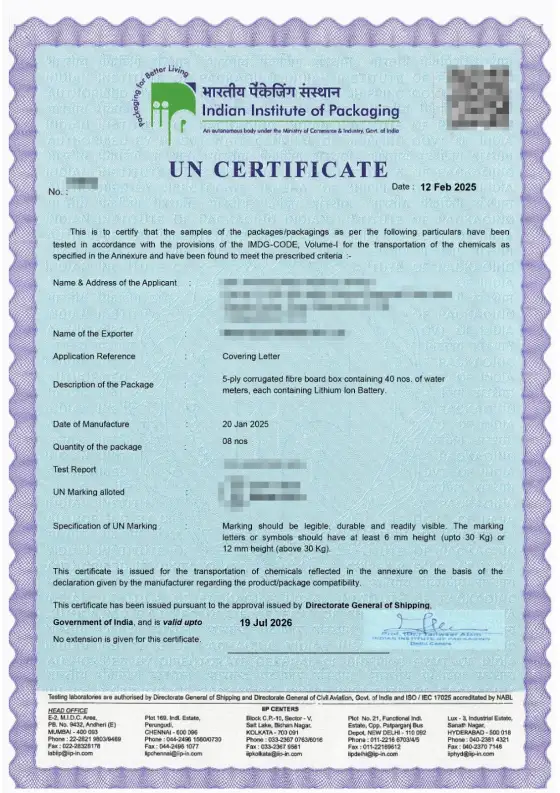
IIP Certificate Sample
- UN Mark IIP Certificate IMDG
- UN Mark IIP Certificate ICAO

Application Process for IIP Certificate for Miscellaneous Dangerous Goods
Obtaining a UN Mark IIP Certificate for Class 9 Miscellaneous Dangerous Goods follows a structured process to ensure compliance with international packaging regulations for hazardous materials. Below is the step-by-step certification procedure:
- Application Submission: Submit the online application through the IIP portal by providing all the required details and supporting documents.
- Payment: During the application submission, payment details must be updated on the portal, including the payment mode, cheque number, or UTR number as applicable.
- Packaging Material Sample Testing: The packaging sample must be sent to the IIP laboratory in Mumbai or Chennai for testing based on specified packaging parameters to verify compliance with UN standards. Samples can be sent via courier, transport, or through customer or marketing channels. After testing, the sample will be retained for up to 30 days.
- Certificate Issuance: Generation of UN Marking Number as specified. Test report & UN certificate is issued by the department. After the certificate is issued, login to LIMS (Laboratory Information Management System) to download the digital certificate.

Documents for IIP Certificate for Miscellaneous Dangerous Goods
To obtain IIP Certificate for Class 9 Miscellaneous Dangerous Goods, the following documents must be submitted to the certifying authority:
1. Business & Legal Documents
- GST Registration Certificate and PAN
- Import Export Code (IEC)
- Certificate of Incorporation (if applicable)
- MOA & AOA or Partnership Deed (if applicable)
- ISO Certificate (optional)
2. Company & Manufacturer Information
- Product Manufacturing Company Details (GST, IEC, Contact No., Email)
- Packaging Manufacturer Details (GST, MSME, ISO, Email, Contact No.)
- Exporter's Name
3. Product & Packaging Details
- Type & dimensions of Outer Packages with images
- Net Weight & Gross Weight of Product
- Mode of Shipment (Air or Sea)
- Photograph of Product with Packaging Material
- Type or State of Product (Solid, Liquid, Gas)
4. Additional Requirements
- MSDS Certificate of the Goods
- Identity Proof of Authorized Person(s)
- Contact Details of Company & Authorized Person
- Copy of cancelled cheque
- Quantity of Sample for Testing
Fees for IIP Certification for Miscellaneous Dangerous Goods
The table below shows the IIP UN Mark Certification fees for packaging materials under Normal, Combine, and Tatkal modes. These fees are particularly useful for businesses seeking IIP Certification for Class 9 Miscellaneous Dangerous Goods, helping them plan and understand the certification costs clearly in advance.
| Types of Packaging Material | Normal Mode | Combine Mode | Tatkal Normal Mode |
|---|---|---|---|
| Metal Drum | ₹ 21,000 | ₹ 31,500 | ₹ 31,500 |
| Plastic Drum | ₹ 24,500 | ₹ 36,750 | ₹ 36,750 |
| Composite Drum | ₹ 27,500 | ₹ 41,250 | ₹ 41,250 |
| CFB Box / Fiber Board Drum | ₹ 20,000 | ₹ 30,000 | ₹ 30,000 |
| CFB with Plastic Container | ₹ 26,000 | ₹ 39,000 | ₹ 39,000 |
| Paper Bag (Multiwall) | ₹ 20,000 | ₹ 30,000 | ₹ 30,000 |
| Plastic Bag | ₹ 20,500 | ₹ 30,750 | ₹ 30,750 |
| Woven Bags | ₹ 21,500 | ₹ 32,250 | ₹ 32,250 |
| Wooden Boxes | ₹ 18,500 | ₹ 27,750 | ₹ 27,750 |
| FIBC / IBC | ₹ 29,000 | ₹ 43,500 | ₹ 43,500 |
Note: The above fee structure represents the Normal Mode, Combined Mode, and Tatkal Mode charges for testing and certification of packaging materials for UN Certificates. If you obtain Combined Tatkal Mode Certification, the Government fee will be 1.5x the Normal Mode charges.
Note: Professional Fee for IIP UN Mark certification Registration Normal mode starts from ₹24,999 whereas the Combine mode (Air & Sea) Fee is ₹37,499.
What is IIP Certificate for Miscellaneous Dangerous Goods?
One essential certification that guarantees packaging used for transporting Class 9 hazardous materials conforms with international safety standards is the UN Mark IIP Certificate for Miscellaneous Dangerous Goods. Class 9 covers a broad range of items and substances that could be dangerous to transport, including dry ice, lithium batteries, chemicals that are harmful to the environment, magnetized materials, and genetically modified organisms. Even though these products might not neatly fall into other hazard categories, they still need to be handled and packaged carefully to avoid mishaps, leaks, and environmental harm.
The Indian Institute of Packaging (IIP), which certifies the packaging, tests it to ensure that it is strong, long-lasting, and complies with the UN Recommendations on the Transport of Dangerous Goods. Following approval, the packaging is identified by a special UN code that includes the manufacturer's information, the country of origin, the type of packaging, and the maximum hazard level it can withstand. Because it enables safe cross-border transportation, this certificate is required for companies that manufacture, export, or ship various dangerous goods. Businesses handling lithium batteries must ensure that both their product documentation and packaging comply with applicable transportation and safety regulations.
Benefits of IIP Certification for Class 9 Miscellaneous Dangerous Goods
The UN Mark IIP Certification is a globally recognized packaging certification that ensures the safe transportation of hazardous goods. Below are the key advantages:
- Enhanced Safety: To obtain certification, packaging must pass rigorous testing, including drop resistance, pressure endurance, and leakproof evaluations, preventing spills, leaks, or contamination and ensuring overall safety.
- International Trade Facilitation: UN certification is acknowledged by regulatory authorities worldwide, simplifying customs clearance and reducing legal complexities for hazardous shipments.
- Increased Market Credibility: Possessing IIP certification showcases a company’s commitment to quality and safety, strengthening its reputation among customers, suppliers, and regulatory agencies while enhancing market opportunities.
- Cost Savings: UN-certified packaging helps businesses avoid penalties, legal risks, and shipment rejections, reducing expenses related to non-compliance, product damage, and safety concerns.
- Competitive Advantage: Securing an IIP UN Mark certificate reinforces a business’s standing in the market by proving compliance with stringent safety and quality regulations, making it more attractive to clients and partners.
List of Class 9 Miscellaneous Dangerous Goods
Class 9 includes substances and articles that pose hazards not covered under other dangerous goods classes. These materials may present environmental, chemical, thermal, electrical, magnetic, or transportation-related risks during handling and transport.
- Environmentally Hazardous Substances (Toxic to aquatic life and ecosystems)
- Persistent Pollutants: Polychlorinated Biphenyls (PCBs), Perfluorooctane Sulfonic Acid (PFOS), Perfluorooctanoic Acid (PFOA)
- Toxic & Hazardous Materials: Asbestos, Lithium Batteries (Damaged or Defective)
- Magnetized and Miscellaneous Hazardous Materials (Capable of causing interference
with navigation or communication equipment)
- Strong Magnetic Fields: Magnetized Materials ,UN2807 (Strong Permanent Magnets)
- Pressure & Chemical Hazards: Dry Ice (Solid Carbon Dioxide) UN1845, Airbag Inflators and Modules, Self-Inflating Life Rafts
- Reactive Polymers: Expandable Polymer Beads (Capable of Releasing Flammable Gas)
- Substances That Pose Unusual Hazards (Do not fit traditional hazard classifications
but still present risks)
- Biological & Chemical Risks: Genetically Modified Microorganisms,UN3245 (GMMOs) and Genetically Modified Organisms (GMOs)
- Reactive & Combustible Substances: Ammonium Nitrate Fertilizers, Safety Matches
- Battery & Electrical Hazards: Battery-Powered Devices (UN3480, UN3481, UN3090, UN3091), Electric Vehicle Batteries
- Industrial & Transportation Risks: Blue Asbestos, Engines and Internal Combustion Machines, Fuel Cell Cartridges
- Pressurized & Miscellaneous Risks: Aerosols, Biomedical Waste
UN Numbers for Class 9 Miscellaneous Dangerous Goods
Class 9 Miscellaneous DG presents a hazard during transport but are not covered under 8 other hazard classes. These goods are assigned 4-digit UN numbers depending on their chemical makeup, physical state, and intended use.
Common Class 9 UN numbers include:
- UN 3077: Solid Chemicals or waste harmful to ecosystems
- UN 3082: Liquid marine pollutants or contaminated oils
- UN 3090: Lithium metal and alloy batteries
- UN 3091: Lithium metal batteries contained in or packed with equipment
- UN 3480: Lithium ion and polymer batteries
- UN 3481: Lithium-ion batteries contained in or packed with equipment
- UN 3166: Vehicle, flammable gas powered, or Vehicle, flammable liquid powered
- UN 3529: Engine, internal combustion, flammable gas powered / Fuel cell, engine, internal combustion
- UN 1845: Carbon dioxide, solid (Dry Ice)
- UN 3268: Safety device, articles (airbag inflators, seatbelt pretensioners)
- UN 3335: Aviation regulated solid, N.O.S.
India-Specific Class 9 Export Compliance
1. India's Battery Export Industry and Class 9 :
India is rapidly expanding its lithium-ion battery manufacturing and export sector through the Production Linked Incentive (PLI) Scheme for Advanced Chemistry Cell (ACC) Batteries. With more batteries being exported for use in electric vehicles, power tools, laptops, phones, and other electronic gadgets, compliance with Class 9 dangerous goods rules is becoming even more critical.
For the export of lithium batteries and battery-powered devices, businesses generally require:
- UN38.3 Test Certification for lithium batteries
- IIP UN Mark Packaging Certification (Class 9) for approved transport packaging
- Compliance with applicable international transport regulations for dangerous goods
India's Chemical Exports and Class 9
India is one of the world's largest chemical producers and exporters. Many exported products, including agrochemicals, industrial lubricants, paints, coatings, and specialty chemicals, may be classified as Environmentally Hazardous Substances (UN3077 or UN3082) under Class 9.
For such products, exporters may require:
- IIP UN Mark Packaging Certification for dangerous goods packaging
- Proper classification and labeling of hazardous materials
- Compliance with international transport and export requirements for Class 9 dangerous goods
Validity of UN Mark IIP Certification for Class 9 Miscellaneous Dangerous Goods
Validity of UN Mark IIP Certification for Class 9 miscellaneous dangerous goods depends on the ISO status of the manufacturer. Extension beyond 18 or 9 months is strictly non-extendable. Upon expiration of the certificate, manufacturers must submit new samples and repeat testing processes to obtain a fresh IIP certificate for class 9 miscellaneous goods.
- ISO 9000 Certified Manufacturers: Valid for 18 months
- General Category (Non-ISO) Manufacturers: Valid for 9 months
Secure Your UN Mark IIP Certificate for Miscellaneous Dangerous Goods
The UN Mark IIP Certificate for Class 9 Miscellaneous Dangerous Goods is essential for organizations involved in the transportation of hazardous materials. It ensures that packaging complies with international safety standards, helping to prevent leaks, spills, accidents, and environmental damage during transit. This certification plays a crucial role in enhancing a company's credibility, facilitating international trade, and minimizing the risk of legal and regulatory issues.
Consult Professional Utilities for smooth and hassle-free assistance in obtaining a UN Mark IIP Certificate in Delhi and across India. Our experts, with more than a decade of experience, provide guidance at every stage of the certification process. Obtaining UN certification is vital for maintaining safety, regulatory compliance, and international transportation standards when handling dangerous goods.
FAQ’s On UN Mark IIP Certificate for Miscellaneous Dangerous Goods
Does the UN Mark IIP Certificate need renewal for Class 9 packaging?
The certificate remains valid as long as the packaging design, material, and construction stay unchanged. Any modifications require re-testing.
What is the purpose of the UN Mark IIP certificate?
The UN Mark IIP certificate ensures that the packaging used for the transport of dangerous goods is compliant with international regulations. It helps prevent accidents, protect people, and minimize environmental hazards during transportation.
What is a Non-Dangerous Goods license and when is it required?
A Non-Dangerous Goods license is required for transporting or shipping goods that do not fall under hazardous or dangerous categories but still need regulatory clearance for logistics and compliance. It ensures safe handling and smooth movement of goods as per Indian and international transport norms. Complete guidance is available at Non-Dangerous Goods License Registration.
Is a UN IIP Certificate mandatory for Class 9 miscellaneous
dangerous goods?
Yes, obtaining a UN IIP Certificate is essential to ensure safe packaging and international compliance for Class 9 materials. For broader details, visit UN Mark IIP Certificate for Dangerous Goods.
Speak Directly to our Expert Today

Reliable

Affordable

Assured
Disclaimer:The information provided on this website is intended for general information purposes only. Although all reasonable efforts are made to ensure that the information provided is correct and reliable, it is not advised to be used as a substitute for professional advice. The information herein is not to be used in place of seeking professional services, counsel, or guidance. We highly advise that you consult a professional before you make any business or legal decisions regarding the information presented on this website. This website and its contents are given "as is", and we do not take any responsibility for any action that is taken based on information given on this website.

- Written by: Anuja Sahi
- Fact-checked: Sahil Singh
- Updated on: May 27, 2026
Testimonials
"Explore how Professional Utilities have helped businesses reach new heights as their trusted partner."





It was a great experience working withProfessional Utilities. They have provided the smoothly. It shows the amount of confidence they are having in their field of work.

Atish Singh


It was professional and friendly experience quick response and remarkable assistance. I loved PU service for section 8 company registration for our Vidyadhare Foundation.

Ravi Kumar
I needed a material safety data sheet for my product and they got it delivered in just 3 days. I am very happy with their professional and timely service. Trust me you can count on them.

Ananya Sharma
Great & helpful support by everyone. I got response & support whenever I called to your system. Heartly thanx for Great & Super Service. Have a Great & Bright future of team & your company.

Prashant Agawekar
Thank you so much Professional Utilities team for their wonderful help. I really appreciate your efforts in getting start business. Pvt Ltd company registration was smooth yet quick.
Abhishek Kumar
I applied for Drug licence and company registration and their follow-up for work and regular updates helped me a lot. They are happily available for any kind of business consultancy.

Vidushi Saini
Great experience went to get my ITR done, process was quite convenient and fast. Had a few queries, am happy about the fact those people explained me all things I wanted to know.

Taniya Garyali
Great services provided by Professional Utilities. They are best in this industry and the best part is their prices are so affordable. Kudos to you. Now you guys are my full-time consultant.

Aftab Alam
Trusted By