



CSR Registration of Trust for CSR Activities- Form CSR-1
CSR Registration permits a Trust to receive CSR funding from eligible corporate entities to carry out different CSR initiatives.CSR full form is Corporate Social Responsibility which means a system that promotes the responsibility of the corporate world towards the society through which non-profit organizations (NGOs and trusts) are able to obtain financial and other support from the business world.
The aim of bringing together all NGOs through the online portal is to develop an effective CSR spending monitoring system. The registration process for CSR-1 for Trusts is completely online and can be completed by Practicing CMA, CS, or CMA certification.
Read on to learn more about the process of registering your trust for CSR activities and the complete requirements of CSR registration for trusts.
- CSR-1 Approval Letter
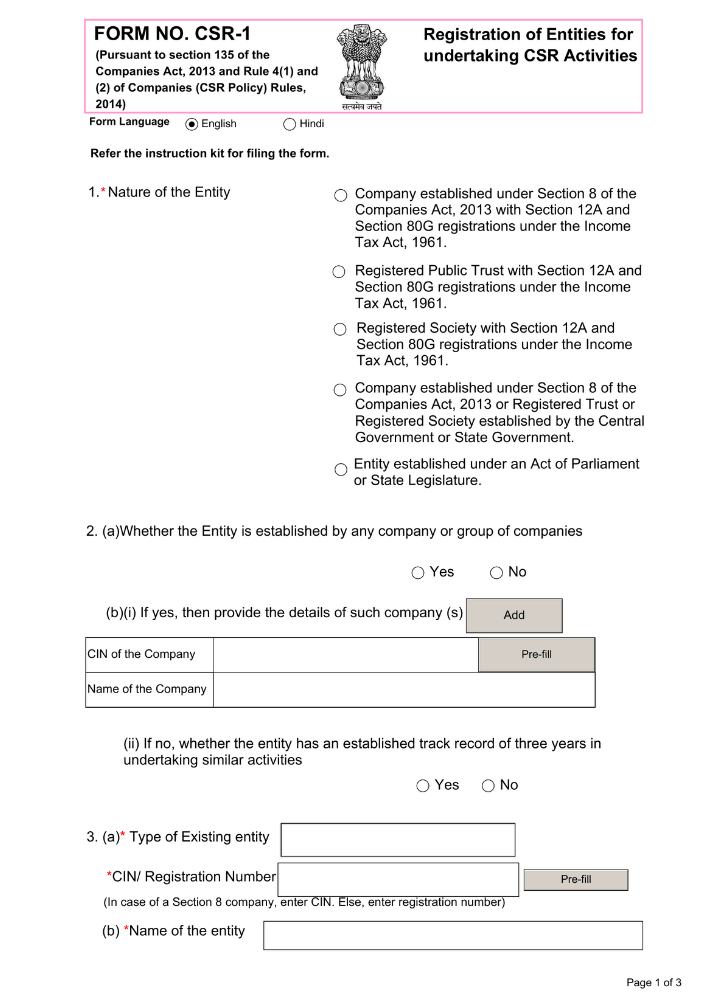
- CSR-1 Sample Form

How do I apply for a CSR-1 form for Trusts?
Process of CSR-1 registration:

Documentation
Filing on MCA Portal
Inspection of the Form
Approval Letter from MCA

Documents Required for CSR registration for Trusts
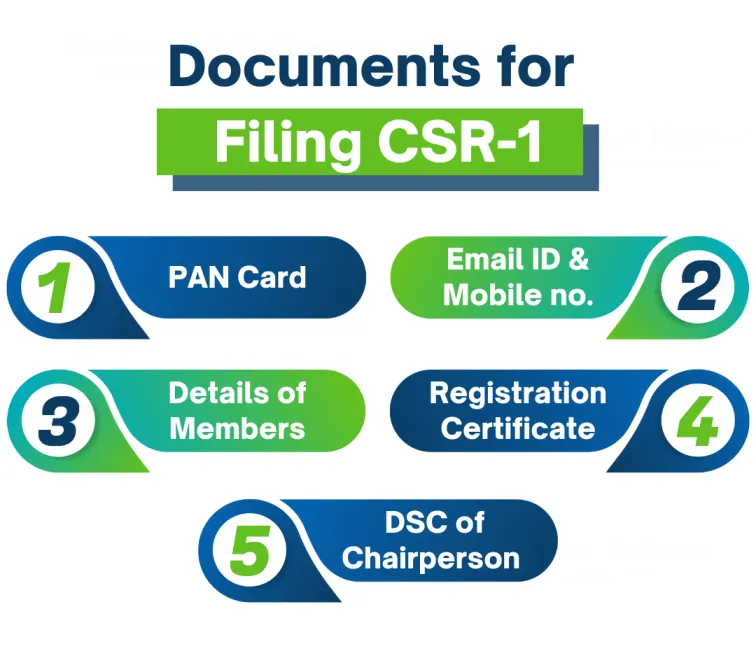
Here is the list of documents required for CSR-1 registration for Trusts:
- 12AB & 80G Registration Order Copy
- PAN card of the Trust
- DIN/PAN of the Secretary, Trustee, and Director of the company.
- DSC of the entity applying
- Trust Deed
- Email ID and Mobile Number
- Details of members of the organization
CSR Registration Fees for Trusts
The cost of CSR-1 registration for Trusts is ₹2,999, the total amount could differ based on the availability of the Chairperson's DSC.
| CSR Registration Costs for Trusts | |
|---|---|
| CSR Filing Fees for the filing of a CSR with a Valid DSC | ₹2,999 |
| CSR Filing fees without valid DSC | ₹2,000(DSC) + ₹2,999(Filing) = ₹4,999 |
Note: The aforementioned Fees is exclusive of GST.
What is CSR registration for Trusts?
The CSR-1 form is for NGOs and trusts to register on the MCA portal. The form must be filled out by entities (Mostly Non-Governmental Organizations) to improve their chances of receiving donations and CSR funding from businesses that are entitled to give 2% of their net earnings to CSR actions.
The Ministry of Corporate Affairs has made it mandatory to file the CSR Form for trusts to obtain funding from corporations. Businesses and NGOs are brought together under one roof where businesses are able to find the appropriate organization to donate funds, while Non-profit organizations can display their plans in their project reports and receive CSR funding.
Eligibility for receiving CSR funds for Trusts
- Public Trusts registered under sections 12A and 80G of the income tax Act, 1961
- Registered trusts established with the assistance of government officials from the Central State Government or State Government.
- Entities that are created through the laws of a State Legislature or an Act of Parliament.
A company can take on CSR initiatives independently or through agencies who plan to engage in CSR activities have to declare their on the MCA portal by filing the CSR-1 form online.
Important: To receive funds via foreign funding sources, Trusts require to register for an FCRA certificate in addition to CSR registration.
CSR registration can be applied to which businesses?
As per Section 135 of the Companies Act of 2013, it is mandatory for certain corporations to invest 2 percent of their net profits in the financial year in CSR actions. According to the Companies Act, The CSR clause applies to businesses that:
- The net worth of ₹500 Cr or more in a financial year or,
- A turnover of ₹1000 Cr or more in a financial year or,
- A Net profit of ₹5 Cr or more.
What CSR-related activities are allowed according to the Companies Act, 2013
To regulate the CSR activities of non-profit organizations and to ensure that the use of CSR funds is actually increasing the standard of living in our nation, the CSR committee has prepared an exhaustive list of tasks that can be carried out with the help of CSR funds that corporate companies provide.
The following CSR actions are permitted for trusts and NGOs in accordance with the Company Act 2013, 2013
- National heritage protection Culture, art, and heritage
- Establishing Public Libraries
- Handicrafts and traditional arts development and promotion
- Actions in support of military veterans, war widows, and their families
- Training for the promotion of rural sports, nationally recognized sports, Paralympic sports, and Olympic sports
- Funds or contributions to technology incubators within universities that are endorsed by the Central Government
- Elimination of Hunger
- Malnutrition and poverty
- Promotion of sanitation and health care
- Access to safe drinking water
- Inspiring education in young women, senior citizens, and people with disabilities
- projects to improve livelihoods
- Promotion of gender equality and women's empowerment
- The establishment of hostels and homes for orphans and women
- The establishment of elderly homes, daycare centers, and similar facilities for seniors
- Actions to decrease inequalities incurred by economically and socially backward groups
- Assuring sustainability of the environment and ecological balance
- Protection of animals and plants( Animal Welfare & Agroforestry)
- Conservation of Natural Resources
- The maintenance of soil quality and the quality of air and water
CSR Registration Benefits for Trusts
CSR registration is beneficial to both charitable trusts who seek CSR funds as well as corporate companies that provide CSR funding.
-
Helps Trusts in obtaining CSR funds
When public Trusts register for CSR, they have the chance to draw the attention of corporations willing to offer substantial financial assistance to run CSR initiatives. The process of getting corporate donations and funding from businesses is made simpler due to the absence of legal hurdles.
-
Builds the Authenticity of trusts
The funds generated through CSR are utilized to support social development, and they affect the quality of life of marginalized and economically depressed people so that they can live healthy and decent lives. CSR is a company-wide effort to assess and take responsibility for business operations on the environment and its impact on social well-being.
-
Builds the Reputation of the Company
Corporate companies who are involved in a cause improve the reputation of the brand among people. It's also a powerful assertion for businesses to demonstrate their values. It aids its employees and the business by contributing to something bigger than the needs of its employees. CSR can also provide a feeling of belonging for employees. It builds bonds among employees and also their loyalty towards the organization.
-
Supports positive environmental and social transformations
CSR is a part of the company's efforts to protect the environment and promotes positive social and environmental changes. CSR initiatives are focused on the promotion of education, health, and water, as well as social and environmental empowerment.
FAQ’s On CSR registration for Trusts
How much does it cost for CSR registration of a Trust?
It only costs Rs 2,499 to file an electronic form CSR-1. However, the amount may be different if the chairperson does not have a valid DSC. The filing fee will only be ₹2499 if the chairperson has a valid DSC.If the chairperson doesn't have an approved DSC, the fee would be ₹1200 for the DSC plus Rs 2,499 for the filing fee, for a total of ₹3,699.
Which CSR activities can be performed by a Public trust?
According to the companies act 2013, CSR funds can be utilized for activities specified by the CSR committee. Some of them include the following-
- Promotion of Healthcare
- Swachh Bharat Kosh
- Promoting education
- Cleaning Rivers
- Promoting Gender Equality
- National Heritage promotion and many more
For detailed information on other activities, please refer to the complete list of CSR activities in India.
How to get CSR Funds from Companies?
You need to file a CSR-1 form to get CSR funds from companies. Apart from that, you also need to prepare a project report that includes detailed information about the CSR activity and its impact on society. A good project report attracts good funds.
How long does it take to register a CSR-1 for Trust?
A CSR form can be filed in about two days. However, if you do not have the project report ready, it may take up to 10-15 days to write an appealing project report that boosts your chances of receiving more and more CSR funds.
Can trusts apply for CSR-1 registration in Kolkata?
Yes, registered trusts are eligible to apply for CSR-1 registration, provided they have valid 12A and 80G certifications and comply with MCA guidelines. Understanding the complete process and eligibility criteria under CSR Registration for Trusts can help ensure smooth approval and compliance.
Is GST registration mandatory for creating a trust in India?
GST Registration is not mandatory to create a private trust in India, as a trust can be formed through a valid trust deed; however, registration is advisable for legal recognition and tax or property-related matters. The legal position and implications are explained in detail in our guide on no GST registration required for trust.
Speak Directly to our Expert Today

Reliable

Affordable

Assured
Industries Served by
Professional Utilities

Apparels

Footwear

Furniture

Gems and Jewellery

Tourism & Hospitality

Consumer Electronics

Chemicals

Telecom

Oils & Gas

Hotel

Railways

Liquor

Health & Medical

Food Processing

Dangerous/ Haz. Goods

Tea & Coffee

Capital Goods

Recycling

Rubber

NGOs

Silk

Handloom

IT & BPM

Steel

Automobile

Tobacco

Constructions


Testimonials
"Explore how Professional Utilities have helped businesses reach new heights as their trusted partner."







It was a great experience working withProfessional Utilities. They have provided the smoothly. It shows the amount of confidence they are having in their field of work.

Atish Singh


It was professional and friendly experience quick response and remarkable assistance. I loved PU service for section 8 company registration for our Vidyadhare Foundation.

Ravi Kumar
I needed a material safety data sheet for my product and they got it delivered in just 3 days. I am very happy with their professional and timely service. Trust me you can count on them.

Ananya Sharma
Great & helpful support by everyone. I got response & support whenever I called to your system. Heartly thanx for Great & Super Service. Have a Great & Bright future of team & your company.

Prashant Agawekar
Thank you so much Professional Utilities team for their wonderful help. I really appreciate your efforts in getting start business. Pvt Ltd company registration was smooth yet quick.
Abhishek Kumar
I applied for Drug licence and company registration and their follow-up for work and regular updates helped me a lot. They are happily available for any kind of business consultancy.

Vidushi Saini
Great experience went to get my ITR done, process was quite convenient and fast. Had a few queries, am happy about the fact those people explained me all things I wanted to know.

Taniya Garyali
Great services provided by Professional Utilities. They are best in this industry and the best part is their prices are so affordable. Kudos to you. Now you guys are my full-time consultant.

Aftab Alam
Trusted By