


EPR Registration for E-waste in India - Process, Fees & Benefits
EPR stands for Extended Producer Responsibility, which means that companies are responsible for collecting and recycling the e-waste created from the products they put into the market. Under the E-Waste Management Rules 2022, all manufacturers, importers, and brand owners must register with the Central Pollution Control Board (CPCB) before they can operate legally.
As more people use electronic items like mobile phones, laptops, televisions, and home appliances, the amount of electronic waste or e-waste is also increasing. This waste can harm the environment and affect human health if not managed properly.
To solve this problem, the Indian government has made EPR Registration for E-Waste mandatory for all businesses that make, import, or sell electronic products. The EPR certificate is given after CPCB checks and approves the company’s plan for managing electronic waste in a safe and eco-friendly way. The process is fully online but requires careful preparation of documents and a clear action plan.
At Professional Utilities, we make the EPR Registration for E-Waste process easy and smooth. Our team helps you at every step, from preparing the documents to submitting the application and getting approval from CPCB. With our expert help, you can meet all legal requirements and also support a cleaner and greener environment.
EPR Registration Online
Process for EPR Registration for E-Waste
The registration process for EPR authorization of e-waste can be summarized in the following steps:
- Step 1: Assessment and Documentation – Applicants must provide complete business and product details for their EPR e-waste registration. Our experts assess all documents to ensure accuracy and compliance.
- Step 2: Filing of EPR Registration Form – After document verification, our team files the online application with CPCB for EPR authorization for e-waste.
- Step 3: Assessment of Application by CPCB – CPCB reviews the submitted EPR registration application. If any discrepancies are found, necessary corrections are made for approval.
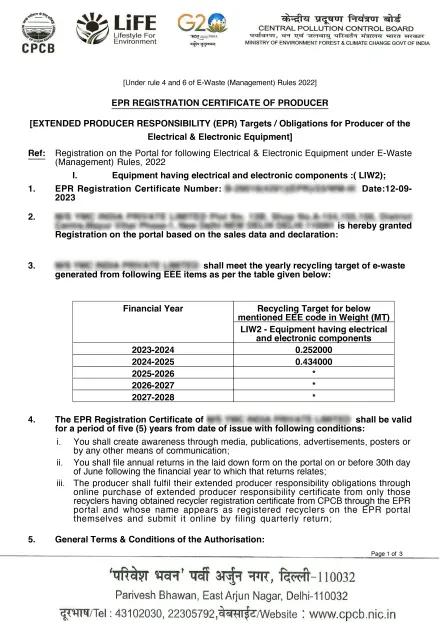
- Step 4: Issuance of EPR Authorization – The EPR authorization certificate is issued within 30 days of application submission. After approval, producers must implement the EPR action plan to meet compliance targets.

Documents Required For EPR Registration for e-Waste
The following documents are required to obtain EPR Registration for E-Waste to verify business credentials and identity as per CPCB guidelines:
- Trade Name/Company Name
- Legal Name
- Mobile Number
- Official email id
- Landline Number(if available)
- CIN / Incorporation Certificate (if available)
- GST Registration
- PAN of company, (if available)
- PAN of Authorized Person
- Postal Address
- List of notified EEE along with their codes for which Registration is required.

EPR Registration Fee for E-Waste
Below is the clear and transparent EPR Registration Fee for E-Waste for both new and existing businesses.
| S.No | Particulars | Fees |
|---|---|---|
| 1 | Existing Units (With Recycling Requirement) | ₹2,500 |
| 2 | Other Business | ₹10,000 |
| 3 | Professional Fee | ₹5,000 |
Note: The aforementioned fees are exclusive of GST.
Note: The renewal application must be submitted 120 days before the expiration of the current EPR authorisation. The EPR authorisation is valid for five years, after which it must be renewed.
What is EPR E-waste management Registration?

EPR e-waste management registration specifically pertains to the registration process for electronic waste management under the Extended Producer Responsibility. It involves ensuring that producers and importers of electronic products comply with the necessary regulations and requirements for managing and disposing of electronic waste in an environmentally responsible manner.
As per the provisions the producers of e-waste are classified as:-
- Recycler
- Producer
- Refurbisher
- Manufacturer
Or any entity that introduces batteries in the market are required to obtain EPR Registration for battery waste management.
Other Types of Registration For Extended Producer Responsibility


Benefits of EPR Registration for E-Waste
Benefits of EPR Registration for E-Waste are numerous, as it promotes compliance, environmental sustainability, and business growth. Here's an overview of the key advantages:
- Accountability: E-waste EPR registration holds electronic device producers responsible for establishing collection and recycling systems for e-waste, ensuring proper disposal and preventing environmental and health hazards.
- Collaboration: EPR registration encourages producers to collaborate with recycling facilities, fostering efficient and responsible e-waste recycling practices.
- Resource Recovery: By partnering with specialized facilities, EPR registration for e-waste enables maximum resource recovery from e-waste.
- Public Awareness: EPR registration promotes awareness and education about e-waste recycling initiatives.
- Environmental Protection: e-waste EPR registration ensures a more systematic and responsible approach to managing e-waste, resulting in environmental protection, reduction of hazardous substances, and preservation of natural resources.
- Sustainable Future: By implementing EPR registration for e-waste, we contribute to building a healthier, sustainable future by reducing the negative impacts of electronic waste on the environment and human health.

Criteria for Producers for E-Waste EPR Registration
For Producers whose presence in the market is either equal to average end of life of its electrical and electronic equipment (EEE) or more than the average life following information is required:
- Quantity of EEE in terms of weight placed (sold) in the market financial year-wise for the period equal to its average end-of-life as given by CPCB
- Sales data of applicable EEE has to be given in terms of weight in metric tonnes.
For Producers whose presence in the market is less than the average end of life of its EEE following information is required
- Quantity of EEE in terms of weight placed (sold) in the market since the time sales started (as per table 1in the portal).
- Scanned copy of covering letter on the letter head of the company duly signed by the authorized person.
- Scanned copy of an affidavit on Rs. 100/- Stamp Paper duly signed by the authorized person of the producer company and duly notarized by notary.
- Scanned copy of CA Certificate, certifying the quantity of EEE placed (sold) on the market financial year (FY) wise in weight (metric tonnes) and / or Imported in terms of weight is correct and checked by CA.
- Scanned copy of signed self-Declaration on the letter head of the producer company that technical documents on RoHS are available and will be provided for verification to CPCB/SPCBs.
- Details of Awareness Plan by the Producer
Cancellation of EPR Registration for E-Waste
Cancellation of EPR registration for e-waste explains the authority and process of the CPCB. Here are the details.
- EPR Registration for e-waste is granted to Producers/Manufacturer can also be liable to cancellation at any point, if the documents submitted are found to be Incorrect.
- In case of non-compliance of Extended Producer Responsibility (EPR) obligations. CPCB can suspend and or cancel the e-waste EPR registration, and can impose Environmental Compensation.
Note: The entity in question will be given an opportunity to hear the applicant within 15 days from the date of issuance of notice prior to their e-waste epr cancellation process.
Key Rules to Follow for Successful EPR E-Waste Registration
Here are the key takeaways for EPR Registration for E-Waste, highlighting its role in ensuring compliance:
- Renwal can be filled 120 days prior to the due date.
- The process of E-waste EPR Registration can take up-to 30 business days.
- Producers are required to fulfill their EPR targets on time to avoid penalties or cancellation.
- Cancellation of EPR registration for E-waste is subjected to CPCB, if any discrepancy is found then the license can be cancelled any time.
Conclusion
EPR registration plays a vital role in promoting sustainable management of electronic waste and safeguarding the environment. It constitutes a pivotal measure that brings forth a multitude of advantages, such as streamlined waste management, cost savings, enhanced public perception, and legal safeguards.
When businesses assume EPR responsibilities, they actively contribute to building a sustainable economy, conserve valuable resources, and fulfill the demands of environmentally aware consumers. It is imperative for businesses to grasp the procedures involved in securing EPR authorization and proactively embed sustainable practices within their operational framework.
FAQ’s On EPR Registration For E-waste
What is EPR registration for e-waste?
EPR registration with the Central Pollution Control Board (CPCB) signifies that producers, importers, brand owners, refurbishers, and recyclers of electrical and electronic equipment (EEE) pledge to oversee the post-consumer lifecycle of the products they introduce to the market - guaranteeing collection, recycling, or disposal in an environmentally responsible way.
Is registration mandatory and what is the validity?
Yes - registration is mandatory for applicable entities under the E-Waste (Management) Rules, 2022, effective from 1 April 2023. The registration certificate is valid for five years (for most cases) and renewal is needed thereafter.
Are there any exemptions or entities not required to register?
Yes. For example: bulk consumers (institutions/corporates consuming EEE) are not required to register themselves but must ensure disposal through authorised recyclers. Also, dealers/retailers who do not act as producers/importers or brand-owners are generally not required to obtain registration.
Is EPR mandatory for importers?
Yes, the EPR registration for importers of electronic products that contribute in waste generation are required to have CPCB EPR authorization.
Speak Directly to our Expert Today

Reliable

Affordable

Assured
EPR Registration For E-waste in Other State
EPR Registration for Different Waste Categories
Testimonials
"Explore how Professional Utilities have helped businesses reach new heights as their trusted partner."





It was a great experience working withProfessional Utilities. They have provided the smoothly. It shows the amount of confidence they are having in their field of work.

Atish Singh


It was professional and friendly experience quick response and remarkable assistance. I loved PU service for section 8 company registration for our Vidyadhare Foundation.

Ravi Kumar
I needed a material safety data sheet for my product and they got it delivered in just 3 days. I am very happy with their professional and timely service. Trust me you can count on them.

Ananya Sharma
Great & helpful support by everyone. I got response & support whenever I called to your system. Heartly thanx for Great & Super Service. Have a Great & Bright future of team & your company.

Prashant Agawekar
Thank you so much Professional Utilities team for their wonderful help. I really appreciate your efforts in getting start business. Pvt Ltd company registration was smooth yet quick.
Abhishek Kumar
I applied for Drug licence and company registration and their follow-up for work and regular updates helped me a lot. They are happily available for any kind of business consultancy.

Vidushi Saini
Great experience went to get my ITR done, process was quite convenient and fast. Had a few queries, am happy about the fact those people explained me all things I wanted to know.

Taniya Garyali
Great services provided by Professional Utilities. They are best in this industry and the best part is their prices are so affordable. Kudos to you. Now you guys are my full-time consultant.

Aftab Alam
Trusted By