
Environmental Clearance License in Punjab
Get Environmental Clearance Certificate in Punjab @ ₹99,000

4.9


Environmental Clearance Certificate in Punjab - Process & Fees
Before starting any of the projects listed in the Environmental Impact Assessment (EIA) Notification, 2006, project proponents must get an Environmental Clearance (EC) in Punjab. The Environmental Clearance Certificate promotes sustainable growth by guaranteeing that all operations follow environmental safety regulations. You must get an environmental clearance in Punjab before starting any on-site activity, including land preparation. An environmental clearance license in Punjab reduces adverse environmental consequences, preserves ecological equilibrium, and protects human health. Professional Utilities guarantees adherence and helps companies swiftly and efficiently receive an Environmental Clearance certificate in Punjab.
Environmental Clearance Certificate [Sample]
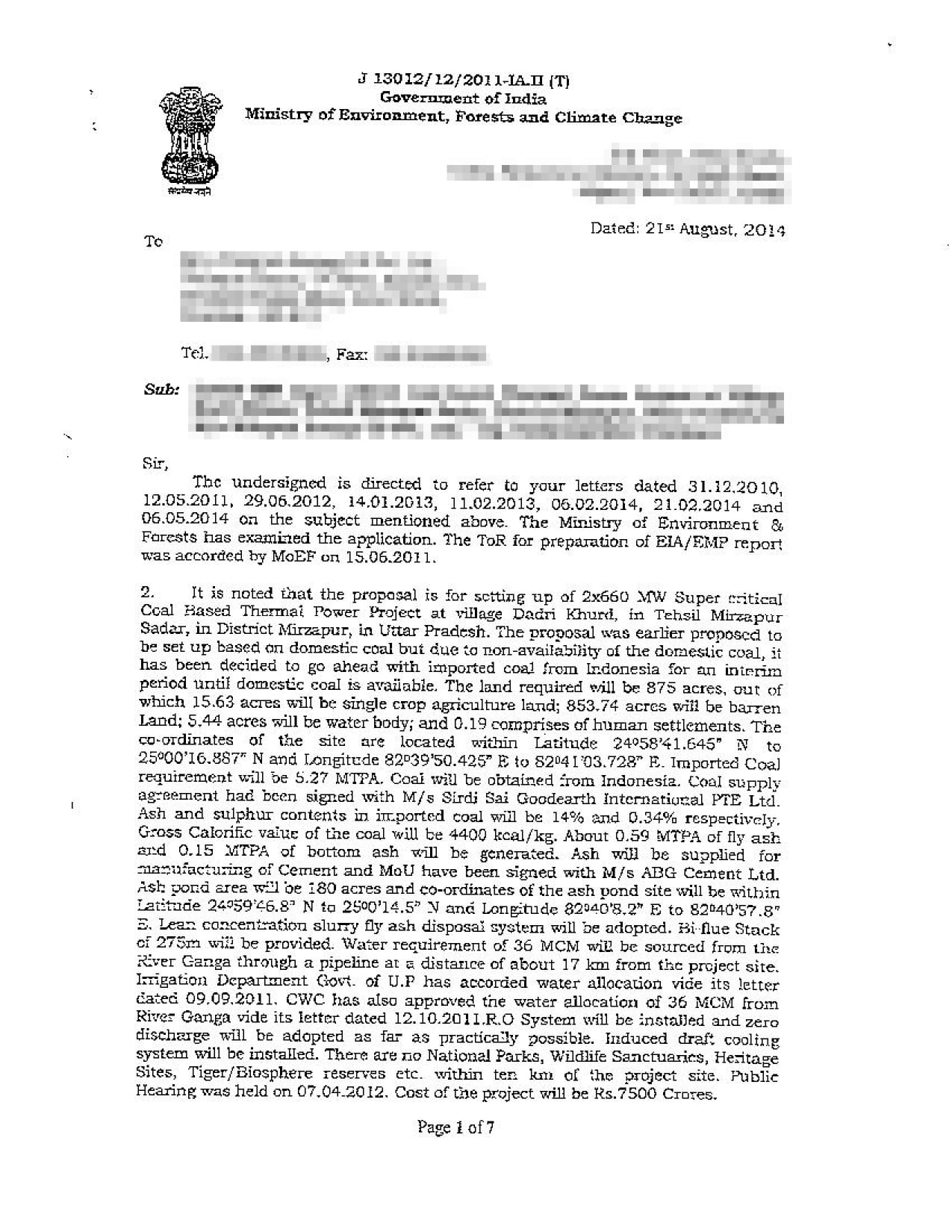
Application for Environmental Clearance in Punjab
The Environmental Clearance process in Punjab includes several steps, managed by the Expert Appraisal Committee (EAC) at the central level and the State Expert Appraisal Committee (SEAC) at the state level, based on the project category. Step-by-step Environmental Clearance in Punjab is given below:
- Step 1: Application for Environmental Clearance: The project proponent may fill out Form 1, along with Form 1A if applicable, and submit all required documents. Projects in categories 1 to 7 must submit a Pre-Feasibility Report, while projects in category 8 must give a Conceptual Plan.
- Step 2: Application Screening: The Appraisal Committee examines the application, which applies to Category B projects only, to determine whether the project requires an Environmental Impact Assessment (EIA). If an EIA is required, the project is classed as Category B1; otherwise, it is classified as Category B2, without the need for thorough environmental evaluations.
- Step 3: Application Scoping: The proposed Terms of Reference (ToR) that outline the scope of the environmental studies, are reviewed by the Expert Appraisal Committee (EAC). A site visit may be conducted if necessary. The applicant is notified of the outcome within 60 days if the application is denied.
- Step 4: Public Consultation: The State Pollution Control Board (SPCB) or Pollution Control Committee (PCC) organizes a public hearing and written responses for the impacted community to provide feedback during public consultation. The time frame is extended by an additional 45 days if the SPCB does not hold the hearing within that time frame. Before submitting the final documents, the applicant must address the issues brought up during this phase and make revisions to the EIA and Environmental Management Plan (EMP).
- Step 5: Appraisal by the Expert Appraisal Committee: The application, the EIA, outcomes of the public consultation, and all submitted documents are examined by the Expert Appraisal Committee. After submission of the final Environmental Assessment Report, the committee has 60 days to make a decision.
- Step 6: Grant of Environmental Clearance Certificate: Following the recommendations made by the EAC or SEAC, the applicant is informed of the regulating authority's decision by the State Environment Impact Assessment Authority (SEIAA) or the Ministry of Environment, Forests, and Climate Change (MoEFCC). After obtaining the recommendations, the Environmental clearance certificate is issued within 45 days.

Documents Required for Environmental Clearance in Punjab
To begin the Environmental Clearance process in Punjab, project proponents must provide several documents demonstrating compliance with environmental standards. The following documents are required for the Environmental Clearance procedure in Punjab:
- Covering Letter
- Terms of Reference (ToR) or Previous EC and Certified Compliance (if applicable)
- Form 1, Form 1A, or Other Requisite Forms
- Land Ownership Documents
- Land Use Documents with Approval
- Environment Management Plan (EMP)
- Pre-Feasibility Report and Conceptual Plan
- Environmental Impact Assessment (EIA) Report and Compliance with ToR
- Risk Assessment Report
- Brief Project Summary
- GPS File (KML Format)
- Location Details Relative to Important Features
- Environment Consultant Details
- Details of Project Proponent with Undertaking
- Layout and Building Plan with Site Plan and Tree Mapping (Approved)
- Traffic Management Plan
- Application Copy for Wildlife Clearance (if applicable)
- Previous EC Letter (for Expansion, Modification, or Amendment)
- Ground Water Details
- Local Body Approvals
For construction projects, additional documents related to energy conservation, air quality, and waste management are necessary.
Fees for Environmental Clearance in Punjab
The fee for Environmental Clearance certificate in Punjab varies based on the total project cost. Tabulated below are the applicable fees and public hearing expenses:
| Total Project Cost | Application Fees for Environmental Clearance | Public Hearing Expenses |
|---|---|---|
| Upto ₹50 lakh | ₹10,000 | Entire expenses to be borne by the project proponent |
| Above ₹50 lakh and upto ₹1 crore | ₹20,000 | |
| Above ₹1 crore and upto ₹5 crore | ₹50,000 | |
| Above ₹5 crore and upto ₹10 crore | ₹1,00,000 | |
| Above ₹10 crore and upto ₹25 crore | ₹2,00,000 | |
| Above ₹25 crore and upto ₹100 crore | ₹4,00,000 | |
| Above ₹100 crore | ₹5,00,000 |
Note: The professional fee for Environmental Clearance certificate in Punjab starts from ₹99,000 (exclusive of GST).
What is Environmental Clearance Certificate?
Environmental Clearance in Punjab is a document issued by the government that allows project development while guaranteeing adherence to environmental regulations. Environmental clearance certificate in Punjab assess a project's effects on the environment, society, and economy and offer solutions to mitigate negative outcomes.
Environmental Clearance in Punjab for Category A projects, which pose serious environmental problems and require a federal evaluation, are issued by the Ministry of Environment, Forests, and Climate Change (MoEF &CC). The State Environmental Effect Assessment Authority (SEIAA) oversees Environmental Clearance in Punjab for smaller, high-impact Category B projects.
Benefits of Environmental Clearance in Punjab
Environmental Clearance license in Punjab benefits the environment, stakeholders, and project developers by promoting sustainable development and regulatory compliance.
- Environmental Sustainability: Environmental Clearance protects natural resources, biodiversity, and ecosystems by imposing actions to reduce environmental harm. It encourages sustainable methods that maintain long-term ecological balance while still promoting economic development.
- Public Health: Environmental Clearance protects public health by reducing pollutants and environmental health hazards benefitting nearby populations by improving overall air, water, and soil quality, resulting in a healthier living environment.
- Stakeholder Engagement: Environmental Clearance licence promotes transparency via obligatory public consultations and allows stakeholders to express their concerns, ensuring that project developers handle environmental and social issues properly, and promoting trust and cooperation.
- Regulatory Compliance: Obtaining Environmental Clearance guarantees that projects comply with national and state environmental rules and prevents penalties, legal actions, and project delays, resulting in a smoother project execution.
- Global Recognition: Environmental Clearance projects adhere to international environmental guidelines and sustainable development goals. This improves global competitiveness, increases market opportunities, and displays a commitment to corporate social responsibility.
Categories of Environmental Clearance in Punjab
Projects are classified as Category A and Category B, based on their scale and environmental sensitivity.
- Category A:
- It is regulated by the Expert Appraisal Committee (EAC) under MoEF &CC.
- It includes large-scale projects such as thermal power plants, major mining operations, and ports.
- Category B:
- It is supervised by SEIAA, with recommendations from the State Expert Appraisal Committee (SEAC).
- It is further divided into:
- B1: Requires detailed EIA reports.
- B2:Exempted from EIA but still needs compliance with environmental norms.
Projects near sensitive areas are treated as Category A, even if they fall under Category B.
List of Projects Requiring Environmental Clearance Certificate in Punjab
Specific industrial, infrastructure, and construction projects in Punjab require an Environmental Clearance permit before they may function. A list of projects requiring an Environmental Clearance Licence in Punjab is listed below.
| Category | Project |
|---|---|
| Mining, Extraction of Natural Resources, and Power Generation |
|
| Primary Processing |
|
| Materials Production |
|
| Materials Processing |
|
| Construction, Area Development Projects, and Townships |
|
| Manufacturing and Fabrication |
|
| Service Sectors |
|
| Physical Infrastructure and Environmental Services |
|
| Construction, Area Development Projects, and Townships |
|
Environmental Impact Assessment (EIA)
Environmental Impact Assessment (EIA) is a critical component of the Environmental Clearance process, predicting potential impacts and proposing mitigating strategies. The Environmental Impact Assessment includes:
- Air, water, and soil quality.
- Biodiversity and vegetation.
- Noise pollution and aesthetic impacts.
- Socio-economic aspects and resettlement plans.
Environmental Clearance for Expansion or Modernization in Punjab
Any expansion in project capacity, area, or technology update has to be done through a new application for Environmental Clearance licence in Punjab. This ensures that updated environmental standards are consistently met.
Environmental Clearance Validity in Punjab
An Environmental Clearance in Punjab has a validity ranging from 5 to 30 years, depending on the type of project. Construction projects have a shorter validity period, while large infrastructure and mining projects may have a longer duration. The standard validity periods of Environmental Clearance certificate in Punjab are:
- Mining projects: 30 years
- River valley projects: 10 years
- All other projects and activities: 5 years
It is important for project proponents to comply with the terms of the Environmental Clearance in Punjab during its validity period in order to maintain compliance with environmental regulations.
Environmental Clearance Renewal in Punjab
To extend the validity, submit a renewal application for Environmental Clearance (EC) in Punjab before the validity has expired. The application must include updated project information, compliance reports, and, if applicable, public hearing records. Authorities will review these submissions to confirm adherence to environmental standards before granting an extension. Missing deadlines of renewal for Environmental Clearance in Punjab may lead to project delays and legal penalties.
For construction projects, the project proponent must submit an amended application using Form 1 and additional Form 1A. After consultation with the Expert Appraisal Committee (EAC), the regulating authority may extend the Environmental Clearance validity. However, this consultation is optional and depends on the authority's discretion.
Conclusion
Environmental clearance in Punjab promotes long-term development by limiting project environmental effect. It improves public health, conserves natural resources, and encourages environmentally sustainable industrial development. By acquiring an Environmental Clearance certificate in Punjab, project proponents can comply with national legislation, avoid legal obstacles, and involve stakeholders through public consultation. The Environmental Clearance process consists of project classification, document submission, screening, scoping, public consultation, and final evaluation. Environmental Clearance Fees vary with project cost, and validity extends from 5 to 30 years. Professional services makes acquiring the Environmental Clearance license in Punjab easier, resulting in seamless project execution and long-term ecological balance.
FAQ's on Environmental Clearance Certificate
What is an Environmental Clearance Certificate in Punjab?
An Environmental Clearance Certificate in Punjab is a government-issued document that assures project development adheres to environmental standards while avoiding negative repercussions on society, the economy, and the environment.
Why is Environmental Clearance Important?
Environmental Clearance Certificate in Punjab promotes environmental sustainability, public health, regulatory compliance, and stakeholder participation, all while avoiding legal difficulties and project delays.
What is the role of environmental impact assessment (EIA)?
Environmental Impact Assessment (EIA) assesses potential environmental consequences and recommends mitigation solutions for air, water, soil quality, biodiversity, noise, and socioeconomic aspects.
What documents are required for an environmental clearance in Punjab?
Documents required for an environmental clearance in Punjab include Form 1, the Environment Management Plan (EMP), the EIA Report, land use approvals, and pre-feasibility or conceptual plans.


Environmental Clearance Certificate in Other States
Environmental Clearance for Construction & Industrial Projects
Testimonials
"Explore how Professional Utilities have helped businesses reach new heights as their trusted partner."





It was a great experience working withProfessional Utilities. They have provided the smoothly. It shows the amount of confidence they are having in their field of work.

Atish Singh


It was professional and friendly experience quick response and remarkable assistance. I loved PU service for section 8 company registration for our Vidyadhare Foundation.

Ravi Kumar
I needed a material safety data sheet for my product and they got it delivered in just 3 days. I am very happy with their professional and timely service. Trust me you can count on them.

Ananya Sharma
Great & helpful support by everyone. I got response & support whenever I called to your system. Heartly thanx for Great & Super Service. Have a Great & Bright future of team & your company.

Prashant Agawekar
Thank you so much Professional Utilities team for their wonderful help. I really appreciate your efforts in getting start business. Pvt Ltd company registration was smooth yet quick.
Abhishek Kumar
I applied for Drug licence and company registration and their follow-up for work and regular updates helped me a lot. They are happily available for any kind of business consultancy.

Vidushi Saini
Great experience went to get my ITR done, process was quite convenient and fast. Had a few queries, am happy about the fact those people explained me all things I wanted to know.

Taniya Garyali
Great services provided by Professional Utilities. They are best in this industry and the best part is their prices are so affordable. Kudos to you. Now you guys are my full-time consultant.

Aftab Alam
Trusted By