
EPR Registration for Used Oil
Start Your EPR Registration for Used Oil @₹9,999

4.9


Extended Producer Responsibility (EPR) Registration for Used Oil
The Central Pollution Control Board has amended its guidelines regarding the waste management regulations in India. The amendment has added new provisions regarding the used oil under the extended producer responsibility. Previously under the preview of EPR also known as extended producer responsibility waste is categorized in four categories.
However, after the new amendment in EPR waste guidelines a new waste category for used oil is introduced under extended producer responsibility for manufacturer, importer and recyclers. Therefore EPR for used oil is mandatory and all the manufacturers, importers & recyclers are required to get EPR certification for their businesses from CPCB/SPCB respectively.
The objective of extending the preview of EPR regime to new categories of waste is due to the nature of waste generated through the product at pre-consumer and post consumer stages. Let's dive further into the article to learn more about EPR Registration for used oil and its certification process.
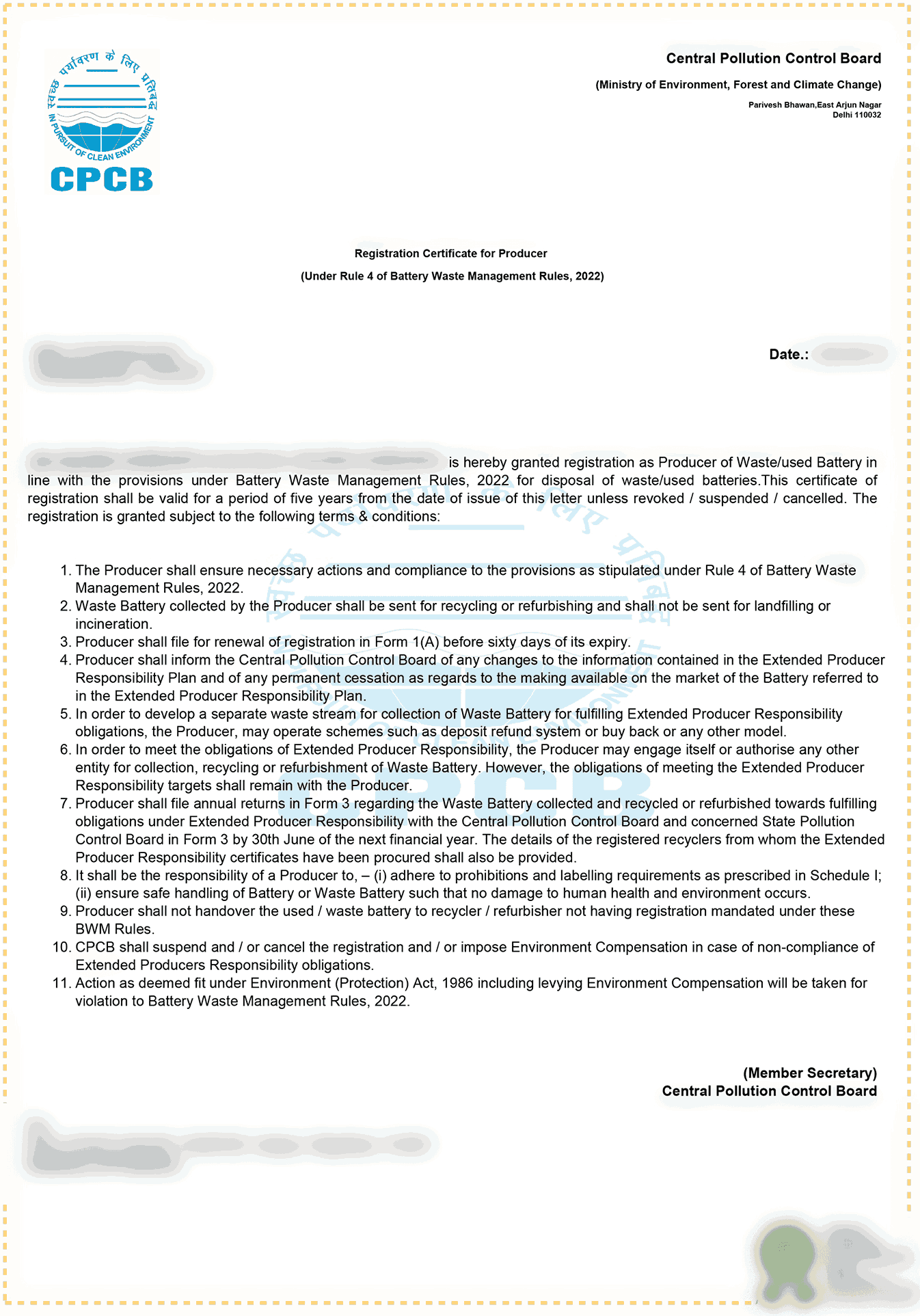
EPR Registration Certificate [Sample]
Process of EPR Registration for Used Oil
To obtain EPR registration for used oil, applicants must follow a structured process set by the Central Pollution Control Board (CPCB). Below is a step-by-step guide to help you complete the registration efficiently.
- Step 1: Assessment and Documentation - Submit all required information and documents for your EPR registration. Our experts will review the details to ensure accuracy before proceeding.
- Step 2: Filing of EPR Registration Form - Once the verification is complete, an online EPR registration application for used oil will be filed with the CPCB authorities on your behalf.
- Step 3: CPCB Assessment of Application - The Central Pollution Control Board (CPCB) will evaluate the submitted application. If any discrepancies are found, necessary corrections will be made promptly.
- Step 4: Issuance of EPR Authorization - After successful verification, the CPCB issues the EPR authorization certificate within 30 days. Producers must then implement their EPR action plan to meet annual targets.

Documents Required for EPR Registration for Used Oil
These are the following documents required to be attached by the applicants to obtain EPR certification for used oils.
- Address proof of the person
- Business registration certificate as applicable
- PAN and GST in Details
- Import Export Code Certificate
- Details of Manufacturing in case of manufacturers/producer
- EPR Action Plan to fulfill the EPR target
- Details of Annual returns
- Details regarding the generation of used oil
- Import details of used oil (for importers)
Other important documents may be required depending upon the nature and capacity of business for epr certification for used oils.
Fee for EPR Registration for Used Oil
We offer comprehensive support for Extended Producer Responsibility (EPR) registration related to used waste oil.
Our professional fee starts from ₹9,999/-.
In addition to our service fee, applicants are required to pay the government registration fee, which varies based on the annual sale volume of base or lubrication oil:
| S. No. | Sale of Base Oil/Lubrication Oil (MTPA) | Government Registration Fee |
|---|---|---|
| 1 | > 1,00,000 MT | ₹10,00,000 |
| 2 | > 50,000 - 1,00,000 MT | ₹5,00,000 |
| 3 | > 10,000 - 50,000 MT | ₹2,00,000 |
| 4 | 5,000 - 10,000 MT | ₹50,000 |
| 5 | < 5,000 MT | ₹25,000 |
Note: The government fee varies depending on the quantity of oil handled. License validity ranges from 1 to 5 years. EPR targets must be fulfilled during this period to avoid penalties or cancellation.
What is EPR For Used Oil?
EPR Registration for Used Oil is a permit issued by the Central Pollution Control Board (CPCB) as part of India’s Extended Producer Responsibility (EPR) framework. This registration is compulsory for producers, importers, and recyclers who are engaged in the generation or management of used lubricating oil. It guarantees that companies are accountable for the collection, transportation, recycling, and environmentally sound disposal of used oil produced from their products. The objective is to mitigate pollution, encourage sustainable recycling methods, and ensure adherence to the Hazardous and Other Wastes (Management and Transboundary Movement) Rules, 2016. Acquiring an EPR certificate also demonstrates a company’s dedication to responsible waste management and environmental conservation.
Who Required EPR Registration for Used Oil or Waste Oil?
Any Entity that indulges in manufacturing, Producing or importing used oil or industrial waste oil are eligible to get EPR Registration for used oils. The objective of implementing EPR for used oil is not just to manage the production of hazardous substances but also to promote economically sustained environmentally friendly industry.
Entities that are required to take EPR for used oil
- Producer
- Importers
- Recyclers
- Manufacturer
Benefits of EPR Registration for Used Oils
The benefits of obtaining EPR Registration for used oils are as follows:
- Promoting Sustainable Waste Management : EPR registration for used oils plays a crucial role in promoting sustainable waste management. Producers are motivated to design products with minimal environmental impact and ensure efficient disposal or recycling of used oils.
- Economic Advantages : EPR registration stimulates economic growth by fostering recycling industries and generating employment opportunities. It reduces the burden on public resources for waste management and redirects financial investments toward sustainable practices.
- Environmental Benefits : By encouraging responsible handling and recycling of used oils, EPR significantly minimizes environmental pollution. It contributes to cleaner air, water, and soil, supporting the overall health of ecosystems.
- Regulatory Compliance and Legal Protection : EPR registration ensures compliance with waste management regulations, shielding companies from potential legal issues. It provides a structured framework for fulfilling environmental obligations.
- Fostering Circular Economy : EPR drives the concept of a circular economy by encouraging the reuse, recycle, and refurbishment of used oils. It aligns with the sustainable development goals, creating a cyclical system that reduces waste.
- Improved Brand Image : Companies with EPR registration exhibit environmental responsibility, enhancing their brand image. Consumers are inclined to support businesses that actively contribute to sustainable practices.
EPR Target for Used Oil Importers Under EPR Regime
The EPR target for importers and producers of used oil or waste oil is assigned during the registration process. The producers and importers are required to meet their EPR obligations of waste oil in a given period of time as per the preassigned target for recycling of waste oil.
The EPR target for used oil is as follows for producer and importers
| Year | EPR Target Limit Annually for used oil |
|---|---|
| 2024-2025 | 10% of 2022-23 |
| 2025-2026 | 20% of 2023-24 |
| 2026-2027 | 30% of 2024-25 |
| 2027-2028 | 40% of 2025-26 |
| 2028-2029 | 50% of 2026-27 |
| 2029-2030 | 60% of 2027-28 |
Note: Importers who directly purchase used oil are required to fulfill 100% of their EPR obligations for the previous year's import respectively.
Renewal of online EPR Registration
Here’s what manufacturers need to know about renewing their EPR registration online:
- Manufacturers must submit a renewal application with all required documentation 60 days before the registration expires.
- Producers must file their annual returns by June 30th of the year following the registration period. Applications for renewal will not be processed until all required annual reports have been filed.
- The Central Pollution Control Board (CPCB) will grant producers EPR Registration and renew it for an extended period within 15 working days.
Responsibility for Producers under EPR Regime
Under the EPR regime, registered producers are required to follow specific guidelines and compliance measures set by the CPCB to ensure responsible waste management.
- Producers are not permitted to conduct any business without first registering for EPR through an online centralized portal developed by CPCB.
- Producers are not allowed to do business with any entity that is not registered through an online centralized portal developed by CPCB to meet Extended Producer Responsibility (EPR) targets.
- Producers are obligated to meet their Extended Producer Responsibility (EPR) targets and must provide a completion certificate from waste processor units authorized by the Central Pollution Control Board (CPCB).
Non Compliance Penalty with EPR
- EPR Registration granted to Producers/Manufacturer is liable to be canceled at any point if the document submitted by the applicant is found to be incorrect.
- If a company fails to meet its Extended Producer Responsibility (EPR) obligations, the Central Pollution Control Board (CPCB) may suspend or cancel their EPR registration or impose an environmental fine.
- The applicant will be given a chance to be heard before the CPCB considers canceling or suspending their EPR registration, within 15 days of the notice being issued.
Key EPR Compliance Rules
- Renewal can be applied 60 days prior to the due date of EPR renewal.
- It takes up to 30 days to complete the registration process with CPCB/SPCB for EPR.
- Producers are required to fulfill their EPR targets as per their certification on time to avoid penalties and cancellation.
- Cancellation of EPR authorization is subject to CPCB or SPCB respectively if any discrepancy is found.
Conclusion
The EPR for used oil is a legal compliance for all the businesses who are responsible for generating industrial oil waste. Any organization failing to comply with the EPR rules of the central pollution control board shall be punished accordingly. The aim of EPR is to build an environmentally friendly circular economy in India. Therefore it is mandatory as well as important to manufacturers, importers and recyclers to obtain EPR certification for used oil waste for their products as per their eligibility.
FAQ’s On EPR Registration for Used Oil
What is EPR for used oil?
EPR is an acronym for Extended Producer Responsibility which holds producers liable for waste generated through its products. EPR is an obligatory certification required by all the manufacturer and importer and recyclers as described under EPR Rule by the central board of pollution control.
What is the cost of getting EPR for used oil?
Our professional consultation fees for EPR starts from 9,999 only. However, the government fee for EPR varies depending upon the quantum of waste generated by the applicant or firm.
What is the Validity of EPR Certificate for used oil?
EPR is valid for the block period of 1-5 years.
How much time does it take to get EPR authorization for used oil?
It takes up to 30 working days to acquire EPR certification from the respective EPR licensing authorities.
Speak Directly to our Expert Today

Reliable

Affordable

Assured
Testimonials
"Explore how Professional Utilities have helped businesses reach new heights as their trusted partner."





It was a great experience working withProfessional Utilities. They have provided the smoothly. It shows the amount of confidence they are having in their field of work.

Atish Singh


It was professional and friendly experience quick response and remarkable assistance. I loved PU service for section 8 company registration for our Vidyadhare Foundation.

Ravi Kumar
I needed a material safety data sheet for my product and they got it delivered in just 3 days. I am very happy with their professional and timely service. Trust me you can count on them.

Ananya Sharma
Great & helpful support by everyone. I got response & support whenever I called to your system. Heartly thanx for Great & Super Service. Have a Great & Bright future of team & your company.

Prashant Agawekar
Thank you so much Professional Utilities team for their wonderful help. I really appreciate your efforts in getting start business. Pvt Ltd company registration was smooth yet quick.
Abhishek Kumar
I applied for Drug licence and company registration and their follow-up for work and regular updates helped me a lot. They are happily available for any kind of business consultancy.

Vidushi Saini
Great experience went to get my ITR done, process was quite convenient and fast. Had a few queries, am happy about the fact those people explained me all things I wanted to know.

Taniya Garyali
Great services provided by Professional Utilities. They are best in this industry and the best part is their prices are so affordable. Kudos to you. Now you guys are my full-time consultant.

Aftab Alam
Trusted By