



Get Expert Consultation

PRC and CRAC - The Two Certificates That Control Government Payments
Two main documents, the PRC and the CRAC, determine when government procurement payments get processed. These are the typical certificates that all Indian public procurement platforms require, no matter where the purchase was made.
One of the main reasons for payment delays are that one of the parties holds up one of the documents - but usually suppliers don't find out until the payment does not go through.
PRC (Provisional Receipt Certificate) is a paper given by a government officer within 48 hours of the consignment being delivered. It acts as proof of receipt through providing the delivery date and quantity - it is not an approval. All remaining timelines - inspection, acceptance, and payment - start from the PRC date.
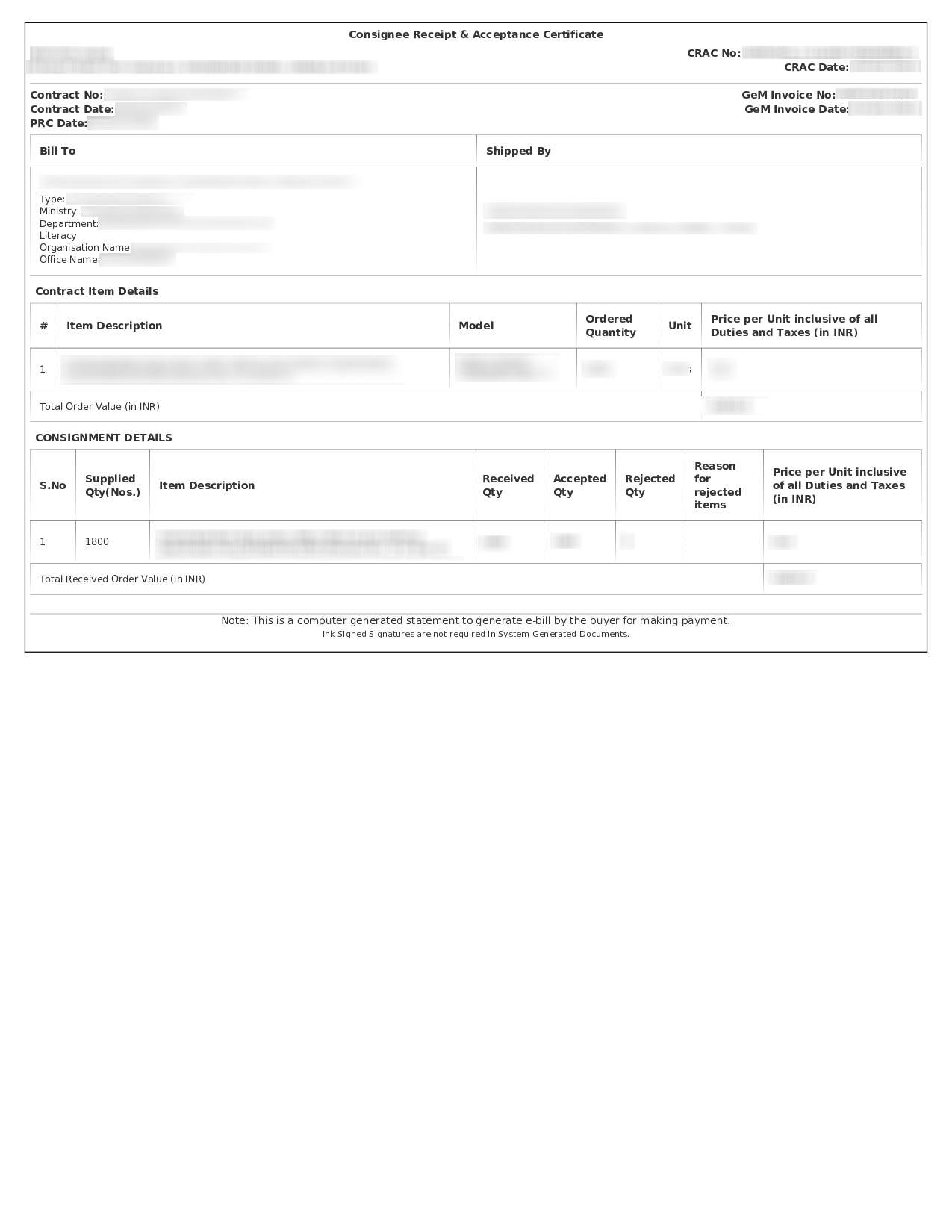
CRAC (Consignee's Receipt and Acceptance Certificate) is issued after the inspection and results in payment being processed. It details whether the items are accepted or rejected and in what numbers.
Knowing these two documents inside and out - their deadlines, the different people involved, ways goods can be rejected, and typical breakdowns in the process - leads to one being able to easily carry out a transaction and avoid payment disputes stretching out over time.
CRAC Certificate Sample
What is a PRC?
A PRC (Provisional Receipt Certificate) is the very first official paperwork. It is generated once goods or services have been supplied to a government customer. It is neither related to checking the quality nor a sign of acceptance. Instead, a recorded fact with a time stamp, the delivery has been made.
With GeM, this paper is issued through the portal itself, not through print and email. It bears a digital signature and a timestamp, which form the legal basis for every subsequent step

Who Generates the PRC?
The person receiving the goods is the one who created it. In government procurement, the consignee is the person responsible for the stores or the receiving officer appointed within the buyer’s organization. They access the GeM portal using their secondary-user credentials and cross-check the delivery with the purchase order and digitally generate the PRC - signed via OTP under the Information Technology (Amendment) Act, 2008.
There is no exchange of physical documents. No stamp or manual signature is necessary. The e-sign based on OTP makes it, in legal terms, the same as a physical document.
When Must the PRC Be Issued?
It has to be issued no later than 48 hours after delivery. This timeframe is a strict one as per GeM’s General Terms and Conditions. Any delay in issuing the PRC will disrupt the entire schedule downstream. Inspection will get delayed. CRAC will get delayed. Even the payment will get delayed. So, largely the seller has no influence over events once the goods have left the premises, which makes it very important for sellers to keep track and even remind the purchaser if the PRC confirmation has not been received within 48 hours of delivery.
What Does the PRC Contain?
The PRC mainly consists of three fundamental data:
- Quantity received,
- date of receipt, and
- a few reference details of the order
The buyer, Drawing and Distributing Officer (DDO), Pay and Accounts Officer (PAO), and the supplier can immediately access the PRC via one portal after it is created. It is a tight document, but its date and time are what act as the basis for the entire payment claim.
Why Does the PRC Date Matter?
As soon as the PRC is issued, the 10-day inspection period starts. After receiving the PRC, the consignee has 10 days to examine the items and produce a CRAC. The payment process cannot proceed until the CRAC is released. Besides, the CRAC cannot be released if the PRC is not ready yet.
Any missing PRC or PRC issued later than scheduled is not just a simple nuisance. It is rather a major source of holdup that leads to a delay in payment, delay in obtaining formal rights for follow-up, and delay in the capability of escalating any matter through the system.
What is CRAC?
A CRAC (Consignee’s Receipt and Acceptance Certificate) is the last document for delivery in government procurement. It is issued post-delivery. It follows the PRC, physical inspection, partial acceptance, or rejection.
The certificate is the immediate cause of payment. Without a CRAC, there will be no payment - not even a delayed payment, but absolutely no payment at all. It is the legal document of acceptance that the paying entity needs before disbursing funds.
Who Issues CRAC?
The consignee issues the CRAC, the same officer who delivered the PRC. At this point, the inspection must have been fully done. The performance of the goods in terms of quality, quantity, and specifications has been checked against the purchase order. Next, the consignee re-enters the GeM portal and digitally creates the CRAC, once more employing the OTP-based e-signing process.
When Must the CRAC Be Issued?
The CRAC should be issued not later than 10 days from the PRC date. This time limit has been stipulated by GeM’s General Terms and Conditions and is based on GRF Rule 149. This rule regulates all procurement through GeM. Similar to the PRC deadline, there is no leniency here. The consignee has to operate within this time frame.
What Does the CRAC Record?
It is very different from the PRC in that the CRAC contains a lot of information:
- Total quantity ordered
- Quantity accepted - the amount that can be paid
- Quantity rejected - with the specific, documented reasons like damage, shortages, or specification mismatch.
Every single field is a point of concern. The accepted quantity is the one that is the basis for the payment. The rejected quantity, with its documented reasons, is the basis for any dispute that may follow. Rejection entries that are vague or without documentation are not in compliance with GeM’s rules. This way, the reasons have to be specific and must be recorded on the portal at the time of CRAC generation.
What Happens When CRAC is Issued?
The GeM portal notifies the buyer, consignee, head of department (HOD), and the supplier automatically and simultaneously. The buyer processes the bill. The DDO sends the bill to the PAO. The system disburses 100% payment for accepted goods within 10 working days from the CRAC date applicable to both goods and services. In case of services, the system makes payment from a monthly cycle, reflecting the period of service certified by CRAC, subject to the condition that there is no contractual clause (CC) specifying a schedule in the contract.
Complete Payment Timeline - Order to Transfer on GeM Portal
Usually, delays occur when someone in the chain does not expect the next step. Here is the entire chain with all the steps in sequence and with the deadlines attached.
- Step 1: Order placed on GeM - The buyer initiates a contract on the portal. After the seller sends the goods, he/she issues an online invoice through GeM. Both the buyer and the DDO receive an automated email and SMS notifications after submission of the invoice.
- Step 2: PRC generated (within 48 hours of delivery) - The consignee is required to go online, endorse acceptance, and generate the PRC. It is the delivery date that is officially recorded. The 10-day quality check period also starts for the goods.
- Step 3: Inspection period (up to 10 days from PRC date) - The consignee carries out the physical inspection of the products, checking whether they are up to the mark for quality, quantity, features, etc. During this time, the consignee has the right to accept or reject the goods completely or partially. No money is transferred at this time.
- Step 4: CRAC issued (within 10 days of PRC) - The consignee registers the result online. The CRAC is completed and sent in. Everyone involved gets instant updates via the portal. The payment countdown starts from here.
- Step 5: Bill processing starts - The buyer manages the bill. In case government bodies are on PFMS, the DDO sends the bill to the PAO through the PFMS portal. PAO checks various linked documents - purchase order invoice, PRC, and CRAC - before deciding to continue.
- Step 6: Payment made (within 10 days of CRAC date) - PAO disburses full payment for goods that are accepted. On GeM, the transaction is treated as complete. When it is a service, the monthly bill is done within the same 10-day post-CRAC timeframe.
If all stakeholders do their work on time, the overall cycle, from delivery to payment, will not exceed 20 days. Though if there are delays at any one step, the cycle time gets longer. The most common problem area is the CRAC, which is directly connected to what happens when things go wrong.
Key Roles in the Payment Chain for PRC & CRAC
Government procurement is not just a two-party transaction. Several officials have different roles, and each one of them is bound by time. If one person delays, all others downstream will be waiting.
- Consignee - The consignee is the key character in the post-delivery process. They are the ones who physically hand over the goods, examine them, and produce both the PRC and the CRAC. Being designated by the Primary User on the GeM portal as a secondary user, their actions or failure to act will immediately influence the time when the payment will be made to the seller. Every portal action is accompanied by a timestamp that is visible.
- Buyer - Typically, the buyer places an order and then processes the bill once the CRAC has been guaranteed. The buyer must make certain that procurement is done according to the GFR 2017 rules and GeM’s terms. Buyers have access to all the documents, including the PRC CRAC invoice in real time.
- DDO (Drawing and Disbursing Officer) - If the method of payment in the government organization is through PFMS, then this role is relevant. The DDO account is not set up correctly, or if the bill is not communicated in time, even a valid CRAC cannot result in payment.
- PAO (Payment Authority Officer) - Actual payment is made by the PAO. They log in to PFMS, check all linked documents, and disburse money within 10 days of the CRAC date. With non-PFMS payment modes, the PAO works directly on the GeM portal.
- Primary User: Head of Department - HOD is the one who gets the organization registered on GeM and sets up all the secondary user accounts - buyer, consignee, and DDO. Direct transactions are not carried out at this level. Yet, the HOD is responsible for the lawfulness of all the roles under them. They lead the coordination committee in case of a dispute.
PRC vs CRAC - Complete Comparison
Both documents will be issued by the same department, on the same portal, and using the same digital signing method.
| Feature | PRC | CRAC |
|---|---|---|
| Full form | Provisional Receipt Certificate | Consignee’s Receipt and Acceptance Certificate |
| Stage | Immediately after delivery | After inspection |
| Purpose | Confirms goods arrived | Confirms acceptance or rejection |
| Deadline | Within 48 hours of delivery | Within 10 days of PRC |
| Covers rejection? | No | Yes, but with quantity and reasons |
| Visible to | Buyer, DDO, PAO, Suppliers | Buyers, DDO, PAO, HOD, Suppliers |
| Triggers payment? | No | Yes, 100% within 10 days |
| Legal standing | Delivery acknowledgement | Binding acceptance document |
| Digital signature | OTP-based | OTP-based |
Note: The PRC starts the process, the CRAC closes it. Everything in between is inspection, and everything after is payment.
The Rejection Window - Rights and Obligations on Both Sides
The inspection time is between the PRC and the CRAC. This is the time when the cosignee has the legal right to accept or reject the delivery. This right is a way in which government buyers are protected. Though it also brings obligations for sellers.
Full Rejection
In case the consignee rejects the entire lot, they note it in the CRAC with the reasons for rejection. The seller is responsible for picking up the rejected goods within 10 days. The buyer should not be made to pay for it. If the goods are left uncollected for a long time, the buyer has the right to get rid of them. In that case, the seller has to bear the disposal costs entirely.
Partial Rejection
It’s very normal to partially accept things. For example, if 100 units were sent and 15 were found to be damaged, the CRAC will show 85 as accepted and 15 as rejected. The buyer will release the payment for 85 units. Those 15 will be picked up in the same 10-day period.
No Payment on Rejected Goods
This is an unbreakable rule. It is part of GeM’s General Terms and Conditions and also supported by GFR rule 149. Rejection signifies no payment. Partial rejection means payment is made for only the accepted part. No exceptions are allowed.
What Counts as a Valid Rejection Reason?
A consignee has to come up with precise, verifiable grounds for rejecting an order. Some common examples of rejection could be:
- The order quantity is less than the purchase order
- Goods have been physically damaged during delivery
- Contracted specifications have not been met by the goods delivered
- Goods have not been delivered as per the agreed-upon quality standards
- Some components or accessories mentioned in the order are missing
Vague entries, “not satisfactory” without reasons, don’t meet GeM’s documentation. When the CRAC is generated, reasons should be specific and documented.
Disputing a Rejection
The dispute resolution procedure of GeM essentially involves the parties negotiating a settlement through a coordinating committee. This committee is composed of members from both parties and chaired by the primary user of the buyer’s organisation. If the matter is still not resolved, it proceeds to arbitration under the Arbitration and Conciliation Act, 1996. GeM SPV is not involved as a party to the dispute. The site of arbitration is based on the primary buyer’s location.
Why Payment Delays Happen & How They’re Avoided
Most GeM payment delays have little to do with the functionality of the portal itself. It is more of a result of a failure to act on someone’s part within the given timeframe. What follows are the main areas where mistakes occur most frequently.
- PRC not released within 48 hours - Everything else you do, including inspection and raising the CRAC, becomes really tight even before you know there’s a problem. If the seller should reach out to the buyer right away.
- CRAC not issued within 10 days - This is, in fact, the largest single reason for the hang-up of payments on GeM. In certain portal settings, if no one does anything, a CRAC is issued automatically, but one shouldn’t bank on that. Contact with the HOD or buyer is the right move if the consignee is not responding.
- Invoice not match the purchase order - Even a small difference in quantity or price between the invoice and the purchase order on the website blocks the flow of the bill. Each invoice should be given a thorough check against the purchase order before being submitted on the portal.
- Rejection made without giving detailed reasons - Not providing detailed rejection reasons creates holes in documentation, which results in the initiation of disputes. Both parties waste their time as the record gets questioned and amended. Consignees must record exact, verifiable reasons simultaneously.
- Rejected goods not collected within 10 days - Storage fees will be charged from the 11th day onwards. If, after a certain period, the buyer still doesn't collect the goods, the seller may, at the buyer's cost, dispose of the goods. Rejection notices are mandatory actions.
Role-Specific Implications of PRC and CRAC in GeM
- For Consignees and Procurement Officers - Deadlines are not flexible. PRC deadline: 48 hours. CRAC deadline: 10 days. The consignee will become the bottleneck and delay the payment of the supplier's rightful dues. Inspection must be done without any delay. The reasons for the rejection must be well-documented and also very specific. Every single portal activity is timestamped and can be seen not only by all stakeholders but also by the audit authority.
- For DDO and PAO - Work should start as soon as a CRAC notification is received. All documents connected to each other, like purchase orders, invoices, PRC, and CRAC, should be checked to ensure their correctness before the invoice is sent for payment. The payment must be made to the seller within a 10-day timeframe from the date of the CRAC. Any delays beyond this point shall be treated as a violation of compliance as per the GFR rules.
Professional Utilities Related Services
Understanding certificates is just the beginning when you decide to sell on GeM. Registration, catalogue listing, bid participation, vendor assessment, and ongoing compliance all play parts simultaneously.
Businesses planning to sell on GeM should complete their GeM Registration to create a seller account and participate in government procurement opportunities.
Manufacturers can obtain GeM Vendor Assessment to improve buyer trust, strengthen credibility, and enhance bidding opportunities.
Authorised partners of OEM can apply for Deemed OEM on GeM to gain OEM benefits and improve visibility across government tenders.
Choose GeM Retainership for complete account management, bid support, and timely compliance assistance.
Indian manufacturers can obtain a Make in India Certificate to avail procurement preferences under government purchasing policies.
Improve product quality and business credibility with ZED Certification under the Zero Defect Zero Effect quality framework.
Contact Our GeM Advisory Team
The PRC and CRAC discussions are just a fraction of the overall selling success on GeM. The entire picture registration, cataloging, bidding, order management, and payment follow-up calls for regular focus and portal familiarity that most companies don't have within their staff.
Professional Utilities has spent more than 10 years assisting Indian businesses in understanding government compliance. Our GeM advisory team collaborates with sellers and buyers from all over the country, from first-time MSMEs to large manufacturers, and we've seen every type of delay, dispute, and documentation gap.
Our GeM portal retainership service keeps a check on PRC and CRAC deadlines on every particular order. This is to identify delays early. Even before an order exists, getting bids on GeM Portal correctly reduces the chances of rejections and disputes later on.
FAQ’s On PRC & CRAC
What is a PRC in government procurement?
A PRC (Provisional Receipt Certificate) serves as the receipt acknowledgement document that the consignee generates electronically within 48 hours upon receiving the goods/services. It documents the delivery date and quantity. This also confirms that the goods have been physically received, but not that the consignee has accepted them. The consignee accepts the goods through further inspection and formal approval via the CRAC.
What is a CRAC?
The Consignee's Receipt and Acceptance Certificate, or CRAC, is a document that inspectors issue after the inspection. It records if the goods are accepted or rejected, or partly accepted with quantities and reasons. This is the payment certificate.
Who issues PRC and CRAC?
Both the consignee, who is the receiving officer in the buyer's organization, and the consignor issue the documents. Both documents are created on the GeM portal through OTP-based digital signing. A physical signature is not needed.
When is the PRC deadline?
The issuer must issue the PRC no later than 48 hours after delivery. The date that the PRC states is what's used as the official receipt date - and the start of the 10-day inspection period is based on this date.
When is the CRAC deadline?
The CRAC has to be issued within 10 days of the PRC date. That is the inspection window - the consignee's time to check the delivery and officially record the result.
How soon is payment released after CRAC?
Full payment is made within 10 days of the CRAC date. If it's goods, it's a one-time payment. If it's services, monthly payments will be made using the CRAC-certified service period.
Is it possible to reject goods in part?
Absolutely. The CRAC distinguishes between accepted and rejected quantities very clearly. Payment is released only for the part that is accepted. Rejected goods have to be picked up by the seller within 10 days - at the buyer's expense.
Do PRC and CRAC also work in the case of service?
Surely. That is a service in the same way. The consignee will issue a PRC within 48 hours of receiving the service or submitting the invoice, and they will issue a CRAC within 10 days after the end of the service period.
Speak Directly to our Expert Today

Reliable

Affordable

Assured
Industries Served by
Professional Utilities

Apparels

Footwear

Furniture

Gems and Jewellery

Tourism & Hospitality

Consumer Electronics

Chemicals

Telecom

Oils & Gas

Hotel

Railways

Liquor

Health & Medical

Food Processing

Dangerous/ Haz. Goods

Tea & Coffee

Capital Goods

Recycling

Rubber

NGOs

Silk

Handloom

IT & BPM

Steel

Automobile

Tobacco

Constructions


Disclaimer:The information provided on this website is intended for general information purposes only. Although all reasonable efforts are made to ensure that the information provided is correct and reliable, it is not advised to be used as a substitute for professional advice. The information herein is not to be used in place of seeking professional services, counsel, or guidance. We highly advise that you consult a professional before you make any business or legal decisions regarding the information presented on this website. This website and its contents are given "as is", and we do not take any responsibility for any action that is taken based on information given on this website.

- Written by: Sailee Dey
- Fact-checked: Sahil Singh
- Updated on: June 26, 2026
Testimonials
"Explore how Professional Utilities have helped businesses reach new heights as their trusted partner."





It was a great experience working withProfessional Utilities. They have provided the smoothly. It shows the amount of confidence they are having in their field of work.

Atish Singh


It was professional and friendly experience quick response and remarkable assistance. I loved PU service for section 8 company registration for our Vidyadhare Foundation.

Ravi Kumar
I needed a material safety data sheet for my product and they got it delivered in just 3 days. I am very happy with their professional and timely service. Trust me you can count on them.

Ananya Sharma
Great & helpful support by everyone. I got response & support whenever I called to your system. Heartly thanx for Great & Super Service. Have a Great & Bright future of team & your company.

Prashant Agawekar
Thank you so much Professional Utilities team for their wonderful help. I really appreciate your efforts in getting start business. Pvt Ltd company registration was smooth yet quick.
Abhishek Kumar
I applied for Drug licence and company registration and their follow-up for work and regular updates helped me a lot. They are happily available for any kind of business consultancy.

Vidushi Saini
Great experience went to get my ITR done, process was quite convenient and fast. Had a few queries, am happy about the fact those people explained me all things I wanted to know.

Taniya Garyali
Great services provided by Professional Utilities. They are best in this industry and the best part is their prices are so affordable. Kudos to you. Now you guys are my full-time consultant.

Aftab Alam
Trusted By