Get All types of pumps for handling liquids

4.9


BIS Certification for All Types Of Pumps For Handling Liquids Liquid Elevators And Their Assemblies
Pumps are used in numerous industries to transport liquids, mixing of thickened materials as well as handling gases. Pumps are used in crop watering and soil wetting or in the provision of water to cities or in industrial applications; the issue of pump efficiency and dependability arises. These requirements in India are governed by the BIS through certain Quality Control orders (QCOs) that apply to these important devices. To implement the standards of pumps, including centrifugal, positive displacement, diaphragm, and gear, and their manufacturing, performance standards, and testing protocols; this knowledge is crucial for the involved manufacturers. Moreover, BIS certification is a way to meet national standards establish trust with consumers, and improve the marketability of the final product.
In this blog, you will learn about the practicalities of pumps for liquids: their assemblies, and parts as well as the basics of obtaining a BIS certification. The subsequent sections present the manufacturing processes, testing methods, labeling requirements for pumps, and the importance of BIS certification to help the manufacturers and related stakeholders in the Indian pump industry to understand the concept of BIS certification in detail.
BIS Registration Sample
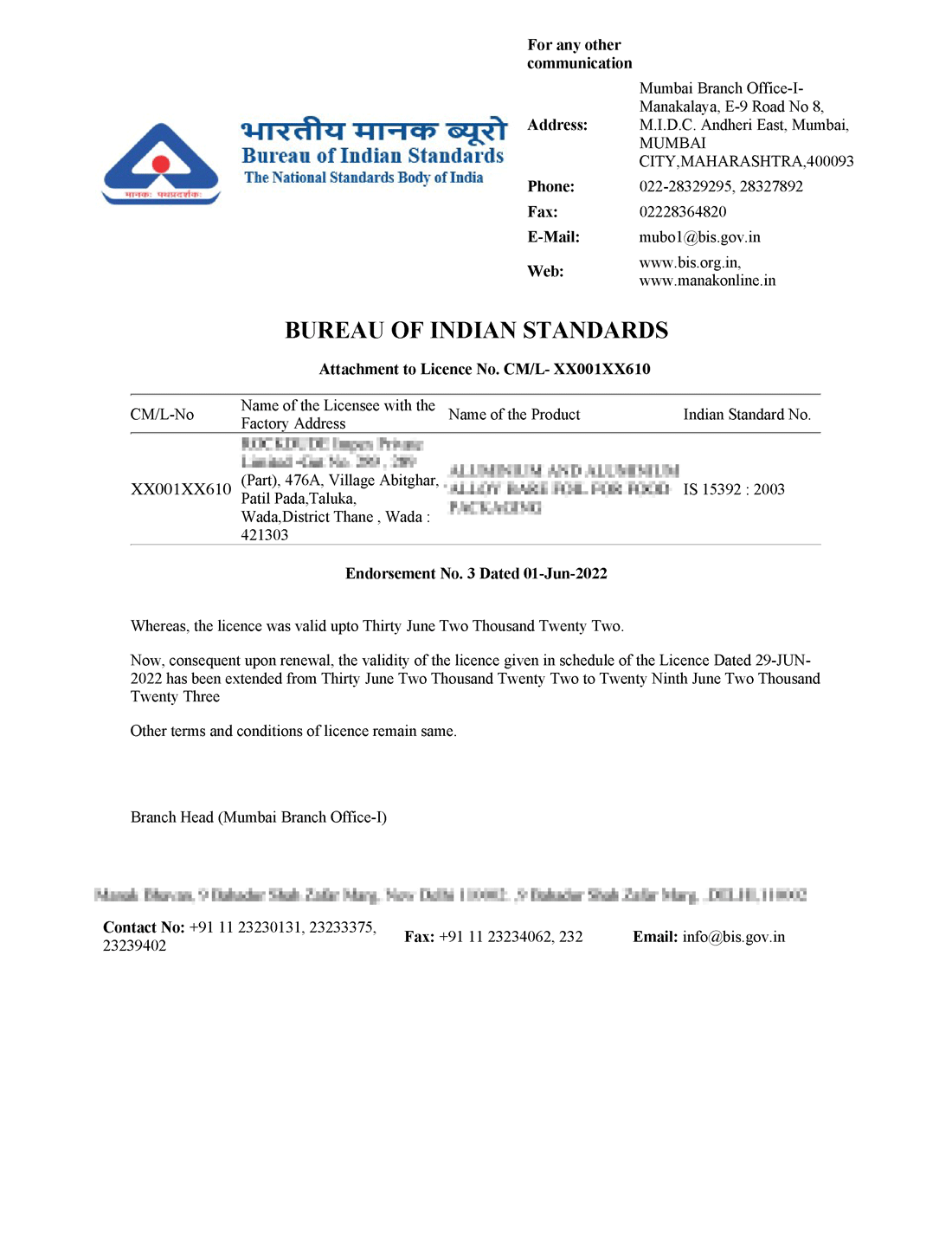
Table of Content
- What are the Pumps for handling liquids.
- Types of Pumps for handling liquids
- Documents Required for handling liquids BIS Certification
- BIS Certification Process of handling liquids
- Importance of handling liquids BIS Certification
- Manufacturing Process of Pumps for handling liquids
- Performance Requirement of Pumps for handling liquids
- Testing Methods of Pumps for handling liquids
- Laboratory Requirements of Pumps for handling liquids
- Labeling and Marking Requirement of Pumps for handling liquids
- Conclusion
- Frequently Asked Questions (FAQs)

What are the Pumps for handling liquids.?
Pumps are actuators whose function is to transport fluids or slurry materials from one place to another through the application of a pressure difference. They are used in agriculture, construction business, manufacturing industries, and business in municipal service among others. Pumps can be categorized depending on the manner in which they function as identified as positive displacement pumps and centrifugal pumps, both types have their inherent properties which qualify them for use in different applications.

Types of Pumps for handling liquids
The process of manufacturing low-voltage switchgear involves several imperative activities before the final products are developed that necessarily conform to the specifications prescribed by BIS. Key stages include:
- Centrifugal Pumps: Use kinetic energy as relates to rotation in order to transport fluids. Found in the systems used for water and sewage pipelines.
- Positive Displacement Pumps: Shut a certain volume in a chamber and eject it into the discharge pipe. Most suitable for high viscosity fluids, hence are recommended for these fluids.
- Diaphragm Pumps: A diaphragm should be used to either draw fluid into it with the use of suction or push the fluid out.
- Gear Pumps: Apply gears to affect the flow of the fluid by displacement; used occasionally in hydraulic applications.
- Peristaltic Pumps: Transfer fluids through a flexible and compressed tubular structure for the vulnerable liquids.
Documents Required for handling liquids BIS Certification
| General Documents | Technical Documents |
|---|---|
| Business License | Plant Layout |
| Trademark License | List of Manufacturing Equipment |
| Application Form | Manufacturing Process Flow Chart |
| Authorization Letter | Product Literature |
| Laboratory Test Reports | List of testing equipment and machinery |
| MSME Certificate | Product’s Technical Specification |
| List of Calibration Certificate |
BIS Certification Process of handling liquids
The BIS certification process for All types of Pumps for handling liquids, liquid elevators, and (or)their assemblies /sub-assemblies /components:
Step 1: Application Submission
Applications are filled including relevant documents that outline the production processes of the manufacturers.
Step 2: Factory Inspection
A BIS officer pays a visit to the manufacturing company in order to assess the levels of compliance with set regulations.
Step 3: Product Testing
The samples from the production batches are analyzed at the BIS-accredited laboratories.
Step 4: Issuance of License
As a result of the evaluation of these facilities and products, BIS grants permission to the manufacturers to use the ISI mark on their products.
Step 5: Surveillance Audits
To sustain the standards practice, normal assertions are carried out.
This is a process that the manufacturers need to understand so that they can get an efficient certification process.
Importance of handling liquids BIS Certification
BIS certification is crucial for several reasons:
- Market Access: It shall be marked with the ISI mark for it is compulsory for any manufacturer who wants their All types of Pumps for handling liquids, liquid elevators and (or) their assemblies/sub-assemblies/components to be sold in India. This means that without this certification, manufacturers cannot be able to sale their products to the market.
- Consumer Safety: Certification means that the products have to conform to given standards in order to prevent the consumer from using dangerous products.
- Quality Assurance: The BIS certification process helps ensure the quality standards of the products as it covers quality control aspects of the products.
- Regulatory Compliance: The BIS certification acts as an asset to manufacturers since it avails them of the legal standards that are accepted by the government hence saving them from legal troubles.
- Brand Credibility: An ISI mark adds value to the business by providing the consumers confidence that they are dealing with products that meet the nation’s quality standards.
- Environmental Considerations: The BIS in its regulations has put forward specific measures to restrict the use of some dangerous chemicals when producing products that have to do with environmental effects in the industry.
Manufacturing Process of Pumps for handling liquids
The manufacturing of pumps involves several critical steps:
- Material Selection: Selection of materials for the pump depending on the service condition - metals or plastics.
- Casting and Machining: Some parts, such as casings and impellers are frequently made through casting and then worked to their accurate measurement.
- Assembly: Pump units are constructed from their individual components thereby checking to ensure that all parts fit well to perform their intended functions.
- Quality Control: Every pump goes through various tests that serve to determine that its performance abilities are up to the required standards to meet the market.
Performance Requirement and Test Method
Pumps must meet specific performance requirements, which can vary based on their application:
- Flow Rate: A measure of the amount of liquid that the pump is able to transfer over a given period of time, normally expressed in liters per minute (L/min).
- Pressure Rating: The highest pressure that a pump is able to deliver before it fails.
- Efficiency: A measurement of how efficiently hydraulic power is used as a result of the pump by the rate of mechanical power input to the pump.
Testing Methods of Pumps for handling liquids
Testing methods for pumps include:
Hydrostatic Testing
This is a routine check to establish if the building is leaking or sagging due to force exerted by water pressure.
Performance Testing
Testing the device in the cells for determination of flow rate, head, and overall efficiency under standard conditions.
Vibration Analysis
Assessing vibrations as the equipment gets used in order to estimate when it may require maintenance.
Each test is conducted to standard operating conditions to check the reliability and safety of the equipment or system.
Laboratory Requirements of Pumps for handling liquids
To conduct testing on All types of Pumps for handling liquids, liquid elevators and (or)their assemblies /sub-assemblies /components effectively, laboratories must adhere to specific requirements:
- Dielectric Tests: For a qualification of the strength of the insulation.
- Temperature Rise Tests: To measure its heat output when operating at normal capacity in order to determine its effectiveness.
- Short-Circuit Tests: To learn about fault conditions in the device thereby getting to understand how the device handles such conditions.
- Mechanical Tests: To verify the endurance of some special mechanisms and the general reinforced frame structure.
Labeling and Marking Requirement of Pumps for handling liquids
Labeling and markings are fundamental requirements of BIS standards regarding specifications for low–voltage switchgear and control gear: Part 2 circuit - Breakers. Each product must include:
- Equipment: State-of-the-art testing equipment like tensile testing machines, spectrometers, and ultrasonic testing gadgets should be included.
- Qualified Personnel: Technicians have to understand and know additional testing techniques and protocols to conduct efficient tests.
- Quality Control Procedures: The applying organization should ensure quality assurance to enhance the reliability of the tested samples in laboratories.
Conclusion
To understand the different types of pumps and their manufacture, their performance demands, testing, and various needs of a laboratory, labeling or marking, documentation for obtaining BIS certification, as well as the certification itself, it is essential for manufacturers of pumps in India to familiarize themselves with. Observation of these regulations assures product quality and also promotes consumer confidence in the market.
Frequently Asked Questions (FAQs)
How to get BIS certificate?
To get a BIS certificate, first identify the correct certification scheme (ISI, CRS, or FMCS) based on your product. Get the product tested in a BIS-approved lab as per the relevant Indian Standard. Then, apply online through the BIS portal with all required documents, including test reports and manufacturing details. For certain schemes, a factory inspection will be conducted. If all requirements are met, BIS issues the certificate, allowing the use of the standard mark. Ongoing compliance through audits and testing is required to maintain the certification.
Can you claim Input Tax Credit (ITC) of GST paid on replacing an existing lift or elevator?
As per GST law, you cannot claim Input Tax Credit (ITC) on the replacement of an existing lift or elevator , since it is considered an immovable property under Section 17(5) of the CGST Act. ITC is only allowed if the lift installation is part of original construction used for business purposes and not for renovation or replacement.
How long does it take for the BIS certification process?
The duration may take as short as one week and as long as several months depending on the status of documentation and testing schedules.
What are the consequences that manufacturers may face if they fail to adhere to the BIS regulations?
While the products are very different, both pumps and canvas shoes with rubber soles require BIS certification to ensure compliance with Indian safety and quality standards. To learn more about footwear certification, visit Get Canvas Shoes Rubber Sole.
Speak Directly to our Expert Today

Reliable

Affordable

Assured
Testimonials
"Explore how Professional Utilities have helped businesses reach new heights as their trusted partner."





It was a great experience working withProfessional Utilities. They have provided the smoothly. It shows the amount of confidence they are having in their field of work.

Atish Singh


It was professional and friendly experience quick response and remarkable assistance. I loved PU service for section 8 company registration for our Vidyadhare Foundation.

Ravi Kumar
I needed a material safety data sheet for my product and they got it delivered in just 3 days. I am very happy with their professional and timely service. Trust me you can count on them.

Ananya Sharma
Great & helpful support by everyone. I got response & support whenever I called to your system. Heartly thanx for Great & Super Service. Have a Great & Bright future of team & your company.

Prashant Agawekar
Thank you so much Professional Utilities team for their wonderful help. I really appreciate your efforts in getting start business. Pvt Ltd company registration was smooth yet quick.
Abhishek Kumar
I applied for Drug licence and company registration and their follow-up for work and regular updates helped me a lot. They are happily available for any kind of business consultancy.

Vidushi Saini
Great experience went to get my ITR done, process was quite convenient and fast. Had a few queries, am happy about the fact those people explained me all things I wanted to know.

Taniya Garyali
Great services provided by Professional Utilities. They are best in this industry and the best part is their prices are so affordable. Kudos to you. Now you guys are my full-time consultant.

Aftab Alam
Trusted By