Automobile Waste Scrap License in India
Automobile Waste Scrap License in India starts from @ ₹99,000

4.9


Automobile Waste Scrap License in India - Process & Fees
The car industry is a very big part of India, and as more cars are being made, there is more waste from cars that people don't use anymore. This waste has old car parts, batteries, oils, and other things that can be bad for the environment and people's health if they are not taken care of properly. To fix this problem, the government in India has made rules that say companies that want to recycle or get rid of this car waste need to have a special permission called a scrap license.
Getting a license to recycle car parts makes your business legal and lets you take advantage of government benefits, like lower road taxes and cheaper new car prices. This program is important for encouraging eco-friendly habits and cutting down on the pollution from old cars in India.
Application process for obtaining an Automobile waste scrap license in India
This is the application process for obtaining a biomedical waste management scrap recycling license in India.
- Application Submission: Form-1: The applicant has to complete an application form appropriately called Form-1 and hand it over to the Registration Authority of the particular state government or union territory.
- Application Submission Note: Processing Fee: It is required that an application be accompanied by a non-refundable processing fee.
- Documentation Requirements: Applicants are required to submit various documents, including Applicants are required to submit various documents.
- Single-Window Clearance Portal: It has set up a single window clearance mechanism for the submission of applications and renewals for FDI. This has been made easier by this portal, whereby the applicant can follow the status of his or her application.
- Verification and Approval: After submission of the application and documents, the authorities shall peruse through all the documents submitted, conduct physical inspections as and when necessary, and ensure that all laws have been complied with.
- License Validity and Renewal: The RVSF license is initially issued for a period of ten years and may be renewed for further terms of ten years, subject to compliance with the current legal requirements.

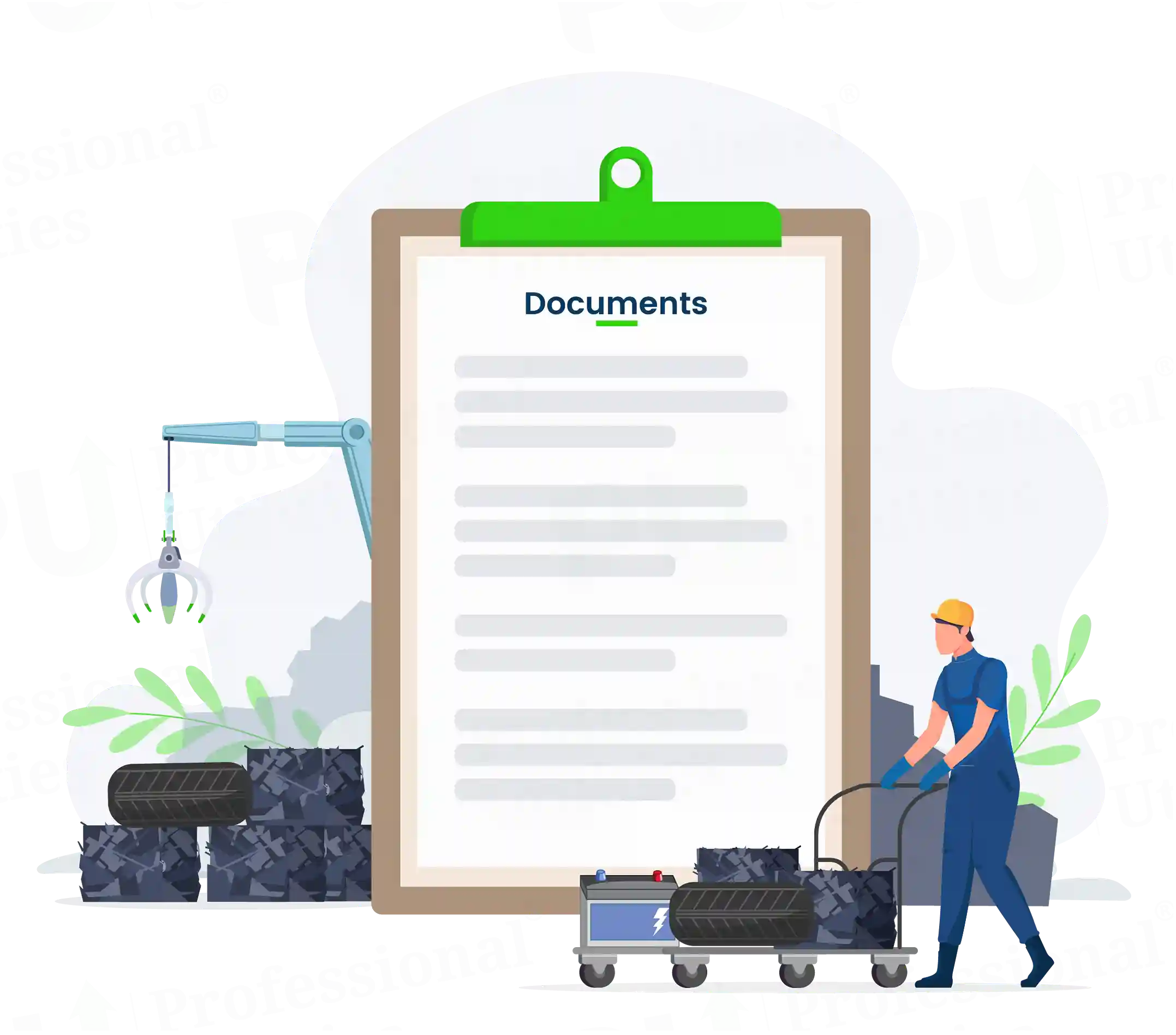
Documents are required for the Automobile waste scrap license in India
To obtain an Automobile waste scrap license in India, several key documents are required to ensure compliance with regulatory standards.
- Importer-exporter code (IEC)
- Goods and service tax (GST) registration
- Registration with custom
- Environmental Clearance Certificate
- Pre-shipment certificate
- Commercial invoice
- Packing list
- Bill of Lading or Airway Bill
- Certificate of Origin
- Insurance Certificate
- Letter of Credit or Advance Payment Receipt
- Bureau of Indian Standards (BIS) Certification
- Customs Declaration Form
- Import license (if required)
Fees for an Automobile waste scrap license in India
The fees for obtaining an Automobile Waste scrap license in India depend on various factors such as the type of scrap, scale of operations, and the issuing authority.
| Particulars | Government Fees (INR) |
|---|---|
| Application Fees | ₹10,000 to ₹50,000 |
| License Fee | ₹1,00,000 to ₹5,00,000 |
| Annual Renewal Fees | ₹50,000 to ₹2,00,000 |
| Environmental Compliance Fees | ₹50,000 to ₹2,00,000 |
| Security Deposit | ₹1,00,000 to ₹1,000,000 |
| Inspection Fees | ₹20,000 to ₹50,000 |
| Consent Fees from Pollution Control Boards | ₹1,00,000 to ₹5,00,000 |
| Training and Certification Fees | ₹10,000 to ₹50,000 |
| Local Body NOC Fees | ₹10,000 to ₹50,000 |
Professional fee for a Scrap license starts from ₹ 99,000.
Note: The aforementioned Fees are exclusive of GST.
What is an Automobile waste scrap license in India?
The license for scrapping old cars in India is a key set of rules designed to handle the recycling and disposal of vehicles that have reached the end of their useful lives. This program is a part of the government's larger plan to update the country's vehicles, cut down on pollution, and encourage eco-friendly methods in the car industry.
The AVSF needs to make sure that they properly take apart and recycle things, including safely getting rid of dangerous stuff like oils and batteries. They also need to keep track of everything they do and have the right machines to work efficiently.
Getting a license to recycle car parts makes your business legal and lets you take advantage of government benefits, like lower road taxes and cheaper new car prices. This program is important for encouraging eco-friendly habits and cutting down on the pollution from old cars in India.
Types of Automobile waste scrap licenses in India
Car waste involves various materials, each needing particular methods for handling and recycling.
- Old cars (ELVs): Cars that are no longer useful because they are old, worn out, or damaged. These cars are taken apart to save parts and materials that can be used again.
- Metal Pieces: Both iron and steel (ferrous) and aluminum and copper (non-ferrous) metals are taken from car bodies, engines, and other parts.
- Plastic Parts: Bumpers, dashboards, and other plastic pieces are either recycled or thrown away based on their condition and type.
- Glass Pieces: Car windshields and windows, can be turned into new glass items.
- Car Batteries: Lead-acid batteries from cars have dangerous materials and must be recycled at special places to get lead and other materials.
- Car Tires: Old tires are either fixed up, turned into rubber items, or used in ways to get energy.
- Oils and Liquids: Engine oil, brake fluid, and coolant are dangerous wastes that must
Conclusion
The process of scrapping a car involves taking it and your application to a licensed scrapyard. There, they check your identity, give you a certificate, and pay you. The scrapyard must then remove all fluids, take apart the car, and safely get rid of any dangerous materials.
FAQ’s On Automobile Waste Scrap License in India
What is the goal of the Automobile waste scrap license in India?
The Automobile waste scrap license in India is designed to control how end-of-life vehicles are collected, stored, moved, taken apart, and recycled. It makes sure that everyone involved in dealing with this kind of waste follows the rules set by the Vehicle Scrapping Policy and does so in a way that protects the environment.
Who has to get this license?
Anyone who owns and runs a facility for taking apart and scrapping vehicles, known as an Authorized Vehicle Scrapping Facility (AVSF), needs to get permission from the government body in their state or union territory.
What do I need to do to get the license?
To get the license, you need to fill out an application (Form-1) and pay a non-refundable fee. You also need to provide some documents, like your company's certificate of incorporation, your GST registration, and proof that you follow the rules set by the CPCB, and develop a plan for your facility. Additionally, you must get permission from the SPCB or PCC to run your facility.
What are the benefits of getting a permit for recycling car scraps?
Getting a permit makes the business legal and lets owners take advantage of government benefits such as reduced road taxes and lower prices for new cars. It also encourages eco-friendly methods and decreases the harm old cars cause to the environment.
Speak Directly to our Expert Today

Reliable

Affordable

Assured
Scrape License in Other Sector
Scrape License in Other States
Testimonials
"Explore how Professional Utilities have helped businesses reach new heights as their trusted partner."






It was a great experience working withProfessional Utilities. They have provided the smoothly. It shows the amount of confidence they are having in their field of work.

Atish Singh


It was professional and friendly experience quick response and remarkable assistance. I loved PU service for section 8 company registration for our Vidyadhare Foundation.

Ravi Kumar
I needed a material safety data sheet for my product and they got it delivered in just 3 days. I am very happy with their professional and timely service. Trust me you can count on them.

Ananya Sharma
Great & helpful support by everyone. I got response & support whenever I called to your system. Heartly thanx for Great & Super Service. Have a Great & Bright future of team & your company.

Prashant Agawekar
Thank you so much Professional Utilities team for their wonderful help. I really appreciate your efforts in getting start business. Pvt Ltd company registration was smooth yet quick.
Abhishek Kumar
I applied for Drug licence and company registration and their follow-up for work and regular updates helped me a lot. They are happily available for any kind of business consultancy.

Vidushi Saini
Great experience went to get my ITR done, process was quite convenient and fast. Had a few queries, am happy about the fact those people explained me all things I wanted to know.

Taniya Garyali
Great services provided by Professional Utilities. They are best in this industry and the best part is their prices are so affordable. Kudos to you. Now you guys are my full-time consultant.

Aftab Alam
Trusted By