IEC Registration for Onion Seed License

4.9


IEC Code Registration Certificate for Onion Seed License
India stands high in terms of onion production and occupies a significant place in India’s agricultural economy since it is produced and exported in massive quantities making onion a vital crop in the Indian agricultural sector. Using a varied and high quality onion seed works as an important factor which highly determines the quality of crop that can surpass both domestic as well as international standards making it a fit for a much demanded and valuable export commodity and give fierce competition. Due to the onion seed’s noteworthy demand and reputation in the international marketplace, the onion seed licensing mechanism in India is now into action, which is a crucial regulatory policy of India that controls exports and imports of onion seeds. An IEC license is essential under this framework, ensuring that only good quality seeds are in circulation—thereby protecting the farmers’ interest and at the same time promoting the production of quality onions. As for the case of the onion seeds, the government retains the control in its compliance to the international standards and the local laws as well.
Through stringent onion seed licensing procedures, the onion seed licensing mechanism ensures that seeds always meet a certain standard before being exported. This strict procedure involves various methods of inspection and quality control checks in order to keep the bidding value of the seed inflated to a certain point.
Therefore, the onion seed license mechanism in India is easily one of the important outlets in the overall agricultural structure of the nation. This, along with IEC Code Registration, will help promote the production of good and quality seeds to the farmers and at the same time promote the nation's competitiveness on world trade. The formal influence that the government exercises in the process of licensing, often followed by consistent certification exercises, makes it possible for onion seeds to meet both the international and local standards, hence enabling the production of enhanced quality onions.
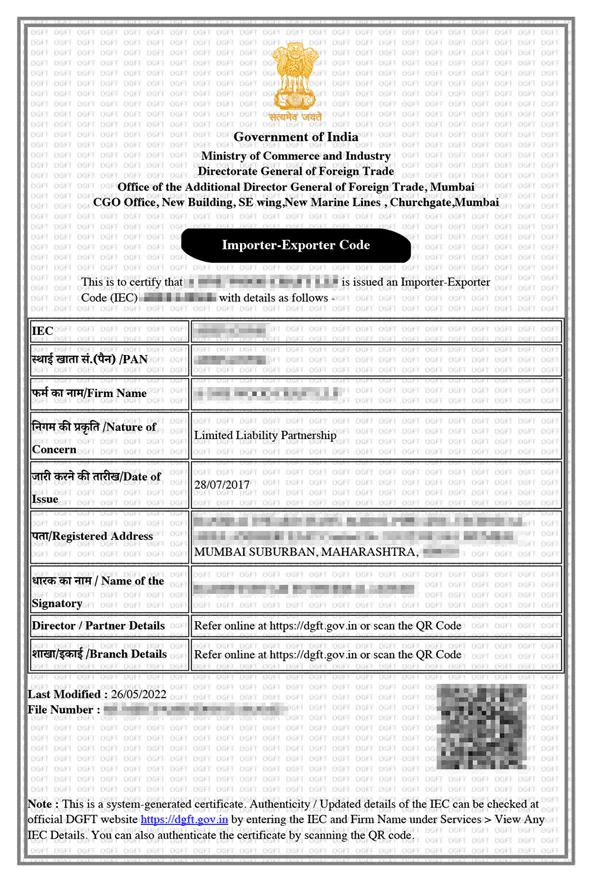
IEC Certificate [Sample]
Process Of IEC for Onion Seed License
To obtain an IEC for an onion seed license, applicants must follow a defined registration process that ensures compliance with import-export regulations.
- Applying for Onion Seed License Registration: Fill out the application form available on the relevant official website.
- Visit the SeedEXIM Website: Create an account and follow the prescribed rules for exporter or importer registration.
-
Eligibility Criteria:
Ensure that the seed source meets the required quality standards.
Verify the seed type and any additives used to enhance crop growth. - Field Inspection: Conduct an inspection to examine the seed type and the chemicals used to improve seed yield.
Note: The procedure may vary depending on the specific Indian state or region. Please seek professional guidance for accurate details.

Documents Required for Onion Seed IEC License
The following are the documents required for iec code for onion seed license:
- Application Form: Form required to apply for onion seed license.
- Identity Proof: A valid government ID proof such as Aadhaar Card, Voter ID, Passport, Driving License, etc.
- Address Proof: Recent electricity bill, Rent Agreement.
- Land Ownership Documents: Land agreement if you plan to cultivate your own crops.
- Seed Source Details: A document mentioning the address, class and other specifications of the seeds.


Import Export Code Registration Fees for Onion Seed License
The fee is Re.1 of every 1000 of export/ estimated export value. Professional charge for the same is Rs.10,000.
| Onion Seed License Fees | |
|---|---|
| Government Fee | Rs.1 of every 1000 of export/ estimate export value |
| Professional Fee | Rs. 10,000 |
Note: The aforementioned Fees is exclusive of GST.
Validity for the onion seed license is 9 months. The license then needs to be renewed.
What is IEC Registration for Onion Seed License?
A license refers to an official permission granted by a relevant authority which certifies that the person performing a certain action is a trained individual (or entity) and provides a permit to perform that specific action seamlessly. Similarly, an Onion seed license refers to a written permit granted by the Indian government which gives an individual or a business legal grants to store, sell and export onion seeds seamlessly. This official document grants the license holder the right to participate in an onion seed trade within the country or for export.
Benefits Of IEC for Onion Seed License
There are numerous advantages of having an onion seed license, some of which are mentioned below:
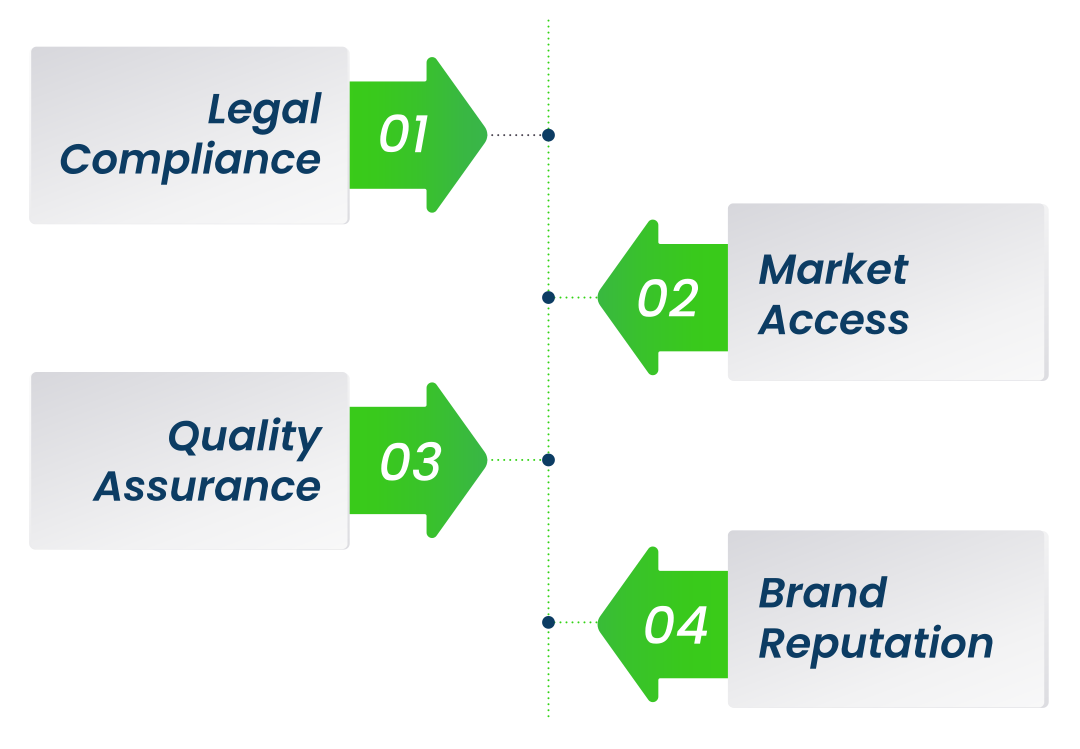
- Legal Compliance: Commits to the country and international laws to avoid affiliation with the legal consequences while creating a trustworthy business climate.
- Market Access: Facilitates market access within the domestic market and the export market, thus increasing the customer base and, therefore, sales.
- Quality Assurance: Certification usually involves assessment of quality and this has the effect of putting the customer’s mind at ease by guaranteeing that the seeds are of desirable quality.
- Brand Reputation: Having a license is considered as meeting the standards of the industry and as a result, the business gets the benefit of increased clientele and more business entity collaborations.
Conclusion
It is important to note that this license is imperative for trading and exporting onion seeds in the country. By virtue of being amongst the highly controlled crops, onions need social controls so that only quality seeds are circulating in the market. The fact that one needs an onion seed license underlines the issue of regulation as a means to preserve the seed quality and the rights of agriculture.
The indicated onion seed license framework is a crucial component of the generation and improvement of the crop seed export - import sector, which has various contributing factors to growth. This industry is not only one of the potential and lucrative spheres for the country itself, but also the guarantee of the high and strict requirements to the quality which is indispensable for the company acting in the world market. In that respect, the onion seed license entails that both exported and imported seeds must be of high quality to act as a guarantee to the farmer and consumer of quality onions seeds produced and sold in the market.
FAQ’s On Import Export Code Registration
Why is IEC Registration important for obtaining an Onion Seed
License, and how does the online IEC registration process work?
IEC Registration is mandatory for anyone importing or exporting onion seeds, as it authorizes the business to engage in cross-border trade. Without a valid IEC, an Onion Seed License application cannot be processed. The online IEC registration process is simple and involves submitting KYC documents, address proof, and business details through the DGFT portal. To understand the complete digital procedure, refer to IEC registration online process.
How to get a seed license?
Confirm the source of seeds before applying for a seed license and make arrangements for a storage space for your seeds first. Register in an e-licensing portal with the required details like email id, phone number, aadhaar number, etc finally, pay the mentioned fee on the portal through given methods.
How to register a seed company?
Confirm the source of seeds before applying for a seed license and make arrangements for a storage space for your seeds first. Register in an e-licensing portal with the required details like email id, phone number, aadhaar number, etc. Finally, pay the mentioned fee on the portal through given methods. You can download the license within 45 days of your payment.
What documents are required for e-NAM registration?
There is no fee on e-NAM registration. Required documents for e-NAM registration are as follows:
Can I sell seeds online in India?
Any person who wishes to sell, export or import seeds at any place in India will be required to obtain a license for the same. Each state and union territory of India uses a different procedure to issue a seed license.


Testimonials
"Explore how Professional Utilities have helped businesses reach new heights as their trusted partner."





It was a great experience working withProfessional Utilities. They have provided the smoothly. It shows the amount of confidence they are having in their field of work.

Atish Singh


It was professional and friendly experience quick response and remarkable assistance. I loved PU service for section 8 company registration for our Vidyadhare Foundation.

Ravi Kumar
I needed a material safety data sheet for my product and they got it delivered in just 3 days. I am very happy with their professional and timely service. Trust me you can count on them.

Ananya Sharma
Great & helpful support by everyone. I got response & support whenever I called to your system. Heartly thanx for Great & Super Service. Have a Great & Bright future of team & your company.

Prashant Agawekar
Thank you so much Professional Utilities team for their wonderful help. I really appreciate your efforts in getting start business. Pvt Ltd company registration was smooth yet quick.
Abhishek Kumar
I applied for Drug licence and company registration and their follow-up for work and regular updates helped me a lot. They are happily available for any kind of business consultancy.

Vidushi Saini
Great experience went to get my ITR done, process was quite convenient and fast. Had a few queries, am happy about the fact those people explained me all things I wanted to know.

Taniya Garyali
Great services provided by Professional Utilities. They are best in this industry and the best part is their prices are so affordable. Kudos to you. Now you guys are my full-time consultant.

Aftab Alam
Trusted By