BIS Certification for All Types of Switch Gear and Control Gear and their Assemblies

4.9


All Types of Machine Tools for BIS Certification in India
Of great importance in construction, manufacturing, and art industries today, there are a variety of machine tools dealing with stone, ceramics, concrete, Asbestos cement, and mineral glass industries. These specialized tools help in the improvement, cutting, and boring of harder materials so as to create a kind of precision in fabrication techniques. With industries developing and the need for better materials emerging, knowledge of the various classifications of machine tools is necessary for producers and artists.
BIS regulates conformity with quality policies in India and grants certification to guarantee that commodities meet the concerned quality, safety, and performance standards. Not only does this certification increase consumer confidence, but also gives opportunities for market entry. This blog will therefore discuss the range of machine tools that are applied to these materials, the processes of manufacturing the tool, the performance characteristics, the method of testing, and the importance of BIS certification. Through the development of these aspects, this paper seeks to give a general perspective and stress on the quality assurance of machine tools for processing stones and similar materials.
BIS Registration Sample
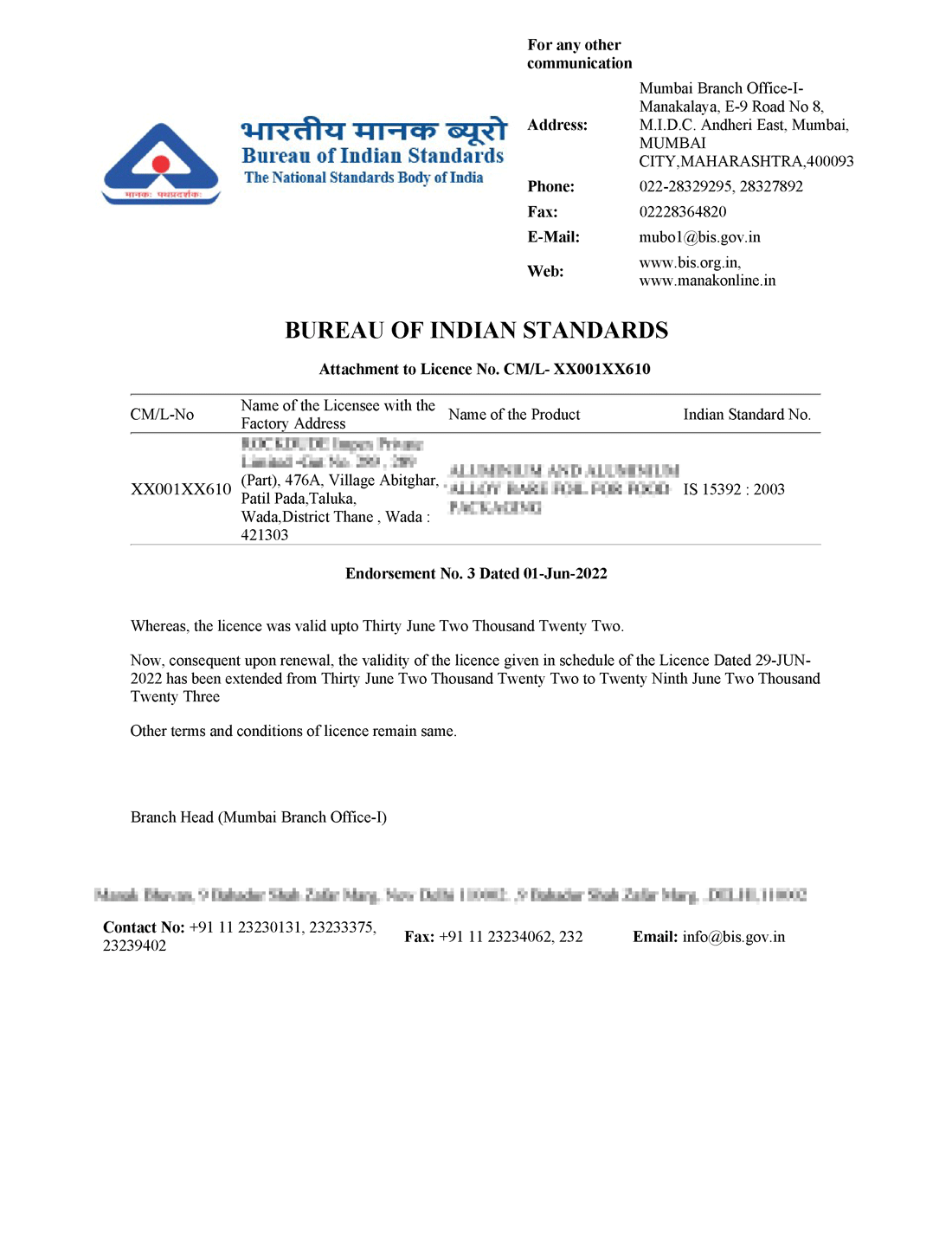
Table of Content
- What are All types of machine tools for working stone, ceramics, concrete, asbestos cement, or like mineral glass and (or)their assemblies /subassemblies /components?
- Manufacturing Process
- Performance Requirement and Test Method
- Testing Methods
- Laboratory Requirements
- Labeling and Marking Requirement
- Documents Required for BIS Certification
- BIS Certification Process
- Importance of BIS Certification
- Conclusion
- Frequently Asked Questions (FAQs)

All types of machine tools for working stone, ceramics, concrete, asbestos cement, or like mineral glass and (or)their assemblies /subassemblies /components?
Machines intended for stone, ceramics, concrete, asbestos cement, and mineral glass are the equipment used so as to form, cut, and polish the above-mentioned materials. These tools are necessary in the construction industry, industries involved in the manufacturing of goods, and particularly in art. The types of machine tools used for these materials can be categorized as follows:.
- Cutting Tools: These include specifically, saws such as diamond saws, wire saws, grinders, and routers used on hard surfaces.
- Drilling Machines:Commonly utilized in masonry operations to drill through the stone or concrete, it seems these machines make heavy use of the diamond-tipped drill.
- Milling Machines: These machines are equipment that is used in cutting stones, ceramics, and other solid minerals which the rotary cutters remove material from in order to arrive at the intended form and shape.
- Polishing Machines: Critically crucial in providing a uniform sheen to natural stone and ceramic tiles.
- CNC Machines:Computer Numerical Control machines that are used in slicing and moulding tasks for accurate work to be done.
These tools therefore not only increase efficiency but also yield good results that conform to industry production standards.

Manufacturing Process
The manufacturing process of machine tools for stone and similar materials involves several key steps:
- Material Selection:Raw materials including steels and other specialty alloy materials are selected based on their costs durability and application criteria.
- Design and Engineering:The machine tools are designed by engineers to meet certain functionalities and the efficiency is created via Computer Aided Design CAD.
- Machining: The components are produced with the help of the required number of machining operations such as turning, milling, and grinding to get the right size.
- Assembly: Sub-assemblies are forthcoming and integrated into finished machines which guarantees proper interconnection of all assemblies for efficiency.
- Quality Control:As with most products, each machine is tested and checked for safety and performance before it is marketed for use.
Performance Requirement and Test Method
Performance requirements for machine tools working with stone and similar materials include:
- Durability:A tool must be able to handle high stress within the working environment.
- Precision:Machines should possess fine tolerances for better and sharper cutting and finishing to be made on the surface.
- Efficiency: It is also important that tools should work at their maximum performance without getting hot or vibrating a lot.
Testing methods typically involve:
- Load Testing: Determining the load-carrying capability of the tool without failure in relation to given loads.
- Operational Testing: Powering the machine under standard operations so as to assess performance parameters including speed.
- Wear Testing:Assessing sample loss rate: how fast a tool degrades when utilized repeatedly.
Testing Methods
To ensure compliance with performance requirements, several testing methods are employed:
Destructive Testing:
This is done by taking the tool to its ultimate limit of failure to determine its exact performance threshold.
Non-destructive Testing (NDT):
For instance, ultrasound or magnetic particle inspection assists in the detection of cracks without actually causing harm to the tools.
Functional Testing:
To determine the best mode of operation of the tool its efficiency in the real world is tested.
Laboratory Requirements
To conduct testing on All types of machine tools for working stone, ceramics, concrete, asbestos cement, or like mineral glass and (or)their assemblies /subassemblies /components.. effectively, laboratories must adhere to specific requirements:
- Equipment:should have state-of-art testing equipment like tensile testing machines, and spectrometers, ultrasonic testing gadgets.
- Qualified Personnel:Technicians have to understand and know additional testing techniques and protocols to conduct efficient tests.
- Quality Control Procedures: The applying organization should ensure quality assurance to enhance the reliability of the tested samples in laboratories.
Labeling and Marking Requirements
Labeling and markings are fundamental requirements of BIS standards regarding specifications for All types of machine tools for working stone, ceramics, concrete, asbestos cement or like mineral glass and (or)their assemblies /subassemblies /components. Each product must include:
- Manufacturer's Name or Trademark: In a manner that tells the consumer who produced it with clarity, means everything is right.
- ISI Mark: The ISI mark has to be affixed prominently on the product in case the product has been certified to conform to Indian standards.
- Material Information: Material should be mentioned along the labels that the footwear is made from and any other information concerning the safe usage of the product.
- Packaging Requirements: It is also important to label the packaging with the product type and care instructions so that the customers can maintain the product for the longest time.
Documents Required for BIS Certification
The following are the given documents for BIS Certification:
| General Documents | Technical Documents |
|---|---|
| Business License | Plant Layout |
| Trademark License | List of Manufacturing Equipment |
| Application Form | Manufacturing Process Flow Chart |
| Authorization Letter | Product Literature |
| Laboratory Test Reports | List of testing equipment and machinery |
| MSME certificate | Product’s technical Specification |
| List of calibration certificate |
BIS Certification Process
The BIS certification process for All types of machine tools for working stone, ceramics, concrete, asbestos cement, or like mineral glass and (or)their assemblies /subassemblies /components.
Step 1: Application Submission
Applications are filled including relevant documents that outline the production processes of the manufacturers.
Step 2: Factory Inspection
A BIS officer pays a visit to the manufacturing company in order to assess the levels of compliance with set regulations.
Step 3: Product Testing
The samples from the production batches are analyzed at the BIS-accredited laboratories.
Step 4: Issuance of License
As a result of the evaluation of these facilities and products, BIS grants permission to the manufacturers to use the ISI mark on their products.
Step 5: Surveillance Audits
To sustain the standards practice, normal assertions are carried out.
This is a process that the manufacturers need to understand so that they can get an efficient certification process.
Importance of BIS Certification
BIS certification is crucial for several reasons:
- Market Access: It shall be marked with the ISI mark for it is compulsory for any manufacturer who wants All types of machine tools for working stone, ceramics, concrete, asbestos cement or like mineral glass and (or)their assemblies /subassemblies /components.. to be sold in India. This means that without this certification, manufacturers cannot be able to sale their products to the market.
- Consumer Safety: Certification means that the products have to conform to given standards in order to prevent the consumer from using dangerous products.
- Quality Assurance: The BIS certification process helps ensure the quality standards of the products as it covers quality control aspects of the products.
- Regulatory Compliance: The BIS certification acts as an asset to manufacturers since it avails them of the legal standards that are accepted by the government, hence saving them from legal troubles.
- Brand Credibility: An ISI mark adds value to the business by providing consumers confidence that they are dealing with products that meet the nation’s quality standards.
- Environmental Considerations: The BIS, in its regulations, has put forward specific measures to restrict the use of some dangerous chemicals when producing products related to environmental effects in the industry.
Conclusion
The instruments for processing stone, ceramics, concrete, asbestos cement, and mineral glass, are indispensable in various branches of industry. It explained their types, manufacturing processes, performance requirements, testing methods as well as labeling requirements, standards of laboratory, and other documentation required for BIS certification and total procedures of certification that are useful for manufacturers who intend to conform to Indian standards. BIS certification therefore cannot be overemphasized as it provides confidence to the consumers on the quality and safety of the product besides helping manufacturers penetrate more markets.
Frequently Asked Questions (FAQs)
What types of machine tools are suitable for working stone?
Some of the saws include the cutting saws known as diamond saws; the drilling machines especially those with diamond bits; milling machines, polishers, and computer numerical control tools commonly known as CNC machines.
How much time does it take to get BIS certification?
The regular duration of the program is between 4 to 6 months, but many factors may cause the period to be longer.
How does BIS certification for machine tools used in stone and ceramic work differ from that for low-voltage switchgear and controlgear?
Both certifications uphold safety and performance standards but apply to different sectors. For machine tools working on stone, ceramics, or glass, BIS certification ensures mechanical precision, durability, and safe operation in heavy-duty industrial settings. In contrast, BIS certification for low-voltage switchgear and controlgear focuses on electrical reliability and protection in power systems. Together, they reinforce BIS’s mission to maintain product quality across industries.
Speak Directly to our Expert Today

Reliable

Affordable

Assured
Testimonials
"Explore how Professional Utilities have helped businesses reach new heights as their trusted partner."





It was a great experience working withProfessional Utilities. They have provided the smoothly. It shows the amount of confidence they are having in their field of work.

Atish Singh


It was professional and friendly experience quick response and remarkable assistance. I loved PU service for section 8 company registration for our Vidyadhare Foundation.

Ravi Kumar
I needed a material safety data sheet for my product and they got it delivered in just 3 days. I am very happy with their professional and timely service. Trust me you can count on them.

Ananya Sharma
Great & helpful support by everyone. I got response & support whenever I called to your system. Heartly thanx for Great & Super Service. Have a Great & Bright future of team & your company.

Prashant Agawekar
Thank you so much Professional Utilities team for their wonderful help. I really appreciate your efforts in getting start business. Pvt Ltd company registration was smooth yet quick.
Abhishek Kumar
I applied for Drug licence and company registration and their follow-up for work and regular updates helped me a lot. They are happily available for any kind of business consultancy.

Vidushi Saini
Great experience went to get my ITR done, process was quite convenient and fast. Had a few queries, am happy about the fact those people explained me all things I wanted to know.

Taniya Garyali
Great services provided by Professional Utilities. They are best in this industry and the best part is their prices are so affordable. Kudos to you. Now you guys are my full-time consultant.

Aftab Alam
Trusted By