How To Convert Sole Proprietorship Into Private Limited Company
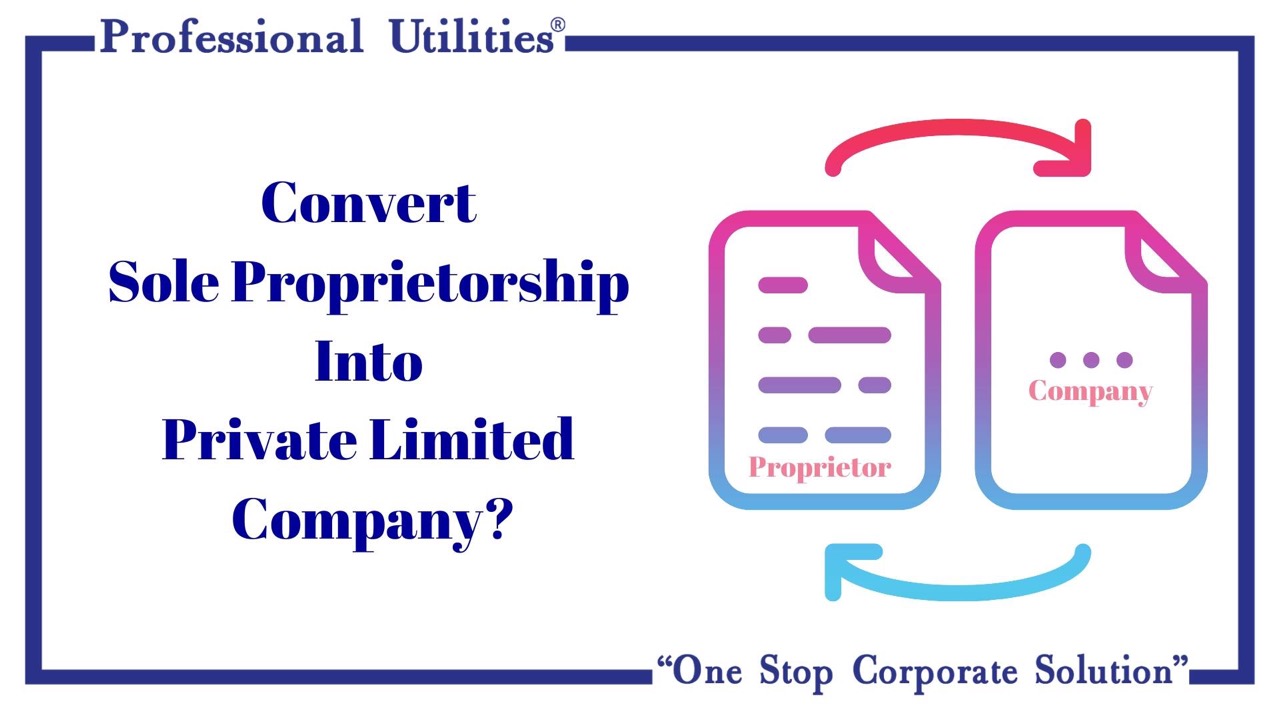
As a business develops, the requests of the business and the downsides of an ownership firm could constrain a business person to begin the procedure for converting ownership into private limited company, typically initiated through private limited company registration. A private limited company offers considerable benefits over the ownership type of business, including that of constrained obligation, capacity to draw in fair capital, constant presence and so on. In this article, we look at the prerequisite and methodology for change of ownership into a private limited company.
Pros and Cons of Either Entity
These issues are significant contemplations at the front line of worries for entrepreneurs who need to change over from sole ownership to a Private Limited Company:
Separate legal entity
With regards to sole proprietorships, the proprietor and the business are one and the same under the law and in your dealings with general society. Despite the fact that you have the benefit of more self-governance over the business and its activities, you are monetarily and legitimately in charge of all risk against the business, and the distinction also becomes clearer when comparing types of private limited company.
Liability
As registered Private limited company under The Companies Act 1956, a business has a different legal identity from the proprietor; the organisation members have restricted liability. For sole ownership, loan providers may take legal action against you for debts brought about and venture into your own assets and property. Consequently, a sole owner faces a more serious danger of complete individual budgetary ruin contrasted with a CEO of a Private Limited organisation.
Tax benefits
Private Limited companies make good on corporate tax on their benefits and profits that the investors get profits are not taxed. Duties are resolved at your own income tax rate.
Limited capital
Sole ownership regularly has restricted subsidising raising choices, regardless of whether as far as getting advances from monetary establishments or as far as equity fundraising from financial specialists - which means your sources of working capital are constrained to your own cash and the moving over of any benefits you make from the business.
Perpetual progression
A sole ownership’s legal presence is dependent upon your reality, hence your retirement or end will consequently mean the end of your business, and business owners evaluating continuity structures may also review the step-by-step process to register private limited company for better understanding of the transition.
Public perception
Sole ownership faces troubles in working together on a bigger scale in light of the fact that the recognition is not exactly as good as if they somehow happened to do it with a bigger business substance, like a private limited company business manages you. Further, it is additionally increasingly hard for sole ownership to pull in high-value workers who are eager and who view the business as offering little entry door for development, highlighting the broader importance of private limited company structure for credibility.
Administrative burden
On the other hand, the consistency prerequisites of a private limited company are a lot higher than those of sole ownership, and businesses should also consider statutory and administrative costs, including private limited company fees. Likewise, the private limited company is administered by the laws, principles, and guidelines under the Indian Companies Act.
Necessities for Conversion
The owner ought to guarantee consistency with the accompanying necessities before starting the conversion of ownership into a private limited company, including identification requirements such as DIN for proposed directors.
- An understanding must be gone into between the sole owner and the private limited company for the conversion.
- The Memorandum of Association (MOA) of the Private Limited Company ought to incorporate an entity that declares - “The takeover of a sole ownership concern”.
- All the benefits and liabilities of the sole ownership firm should be converted to the private limited company.
- The sole owner ought to be a member of the organisation’s directorial board with a voting rule which comprises to in any event half of that of the organisation. It might be noticed that a private limited company must have at least two directors.
- The integration principles of a private limited company make it mandatory that the minimum share capital limit ought to be Rs 1,00,000.
Documents Required
Conversion of a sole proprietorship into private limited company needs the following documents:
- Basic ID and address proof of the firm’s directors, along with authentication documents such as DSC, may be required for filing incorporation forms on the MCA portal.
- Letter of Authority/Power of Attorney.
- Testimony of registered office address can be presented in the form of a copy of the electricity bill, rent agreement, sale deed, and so forth.
The concerned person needs to provide Form 1, Form 18, and Form 32. The documents and forms referenced here ought to be uploaded on the official website of the Ministry of Corporate Affairs (MCA).
Compliance procedures remain consistent for entities formed through private limited company registration in Karnataka.
Declaration of Incorporation
After furnishing all the necessary processes indicated above, the MCA approves the stipulated fulfilment necessities, and upon approval the entity receives a Certificate of Incorporation, explaining how to get company incorporation certificate as proof of legal existence. In case the directing body thinks that it’s attractive, the entity will be furnished with a Certificate of Incorporation, which officially brings into existence a new private limited company. For a detailed understanding of the registration procedure, you can refer to the step-by-step guide to register a private limited company.
Similar incorporation requirements apply to businesses opting for private limited company registration in Tamil Nadu.
Conclusion
Converting a sole proprietorship into a private limited company allows businesses to benefit from limited liability, improved credibility, better access to capital, and perpetual succession while operating under a structured legal framework. By understanding the requirements, documentation, and procedural steps involved, business owners can ensure a smooth transition and establish a stronger foundation for long-term growth and compliance.
For proper guidance and advice on Convert Sole Proprietorship into Private Limited Company, consult experts at Professional Utilities.


Reliable
Businesses rely on us due to our Strong commitment to customer satisfaction.