CDSCO MD-42 License Registration in India
Get MD-42 License Start @ ₹35,000 — Apply Today!

4.9


MD-42 License Registration in India – Documents, Cost & Validity
MD-42 license is a registration certificate which allows a business organization to sell, stock, exhibit, distribute, or offer to sell medical devices in India. Under rule 87-A and 87-C of the Drugs and Cosmetics Act, 1940 the state drug authority is allowed to issue form MD-42 license. An MD-41 application for the medical device license is submitted to the CDSCO portal, which is subsequently approved by the state licensing authority.
The Ministry of Health & Family Welfare made MD-42 a compulsory requirement for entities engaged in the sale or stocking of medical devices in India vide Notification GSR 754(E) dated 30th September 2022. The requirement for MD-42 licenses arises to bring medical devices under a structured regulation that ensures product quality, maintains traceability, and protects patient safety.
Professional Utilities brings over a decade of dedicated experience in handling medical device and CDSCO Registration in India related compliances for manufacturers, importers, distributors, and retailers across India. From documentation and premises mapping to coordination with the State Licensing Authority for the grant of the license, we manage the end-to-end MD-42 application so that importers, retailers, and stockists can focus on running their business while we take care of medical devices compliance.
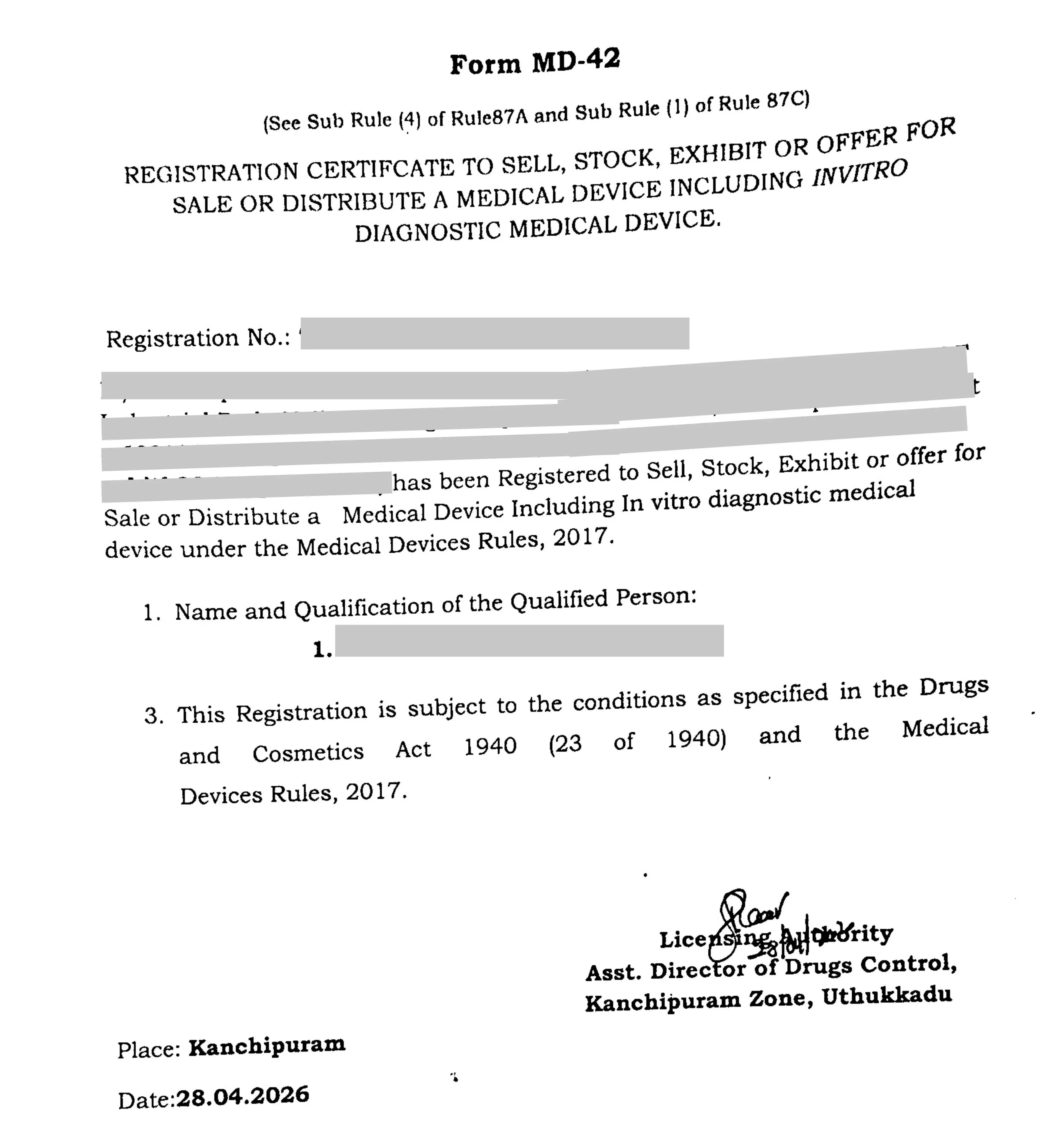
MD-42 License [Sample]
MD-42 License Apply Online – Step-by-Step Application Process
MD-42 application is filed online through the CDSCO SUGAM portal, but the process involves a sequence of preparatory steps that determine whether the application clears the first review or returns with queries.
- Document Verification : Verify that all eligibility documents business registration, premises proof, technical staff credentials are current, properly attested, and consistent with each other.
- CDSCO SUGAM Portal Registration : Create a user account on the CDSCO SUGAM Portal using the entity's PAN, contact details, and authorised signatory information.
- Form MD-41 Filing : Fill in Form MD-41 on the portal, capturing entity details, premises information, technical staff particulars, and the categories of medical devices proposed to be dealt with.
- Document Upload : Upload the supporting documents in PDF format, keeping each file within the size limit allowed by the portal.
- Fee Payment : Pay the prescribed fee through the integrated payment gateway on the portal.
- Application Submission : Submit the completed application and note the application reference number generated by the portal.
- Submission of Physical Copies to SLA : Submit hard copies of the application form, premises documents, staff credentials, and application fees to the State Licensing Authority (SLA) for physical verification.
- Premises Inspection by the Drug Inspector : State Licensing Authority forwards the application to the Drug Inspector of jurisdiction, who conducts a physical inspection of the premises to verify storage conditions, segregation, technical staff presence, and record-keeping arrangements.

Documents Required for MD-42 License
The following documents are required to comply with the MD 42 license requirements prescribed under the Medical Devices Rules, 2017. Submission of a complete set of documents facilitates timely verification and reduces the likelihood of objections from the licensing authority.
- Aadhaar Card of the Proprietor / Partners / Directors
- PAN Card of the Proprietor / Firm / Company
- Passport-size photographs
- Firm constitution proof (Certificate of Incorporation / Partnership Deed / MOA & AOA)
- List of Directors / Partners with contact details
- Board Resolution authorising the signatory (for companies)
- Rent Agreement / Lease Deed / Ownership Proof with NOC
- Latest electricity bill & Property tax receipt
- Premises layout plan signed by the architect and the owner
- Aadhaar and PAN of the technical person
- Educational qualification certificates of the technical person
- Experience certificates (joining, experience, and relieving)
- Pharmacy Council registration (if the technical person is a registered pharmacist)
- Bio-data with contact details and passport-size photograph
- Appointment letter and acceptance from the technical person
- Affidavit of the competent technical person
- Product category details (devices and IVDs proposed to be dealt with)
- GST Certificate
- UDYAM Certificate
- Trade Licence / Shop and Establishment Certificate (if available)
- Covering letter with brief description of activities
- Confirmation of storage compliance
- Self-certification of compliance with Good Distribution Practices
MD-42 License Cost – Government & Professional Charges
The total cost of obtaining an MD-42 certificate with professional utilities is ₹44,300, including the government fees and GST .
| MD41 Registration | Fees Charged (₹) |
|---|---|
| Government Fee | 3,000 |
| Professional Fee | 35,000 |
| GST on Professional Fees (18%) | 6,300 |
| Total | 44,300 |
MD-41 vs MD-42 — Key Differences
MD-41 is the application form filed with the Central Drugs Standard Control Organization (CDSCO) for sale, stock, distribution, or exhibition of medical devices and in-vitro diagnostics, whereas MD-42 is the registration certificate issued by the State Licensing Authority to retailers, wholesalers, stockists, and distributors of medical devices, including IVDs. Filing MD-41 is just your application; it does not authorize you to sell or stock medical devices. Commercial activity can begin only after MD-42 is granted.
Additional point of difference between MD-41 and MD-42 is related to the govt. organization that approves at various stages. MD-41 application is submitted through the CDSCO online portal; however, the grant of approval rests with the State Licensing Authority of the concerned State in which premises are situated. Consequently, MD-42 is a State-specific license, and a separate application is required for each State in which the business proposes to operate, sale or distribute medical devices equipment.
In summary, MD-41 is the application submitted, whereas MD-42 is the approval granted.
Section- MD-42 License Product List
Drug license MD-42 is granted for the import of medical devices in India under the Medical Devices Rules, 2017 (MDR, 2017). The license grants permission to importers to legally import and distribute medical devices in Indian market. MD –42 license is approved by CDSCO.MD-42 license product list may cover a single product, multiple products, or a wide range of medical devices belonging to the same category.
MD-42 License Product List typically comprises the following medical devices:
- Diagnostic equipment and testing devices
- In-vitro diagnostic (IVD) medical devices
- Surgical instruments and accessories
- Orthopaedic implants and prosthetic devices
- Cardiac stents and cardiovascular devices
- Catheters, cannulas, and tubing systems
- Patient monitoring equipment
- Medical imaging devices
- Dental instruments and dental consumables
- Disposable medical products
- Infusion pumps and injection systems
- Respiratory care devices
- Ophthalmic medical devices
- Hospital furniture and patient care equipment
- Wound care and infection control products
Validity & Renewal of MD-42 License
MD-42 registration certificate is valid in perpetuity, subject to payment of the prescribed retention fee before the expiry of every five years from the date of registration. The renewal application, along with the retention fee notified under the Second Schedule of the Medical Devices Rules, 2017, must be filed at least three months prior to the completion of each five-year cycle.
Benefits of MD-42 License for Medical Device Businesses
For businesses involved in the medical device trade, MD-42 license serves as the regulatory foundation for both legal compliance and commercial access. Principal benefits of obtaining an MD-42 license are listed below:
- Legal Compliance — Operation without MD-42 is punishable under Section 27(b)(ii) of the Drugs and Cosmetics Act, 1940, with an imprisonment of three to five years and a minimum fine of ₹1,00,000 or three times the value of the devices seized, whichever is higher.
- E-commerce Access — MD-42 certification is mandatory for listing products on online portals such as Amazon, Flipkart, PharmEasy, 1mg, Practo, and Tata 1mg under medical device categories.
- Government Tenders — MD-42 is a prerequisite for bidding on the Government e-Marketplace (GeM), supplying to AIIMS and other public sector hospitals, and qualifying as an empanelled vendor under Ayushman Bharat .
- Institutional Credibility — Hospital procurement teams, group purchasing organisations, and diagnostic chains rely on MD-42 as a baseline regulatory credential during vendor empanelment, and businesses without the certificate are filtered out at the prequalification stage.
- Supply Chain Risk Mitigation - Under Rule 87B, the holder must get the device from a licensed manufacturer, authorized importer, or any other valid MD-42 holder, which minimizes the risks of getting counterfeit/spurious devices.
- Pan-India Expansion - MD-42 registration on a separate basis in each State of operation offers a structured approach for distributors, importers, and e-commerce vendors to expand operations on a national scale.
Penalties for MD-42 License Non-Compliance
The Drugs and Cosmetics Act, 1940 places medical devices on the same penal footing as drugs, which means the sale, stock, exhibition, or distribution of a medical device without the required certificate is a cognisable offence under the Act. The position is more serious than is generally assumed by businesses entering the trade for the first time, and it is worth setting out in detail.
- Imprisonment and Fine under Section 27 : Section 27(b)(ii) of the Drugs and Cosmetics Act, 1940 — the provision that applies to the sale of drugs (and now medical devices) without a valid licence — prescribes imprisonment of three to five years, together with a minimum fine of ₹1,00,000, or three times the value of the devices confiscated, whichever is higher. Where the contravention falls outside Section 27(b)(ii) and is covered by Section 27(d), the imprisonment is one to two years with a minimum fine of ₹20,000. It is also worth noting that on a second conviction, the penalties escalate sharply — imprisonment of two to six years and a fine of not less than ₹10,000 under Section 30.
- Seizure of Stock : Drug Inspectors authorised under Section 22 of the Act are empowered to enter any premises where medical devices are stored, sold, or distributed, examine records, take samples, and seize stock that is found to be sold or stocked in contravention of the Rules.
- Criminal Prosecution and Court Proceedings : A complaint under the Drugs and Cosmetics Act is filed by the Drug Inspector or the Drug Controller before a Court of Session, and the trial is conducted under the procedure laid down in Section 32 of the Act. A conviction carries not just the fine and imprisonment, but a permanent record that affects every future application for licensing, tender participation, and institutional empanelment.
- The Practical Position : The cost of obtaining MD-42 is far lower than the cost of a single enforcement action, including the value of seized stock, legal expenses, and the lasting impact on future licensing and tender eligibility.
Legal Framework Governing MD-42 License
MD-42 license derives its authority from a structured chain of legislation, that begins with the Drugs and Cosmetics Act, 1940. The Act is the principal legislation that regulates the import, manufacture, sale, and distribution of drugs and medical equipment in India. Under the rule-making powers conferred by this Act, the Government framed the Medical Devices Rules, 2017, which, for the first time, brought medical devices and in-vitro diagnostics under a dedicated regulatory regime, different from the rules governing conventional pharmaceuticals.
The registration certificate was introduced subsequently, through the Medical Devices (5th Amendment) Rules, 2022, notified by the Ministry of Health and Family Welfare on 30th September 2022 vide G.S.R. 754(E).This amendment introduces four new provisions—Rules 87A, 87B, 87C, and 87D—into the Medical Device Rules, 2017, which together form the operative basis of the MD-42 framework as it exists today.
- Rule 87A lays down the requirement for the Registration Certificate and its acquisition process. Any individual who intends to sell, store, exhibit, or distribute any medical devices, including IVDs, must submit Form MD-41 to the State Licensing Authority of the respective State in which the premises are situated.
- Rule 87B sets out the conditions attached to the certificate once granted. These cover proper maintenance of premises, correct storage of devices, sourcing only from licensed manufacturers or importers, and the maintenance of records of all purchases and sales.
- Rule 87C governs the validity of the certificate. MD-42 is not subject to a fixed expiry date; it remains valid in perpetuity, provided the prescribed retention fee is paid before the completion of every five-year period from the date of issue.
- Rule 87D addresses the consequences of non-compliance. The State Licensing Authority is empowered to suspend or cancel the certificate, and the holder is entitled to prefer an appeal before the State Government within the prescribed period.
Post-Licensing Compliance Obligations
87B of Medical Devices Rules, 2017 sets out a continuing set of obligations that the certificate holder is required to comply with for as long as the registration remains in force, and a failure on any of these heads is by itself a ground for suspension or cancellation of the certificate.
- Display of the Registration Certificate : It is required that the certificate is placed on prominent display at the registered premises. This should be done in such a way that it can be seen by both members of the public and the inspecting officer. Display of the certificate is not merely a formality but a mandatory process that every certificate holder follow.
- Storage Conditions — Temperature, Lighting, Ventilation, Segregation : The premises must be maintained at standards that match what the medical devices stocked actually require. This includes sufficient floor space, adequate lighting, functional ventilation, and, where relevant, controlled temperature and humidity levels. These are not just general standards for facilities; they are specific to the devices themselves. A distributor of surgical products may operate under rather minimal standards, while a supplier of diagnostics, reagents, or biological IVDs requires precise cold chain systems with temperature records.
- Sourcing — Purchase Only from Licensed Channels : Medical devices must be sourced only from licensed manufacturers (holding Form MD-5 or MD-9), registered or licensed importers (holding Form MD-15), or other valid MD-42 certificate holders. Every purchase invoice must therefore be traceable back to a licensed source, and the purchase records must be capable of being matched against the supplier's licence number on demand.
- Maintenance of Purchase and Sale Records : The Rule requires the certificate holder to maintain separate records — by way of invoices, registers, or electronic systems — of every purchase and every sale of a medical device. The records must capture the name and quantity of the device, the name and address of the manufacturer or importer, the batch or lot number, and the expiry date where applicable.
- Inspection Book in Form MD-43 : The certificate holder is required to maintain an inspection book in Form MD-43 at the registered premises. The pages of this book are serially numbered and stamped by the State Licensing Authority, and the first and last pages carry an endorsement by the Authority recording the total number of pages.
- Reporting of Serious Adverse Events : While the primary post-market surveillance obligation under the Medical Devices Rules, 2017 rests with the manufacturer and the importer, an MD-42 certificate holder who receives a complaint of a serious adverse event — a device-related death, a life-threatening illness, a permanent impairment, or a requirement of medical or surgical intervention to prevent any of the foregoing — is expected to forward the report to the manufacturer or importer, and where appropriate to the Materiovigilance Programme of India (MvPI), within fifteen days of becoming aware of it.
Who Needs an MD-42 License?
The following categories of entities fall within the scope of MD-42:
- Wholesalers — Businesses involved in the wholesale supply of medical devices to hospitals, retail drug stores, diagnostic centres, and other intermediary entities. The permit is necessary irrespective of whether the wholesaler stocks goods or does transactions on a back-to-back order basis.
- Retailers — Pharmacies, surgical stores, medical device showrooms, and standalone retail outlets selling medical devices directly to end consumers, healthcare professionals, or institutional buyers.
- Stockists — Entities that maintain stock of medical devices for onward supply to wholesalers, retailers, or institutional buyers, including consignment agents and depot operators.
- Distributors — Authorised distributors appointed by Indian or foreign manufacturers to handle the regional or pan-India distribution of specific brands or product lines of medical devices and IVDs.
- Importers — Businesses bringing medical devices into India for sale or distribution. Importers must hold an Import License in Form MD-15 issued by CDSCO for the import itself, and additionally an MD-42 registration for any premises from which the imported devices are sold, stocked, or distributed.
- E-commerce Sellers — Sellers listing medical devices on online marketplaces such as Amazon, Flipkart, PharmEasy, 1mg, Practo, and Tata 1mg require to upload a valid MD-42 registration license.
- Exhibitors — Businesses display medical devices at trade fairs, healthcare expos, hospital procurement events, and industry exhibitions. Even where the device is exhibited and not sold on the spot, the act of exhibiting for the purpose of sale or distribution falls within the scope of Rule 87A and requires registration.
- Hospital Procurement Agents — Third-party procurement entities and group purchasing organisations that source medical devices on behalf of hospitals, clinics, and government health institutions for onward supply. While hospitals procuring purely for in-house use are generally outside the scope of MD-42, intermediaries who procure and supply on a commercial basis are required to register.
Eligibility Criteria for CDSCO MD-42 License
Eligibility under MD-42 is not a single qualifying test but a set of three independent conditions that must be satisfied together — the legal form of the business, the suitability of the premises, and the qualifications of the technical personnel appointed to supervise the sale or distribution.
(a) Business Registration: The applicant must be a legally constituted entity in India. Medical Devices Rules, 2017 do not define MD-42 registration for only a specific kind of organization; all entities recognized under Indian law can apply, including sole proprietorship firms, partnerships, LLPs, private limited companies, and public limited companies. Trusts and registered societies involved in business transactions involving medical devices are also eligible, subject to their charter permitting such activity.
(b) Premises Requirements : The premises proposed for the sale, stocking, or distribution of medical devices must be physically suitable for the activity and must meet the standards prescribed under the Medical Devices Rules, 2017. The applicant is required to demonstrate the following in respect of the premises:
- Adequate space and storage capacity: The premises must have sufficient floor area to store the categories of medical devices proposed to be dealt with, without overcrowding or improper stacking.
- Proper storage and segregation: Different categories of medical devices must be stored separately, with clear segregation between devices awaiting sale and devices that have been recalled, expired, or rejected. Devices of different temperature classes should not be stored in the same area, and IVD reagents must be kept apart from general medical consumables.
- Ventilation and lighting: The premises must be well-ventilated and adequately lit, since poor air circulation and insufficient lighting are flagged regularly during inspections. Air conditioning is required where the devices stocked have a recommended ambient storage range.
- Temperature and humidity control: Devices that require cold-chain storage (such as certain diagnostic kits, reagents, and biological IVDs) must be stored in calibrated refrigerators or cold rooms that maintain the manufacturer-specified temperature range. A temperature monitoring log must be maintained and made available at the time of inspection.
- Documentary proof of premises: The applicant must submit either a registered sale deed (in case of owned premises) or a notarised lease or rent agreement (in case of rented premises), along with a layout plan of the premises certified by the applicant.
(c) Qualified Personnel (Competent Technical Staff) : Every MD-42 applicant must assign one Competent Technical Staff to control and supervise the sales and distribution activities at the registered premises. This is not an arbitrary administrative step – the appointment of qualified staff members is a substantial criterion of eligibility, and the application will not be cleared without it.
Rule 87A of the Medical Devices Rules, 2017 requires the Competent Technical Staff to meet any one of the following three qualifications:
- A degree from a recognised University or Institution: typically in pharmacy, life sciences, biomedical engineering, or a related discipline. The degree must be from a UGC-recognized or AICTE-recognised institution.
- Registration as a pharmacist: under the Pharmacy Act, 1948 — the registration must be active at the time of appointment and held with a State Pharmacy Council.
- A pass certificate of the intermediate examination (10+2)or its equivalent from a recognised Board, along with at least one year of documented experience in the sale of medical devices.
Note:The appointment must be proved by a formal appointment letter issued by the applicant and accepted by the staff member, and the qualification and experience certificates (if any) must be submitted along with the MD-41 form.
Activities Permitted Under CDSCO MD-42
MD-42 registration certificate grants the holder to undertake four particular commercial activities in respect to medical devices and in-vitro diagnostic devices. These activities are defined under Rule 87A of the Medical Devices Rules, 2017, and the scope of the certificate is limited to what the Rule expressly permits — anything outside this list falls under a different licensing regime or is not permitted at all.
The four permitted activities are:
SELL · STOCK · EXHIBIT · DISTRIBUTE
Each of these terms carries a specific meaning within the framework, and it is useful to understand what the certificate allows on the ground:
- Sell: Certificate holders are permitted to sell medical devices to end users, health care providers, hospitals, diagnostic centers, retail customers, and institutional buyers. The sale may be conducted through a physical premises, internet platforms, tender based supply arrangement, or direct contract with an institutional buyer.
- Stock: Those with valid license are permitted to maintain inventory of medical devices at the registered premises for further sale, fulfillment of pending orders, or for storage on behalf of a manufacturer or importer on a consignment basis. The storage should be in accordance with the conditions laid down under rule 87B.
- Exhibit:The certificate holder is permitted to display medical devices at the registered premises and at trade fairs, healthcare expos, hospital procurement events, and industry exhibitions, where the display is for the purpose of sale or distribution. Even where no transaction takes place at the exhibition, displaying the device with a commercial intent triggers the requirement of registration.
- Distribute: MD-42 license holders can distribute medical devices to wholesalers, retailers, stockists, hospitals, and other downstream entities in the supply chain. Distribution covers the transfer of devices from one point in the supply chain to another, whether for onward sale or for institutional supply.
Scope across device classes
MD-42 certificate pertains to all medical devices in each of the four risk classes, which include Class A (low-risk devices), Class B (low to moderate risk), Class C (moderate to high risk), and Class D (high-risk devices) -as well as in-vitro diagnostic medical devices (IVDs) across the corresponding risk classes. The certificate upon issuance allows the entity holding the license to deal with devices of any class.
Secure Your MD-42 License with Expert Compliance Support
Obtaining an MD-42 License is essential for businesses seeking to operate legally within India's medical devices sector and avoid penalties under the Drugs and Cosmetics Act, 1940. Failure to comply with regulatory requirements, maintain proper documentation, or prepare premises for inspection can lead to delays in the approval process.
As an experienced MD-42 license consultant, Professional Utilities provides end-to-end assistance throughout the application process. Our experts offer structured support, including eligibility assessment, document preparation, application filing, regulatory compliance review, coordination with the State Licensing Authority for premises inspection, and follow-up until the final grant of the MD-42 License.
FAQ’s On MD-42 License Registration
How to apply for a MD 42 license online?
To apply for MD-42, register your entity on the CDSCO SUGAM Portal and complete Form MD-41. Upload the required documents, pay the prescribed fee, and submit the application to your State Licensing Authority. A Drug Inspector will then conduct a premises inspection before the MD-42 license is granted.
What documents are required for MD-42 license ?
Important documents for MD-42 license registration includes PAN/Aadhaar details of partners, GST registration, Rent agreement/Property details, Site plan by an authorized architect, Proof of technical competence, Self-certification of GDP compliance, and Storage compliance undertaking.
What is the purpose of MD 42 license?
The purpose of MD 42 license is to legally authorize businesses in India to stock, exhibit, distribute, and wholesale medical devices including IVDs. It ensures distributors adhere to strict safety and quality standards.
What is the validity of an MD-42 license?
MD-42 license, required for selling or distributing medical devices in India under CDSCO, is valid indefinitely, provided a retention fee is paid every five years to keep it active. Renewal applications must be submitted at least 3 months before the expiry date to avoid disruption to selling operations.
Who needs an MD-42 License in India?
Any business or entity that stocks, exhibits, or distributes medical devices in India must secure an MD-42 license. MD-42 license is also required for e-commerce platforms such as Amazon, Flipkart, PharmEasy, 1mg, Practo, and Tata 1mg.
Can importers apply for an MD-42 License?
Yes, importers can and must apply for an MD-42 license. Under the Medical Devices Rules, 2017 it is a mandatory requirement if business stocks, distributes, or sells devices domestically after importing them.
Does MD-42 cover all classes of medical devices?
No, an MD-42 license is not valid for all classes of medical devices. MD-42 license generally applies to lower-risk devices, while higher-risk devices need specialized central approval.
Which authority issues the MD-42 License?
State Licensing Authority (SLA) of respective states operating under the regulatory framework established by CDSCO issues MD –42 license.
Speak Directly to our Expert Today

Reliable

Affordable

Assured
Industries Served by
Professional Utilities

Apparels

Footwear

Furniture

Gems and Jewellery

Tourism & Hospitality

Consumer Electronics

Chemicals

Telecom

Oils & Gas

Hotel

Railways

Liquor

Health & Medical

Food Processing

Dangerous/ Haz. Goods

Tea & Coffee

Capital Goods

Recycling

Rubber

NGOs

Silk

Handloom

IT & BPM

Steel

Automobile

Tobacco

Constructions


Testimonials
"Explore how Professional Utilities have helped businesses reach new heights as their trusted partner."





It was a great experience working withProfessional Utilities. They have provided the smoothly. It shows the amount of confidence they are having in their field of work.

Atish Singh


It was professional and friendly experience quick response and remarkable assistance. I loved PU service for section 8 company registration for our Vidyadhare Foundation.

Ravi Kumar
I needed a material safety data sheet for my product and they got it delivered in just 3 days. I am very happy with their professional and timely service. Trust me you can count on them.

Ananya Sharma
Great & helpful support by everyone. I got response & support whenever I called to your system. Heartly thanx for Great & Super Service. Have a Great & Bright future of team & your company.

Prashant Agawekar
Thank you so much Professional Utilities team for their wonderful help. I really appreciate your efforts in getting start business. Pvt Ltd company registration was smooth yet quick.
Abhishek Kumar
I applied for Drug licence and company registration and their follow-up for work and regular updates helped me a lot. They are happily available for any kind of business consultancy.

Vidushi Saini
Great experience went to get my ITR done, process was quite convenient and fast. Had a few queries, am happy about the fact those people explained me all things I wanted to know.

Taniya Garyali
Great services provided by Professional Utilities. They are best in this industry and the best part is their prices are so affordable. Kudos to you. Now you guys are my full-time consultant.

Aftab Alam
Trusted By