
Export of Defence Products from India

4.9


Export of Defence Products License in India - Document, Process & Fees
India's defence export figures have grown sharply over the last few years. According to the Ministry of Defence press release dated 2 April 2026, defence exports from India touched ₹38,424 crore in FY 2025-26, a 62.66% increase over the ₹23,622 crore recorded in FY 2024-25. Exports now reach more than 80 countries, and 145 Indian companies are registered as defence exporters with the Department of Defence Production.
For Indian manufacturers, this growth has opened a clear commercial opportunity. However, the export of defence products is a strictly controlled activity, and the licensing process is governed by specific legal rules. A single error in classification, end-user documentation, or compliance reporting can delay an application by several weeks or result in straight refusal. That is why you will need professional guidance.
Professional Utilities is one of India's most trusted partners for defence export licence, guiding defence product manufacturers and software developer, MSMEs, and exporters through every step of the process. Further, this guide explains how the export authorization process works in practice. It covers the legal framework, the types of licenses issued by the Department of Defence Production, the documents required, the timeline, the fees, and the post-export compliance obligations every exporter must meet.
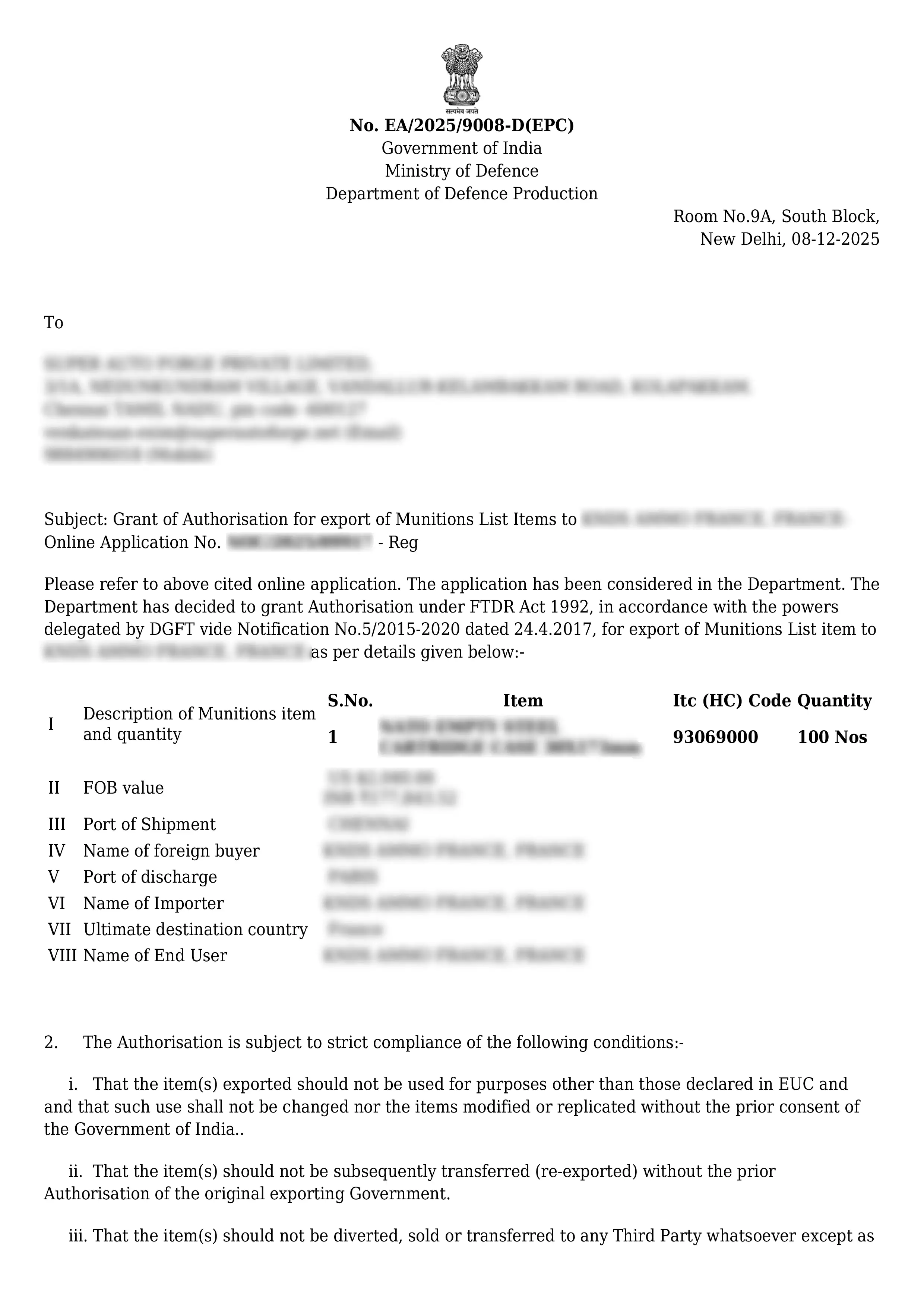
Export of Defence Products Certificate [Sample]
How to Apply for Export of Defence Product License
Applying for a defence export license in India is a fully digital process managed through the defenseexim.gov.in portal. Companies dealing in military equipment export activities in India can complete the entire application in five clear steps.
-
Step 1: Complete Pre-Requisites (IEC, DSC & Portal Registration)
Every exporter needs three essentials before applying. The first is an Importer-Exporter Code (IEC) from the DGFT, which is mandatory for DDP registration. The second is a Digital Signature Certificate (DSC) in the authorized signatory's name. The third is company registration on defenceexim.gov.in using the PAN, IEC, and an authorization letter. Once done, the company is ready to apply. -
Step 2: Identify the Correct License Type and Prepare Documents
Choose the license that matches your export, such as Standard Export Authorization, OGEL, Form X-A, Temporary Export Authorization, or Re-Export Authorization. Then prepare the document set: the purchase order, technical specifications, ITC (HS) code, consignee details, and an internal compliance program declaration. A fee of Rs. 5,000 per purchase order applies for small arms parts under the Arms Rules, 2016. -
Step 3: Secure the End-User Certificate (EUC) from Foreign Buyer
The EUC is the most important document in the process. It must follow the format under Appendix IV(a), IV(b), or IV(c) of the SOP and be signed by the foreign government, the importing entity, or an authorized representative. If it is not in English, a notary-certified translation is required. -
Step 4: Submit Online Application & Undergo Inter-Ministerial Review
Submit the digitally signed application through the portal. The DDP then reviews it and decides whether the case needs stakeholder consultation, which means seeking clearance from the Ministry of External Affairs (MEA), Ministry of Defence (MoD), and DRDO before approval. If consultation is not needed, then authorization is issued within 2 weeks.On the other hand, if consultation is needed, then it will be issued in 4 weeks.
NOTE: If an application is rejected, the exporter can file an appeal with the secretary (Defence production) within 30 days of the denial. Compliance with these rules keeps the company in good standing under the FTDR Act, Arms Act, and WMD Act.
- Step 5: Receive Authorization & Maintain Post-Export Compliance
Approved authorizations are issued digitally and can be verified on the portal. After export, companies must maintain all records for 5 years under Para 3 of Public Notice No. 5/2015-20, submit quarterly reports for OGEL exports, renew before validity ends, and notify the DDP of any changes in end-user, destination, or product. This keeps the company compliant under the FTDR Act, Arms Act, and WMD Act.

Documents Required for Export of Defence Product License
Below are the documents you will require for obtaining a defence export license in India.
Pre-Application Documents
1. Company-Related Documents
- Importer-Exporter Code (IEC) certificate
- PAN card of the company
- Certificate of Incorporation / MoA & AoA (proof of business existence)
- Industrial License under the IDR Act, 1951 (for defence manufacturers)
- Authorisation letter for the nodal officer (PDF, max 5 MB)
- Digital Signature Certificate (DSC) of the authorized signatory
- Bank account details of the company
- Internal Compliance Programme (ICP) declaration
- Technical Compliance Programme (TCP) declaration (for technology transfers, as per Wassenaar best practices)
2. Transaction-Related Documents
- Purchase order or contract from the foreign buyer
- Technical specifications, drawings, and brochures of the item
- ITC (HS) code and SCOMET classification of the product
- Consignee profile (intermediary and ultimate end-user)
- Country of final destination details
3. End-User Documents
- End-User Certificate in the prescribed format under Appendix IV(a), IV(b), or IV(c) of the SOP
- Notarised English translation of the EUC, if issued in another language
- Declarations regarding non-diversion, non-re-export, and non-use for prohibited purposes
- For intra-company transfers, EUC may be signed by the parent company (as per SOP dated 21 June 2022)
Fees for Export of Defence Product License
The total cost of getting a defence export licence in India includes two parts: the government fees and the professional fees.
| Type of Fee | Amount | Details |
|---|---|---|
| Government Fees (SCOMET Category 6) | No fee | No fee for export authorization of items under the Munitions List |
| Government Fees (Arms Rules, 2016) | Rs. 5,000 per purchase order | Applies to export of arms, ammunition, and firearm parts |
| Additional Government Fees | Varies | Depends on the consignee, destination country, and value of the shipment |
| Professional Fees | Rs. 50,000 | Covers documentation, application filing, follow-up with the DDP, and end-to-end support until the licence is issued |
What "Defense Export" Means under Indian Law
Defence export refers to the sale or transfer of military items, weapon systems, defence technology, and related parts from India to a foreign buyer. The scope covers finished platforms such as missiles, aircraft, and naval vessels, as well as smaller components and sub-systems supplied to global defence manufacturers.
The Department of Defence Production (DDP), under the Ministry of Defence, manages the entire defence export structure. Applications for export approval are filed online at defenceexim.gov.in, the official single-window portal for SCOMET Category 6 items and firearm parts under the Arms Rules, 2016.
The export framework covers four main areas:
- SCOMET Category 6 (Munitions List) — military items or items intended for military end-use, listed in Appendix-3 to Schedule 2 of the ITC (HS) Classification.
- Arms Act, 1959 and Arms Rules, 2016 — nine categories of firearm parts under Schedule I, requiring authorization in Form A X-A.
- Open General Export Licence (OGEL)—a pre-approved licence permitting export of specified items to specified countries within the validity period, without a separate approval for each shipment.
- Dual-use items — goods with both civilian and military applications, classified under the broader SCOMET list managed by the Directorate General of Foreign Trade (DGFT).
The objective of the framework is dual: to support the policy goals of Atmanirbhar Bharat and Make in India and to ensure that exports are consistent with national security interests and India's international commitments.
Post-Shipment Documents (To Be Maintained for 5 Years)
As per Para 3 of Public Notice No. 4/2015-20, exporters must retain the following records for at least 5 years from the date of export:
- All application documents and correspondence with the buyer, consignee, and end-user
- Relevant contract documents and book of accounts
- Shipping bill, bill of entry, and bill of lading
- Quarterly export reports for OGEL-based shipments
- Renewal applications and revised authorizations, where applicable
- Records of any change notifications submitted to the DDP
Important Notes
- Brokering is prohibited under the FTDR Act, 1992, and the WMD Act, 2005. No brokering license is issued by the DDP.
- Authorized Economic Operator (AEO) certification is optional but strengthens the application by demonstrating supply chain honesty.
- All documents should be uncompressed PDFs as per the portal's upload guidelines.
Defence Export Laws and Rules in India
Every shipment of arms, ammunition, or military technology leaving India passes through a Defence exports rules set by India that is controlled by a combination of domestic laws and international commitments. Every exporter must comply with the following:
- Foreign Trade (Development and Regulation) Act, 1992 (FTDR Act): The primary legislation that enables the government to regulate exports and imports. The Directorate General of Foreign Trade (DGFT) operates under this Act and administers the SCOMET list.
- Arms Act, 1959, and Arms Rules, 2016: Govern the manufacture, sale, transport, and export of firearms and ammunition. Schedule I of the Arms Rules lists the categories that require licensing.
- Weapons of Mass Destruction (WMD) Act, 2005: Prohibits the export or transfer of any goods, technology, or services that could contribute to nuclear, chemical, or biological weapons programs.
- Public Notice No. 5/2015-2020 dated 24 May 2017: Issued by DGFT, this notification assigns the authority to grant export authorizations for SCOMET Category 6 items to the Department of Defence Production. Applications under Form A X-A for firearm parts are also processed by DDP, following MHA's notification of 1 November 2018.
- Standard Operating Procedure (SOP) dated 10 May 2024: Issued by DDP and available on the defenceexim.gov.in portal. This is the operative document that defines the process for export authorization, documentation requirements, and validity periods.
India is also a member of the Wassenaar Arrangement, the Missile Technology Control Regime (MTCR), and the Australia Group. These memberships impose obligations on the export of arms and dual-use items, and they also support India's standing as a responsible exporter in regulated markets.
Types of Defence Export Licenses & Authorizations
The Department of Defence Production issues five main types of authorizations. The correct selection depends on the nature of the item, the destination country, and whether the export is one-time or recurring.
1. Standard Export Authorisation
A case-specific authorization for one-time exports of finished defence systems or major equipment. Applications are reviewed by DDP and, where required, sent for stakeholder consultation with the Ministry of External Affairs (MEA), Ministry of Defence (MoD), and the Defence Research and Development Organization (DRDO). The authorization is shipment-specific and time-specific. As per the SOP, validity is two years, with two permissible extensions of six months each.
2. Open General Export License (OGEL)
A pre-approved license that allows the export of specified items to specified countries during the validity period without a fresh application for each shipment. The eligibility requirement is the existence of an effective Internal Compliance Program (ICP) within the exporting company. DDP issued three OGELs on 14 June 2022:
- OGEL 1 — for export of parts and components of specified items
- OGEL 2 — for export of additional parts and components categories
- OGEL 3 — for export of major platforms and equipment
OGEL 1 and OGEL 2 are available for exports to a defined list of countries: Belgium, France, Germany, Japan, South Africa, Spain, Sweden, the United Kingdom, the United States, Canada, Italy, Poland, and Mexico. OGEL 3 has its own list of permitted destinations.
OGELs are valid for two years and do not restrict the number of shipments during the validity period.
3. Form A X-A Authorisation
Issued under the Arms Rules, 2016 for the export of firearm parts and small arms components. DDP became the single point of contact for these exports through MHA's notification dated 1 November 2018. A fee of ₹5,000 per purchase order applies.
4. Temporary Export Authorisation
A returnable authorization for testing, evaluations, demonstrations, and participation in international defence exhibitions. The goods must be returned to India after the stated purpose is completed. Validity is governed by Para 6 of the SOP, depending on the purpose of export.
5. Re-Export and Repair Authorisation
Permits re-export of parts and components for repair, replacement under warranty, or rework. The validity has been extended to cover the date of order completion or two years, whichever is later.
For quick reference, here is how the six license types compare:
| License Type | Best For | Issued By | Validity |
|---|---|---|---|
| Standard Export Authorization | One-time export of finished defence systems | DDP | 2 years from issue date |
| OGEL | Repeat exports of approved items to approved countries | DDP | 2 years from issue date, renewable |
| Form X-A | Firearm parts and small arms components | DDP (delegated by MHA) | 2 years from issue date |
| Temporary Export Authorization | Testing, demos, exhibitions | DDP | As per purpose stated in SOP Para 6 (typically 6 months to 1 year) |
| Re-Export / Repair Authorization | Replacement, warranty, rework | DDP | Order completion or 2 years, whichever is later |
Choosing the right license depends on the product, the destination country, and the nature of the deal. A clear understanding of these categories helps Indian exporters move faster, stay compliant, and build long-term trust with global buyers.
India's Defence Export Position in FY 2025-26
The official figures released by the Press Information Bureau (PIB) on 2 April 2026 confirm the scale of growth:
- Total defence exports: ₹38,424 crore in FY 2025-26
- Increase over previous year: ₹14,802 crore (62.66%)
- DPSU contribution: ₹21,071 crore (54.84% of total exports)
- Private sector contribution: ₹17,353 crore (45.16% of total exports)
- DPSU year-on-year growth: 151%
- Private sector year-on-year growth: 14%
- Number of registered exporters: 145, up from 128 (a 13.3% rise)
The five-year picture shows nearly a threefold increase in exports. The export target set by the government is ₹50,000 crore by FY 2029-30.
Major Export Destinations
India currently exports defence products to more than 80 countries across the following regions:
- North America: United States, Canada
- Europe: France, Germany, United Kingdom, Italy, Belgium, Netherlands
- Asia-Pacific: Philippines, Indonesia, Sri Lanka, Myanmar, Nepal, Japan, South Korea, Australia, New Zealand
- Middle East and Africa: Israel, Egypt, Mauritius, Mozambique, Seychelles, Morocco, Nigeria, Kenya, Namibia
- Latin America: Brazil, Argentina, Guyana, Ecuador, Suriname, Honduras
- CIS Region: Armenia
The United States remains the largest buyer of Indian subsystems and components. France and Armenia are the leading buyers of finished platforms, including artillery guns, missile systems, and rocket launchers. By value, ships account for the largest share of exports at approximately 55%, followed by personal protection equipment, electronic systems, components, subsystems, ammunition, and unmanned systems.
Common Challenges in Defence Exports from India
India's defence exports are growing fast, but the journey is not without challenges. Solving these issues is important if the country wants to reach its ₹50,000 crore export target by 2029 and compete against established global players
- R&D Gaps in Advanced Technologies : Indian defence companies spend only 1.2% of revenue on R&D, far below the global average of 3.4%, which limits the country's ability to build next-generation technologies on its own.
- Competition from USA, Russia, France, South Korea, and Turkey : India's annual defence exports stand at around USD 4.15 billion, while South Korea exports USD 9.5 billion and Turkey USD 7.1 billion, leaving a clear gap with the bigger global players.
- Approval and Procurement Delays : Long inter-ministerial approvals and slow clearances often delay export deals, sometimes causing foreign buyers to lose interest before authorizations arrive.
- Quality Perception in Global Markets : Past issues like delivery delays, spare parts shortages, and dependence on foreign suppliers have affected the global image of Indian defence products, making repeat orders harder to win.
- Financing Support for Buyer Nations : Many buyer countries in Africa, Southeast Asia, and Latin America cannot pay upfront, and limited EXIM Bank credit options often cost India deals to countries offering better financing.
- Limited Global Marketing and Brand Presence : Despite strong products, India's global marketing remains weak compared to other exporters, with low presence at major trade shows and limited buyer outreach.
Major Indian Defence Products Exported Globally
This defence exports list showcases India’s strongest military equipment export offerings, ranging from advanced missiles and aircraft to artillery, drones, and ammunition. Below is the complete list.
BrahMos Supersonic Cruise Missile
Akash Surface-to-Air Missile System
Pinaka Multi-Barrel Rocket Launcher
Advanced Towed Artillery Gun System (ATAGS)
Tejas Light Combat Aircraft (LCA)
ALH Dhruv and Dornier-228 Aircraft
Naval Platforms: OPVs and Fast Attack Craft
Radars and Electronic Warfare Systems
Drones and Unmanned Aerial Systems (UAS)
Ammunition, Small Arms and Components
Government Initiatives Boosting Defence Exports
The government has introduced several measures to support defence manufacturing and exports.
Atmanirbhar Bharat and Make in India
Defence Production and Export Promotion Policy (DPEPP) 2020
Innovations for Defence Excellence (iDEX)
Defence Industrial Corridors
SRIJAN Portal
Defence Attaché Scheme
EXIM Bank Lines of Credit
Top Indian Defence Exporters
These are the top Indian companies driving the country's defence exports, both through government contracts and private sector deals.
Hindustan Aeronautics Limited (HAL)
Bharat Electronics Limited (BEL)
Bharat Dynamics Limited (BDL)
Mazagon Dock Shipbuilders Limited (MDL)
Tata Advanced Systems Limited (TASL)
Larsen and Toubro (L&T) Defence
Mahindra Defence Systems
Bharat Forge
Adani Defence and Aerospace
Reliance Defence
Future Outlook: Roadmap to ₹50,000 Crore by 2029
The Ministry of Defence has set a target of ₹50,000 crore in defence exports by FY 2029-30, supported by a goal of ₹3,00,000 crore in annual defence production.
The roadmap is set on three core elements. First, the scale of domestic defence production, which crossed ₹1,54,000 crore in 2025 and is projected to reach approximately ₹2,00,000 crore in FY 2025-26. Second, deeper participation by the private sector, which already contributes 45.16% of defence exports and is expected to account for 50% of total production by value. Third, expansion of the export buyer base across Africa, Latin America, ASEAN, and the European Union.
Emerging technology areas like drones, AI-driven surveillance, cyber defence, hypersonic systems, and indigenous fighter engines are expected to play a significant role in achieving the longer-term vision of becoming the world's largest defence exporter by 2047.
Conclusion
India's defence export sector is growing at its fastest pace ever. The laws are clear, the digital portal at defenceexim.gov.in has made the process faster, and global buyers are more open than ever to Indian defence products. The opportunity is real, but only companies that act now and act correctly will benefit from this.
Getting a defence export licence involves correct SCOMET classification, the right authorization type, a complete document set, a proper End-User Certificate, and full post-export compliance. One mistake at any stage can delay your shipment by months.
This is where Professional Utilities comes in. Our team handles your defence export licence application from start to finish, including documentation, filing, follow-ups, and compliance support. Visit our website or call our team today and let our experts manage the complete process while you focus on growing your business.
FAQs on Export of Defence Products
Does India export defence equipment?
Yes. India exports defence equipment to over 80 countries, with exports reaching a record ₹38,424 crore in FY 2025-26, a 62.66% jump over the previous year.
Who issues defence export licenses in India?
The Department of Defence Production (DDP) under the Ministry of Defence issues all defence export authorizations through the official defenceexim.gov.in portal.
How long does it take to get a defence export license in India?
As per defenceexim.gov.in, authorizations are issued within 2 weeks without consultation and within 4 weeks when stakeholder consultation with MEA, MoD, or DRDO is required.
What is OGEL (Open General Export License)?
OGEL is a pre-approved license that allows Indian companies to export specified items to specified countries during its validity, without applying for fresh authorization each time.
Can private companies export defence products from India?
Yes. Private companies registered with the DDP can export defence products and currently contribute 45.16% of India's total defence exports.
Is an End User Certificate (EUC) mandatory for defence exports?
Yes. An EUC is mandatory and must follow the format under Appendix IV(a), IV(b), or IV(c) of the SOP, signed by the foreign buyer or government.
What is the penalty for unauthorized defence exports from India?
Unauthorized exports attract penalties under the FTDR Act, Arms Act, WMD Act, and Customs Act, including fines, IEC cancellation, imprisonment, and permanent debarment.
How can I register on the defenceexim.gov.in portal?
Register with an active IEC, Digital Signature Certificate, PAN, nodal officer details, and an authorization letter (PDF, max 5 MB), subject to DDP verification.
Speak Directly to our Expert Today

Reliable

Affordable

Assured
Industries Served by
Professional Utilities

Apparels

Footwear

Furniture

Gems and Jewellery

Tourism & Hospitality

Consumer Electronics

Chemicals

Telecom

Oils & Gas

Hotel

Railways

Liquor

Health & Medical

Food Processing

Dangerous/ Haz. Goods

Tea & Coffee

Capital Goods

Recycling

Rubber

NGOs

Silk

Handloom

IT & BPM

Steel

Automobile

Tobacco

Constructions


Disclaimer:The information provided on this website is intended for general information purposes only. Although all reasonable efforts are made to ensure that the information provided is correct and reliable, it is not advised to be used as a substitute for professional advice. The information herein is not to be used in place of seeking professional services, counsel, or guidance. We highly advise that you consult a professional before you make any business or legal decisions regarding the information presented on this website. This website and its contents are given "as is", and we do not take any responsibility for any action that is taken based on information given on this website.

- Written by: Anuja Sahi
- Fact-checked: Sahil Singh
- Updated on: June 03, 2026
Testimonials
"Explore how Professional Utilities have helped businesses reach new heights as their trusted partner."







It was a great experience working withProfessional Utilities. They have provided the smoothly. It shows the amount of confidence they are having in their field of work.

Atish Singh


It was professional and friendly experience quick response and remarkable assistance. I loved PU service for section 8 company registration for our Vidyadhare Foundation.

Ravi Kumar
I needed a material safety data sheet for my product and they got it delivered in just 3 days. I am very happy with their professional and timely service. Trust me you can count on them.

Ananya Sharma
Great & helpful support by everyone. I got response & support whenever I called to your system. Heartly thanx for Great & Super Service. Have a Great & Bright future of team & your company.

Prashant Agawekar
Thank you so much Professional Utilities team for their wonderful help. I really appreciate your efforts in getting start business. Pvt Ltd company registration was smooth yet quick.
Abhishek Kumar
I applied for Drug licence and company registration and their follow-up for work and regular updates helped me a lot. They are happily available for any kind of business consultancy.

Vidushi Saini
Great experience went to get my ITR done, process was quite convenient and fast. Had a few queries, am happy about the fact those people explained me all things I wanted to know.

Taniya Garyali
Great services provided by Professional Utilities. They are best in this industry and the best part is their prices are so affordable. Kudos to you. Now you guys are my full-time consultant.

Aftab Alam
Trusted By